topsy-turvy
pp. 26-27 · Read in the full issue

A case of topsy-turvy priorities
The present writers still fondly remember the times, 20 or 30 years ago, when everything worth knowing about the affairs of Tahiti (including amorous and political scandals) was stored in the heads of a few government officials, and could be told over a rum punch.
But with the brutal transformation of the island into a military rear base, and the arrival of 20 000 new French settlers, such primitive recording and retrieval techniques rapidly became inadequate.
Yet most local government bigwigs failed for a long time to register how badly needed a modern, well equipped Institute of Statistics had become or perhaps they simply dreaded the discovery of hard facts and unpalatable truths. In any event, it was not until last year that the long overdue institute was finally set up.
In these circumstances it is easy to forgive the institute’s staff for the fact that they have not yet tackled their biggest and most important task: the carrying out of an accurate and reliable census. Paradoxically, the various census operations conducted during the 1800 s, when nobody cared about the outcome, were far more accurate than those done over the last 20 years despite the fact that a thorough knowledge of the demographic situation is quite essential for an understanding of many of the present problems.
But while waiting for this much needed scientific census, let us be grateful to and commend the institute for its recent publication of a first, tentative report on the economic situation in the territory, anno 15 after the bomb.
The good news is supposedly that the local labour force was, by the end of 1980, about 45 000 strong. This is certainly an impressive figure, considering that persons who could be classified as genuine workers in pre-bomb days comprised only a few hundred barmaids and housemaids, about the same number of dockers and sailors, and about 50 men employed by the Martin brewery and electric power plant.
However, when we analyse the occupations of the lucky 45 000 who’ve got a job more closely, it becomes questionable whether the enormous increase necessarily represents any great progress.
To begin with, 15 000 of them are government employees.
Since the population of French Polynesia does not exceed 150 000, this means that the government services absorb 10% of the population or, if we count only the adult population, as much as 20%. This must be something of a bureaucratic record, and is certainly nothing to be particularly proud of. Another 15 000 are service personnel working for the local shops, hotels, restaurants and transport companies. There are about 4000 building and construction workers, and about 3000 men and women are employed in small-scale manufacturing and processing plants.
This leaves only 6000 individuals whose profession is given as farming, and fewer than 1000 who are listed as fishermen although most of these people farm and fish essentially for their own needs. It goes without saying that all these self-supporting farmers and fishermen are Polynesians, whereas of the 5000 or so Chinese 75% are engaged in commerce, and the remainder are in service jobs.
The 10 000 Frenchmen of active age are found mainly in
government positions, the liberal professions, business and industry.
As for Polynesians engaged in the nuclear death industry, their number is fewer than 700 a fact which makes the oft repeated government claim that the CEP is a vital factor in the island’s economy seem rather thin.
But here comes the real catch: the adult population of working age stands at about 70 000, or 25 000 persons more than the acknowledged labour force. What are these lost folk doing? Officially, they are listed in the statistics as housewives, or persons ‘without a profession’. If fact, a large proportion of them are unemployed, and their ranks are swelled each year by another 2000 school-leavers and school drop-outs. This surely helps to explain the rapidly rising incidence of juvenile delinquency and adult crime.
Also to be considered is the fact that the 45 000 people in jobs produce so little. In this respect, the institute’s report is highly revealing.
In pre-bomb days the territory produced enough food to feed all hungry mouths, and exported enough agricultural produce to pay for public services.
Today the annual cost of imported foods is more than 8000 million Tahitian francs. As for exports, the main item is coconut oil, extracted locally in a Chinese-owned mill. It was fed last year with the total production of copra 18 891 tonnes which is paid for at the subsidised price of 40 Tahitian francs a kilogramme. An additional bounty of five francs a kilogramme going to the copra cutters may eventually pull production back up to the pre-bomb level of 25 000 tonnes a year. The only other 1980 exports worth mentioning are pearls to the value of 100 million (down from 157 million in 1979), and trochus shell six million (down from 20 million in 1979).
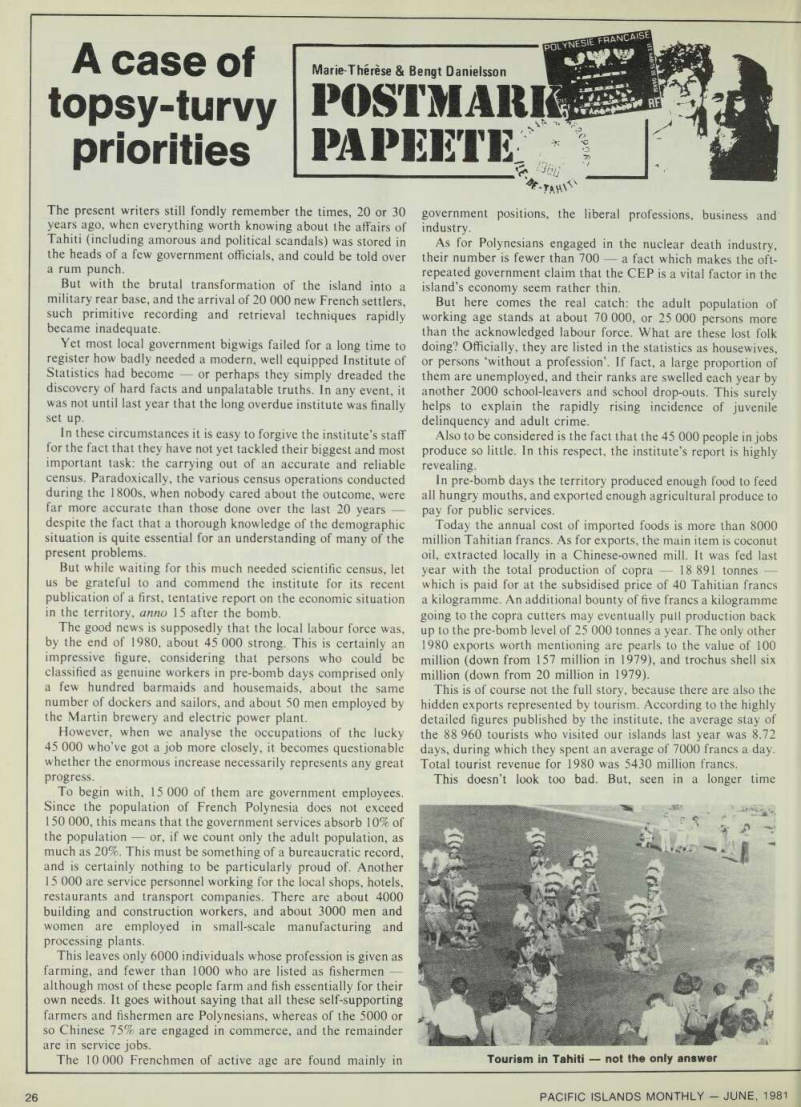
This is of course not the full story, because there are also the hidden exports represented by tourism. According to the highly detailed figures published by the institute, the average stay of the 88 960 tourists who visited our islands last year was 8.72 days, during which they spent an average of 7000 francs a day.
Total tourist revenue for 1980 was 5430 million francs.
This doesn’t look too bad. But, seen in a longer time
Tourism in Tahiti not the only answer
perspective, and compared to the planned and expected results, the 1980 figure of 89 000 tourists represents a major setback.
When, about 10 years ago, the French Government began encouraging foreign firms to invest in French Polynesia, one of the results was the rapid construction of four major hotels in Tahiti, and half-a-dozen smaller ones on Moorea. The serious minded and competent planners predicted a steady increase of about 50 000 tourists a year, culminating in a figure of 500 000 by 1980.
In fact, the number levelled off at 90 000 in 1974, and has stayed around that figure ever since. It is clearly not surprising that the local hoteliers are unwilling to expand the present 2069-bed capacity.
The explanation most commonly heard for this stagnation is the virtual monopoly enjoyed on the Tahiti route by the French airline UTA, which is accused of maintaining too high a fare structure and of blocking much needed American charter flights.
UTA officials hotly retort that unless more hotels are built first, there is no point in lowering fares and permitting cheap charter flights. So far UTA’s viewpoint has invariably prevailed, even when recently the very militant president of the Papeete Chamber of Commerce, Charles Poroi, backed by all prominent local businessmen, vowed to form his own airline and travel company to break the French monopoly (PIM Dec 1980, p 55, and Apr 1981, p 55). Originally scheduled for February, the inaugural Honolulu-Papeete flight of the Poroi venture has now been postponed indefinitely.
The number of people directly employed by the existing hotels is fewer than 1830. It is often claimed that a further 4000 people make their living from tourism in various service jobs but this is far from certain. But even if true, it still represents a very meagre proportion of a total potential labour force of 70 000.
It seems therefore most unlikely that tourism could ever become the main industry in French Polynesia and perhaps this is just as well for the Polynesian people.
To replace it there is always as local political leaders such as John Teariki and Francis Sanford steadfastly maintain agricultural development, aquaculture in the lagoons, deepsea fishing, and, perhaps, in the more distant future, ocean mining.
In other words, it is time to return to a more productive type af economy, built not on a flow of salaries to selected and specially favoured ethnic groups, but on the wealth in the soil and the sea which can be exploited by and for the benefit of the Polynesians.
While waiting for this complete turn-around of economic priorities (which in the final analysis can result only from aolitical changes in France), the institute’s report predicts a aleak year ahead for the Polynesian workers.
Main reason for this is that inflation, which last year was unning at between 15% and 20%, will increase even more iteeply in 1981.
This is due to: • Continued steady increases in prices in the exporting countries (believed to have been 9.3% last year in Australia, and 16.1% in New Zealand); • Anticipated higher freight rates (up 20% in 1980); and • The increasing value of US, Australian and New Zealand lollars.
The only thing lacking in the government report from which ve have repeatedly quoted here is a frank admission that the vrong choice has been made, and a firmly expressed letermination, emanating from government circles, to make the erritory economically independent.
But since there is a strong suspicion that such a course will lutomatically also lead to political independence, it is one which ias been consistently vetoed by all presidents of the Fifth
Tench Republic.
Marie-Therese and Bengt Danielsson.