New chancery building for PNG
p. 23 · Read in the full issue
makes eyes turn in Canberra
In a bold architectural move Papua New Guinea has used one of its traditional building themes the haus tambaran as the pattern for its new chancery building in the Australian capital, Canberra.
It’s the first chancery building PNG has built anywhere in the world, and the PNG Prime Minister, Sir Julius Chan, flew from Port Moresby recently to open it.
Of all the traditional Papua New Guinea buildings which have been part of tribal society for longer than written history, few have the significance and the impressiveness of the haus tambaran of the Sepik River area. Many of the haus tambarans are disappearing under the social changes sweeping through PNG (PIM, May p 35) but they are not forgotten.
Their sweeping triangular gables rising from ground level to above the trees, their decorated gable-ends and the woven and carved materials which are part of their structure make them a distinctive part of their country’s culture.
Loosely described as a ‘spirit house' the haus tambaran was the place where tribal leaders discussed their plans, where young men were initiated into their tribes, where sacred objects were kept and where the spirits of ancestors were believed to hold sway.
Modern PNG has borrowed
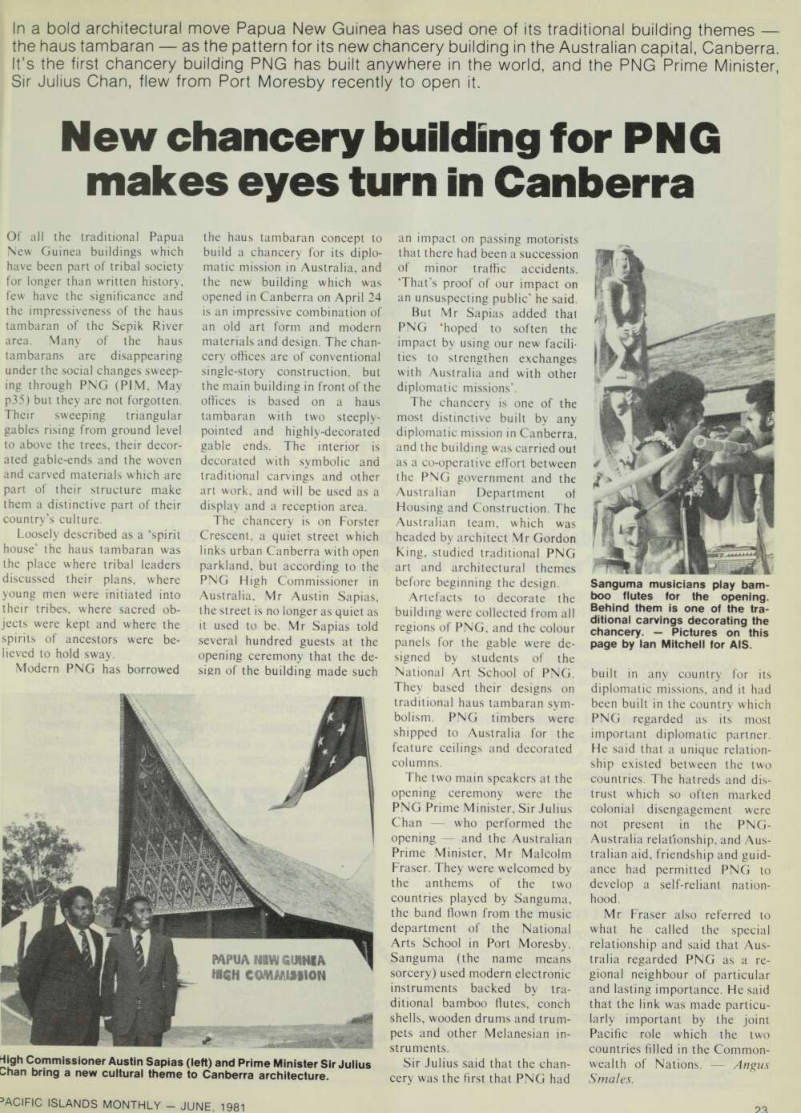
the haus tambaran concept to build a chancery for its diplo matic mission in Australia, and the new building which was opened in Canberra on April 24 is an impressive combination of an old art form and modern materials and design. The chan eery offices are of conventional single-story construction, but the main building in front of the offices is based on a haus tambaran with two steeply pointed and highly-decorated gable ends. The interior is decorated with symbolic and traditional carvings and other art work, and will be used as a display and a reception area, The chancery is on Forster Crescent, a quiet street which links urban Canberra with open parkland, but according to the PNG High Commissioner in Australia. Mr Austin Sapias, the street is no longer as quiet as it used to be. Mr Sapias told several hundred guests at the opening ceremony that the de sign of the building made such
an impact on passing motorists that there had been a succession of minor traffic accidents.
That's proof of our impact on an unsuspecting public’ he said.
But Mr Sapias added that PNG ‘hoped to soften the impact by using our new facili ties to strengthen exchanges with Australia and with other diplomatic missions’.
The chancery is one of the most distinctive built by any diplomatic mission in Canberra, and the building was carried out as a co-operative effort between the PNG government and the Australian Department of Housing and Construction. The Australian team, which was headed by architect Mr Gordon King, studied traditional PNG art and architectural themes before beginning the design.
Artefacts to decorate the building were collected from all regions of PNG, and the colour panels for the gable were de signed by students of the National Art School of PNG.
They based their designs on traditional haus tambaran sym bolism. PNG timbers were shipped to Australia for the feature ceilings and decorated columns.
The two main speakers at the opening ceremony were the PNG Prime Minister, Sir Julius Chan who performed the opening and the Australian Prime Minister, Mr Malcolm Fraser. They were welcomed by the anthems of the two countries played by Sanguma, the band flown from the music department of the National Arts School in Port Moresby.
Sanguma (the name means sorcery) used modern electronic instruments backed by tra ditional bamboo flutes, conch shells, wooden drums and trum pets and other Melanesian in struments.
Sir Julius said that the chan cery was the first that PNG had
built in any country for its diplomatic missions, and it had been built in the country which PNG regarded as its most important diplomatic partner.
He said that a unique relation ship existed between the two countries. The hatreds and dis trust which so often marked colonial disengagement were not present in the PNG- Australia relationship, and Aus tralian aid, friendship and guid ance had permitted PNG to develop a self-reliant nation hood.
Mr Fraser also referred to what he called the special relationship and said that Aus tralia regarded PNG as a re gional neighbour of particular and lasting importance. He said that the link was made particu larly important by the joint Pacific role which the two countries filled in the Common
wealth of Nations.
Angus
Smales.
High Commissioner Austin Sapias (left) and Prime Minister Sir Julius Chan bring a new cultural theme to Canberra architecture.
Sanguma musicians play bam boo flutes for the opening.
Behind them is one of the tra ditional carvings decorating the chancery. Pictures on this page by lan Mitchell for AIS.