again
p. 10 · Read in the full issue
followed the principle of first past-the-post, and confirmed the Popular Unity candidate as president, although the consti tution actually permitted it to ‘elect between the first two majorities’.
The fact that the Popular Unity had openly proclaimed its scorn for what it termed ‘bour geois democracy’, and avowed its intention of doing away with it, led congress to demand the signing of a Statute of Guaran tees, by which the Popular Unity committed itself to re spect Chile’s independence and democratic ways. In retrospect, that document strongly evokes Mr Neville Chamberlain and his umbrella. The extent to which this statute was broken and violated is reflected in the statements made in 1973, both by the Chilean Congress and the Chilean High Court, to the effect that through violence and illegal measures the Popular Unity government had placed itself beyond the law.
It must be borne in mind that Chile’s economy was to a great extent socialised by 1970. Land reforms had proceeded since 1960. Copper concerns had first been ‘Chileanised’ at the time of the Christian-Democratic government, and finally nationalised in 1971. The gov ernment held in its hands mech anisms of total economic con trol.
When the Marxist regime assumed power the inflation rate was running at around 30%. An indication of the economic situation of Chile in the ensuing years was an inflation rate of more than 1000% in 1973. Meanwhile, the taking-over of total power by means of armed violence was constantly advocated by leaders of the government coalition.
Fifteen thousand trained guer rillas, mainly Cuban, had ar rived in Chile and guerrilla training camps operated openly.
Seen against its proper back ground and perspective, there can be no doubt that the events of September 1973 were, in their essence, a Chilean move ment of assertion of national independence and freedom. In light of Professor Crocombe’s thesis it should be of interest to observe these events in their appropriate context.
As for his references to Easter Island, it seems necess ary to make clear that the island is an integral part of Chilean territory. It is a province of the country’s Fifth Region, and its administration falls within the regular civil administration of the nation. It has a provincial governor and a mayor who heads the local council. It holds no particular military status, and the Chilean navy ceased to administer it in 1966.
I hope this background ma terial will be of help to those who have appreciated Professor Crocombe’s enlightening article.
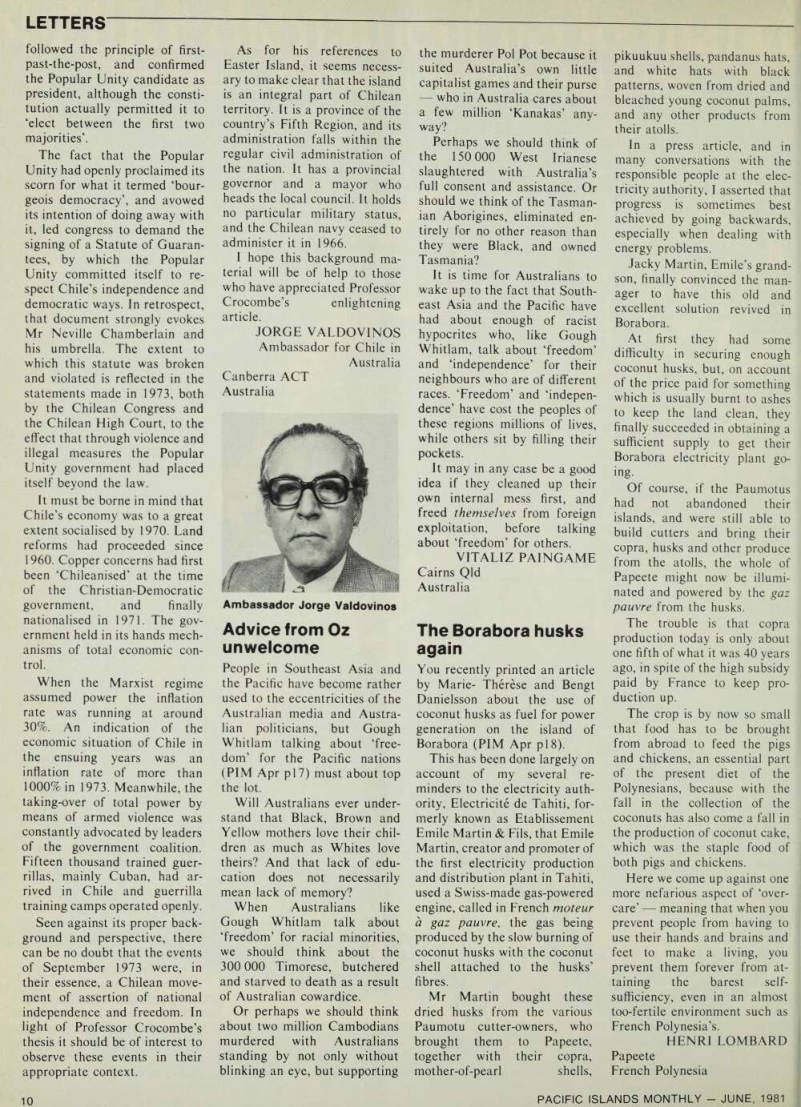
Jorge Valdovinos
Ambassador for Chile in Australia Canberra ACT Australia
Advice from Oz
unwelcome
People in Southeast Asia and the Pacific have become rather used to the eccentricities of the Australian media and Austra lian politicians, but Gough Whitlam talking about ‘free dom’ for the Pacific nations (PIM Apr pi 7) must about top the lot.
Will Australians ever under stand that Black, Brown and Yellow mothers love their chil dren as much as Whites love theirs? And that lack of edu cation does not necessarily mean lack of memory?
When Australians like Gough Whitlam talk about ‘freedom’ for racial minorities, we should think about the 300 000 Timorese, butchered and starved to death as a result of Australian cowardice.
Or perhaps we should think about two million Cambodians murdered with Australians standing by not only without blinking an eye, but supporting
the murderer Pol Pot because it suited Australia’s own little capitalist games and their purse who in Australia cares about a few million ‘Kanakas’ any way?
Perhaps we should think of the 150 000 West Irianese slaughtered with Australia’s full consent and assistance. Or should we think of the Tasman ian Aborigines, eliminated en tirely for no other reason than they were Black, and owned Tasmania?
It is time for Australians to wake up to the fact that South east Asia and the Pacific have had about enough of racist hypocrites who, like Gough Whitlam, talk about ‘freedom’ and ‘independence’ for their neighbours who are of different races. ‘Freedom’ and ‘indepen dence’ have cost the peoples of these regions millions of lives, while others sit by filling their pockets.
It may in any case be a good idea if they cleaned up their own internal mess first, and freed themselves from foreign exploitation, before talking about ‘freedom’ for others.
Vitaliz Paingame
Cairns Qld Australia
The Borabora husks
again
You recently printed an article by Marie- Therese and Bengt Danielsson about the use of coconut husks as fuel for power generation on the island of Borabora (PIM Apr pi8).
This has been done largely on account of my several re minders to the electricity auth ority, Electricite de Tahiti, for merly known as Etablissement Emile Martin & Fils, that Emile Martin, creator and promoter of the first electricity production and distribution plant in Tahiti, used a Swiss-made gas-powered engine, called in French moteur a gaz pauvre, the gas being produced by the slow burning of coconut husks with the coconut shell attached to the husks’ fibres.
Mr Martin bought these dried husks from the various Paumotu cutter-owners, who brought them to Papeete, together with their copra, mother-of-pearl shells.
pikuukuu shells, pandanus hats, and white hats with black patterns, woven from dried and bleached young coconut palms, and any other products from their atolls.
In a press article, and in many conversations with the responsible people at the elec tricity authority, I asserted that progress is sometimes best achieved by going backwards, especially when dealing with energy problems.
Jacky Martin, Emile’s grand son, finally convinced the man ager to have this old and excellent solution revived in Borabora.
At first they had some difficulty in securing enough coconut husks, but, on account of the price paid for something which is usually burnt to ashes to keep the land clean, they finally succeeded in obtaining a sufficient supply to get their Borabora electricity plant go ing.
Of course, if the Paumotus had not abandoned their islands, and were still able to build cutters and bring their copra, husks and other produce from the atolls, the whole of Papeete might now be illumi nated and powered by the gaz pauvre from the husks.
The trouble is that copra production today is only about one fifth of what it was 40 years ago, in spite of the high subsidy paid by France to keep pro duction up.
The crop is by now so small that food has to be brought from abroad to feed the pigs and chickens, an essential part of the present diet of the Polynesians, because with the fall in the collection of the coconuts has also come a fall in the production of coconut cake, which was the staple food of both pigs and chickens.
Here we come up against one more nefarious aspect of ‘over care’ meaning that when you prevent people from having to use their hands and brains and feet to make a living, you prevent them forever from at taining the barest self sufficiency, even in an almost too-fertile environment such as French Polynesia’s.
Henri Lombard
Papeete French Polynesia
Ambassador Jorge Valdovinos