A park sparks
pp. 7-9 · Read in the full issue

Letters
ideas for
W. Samoa
I was cheered by your article about the new Western Samoa national park on the island of Upolu (PIM Apr p 22). I have long felt that the country needed a national park. The central dividing range rises impressively behind Apia (and sometimes one gets an even more exciting look at it on a flight from Pago Pago). But it is not easy to find a way into it, or any information about it. I hope that the park project will rectify this situation as well as protec ting the island’s fine rain forests from increasing attack by both large-scale agricultural and tim ber development, and tra ditional cut-and-burn agricul ture.
It is even more clear that the great island of Savaii needs parks, and this should be the next step. It has vast and trackless rain forests, but they are remote and difficult of access, and they face the same
threat of increasing develop
ment.
The most interesting natural eature of the island is its great ihield volcano with vast lava lows and forests and many finder cones culminating in Mt Mlisili (1858 m), highest in the slands. But the only two trails, >r tracks, to the top have been fiosed by the superstitious and mco-operative villages of Aopo md Satuiatua where the tracks >egin.
The first objective should be large reserve to protect the ummit and a generous belt of orest at all altitudes, with racks free from village inter erence. Some consideration night be given to accommo iation such as alpine huts or tostels with roof catchments, as he rain forest is difficult for amping, and there is a lack of
public accommodation and sur face water at the western end of the island near the mountain.
I hope the new national park will be successful, that infor mation on it will be made avail able — a problem in Samoa — and that it will be expanded to Savaii, largest, highest and wildest island in Samoa.
Roger A C. Williams
Tafuna American Samoa
A moving plea
from ‘inside’
As a very keen and regular reader of your most excellent periodical, I am writing to say how regretful I am really, that I have been unable to read it for a long time. This for me is a great loss.
The reason is simply my imprisonment at the state peni tentiary named below.
Upon my entry into prison, I came across many other readers of your excellent publication, and they have the same feeling of loss as I do at not being able to read it any more.
Hence, in writing to you, it is our only wish to request you to send us a copy or two of previous issues, even if not recent ones, if you have any available, at no cost.
It is also our wish that in future if you have some copies in excess after you have sup plied your customers and sub scribers you would make them available to us at regular inter vals.
Many thanks for any help that you may offer, and looking forward to hearing from you soon.
Winch Rodger Lee
Detainee, and colleagues Bomana Corrective Institution PO Box 5161 Boroko Papua New Guinea PIM will act on this request.
Editor.
How Tonga moves with the times I am referring to the letter b> Randy Duff Tonga should move with the times’ (PIM Mar p 9). Apparently your previous reports on the Tongan prince’s wedding gave Mr Duff his ver> much mistaken attitude to wards our King and our tra ditions, for it is obvious that he
knows nothing at all about the reason behind His Majesty’s decision disallowing it.
It is very unfortunate that our royal family and our traditions have come under such unde served criticism and humili ation and frankly I am very surprised at Mr Anderson (father of Miss Heimatataura Salmon Anderson, the prince’s bride PIM). Either he is a very loyal father, or he has a very short memory in which he expects us Tongans to share.
So much for his version of the story, for he was supposed to be in Hawaii unaware of what his daughter was doing in Tonga and only to be surprised by the couple’s turning up on his doorstep demanding that they be married. And the best he could do was to throw a sumptu ous celebration which attracted the utmost publicity, knowing that a long-standing friendship with Their Majesties would suffer.
For Mr DufTs information on our traditions, there is no law against a royal-commoner ro mance or marriage. But it takes more than just being a high chief s daughter to be taken as a suitable wife for a prince in Tonga, or in any other kingdom marching with the times things like birth status and background. And there is definitely nothing ‘Middle Ages’ about such values.
P Manutu’Ufanga ’Unga
Sydney NSW Australia
'Satanic 9 Mr
Dijoud?
In his interview with Le Nouvel Observateur (PIM Apr pis), France’s Secretary of State for Overseas Departments and Territories Paul Dijoud clearly expressed the conservative, capitalistic and satanic views of the colonialist Paris adminis tration on decolonisation in the Pacific.
His blatant statement that ‘. . . it is by the clearly ex pressed will of the inhabitants’ of its territories that France is in the Pacific is drastically mis leading and false.
I wonder whether Mr Dijoud’s government which is an advocate of human rights - would have the courage to permit a referendum to deter mine the true wishes of the islands’ peoples?
The recent experience on Santo in Vanuatu should one call it ‘the abortive French connection’? reflected the active involvement of Paris in brain-washing campaigns, and her eagerness to exploit the islands and deprive the is landers of their legitimate right to self-determination.
The seabed mineral nodules that Mr Dijoud longs to get his hands on rightly belong to the
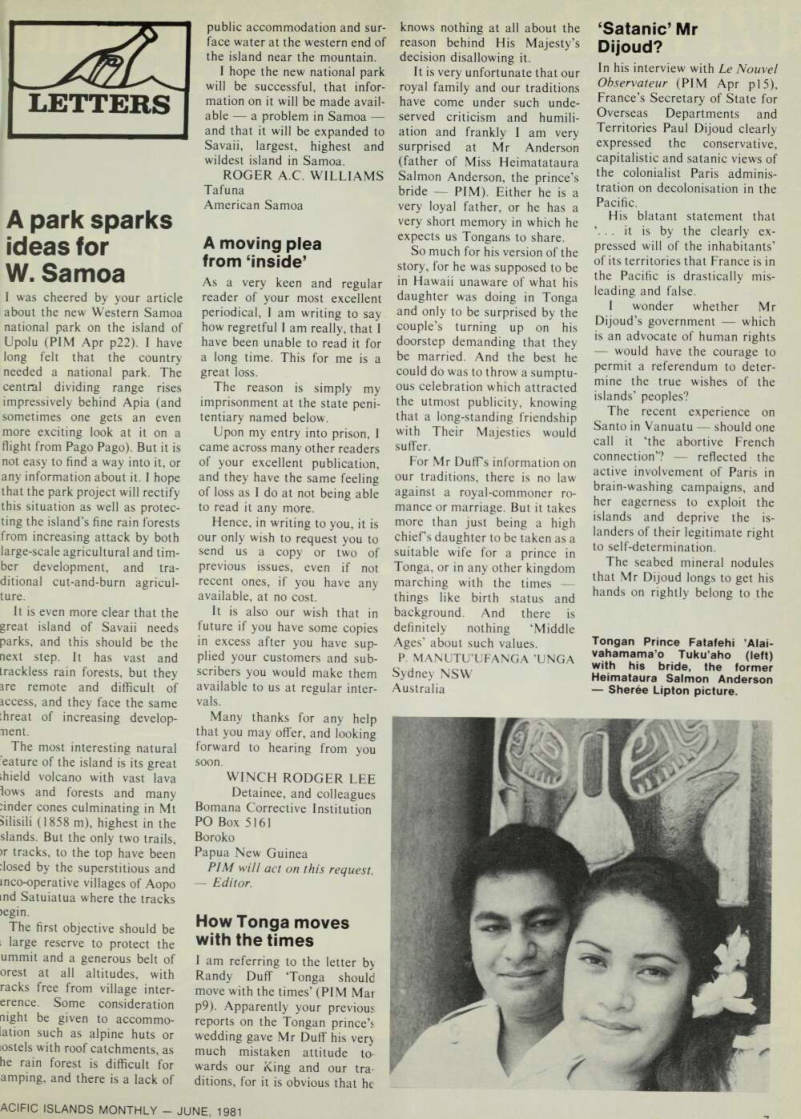
Tongan Prince Fatafehi ’Alai vahamama’o Tuku’aho (left) with his bride, the former Heimataura Salmon Anderson -Sheree Lipton picture.
peoples of New Caledonia, Tahiti and Wallis and Futuna.
Coleman Pinda Moni
Port Moresby Papua New Guinea New light on Ai Sokula I am writing to correct and enlarge upon your report (PIM Apr p 63) of the grounding of the Ai Sokula in Tokelau.
The Ai Sokula sailed from Apia on Saturday February 20 at 2300 hrs. The passage to Fakaofo, 480 km, should have taken 30 hours, making their estimated time of arrival 0500 hrs on Monday February 22.
The vessel reported late on Monday that she was drifting 160 km south of Atafu, an atoll 130 km west-northwest of Fakaofo, carrying out engine repairs.
No more was heard of her until Wednesday evening, around 1900 hrs, when Fakaofo radio reported sighting the vessel in a short break in a violent rainstorm that was mak ing visibility zero (Cyclone Freda was in the vicinity). The vessel was estimated to be 16 km due south of Fakaofo village.
At 2030 hrs Fiji radio picked up an SOS from the Ai Sokula which announced that she was aground on the atoll’s reef.
The villagers, having seen no more of the vessel, sent out search parties and discovered the vessel aground on the easternmost point of the atoll.
Due to the appalling conditions they were unable to reach the vessel in their light aluminium boats. On Thursday the crew and passengers were rescued by the local boats, but the ship was turned broadside to the reef and driven on further. A later report said she was holed.
There were 12 passengers aboard, with 140 drums of petroleum stored above and below decks, and, as well as general cargo, a large quantity af beer bound for Funafuti, Tuvalu.
The Ai Sokula was not awned, as stated in your report, by Wong’s Shipping, but char tered by them from another party.
Attempts were made by the
I was in Apia when the Ai Sokula grounded. On hearing the news I went to the Office of Tokelau Affairs, where I was able to learn of the action being taken as reports came in direct from Fakaofo radio.
This information, to the best of my knowledge, is correct.
owners of the ship and of the cargo to recover the vessel and cargo. I heard that a tug and a helicopter were sent out for the purpose. However, I later learned that the Council of Elders on Fakaofo have claimed the cargo and can presumably recover it with manual labour.
The ship, still on the reef, has been written off.
My own position at the time was merely that of an intersted bystander. I have my Second Mate’s Foreign Going certif icate, and had travelled back on the Ai Sokula to Apia on her last run on that route. I had earlier served as Second Officer on the Benjamin Bowring, the previous vessel on the Tokelau charter. I was also negotiating with a representative of Wong’s Shipping for a job as Second Mate on Ai Sokula, but this fell through.
While I was aboard the vessel, I noticed or had brought to my attention several defects.
Perhaps, in the light of sub sequent events, the most serious were the non-functioning radar and the lack of a certified chronometer.
R.R. Bygott
Auckland New Zealand A can is tipped
on ol’ Tip’s trip
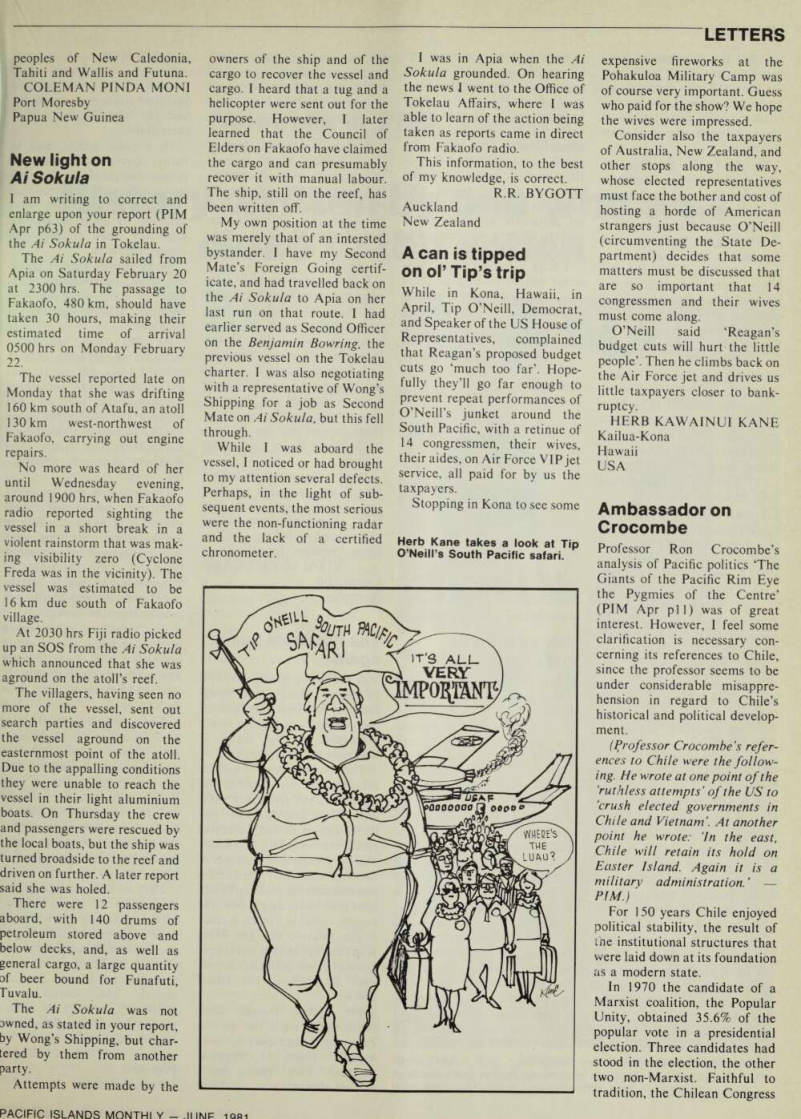
While in Kona, Hawaii, in April, Tip O’Neill, Democrat, and Speaker of the US House of Representatives, complained that Reagan’s proposed budget cuts go ‘much too far’. Hope fully they’ll go far enough to prevent repeat performances of O’Neill’s junket around the South Pacific, with a retinue of 14 congressmen, their wives, their aides, on Air Force VIP jet service, all paid for by us the taxpayers.
Stopping in Kona to see some
expensive fireworks at the Pohakuloa Military Camp was of course very important. Guess who paid for the show? We hope the wives were impressed.
Consider also the taxpayers of Australia, New Zealand, and other stops along the way, whose elected representatives must face the bother and cost of hosting a horde of American strangers just because O’Neill (circumventing the State De partment) decides that some matters must be discussed that are so important that 14 congressmen and their wives must come along.
O’Neill said ‘Reagan’s budget cuts will hurt the little people’. Then he climbs back on the Air Force jet and drives us little taxpayers closer to bank ruptcy.
Herb Kawainui Kane
Kailua-Kona Hawaii
Usa
Ambassador on
Crocombe
Professor Ron Crocombe’s analysis of Pacific politics ‘The Giants of the Pacific Rim Eye the Pygmies of the Centre’ (PIM Apr pi I) was of great interest. However, I feel some clarification is necessary con cerning its references to Chile, since the professor seems to be under considerable misappre hension in regard to Chile’s historical and political develop ment. (professor Crocombe’s refer ences to Chile were the follow ing. He wrote at one point of the ‘ruthless attempts’ of the US to ‘crush elected governments in Chile and Vietnam’. At another point he wrote: In the east, Chile will retain its hold on Easter Island. Again it is a military administration. ’
Pim.)
For 150 years Chile enjoyed political stability, the result of the institutional structures that were laid down at its foundation as a modern state.
In 1970 the candidate of a Marxist coalition, the Popular Unity, obtained 35.6% of the popular vote in a presidential election. Three candidates had stood in the election, the other two non-Marxist. Faithful to tradition, the Chilean Congress
Herb Kane takes a look at Tip O’Neill’s South Pacific safari.