close to the action
pp. 11-15 · Read in the full issue

Australia in PNG, 1945-75 History written by one who was close to the action
Sir JOHN GUNTHER, one of the most distinguished Australian public servants to be associated with Papua New Guinea in recent times, here reviews an important new publication on Australia’s role in PNG, Papua New Guinea: The Australian Trusteeship 1945-75 , * by lAN DOWNS. Sir John is a former director of health and assistant administrator in PNG. His last official post before retirement was to serve as the foundation vice-chancellor of the University of Papua New Guinea.
lan Downs went as a cadet patrol officer to what was the Mandated Territory of New Guinea in January 1936. Late in 1938, after a short course at the University of Sydney, Downs was sent to Wabag to put down an insurrection by some 6000 Enga warriors against the presence of a small base camp left by Taylor’s Hagen-Sepik patrol. He then became officer-in-charge of Chimbu, at that time the biggest sub-district in the terri tory. Thus, much of his early experience was among the iso lated mountain people of the central highlands the re cently contacted people of Taylor’s Middle Kingdom. Dur ing the war, Downs spent most of his time in command of small ships. A mutual friend, the very engaging J. K. McCarthy, told me that he drove his ship with such resolution that he became well acquainted with reefs in New Guinea’s northern waters.
After the war, Downs gained wide experience, rising quickly from the rank of patrol officer to district commissioner. He served in four districts, in one as a magistrate, and then briefly at headquarters before returning to the ‘Middle Kingdom’. He was a man of great initiative, an mproviser. In his district, no natter in what field of endeav our, if there was a real problem le only had to be asked once md he would give assistance.
As district commissioner in he eastern highlands Downs’
*The Australian Trusteeship: s apua New Guinea 1945-75. By ’an Downs. Published by the iustralian Government Pub ishing Service, Canberra. $2B.
Sbn 0 642 04139 3.
dynamic drive built a road over the Ramu-Purari divide and into the upper Markham River valley. This was a masterly piece of engineering, amateur if you like, but the route taken is not far from the professionally engineered road that was to replace it over Kassam Pass.
It was done by the people, using'picks and shovels, guided by young men of the Native Affairs Department. It was something quite magnificent. It joined the coast to the high lands. He extended the road to the west over Dualo Pass. This is all now part of the Highlands Highway, a Downs brainchild.
A consequence of this was the system of feeder roads that led to the villages and hamlets.
Downs’ tree-planting cam paign along the denuded high valley floors and on to the slopes must be greatly admired. The people should be eternally grateful, and it was his initiat ive.
Coffee was a crop that seemed well suited to the high lands, and villagers were en couraged by Downs and his officers to plant it, even before the Department of Agriculture gave its blessing. It brought in cash to people less than 20 years from the time when their tools were stone. Coffee also at tracted white settlers, who took up land in an unconventional way.
Hasluck, now Sir Paul Hasluck, then minister for territories, who had been a student of settlement in West ern Australia, has written most sympathetically about early Aboriginal rights. He was deter mined to see that over alienation of land and uncon trolled settlement didn’t occur in Papua New Guinea. He was
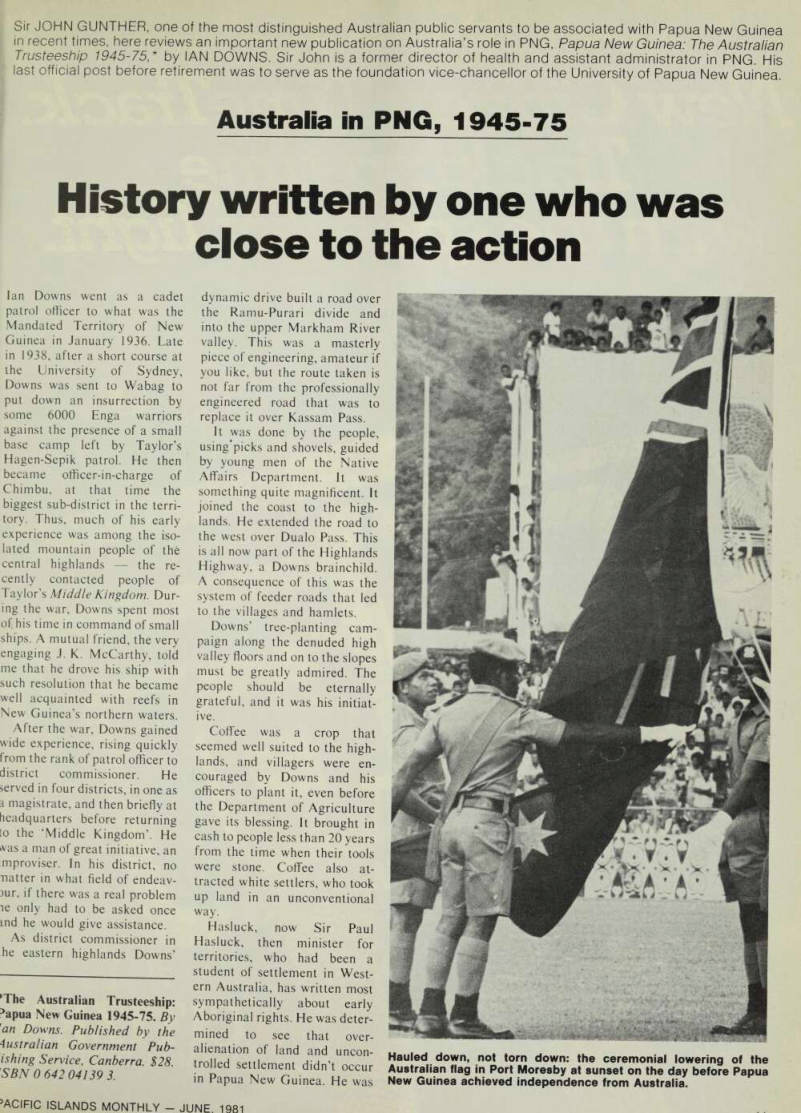
Hauled down, not torn down: the ceremonial lowering of the Australian flag in Port Moresby at sunset on the day before Papua New Guinea achieved independence from Australia.
The Australian Trust
disturbed by the fact that officers of the administration, and senior ones at that, while holding positions of authority, had ‘squatted on’ and planted up land with coffee, land for which they held no title. lan Downs’ The Australian Trusteeship: Papua New Guinea 1945-75, was described on an invitation to its launching as the ‘Official History of New Guinea’. Downs apparently had full access to the Department of Territories (and External Territories) files. He has put his own interpretation on what they threw up. He sought the opinions of many people. His own great experience in Papua New Guinea, and his ready access to documents, clearly entitle him to assume the role of an historian.
On the other hand, Sir Paul Hasluck'has written A Time for Building. He uses his fully argued minutes during the time he was minister to set down what Australian trusteeship policies were from 1951 to 1963. Where A Time for Build ing and The Australian Trusteeship are in conflict either as to fact or interpret ation, one would have to lean towards Sir Paul Hasluck.
The two books, however,
‘There are some who saw no good in the policies of Paul Hasluck. the minister responsible for Papua New Guinea.
Hasluck was accused of gradualism, inflexibility, and of not listening to local advice. I don ’t accept any of these charges. If gradualism meant slow but progressive advance, then it simply is not true. Hasluck was impatient with slowness. He did change his views if the discussion justified it. But if having heard all argument he made up his mind, he expected immediate and loyal support. ’
complement each other: the minister and Downs, the colonial civil servant, entrepreneur and local politician, saw some things differently. Indeed, Downs has quoted those who said they saw no good in Hasluck’s policies. He was accused of gradualism, inflexibility, and of not listening to experienced local or territory advice. I don t accept any of these charges. If gradualism meant slow but progressive advance, then it simply is not true.
Hasluck was impatient with slowness. He did change his views if the discussion justified it. But if having heard all
argument he made up his mind, he expected immediate and loyal support.
He did listen to local advice, if it was sound and well pres ented. But too often it was not sound and well presented. Let me take just one example. For some years during the budget debate in the Legislative Coun cil the administration was casti gated for levying unfair export duties on the products of econ omic tree crops. It could best be replaced by income tax. As
Downs writes, there was ample opportunity to review the terri tory’s finances before income tax was introduced. It was apparent to all those debating the Review of Finances that they were in fact debating the introduction of income tax, de spite official denials. But about all the opponents of income tax could come up with was a demand for that hoary old delayer of progress an in quiry.
I have boundless respect for both authors. Downs as a public servant had opportunities to thrust ahead, and he did. He had flexibility, and he used it
As an entrepreneur, he was a very successful manager of a coffee estate. I always had a feeling he kept a separate card for each tree and for each shade tree. He sponsored and fostered a body of farmers and settlers whose voice was heard and listened to in Port Moresby perhaps with more attention than the voice of the New Guinea Planters Association.
The Highland Farmers and Settlers Association was a lib eral body which encouraged New Guineans to become mem bers. In this respect it was much in advance of kindred associ ations in Papua and in New Guinea. Downs was an active and helpful politician, as this review will try to show.
Downs’ book is between 300 000 and 350 000 words long, and as he writes in his preface it was reduced to this size from the original of ‘over half a million words’. One person who saw an early manu script thought it might well have contained 750 000 words.
Should an ‘official history’ be too rigidly cut down? If the author has to cut, what does he leave out? My understanding is and I have no authority for this that Downs wanted to write about the part played by Australians in the development of Papua New Guinea. He sought access to departmental files, and instead was offered employment in the public ser vice of Australia and given the task of writing a history. But a history of what'l
Papua New Guinea was a colony, the metropolitan power 1 was a next-door neighbour. His tory could detail Australian policies and how those policies came to be adopted. In Papua New Guinea those policies were pul into being by a separate civil service. The adminis tration of Papua New Guinea had a twofold task: it carried out policy directions, but it also represented the dependent people. There was an obligation on the administration to put forward what it thought was in the best interests of the Papua New Guinea people, whether this was in Australia’s best interest or not. It should surely continue to do this until the minister gave an unequivocal direction. Then the public ser vice had to carry out Australian policy.
Thus in any history of Aust ralia’s trusteeship what was being thought in Papua New Guinea would be an important component of that history although I am not sure that Papua New Guinea’s archives are complete and easily access
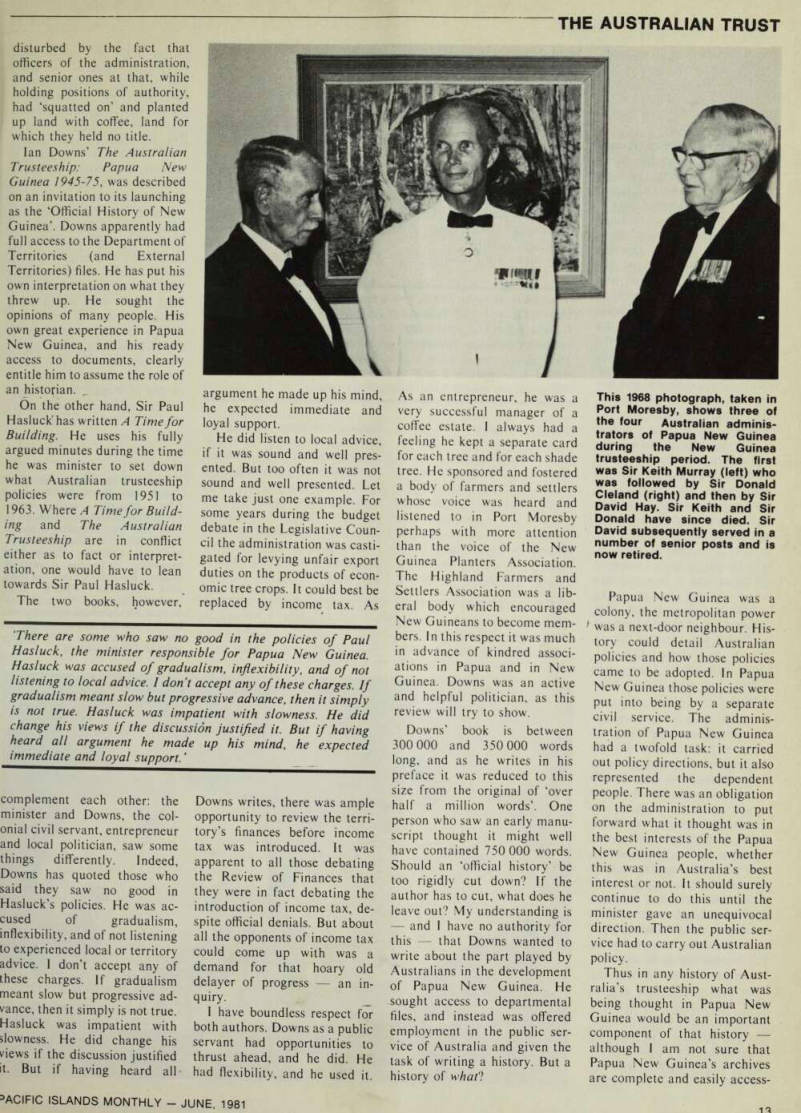
This 1968 photograph, taken in Port Moresby, shows three of the four Australian adminis trators of Papua New Guinea during the New Guinea trusteeship period. The first was Sir Keith Murray (left) who was followed by Sir Donald Cleland (right) and then by Sir David Hay. Sir Keith and Sir Donald have since died. Sir David subsequently served in a number of senior posts and is now retired.
ible. I can think of an example.
Downs does not give much cover of the national salaries arbitration case, although at the time it was a sensational issue in Papua New Guinea.
The Public Service Associ ation sought an increase of the 1964 salaries before the arbi trator. J.H. Wootten QC, now a judge of the Supreme Court of New South Wales, was retained by the public service com missioner. At first J. Greville Smith, then president of the Public Service Association, now Mr Justice Greville Smith of the Supreme Court of Papua New Guinea, represented the national public servants.
Wootten produced an amended salaries scale which was accept able to Greville Smith. But this was rejected by Canberra.
After lengthy proceedings, the proposed scale was almost exactly the same as that eventu ally determined by the Arbi trator. R. J. L. Hawke, an Aust ralian union advocate who is now a member of the Australian Parliament, later entered the lists on behalf of the public servants. The case dragged on, daily becoming more emotional and bitter, and as Downs writes ‘it was stored up to make trouble at a later stage’. This situation would never have been reached if the Wootten/Smith accord had been followed.
Sound Papua New Guinea ad ministration advice had been ignored.
Downs must have been ex tremely harassed in trying to write a full history of the Australian trusteeship, and meet the requirements of his editors and I’m sure he hasn’t satisfied himself. It would be natural to take samples, hoping they would represent the whole. These are done extremely well: the role of the kiap; land policy; the visits of two United Nations missions; the J. K. Murray era; the devel opment of the eastern high lands; the 1968 five-year plan; the Derham report and the administration of justice; the Tolai nation and local govern ment councils; Whitlam’s influence. I got the impression that if he had to cut savagely the author chose to delete those matters with which he was less familiar. New Guinea seems
more dominant in his text than Papua. Downs was a New Guinea man. The Tommy Kabu movement of Papua is not mentioned, whereas the so called Paliau, Yali, Hahalis and Johnson cults of New Guinea are well covered. The Tommy Kabua movement was as im portant as they were, as was and is Papua Besena, which occupies small space beside the Mataungan Association and Napidakoe Navitu.
Hasluck’s 1961 development
‘lt is interesting to conjecture what might have happened if Paul Hasluck had remained responsible for Papua New Guinea after the 1963 Australian elections. I would guess universal primary education would have been achieved, the 1961 development plan would have flowed, the university would have started a year earlier, and self-government and independence would have come a year sooner. ’
plan gets scant mention, yet it set targets in economic develop ment and also goals for social advance. Its targets were not unlike those prepared by the World Bank mission in 1964 and put into a programme in 1968. What is more Hasluck was personally interested in the creation of an infrastructure, and this meant staff, housing, offices and tools. Downs says that between 1961 and 1968 Australia provided an annual average grant of 15%. What he doesn’t say is that the rate of the
average increase to achieve Hasluck’s targets was just short of 18%, and that of Barnes leading to the five-year plan just over 11%.
It is interesting to conjecture what might have happened if Hasluck had remained as minis ter after the 1963 elections. I would guess universal primary education would have been achieved, the 1961 plan would have flowed, the university would have started a year earlier, and self-government
and independence would have come a year sooner. It is just possible that if F. N. Chaney, now a senator and the present Australian minister for social security, had remained the executive officer of Guise’s 1965 Select Committee on Con stitutional Development, inde pendence would have come a year sooner.
Hasluck’s effect and Chaney’s endeavours could not be compounded. In Chaney’s case the proviso would be that there would be no outside inter
ference with the select com mittee. Unfortunately there was. Chaney was then a young man, a lawyer in the Papua New Guinea public service.
Guise had called for a name, a flag, an anthem, and Chaney went about devising ways to educate the people, including the select committee, as to what a constitution was.
About the only political change the committee achieved was to be told that seventh statehood or other consti tutional links with Australia were not on. There would have been some who would have predicted that in 1965, al though readily admitting it would have been a very short odds favourite in any ballot giving a free choice to the people of Papua New Guinea and, as Downs shows, more than 30% of Australians would have accepted it. But would such a number have accepted
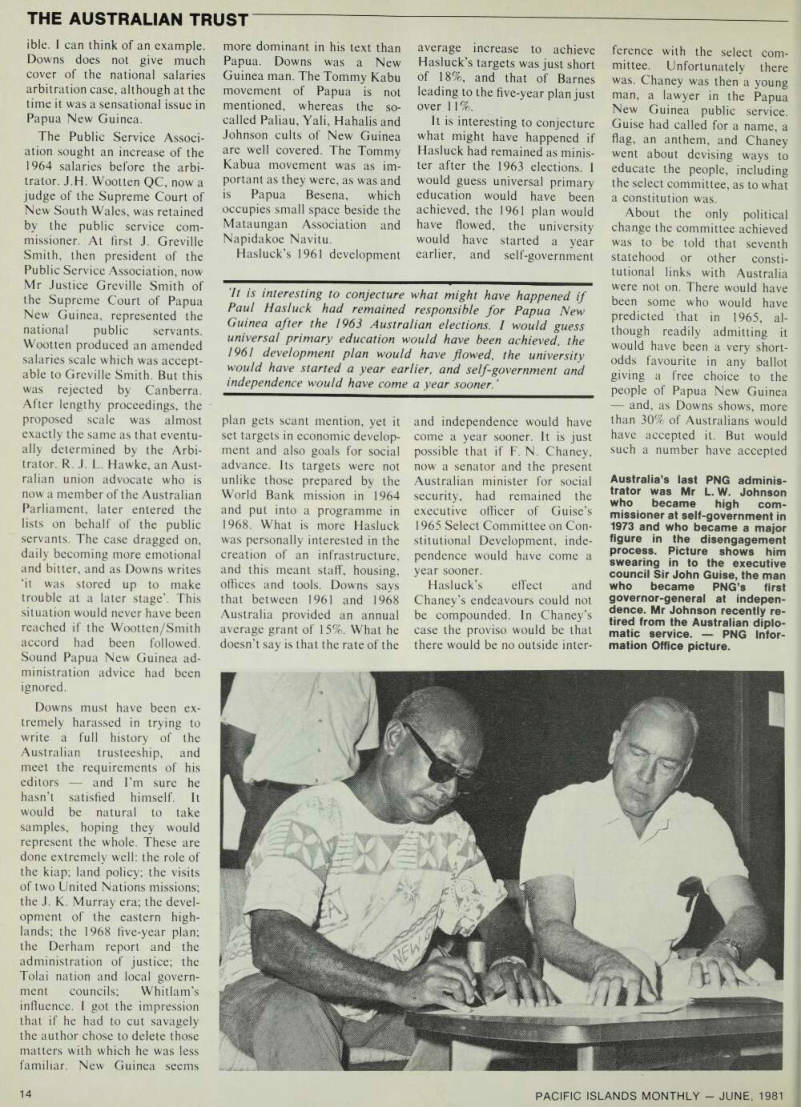
Australia’s last PNG adminis trator was Mr L. W. Johnson who became high com missioner at self-government in 1973 and who became a major figure in the disengagement process. Picture shows him swearing in to the executive council Sir John Guise, the man who became PNG’s first governor-general at indepen dence. Mr Johnson recently re tired from the Australian diplo matic service. PNG Infor mation Office picture.
Papua New Guinea as a seventh state if the question had been put: Would you agree to two million Papua New Guineans being given free access at all ' times to Australia, and one million of them voting in federal elections?
The administration of justice was forever an issue. A continu ing bone of contention was whether there should be native or village* courts! The field officers of the Department of Native Affairs were nearly unanimous that there should be; the judges and the lawyers were generally totally opposed. The policy-makers thought they must accept the views of the judges and the lawyers. They did not disparage what the native affairs officers thought. A choice had to be made. Downs does not argue the other side of the case.
Much of the ‘lntroduction’ in The Australian Trusteeship is given over to the paternal kiap system. This treatment occurs more than once again through out the text. A sub-chapter is The End of the Department of Native Affairs’. I found such a lament unnecessary and not needed by a body of men who for the most part were fine officers. Their ultimate job was to hand over to nationals.
Where much material had to be cut out these few pages could have been replaced by a very much longer discourse as to why the department and the police did not see the need to use the word Downs doesn’t like: local ise.
The two departments where localisation should have oc curred as soon as it was possible were Native Affairs and Police.
In the case of Police it could have happened in 1947 with the appointment of John Guise, now Sir John Guise GCMG, KBE, LL.D., as an officer.
There were a few who could have been found and who could have been trained as Native Affairs officers. Indeed, the ;ame Guise was an assistant :lerk in the late 1950 s doing vhat was essentially the kind of vork done by Native Affairs )fficers. For Downs to say the education system did not eadily produce sufficiently ;ducated nationals is but a pale :xcuse. Other departments
were training their personnel even Native Affairs was train ing local government clerks, but not patrol officers. I know of no move until the late 1950 s by either Native Affairs or Police to consider such training. At first the police set out such ridiculous requirements for en try into a police college as the Leaving Certificate and six, or was it eight, years experience as a constable. What man in those days with a Leaving Certificate would have wasted time as a constable when so much more was offering?
The Director of Native Labour, J. L. Taylor had no difficulty in 1945-46 recruiting as clerks Papuans who had been to Australia to undertake a medical course in the 19305.
One of the most sophisticated telecommunication systems in the developing world is main tained by Papua New Guin eans. The director of post and telegraphs began planning and set about the training of techni cal staff from 1953 onwards.
The story of that development deserves a place in any history of Papua New Guinea. 1 am not sure I can accept Downs’ statement that the
7 am not sure I can accept lan Downs' statement that the adoption of a parliamentary system in the image of Westminster was a compromise. I agree all alternative systems that seemed to be available were thoroughly canvassed, but the Westminster system was always the most likely one to be acceptable to Papua New Guineans. ’
adoption of a parliamentary system in the image of Westminster was a compro mise. I agree all alternative systems that seemed to be available were thoroughly can vassed, but the Westminster system was always the one most likely to be acceptable to Papua New Guineans. An integral part of that system is a ‘loyal opposition’. It was not difficult for the official members to play their role as the executive government, quasi if you wish, according to Westminster, but nearly impossible for them to create an opposition just for the sake of doing so. One has to accept that the Legislative Councils and the first two Houses of Assembly had edu cative roles. Downs admirably fulfilled the role of teaching
what an opposition was. I don’t remember a day from the time he was elected to the Legislat ive Council when he didn’t call meetings of the non-official members, where they discussed the legislation before the parlia ment. It would have been easy for the official members to have been complacent from 1951-61.
Despite Downs’ complaint that their majority made good government impossible, official members took their role seriously, often because of Downs’ badgering. They saw the need to try to influence all members from 1961 when there was a non-official majority this official practice was essen tial.
It is possible that if Hurrell had not moved as he did in 1961 and 1962, with the full conniv ance of Downs, the establish ment of the House of Assembly might have been delayed. There is no knowing what a new minister and a new prime minister may have done if the 1962 select committee had been held up for two years.
Self-government and indepen dence would have come later rather than sooner. Who knows?
If that had happened, perhaps
the governor-general-designate would not have said '.. . we are lowering the flag of our colonisers. We are lowering it.
We are not tearing it down.’
Viable political parties were very slow in assembling. Downs gave a boost in this direction without attempting to set down any principles. This was the election of John Guise, who so carefully lowered the Aust ralian flag, as leader of the elected members. Mathias Toliman was elected his deputy.
Perhaps Guise did not grasp the possible significance of the pos ition for his political future. I can remember in 1965 in a London hospital when trying to describe who Guise was I said he was the ‘elected leader of the elected members’. The doctor replied ‘Oh, he is like a chief
minister’. And so he was put in a bed under one of the honorary surgeons to Her Majesty. One should add to Downs’ history that just as he had created the position for Guise and I’m sure it was his idea and his alone he just as suddenly decided the position was no longer necessary.
I think Australian Trustee ship might well have looked more thoroughly into the failure of the administration to promote political parties. One of the warts that is now almost malignant, and which is a result of that neglect, is the number of splinter parties. Parties did not have time to establish traditions and loyalties. Splinter parties do not help a developing nation.
They can lead to one-party parliaments.
The Australian Trusteeship: Papua New Guinea 1945-75 is a history of Australia’s devolution of authority to a new and independent nation in a gener ation. The historian apparently had complete access to official records. He has used his exten sive personal experience to in terpret the information avail able to him. Although I would find it hard to call it ‘official’, it is an important document. It certainly deserves to be widely read by Australians. Aust ralians should be proud of their achievements in Papua New Guinea. It will be of interest to other Melanesian people from Irian Jaya through to Solomon Islands and Vanuatu, and to New Caledonia and Fiji, to study the status the English speaking countries enjoy since Britain and Australia granted them independence without strings.
It took a long time to print from when lan Downs com pleted his preface in April 1978 to its launching in March 1981.
But this has been well done, and done in Australia, even if the book has that official Australian Government Publishing Service look about it.
The waiting has been worth
it.
John Gunther.
• Author lan Downs has some words of his own to add to the story of why his book took so long to appear. One Page 17 he describes the problems of writ ing for a government com mittee.