Stamps
p. 59 · Read in the full issue
On May 22, a set of four Nauru stamps will illustrate the progressive nature of fishing on the island, from ancient canoe to powered vessel. The issue will be promoted widely, especially at Vienna in Austria, where the Nauru Philatelic Bureau will participate in the WIPA 1981 International Stamp Exhi bition. The exhibition will be staged at Vienna’s Imperial and Trade Palaces on May 22 and 23. The stamps will show hand casting a net 80, a traditional canoe 200, a powered boat 320, and a fishing vessel 400.
In July Nauru will commem orate the fifth anniversary of the Bank of Nauru. A stamp issue is to be made for the occasion, but details have not yet been announced.
Nauru also plans to issue an undisclosed number of stamps in October to mark United Nations Day and the Economic and Social Council for the South Pacific.
Nauru plans to end the year with a Christmas issue which will have a basic design similar to that of the stamps designed by Clive Abbott for last Christmas. Gold printing will be added to the design.
Sailing Contrasts
Sailing ships and voyaging canoes are always a popular Pacific Island subject for stamps, and Penrhyn in the northern Cook Islands is com bining the two in a new set of definitives which became avail able in February. There are five denominations, 10, 30, 40, and 100, but each includes four different designs.
Four sailing ships from the Old World are included in the designs. They are Magellan’s Victoria from Spain, Drake’s Golden Hind and Bligh’s Bounty from England, and d’Urville’s Astrolabe from France.
Contrasting strongly with the European sailing ships are the five voyaging and special pur pose canoes featured in the other designs. One of the canoes shown is the amatasi, a single sail canoe up to 20 metres long and able to carry 25 men.
Another is the ndrua, a heavy canoe traditionally used in some of the fringe islands of Fiji.
There is also the waka, a double-hull canoe designed to travel long distances. One type of war canoe used by the Maoris
Disabled Painter
Pacific stamp issues are re sponding to the world-wide theme in which 1981 is the International Year for Disabled Persons.
Perhaps one of the most inter esting is a set of four stamps issued by Fiji to show the work of the disabled Fijian artist Semsi Maya. One of the stamps, 500, shows Maya at work. The others are a coastal scene 60, an underwater scene 350 and a peacock 600. The printing was done by House of and the stamps were ssued on April 21.
American Samoa has tied to gether two themes in its ap )roach to stamp issues for the Fear of the Disabled. The hemes recognise that the for ner US president Franklin D.
Roosevelt was disabled by polio, nd also that he was a stamp ollector of some note. There re six stamps in the set which /ill be issued in May. One of he six, 38s, shows the president t work on his stamp collection. )thers show him with his fam y 12s, at his inauguration 48 ears ago 18s, and with his wife Jeanor Roosevelt 275. The two thers include a picture of the Roosevelt summer home 'ampobello House $l, and a 941 Atlantic wartime convoy ssociated with the Roosevelt nd-lease legislation 325.
Lauru Head Chiefs
i February Nauru celebrated ie 30th anniversary of its local avernment council, issuing tree stamps to honour head fiefs who were prominent ‘ remain prominent in the odern politics of the country, he portraits are of the 1951-53 ‘ad chief Timothy Detudamo )0, the 1953-55 head chief aymond Gadabu 300, and the ‘ad chief who became presi “nt of the new country, Ham er Deßoburt, 500. The amps also include a picture of e domanead, or meeting mse, taken from the 9d stamp 1954.
of New Zealand was known as a waka tuua. The remaining canoes in the stamp designs are the tongiaki, a fast, single-sail, double-hull craft from Tonga; and the vaa teuua, a sturdy and large canoe from the Marquesas.
Png Defence Force
The Papua New Guinea De fence Force is the biggest of the three military forces main tained by any of the Pacific Island countries. (The two others are in Fiji and Tonga.) It consists of infantry, infantry support, maritime and air el ements, and it evolved at inde pendence in 1975 from the defence structure created by Australia in PNG. It achieved prominence last year when it intervened, at the request of the Vanuatu government, in the Santo rebellion.
PNG has now issued a set of four stamps featuring the force.
The stamps are in values of 7t, Ist, 40t and 50t. One shows a mortar platoon providing fire support, one shows a Dakota patrol aircraft in flight, the third shows the patrol ship Aitape and the fourth shows a medical platoon providing civil assistance. The 15l aircraft stamp was designed by T. Reilly and the three others by Richard Bates. Printing was by Joh Enschede En Zonen of Holland.
PNG’s next stamp issue will be a set of four on June 4 and will depict missionary aviation.
Reciprocal Sets
On May 5, Pitcairn Islands will issue three stamps to commem orate the 125th anniversary of the Pitcairners’ migration to Norfolk Island. Denominations of the set are 90, 350 and 700.
Commemorating the arrival of the Pitcairners at Norfolk
Island, a set of three stamps, (50, 350 and 600), and a souvenir sheet will be issued by Norfolk on June 5. The Pitcairners landed on Norfolk in the ship Morayshire, on June 8, 1856, and since that date, descendants of the Pitcairn families have annually com memorated the safe arrival in traditional fashion.
June 8 each year is a public holiday on Norfolk, and the festivities commence with a re enactment of the 1856 landing.
After a spiritual ceremony, families of Pitcairn descendants proceed to Government House for the judging of the most originally dressed family. After an anniversary day picnic lunch, an annual cricket match is contested between The Bounty team and The Allcomers team. A ball is held at night.
Fish And Space
French Polynesia has started the year with a dramatic series of stamps ranging from fish in the ocean to astronauts in space.
The first issue for the year featured Polynesian fish. These big stamps show the zebra unicorn I 3Fr, the yellow striped snapper 16Fr and the purple spotted grouper 24Fr. (In PNG, Australia and New Zealand the grouper is more generally known as the groper.) Gauguin paintings were fea tured in a I OOFr stamp issued in March, followed by an impress ive 300 Fr issue in April to commemorate the 20th anniver sary of man in space.
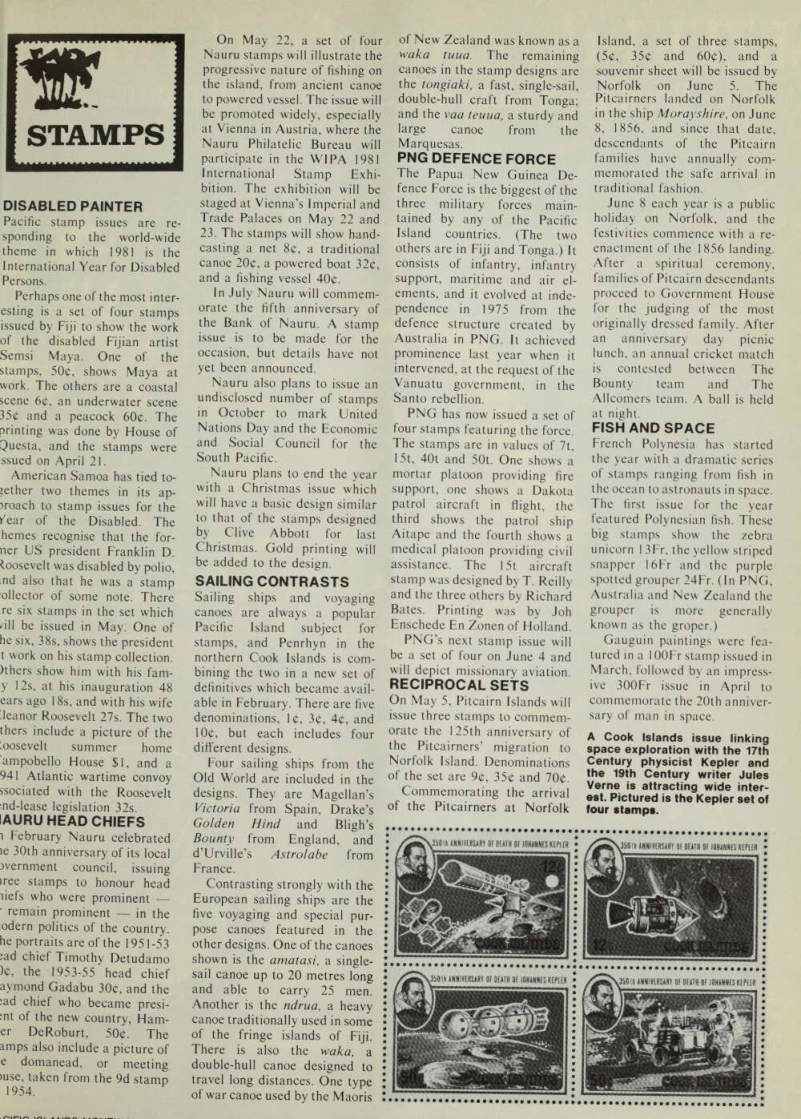
A Cook Islands issue linking space exploration with the 17th Century physicist Kepler and the 19th Century writer Jules Verne is attracting wide inter est. Pictured is the Kepler set of four stamps.