to landplanes
pp. 61-63 · Read in the full issue
Trade
Winds
From flying boats to landplanes on Island routes
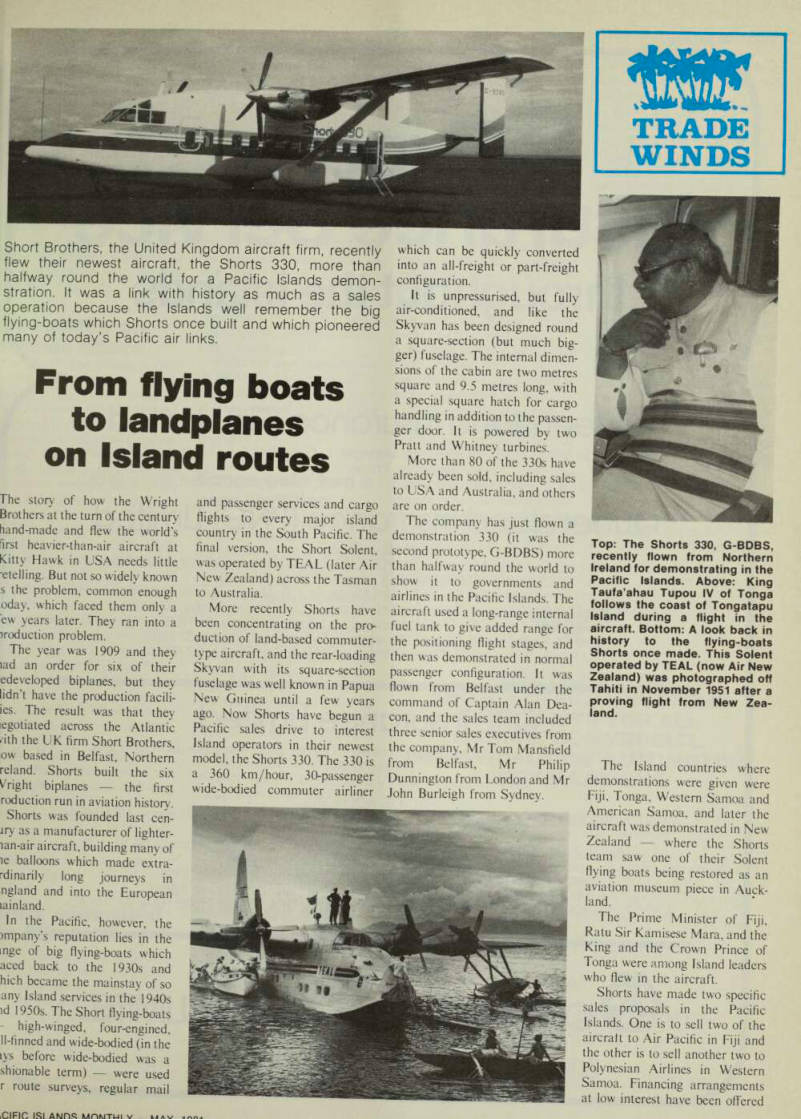
Short Brothers, the United Kingdom aircraft firm, recently flew their newest aircraft, the Shorts 330, more than halfway round the world for a Pacific Islands demon stration. It was a link with history as much as a sales operation because the Islands well remember the big flying-boats which Shorts once built and which pioneered many of today’s Pacific air links.
The story of how the Wright Brothers at the turn of the century hand-made and flew the world’s first heavier-than-air aircraft at Kitty Hawk in USA needs little •etching. But not so widely known s the problem, common enough oday, which faced them only a ew years later. They ran into a iroduction problem.
The year was 1909 and they lad an order for six of their edeveloped biplanes, but they lidn’t have the production facili ies. The result was that they icgotiated across the Atlantic /ith the UK firm Short Brothers, ow based in Belfast, Northern reland. Shorts built the six bright biplanes the first reduction run in aviation history.
Shorts was founded last cen iry as a manufacturer of lighter lan-air aircraft, building many of le balloons which made extra rdinarily long journeys in ngland and into the European lainland.
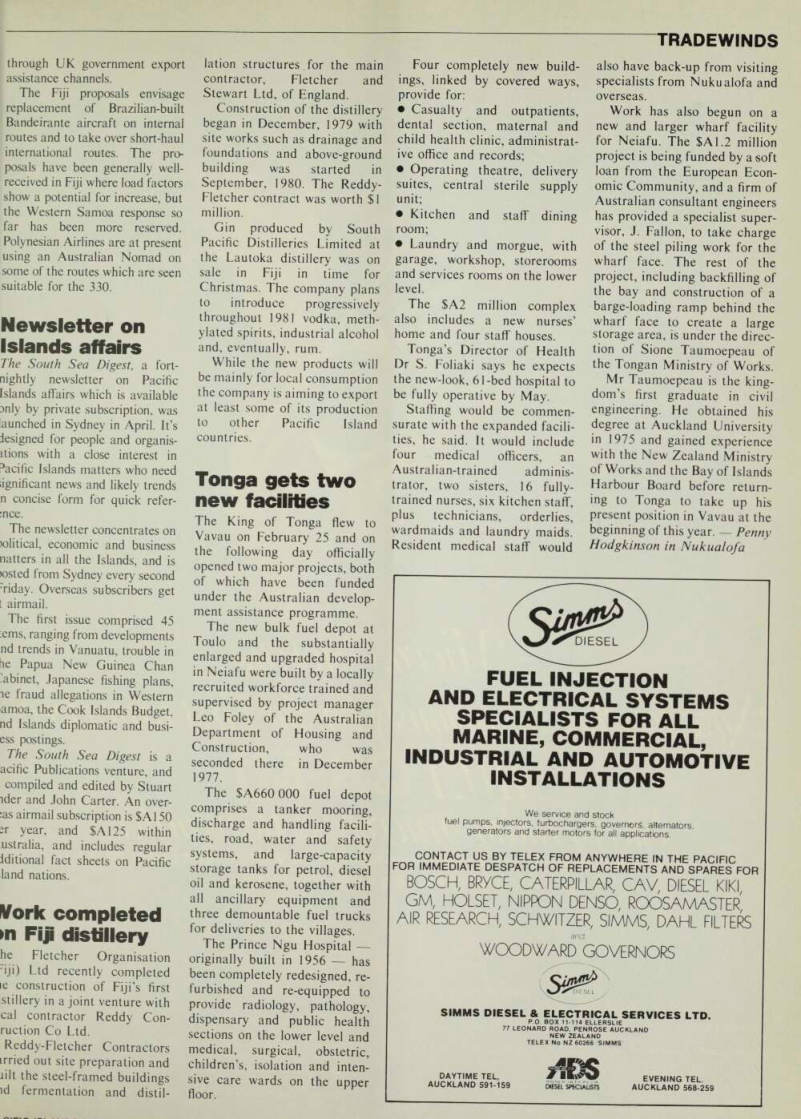
In the Pacific, however, the impany’s reputation lies in the inge of big flying-boats which aced back to the 1930 s and hich became the mainstay of so any Island services in the 1940 s id 1 9505. The Short flying-boats
- high-winged, four-engined,
11-finned and wide-bodied (in the lys before wide-bodied was a shionable term) were used r route surveys, regular mail
and passenger services and cargo flights to every major island country in the South Pacific. The final version, the Short Solent, was operated by TEAL (later Air New Zealand) across the Tasman to Australia.
More recently Shorts have been concentrating on the pro duction of land-based commuter type aircraft, and the rear-loading Skyvan with its square-section fuselage was well known in Papua New Guinea until a few years ago. Now Shorts have begun a Pacific sales drive to interest Island operators in their newest model, the Shorts 330. The 330 is a 360 km/hour, 30-passenger wide-bodied commuter airliner
which can be quickly converted into an all-freight or part-freight configuration.
It is unpressurised, but fully air-conditioned, and like the Skyvan has been designed round a square-section (but much big ger) fuselage. The internal dimen sions of the cabin are two metres square and 9.5 metres long, with a special square hatch for cargo handling in addition to the passen ger door. It is powered by two Pratt and Whitney turbines.
More than 80 of the 330 s have already been sold, including sales to USA and Australia, and others are on order.
The company has just flown a demonstration 330 (it was the second prototype, G-BDBS) more than halfway round the world to show it to governments and airlines in the Pacific Islands. The aircraft used a long-range internal fuel tank to give added range for the positioning flight stages, and then was demonstrated in normal passenger configuration. It was flown from Belfast under the command of Captain Alan Dea con, and the sales team included three senior sales executives from the company, Mr Tom Mansfield from Belfast, Mr Philip Dunnington from London and Mr John Burleigh from Sydney.
The Island countries where demonstrations were given were Fiji, Tonga, Western Samoa and American Samoa, and later the aircraft was demonstrated in New Zealand where the Shorts team saw one of their Solent flying boats being restored as an aviation museum piece in Auck land.
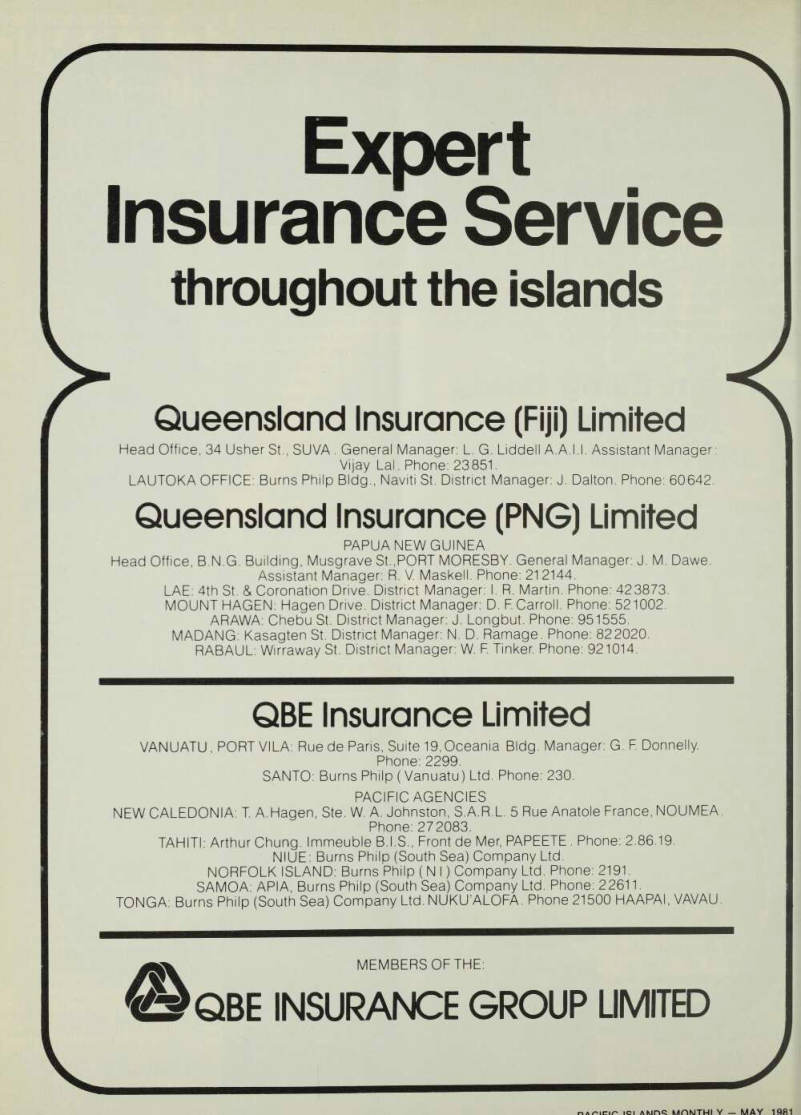
The Prime Minister of Fiji, Ratu Sir Kamisese Mara, and the King and the Crown Prince of Tonga were among Island leaders who flew in the aircraft.
Shorts have made two specific sales proposals in the Pacific Islands. One is to sell two of the aircraft to Air Pacific in Fiji and the other is to sell another two to Polynesian Airlines in Western Samoa. Financing arrangements at low interest have been offered
Top: The Shorts 330, G-BDBS, recently flown from Northern Ireland for demonstrating in the Pacific Islands. Above: King Taufa’ahau Tupou IV of Tonga follows the coast of Tongatapu Island during a flight in the aircraft. Bottom: A look back in history to the flying-boats Shorts once made. This Solent operated by TEAL (now Air New
Zealand) was photographed off
Tahiti in November 1951 after a proving flight from New Zea land.
through UK government export assistance channels.
The Fiji proposals envisage replacement of Brazilian-built Bandeirante aircraft on internal routes and to take over short-haul international routes. The pro posals have been generally well received in Fiji where load factors show a potential for increase, but the Western Samoa response so far has been more reserved.
Polynesian Airlines are at present using an Australian Nomad on some of the routes which are seen suitable for the 330.
Newsletter on
Islands affairs
The South Sea Digest, a fort nightly newsletter on Pacific Islands affairs which is available Dnly by private subscription, was aunched in Sydney in April. It’s designed for people and organis itions with a close interest in Pacific Islands matters who need lignificant news and likely trends n concise form for quick refer :nce.
The newsletter concentrates on >olitical, economic and business natters in all the Islands, and is >osted from Sydney every second Tiday. Overseas subscribers get t airmail.
The first issue comprised 45 ems, ranging from developments nd trends in Vanuatu, trouble in he Papua New Guinea Chan Cabinet, Japanese fishing plans, le fraud allegations in Western amoa, the Cook Islands Budget, nd Islands diplomatic and busi ess postings.
The South Sea Digest is a acific Publications venture, and compiled and edited by Stuart ider and John Carter. An over :as airmail subscription is SAISO * r year, and SAI2S within ustralia, and includes regular iditional fact sheets on Pacific land nations.
Vork completed
•n Fiji distillery
he Fletcher Organisation : iji) Ltd recently completed ie construction of Fiji’s first stillery in a joint venture with cal contractor Reddy Con ruction Co Ltd.
Reddy-Fletcher Contractors irried out site preparation and lilt the steel-framed buildings id fermentation and distil
lation structures for the main contractor, Fletcher and Stewart Ltd, of England.
Construction of the distillery began in December, 1979 with site works such as drainage and foundations and above-ground building was started in September, 1980. The Reddy- Fletcher contract was worth $1 million.
Gin produced by South Pacific Distilleries Limited at the Lautoka distillery was on sale in Fiji in time for Christmas. The company plans to introduce progressively throughout 1981 vodka, meth ylated spirits, industrial alcohol and, eventually, rum.
While the new products will be mainly for local consumption the company is aiming to export at least some of its production to other Pacific Island countries.
Tonga gets two
new facilities
The King of Tonga flew to Vavau on February 25 and on the following day officially opened two major projects, both of which have been funded under the Australian develop ment assistance programme.
The new bulk fuel depot at Toulo and the substantially enlarged and upgraded hospital in Neiafu were built by a locally recruited workforce trained and supervised by project manager Leo Foley of the Australian Department of Housing and Construction, who was seconded there in December 1977.
The SA66O 000 fuel depot comprises a tanker mooring, discharge and handling facili ties, road, water and safety systems, and large-capacity storage tanks for petrol, diesel oil and kerosene, together with all ancillary equipment and three demountable fuel trucks for deliveries to the villages.
The Prince Ngu Hospital originally built in 1956 has been completely redesigned, re furbished and re-equipped to provide radiology, pathology, dispensary and public health sections on the lower level and medical, surgical, obstetric, children’s, isolation and inten sive care wards on the upper floor.
Four completely new build ings, linked by covered ways, provide for: • Casualty and outpatients, dental section, maternal and child health clinic, administrat ive office and records; • Operating theatre, delivery suites, central sterile supply unit; • Kitchen and staff dining room; • Laundry and morgue, with garage, workshop, storerooms and services rooms on the lower level.
The SA2 million complex also includes a new nurses’ home and four staff houses.
Tonga’s Director of Health Dr S. Foliaki says he expects the new-look, 61-bed hospital to be fully operative by May.
Staffing would be commen surate with the expanded facili ties, he said. It would include four medical officers, an Australian-trained adminis trator, two sisters, 16 fully trained nurses, six kitchen staff, plus technicians, orderlies, wardmaids and laundry maids.
Resident medical staff would
also have back-up from visiting specialists from Nukualofa and overseas.
Work has also begun on a new and larger wharf facility for Neiafu. The SAI.2 million project is being funded by a soft loan from the European Econ omic Community, and a firm of Australian consultant engineers has provided a specialist super visor, J. Fallon, to take charge of the steel piling work for the wharf face. The rest of the project, including backfilling of the bay and construction of a barge-loading ramp behind the wharf face to create a large storage area, is under the direc tion of Sione Taumoepeau of the Tongan Ministry of Works.
Mr Taumoepeau is the king dom’s first graduate in civil engineering. He obtained his degree at Auckland University in 1975 and gained experience with the New Zealand Ministry of Works and the Bay of Islands Harbour Board before return ing to Tonga to take up his present position in Vavau at the
beginning of this year.
Penny
Hodgkinson in Nukualofa