the Yanks in Pukapuka
pp. 56-57 · Read in the full issue
A right royal welcome for the Yanks in Pukapuka
Travel
American freelance travel writer JAMES C. SIMMONS turns in an account of his visit to Pukapuka, northern Cook Islands, with a group of his fellow countrymen. He says they were the first group of tourists in history to visit Pukapuka Thev chartered a Cook Islands copra boat, the Manuvai, to pull off the feat.
It was after midnight and I could not sleep. I passed the time watching a brown roach slowly make its way across the stained ceiling of our sultry cabin. Our boat, the Manuvai, a 44 m copra boat and a relic from an earlier era of Pacific travel, pitched and rolled. plunged and hung, and then plunged again through ‘boisterous seas’ (our captain’s phrase).
I had tied myself into the top bunk with a sheet as a precaution against being thrown onto the metal floor below, Suddenly, a particularly violent lurch of the ship shook the roach loose, and it fell into the bunk across from me. My companion went on sleeping fitfully, unaware he now had company. From deep in the
bowels of the Manuvai I could hear the muffled sounds of the engines that seemed to repeat over and over, ‘Puka-puka, puka-puka’ through the long night.
I was with a group of 20 other Americans, most from Southern California, who had signed on to the Manuvai, sailing under charter to Richard Goodman of Oakland’s Goodtravel Tours, for what had sounded like the finest Pacific adventure in a decade the chance to be among the first group of tourists ever to visit the remote, legendary atolls of the northern Cook Islands. Our group included a retired Hollywood film director, an insurance salesman from San Jose, a housewife from
Whittier, and an 82-year-old freighter buff. What we all had in common was a lifelong love affair with the Pacific islands of romance and myth. For us the.
Manuvai with its utter lack of amenities was less an ordeal and more a challenge, a pant of the adventure we had come to experience.
The islands in the northern group of the Cook Islands are among the most legendary in the Pacific. These are the atolls of fantasy and romance, each one a handful of emerald chips scattered across the opal waters of a shallow lagoon, snugly tucked inside a coral reef which encircles them all like a loose fitting necklace. Lying far off the major shipping and yacht ing routes and sporting such
names as Pukapuka, Rakahanga, Manihiki, and Palmerston, the islands of the northern group are accessible only to travellers willing to endure the rigours of the Silk and Boyd Steamship Co on one of their infrequent trips to that part of the Pacific.
Three days after departing from American Samoa we ar rived at Pukapuka, home to 786 people and one of the most famous yet least visited islands
in the entire Pacific. The sea that morning was smooth as silk, stretching away to infinity, making our copra boat appear pitifully small against its im mensity. Ahead beyond a line of surf we could see the vivid belt of green coconut and pandanus trees poised in the air above beaches of glittering whiteness.
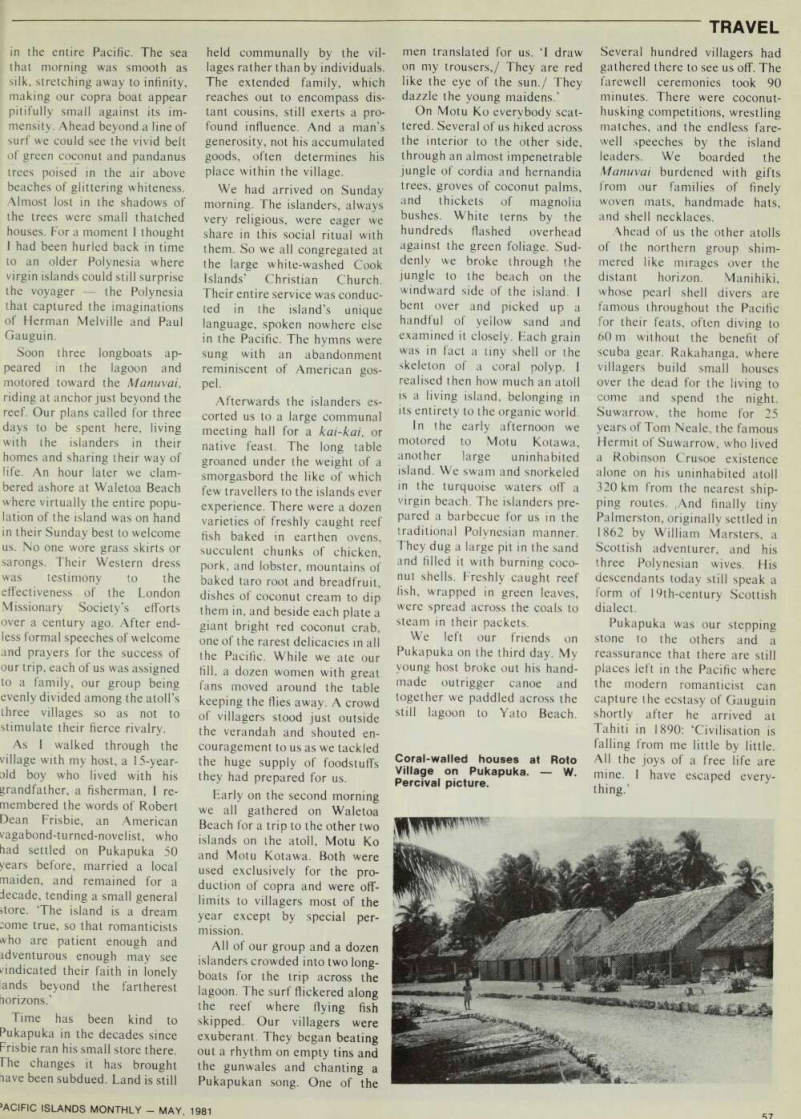
Almost lost in the shadows of the trees were small thatched houses. For a moment I thought I had been hurled back in time to an older Polynesia where virgin islands could still surprise the voyager the Polynesia that captured the imaginations of Herman Melville and Paul Gauguin.
Soon three longboats ap peared in the lagoon and motored toward the Manuvai, riding at anchor just beyond the reef. Our plans called for three days to be spent here, living with the islanders in their homes and sharing their way of life. An hour later we clam bered ashore at Waletoa Beach where virtually the entire popu lation of the island was on hand in their Sunday best to welcome us. No one wore grass skirts or sarongs. Their Western dress was testimony to the effectiveness of the London Missionary Society’s efforts over a century ago. After end less formal speeches of welcome and prayers for the success of our trip, each of us was assigned to a family, our group being evenly divided among the atoll’s three villages so as not to stimulate their fierce rivalry.
As I walked through the village with my host, a 15-year old boy who lived with his grandfather, a fisherman, I re membered the words of Robert Dean Frisbie, an American /agabond-turned-novelist, who had settled on Pukapuka 50 /ears before, married a local maiden, and remained for a decade, tending a small general »tore. ‘The island is a dream :ome true, so that romanticists kvho are patient enough and adventurous enough may see /indicated their faith in lonely ands beyond the fartherest horizons.’
Time has been kind to Pukapuka in the decades since Frisbie ran his small store there.
Fhe changes it has brought lave been subdued. Land is still
held communally by the vil lages rather than by individuals.
The extended family, which reaches out to encompass dis tant cousins, still exerts a pro found influence. And a man’s generosity, not his accumulated goods, often determines his place within the village.
We had arrived on Sunday morning. The islanders, always very religious, were eager we share in this social ritual with them. So we all congregated at the large white-washed Cook Islands’ Christian Church.
Their entire service was conduc ted in the island’s unique language, spoken nowhere else in the Pacific. The hymns were sung with an abandonment reminiscent of American gos pel.
Afterwards the islanders es corted us to a large communal meeting hall for a kai-kai, or native feast. The long table groaned under the weight of a smorgasbord the like of which few travellers to the islands ever experience. There were a dozen varieties of freshly caught reef fish baked in earthen ovens, succulent chunks of chicken, pork, and lobster, mountains of baked taro root and breadfruit, dishes of coconut cream to dip them in, and beside each plate a giant bright red coconut crab, one of the rarest delicacies in all the Pacific. While we ate our fill, a dozen women with great fans moved around the table keeping the flies away. A crowd of villagers stood just outside the verandah and shouted en couragement to us as we tackled the huge supply of foodstuffs they had prepared for us.
Early on the second morning we all gathered on Waletoa Beach for a trip to the other two islands on the atoll, Motu Ko and Motu Kotawa. Both were used exclusively for the pro duction of copra and were off limits to villagers most of the year except by special per mission.
All of our group and a dozen islanders crowded into two long boats for the trip across the lagoon. The surf flickered along the reef where flying fish skipped. Our villagers were exuberant. They began beating out a rhythm on empty tins and the gunwales and chanting a Pukapukan song. One of the
men translated for us. T draw on my trousers,/ They are red like the eye of the sun./ They dazzle the young maidens.’
On Motu Ko everybody scat tered. Several of us hiked across the interior to the other side, through an almost impenetrable jungle of cordia and hernandia trees, groves of coconut palms, and thickets of magnolia bushes. White terns by the hundreds flashed overhead against the green foliage. Sud denly we broke through the jungle to the beach on the windward side of the island. I bent over and picked up a handful of yellow sand and examined it closely. Each grain was in fact a liny shell or the skeleton of a coral polyp. I realised then how much an atoll is a living island, belonging in its entirely to the organic world.
In the early afternoon we motored to Motu Kotawa, another large uninhabited island. We swam and snorkeled in the turquoise waters off a virgin beach. The islanders pre pared a barbecue for us in the traditional Polynesian manner.
They dug a large pit in the sand and filled it with burning coco nut shells. Freshly caught reef fish, wrapped in green leaves, were spread across the coals to steam in their packets.
We left our friends on Pukapuka on the third day. My young host broke out his hand made outrigger canoe and together we paddled across the still lagoon to Yato Beach.
Several hundred villagers had gathered there to see us off. The farewell ceremonies took 90 minutes. There were coconut husking competitions, wrestling matches, and the endless fare well speeches by the island leaders. We boarded the Manuvai burdened with gifts from our families of finely woven mats, handmade hats, and shell necklaces.
Ahead of us the other atolls of the northern group shim mered like mirages over the distant horizon. Manihiki, whose pearl shell divers are famous throughout the Pacific for their feats, often diving to 60 m without the benefit of scuba gear. Rakahanga, where villagers build small houses over the dead for the living to come and spend the night.
Suwarrow. the home for 25 years of Tom Neale, the famous Hermit of Suwarrow, who lived a Robinson Crusoe existence alone on his uninhabited atoll 320 km from the nearest ship ping routes. ,And finally tiny Palmerston, originally settled in 1862 by William Marsters, a Scottish adventurer, and his three Polynesian wives. His descendants today still speak a form of 19th-century Scottish dialect.
Pukapuka was our stepping stone to the others and a reassurance that there are still places left in the Pacific where the modern romanticist can capture the ecstasy of Gauguin shortly after he arrived at Tahiti in 1890: ‘Civilisation is falling from me little by little.
All the joys of a free life are mine. 1 have escaped every thing.’
Coral-walled houses at Roto Village on Pukapuka. - W.
Percival picture.