Peter Simogun: The story of
pp. 51-53 · Read in the full issue
‘a man of consequence’
Yesterday
MALCOLM WRIGHT, a former patrol officer and World War II coastwatcher in Papua New Guinea relates the life story of his comrade-in-arms and friend Peter Simogun.
lelf-government in Papua New juinea grew from a small begin ing in 1951 when three indigen us members were nominated to their people in the .egislative Council, one each rom Papua, the New Guinea slands and the New Guinea lainland. The men nominated 3r the first two areas were elected on their educational ackground, the test being ‘per- Dnal qualifications among which 'as placed a capacity to use the nglish language so as to under and what was going on in the ouncil and to express views uenlly’. The men selected for apua and the New Guinea ffands filled the requirements, ut on the New Guinea mainland o such person was in sight, inally the Administrator, Co
lonel J. K. Murray, selected a Wewak man, Simogun Peta, ‘partly on his war-time record and partly on the energy he had shown in growing cash crops since the war for local food supply,’ as Sir Paul Hasluck puts it in his book A Time for Building.
The three indigenous members of the council were at first regarded as an ‘acceptable novelty’ by most of the Europeans in the Territory. But Simogun quickly began to show his ability and strength of charac ter so that Paul Hasluck, then minister for territories, came to regard him as one of the really ‘big men of his country’.
Peter Simogun, as he chose to be known later, had no formal education and in his childhood
had little to do with white men or their ways. He was born in Dagua, a village inland from Wewak, in 1902 so far as it can be calculated. He came from a line of ‘big men’ who held their position of authority from their wealth, their prowess as warriors and their control of the sorcerers.
As a boy he worked for a German planter in Manus before World War I and later worked as a plantation labourer in various districts. He joined the TNG Native Constabulary in about 1930 but in this field he showed no early promise in fact Mr Waterhouse, principal of the Malaguna Native School, who was responsible for teaching police recruits how to read and write, noted on his papers that Recruit Simogun was quite in capable of learning either, and reported him to be below average intelligence.
After service in the Rabaul- Kokopo area Simogun was posted to Talasea where I met him in 1938. He was now a lance corporal and was assigned by J. K. McCarthy, then assistant district officer at Talasea, as NCO in charge of the eight police with whom I was directed to reopen the old police post at Malutu in Central Nakanai. This was the site of the headquarters of the punitive expedition against the Central Nakanais after four white prospectors had been killed in 1 926. On the post Simogun showed his capacity for getting on well with ‘locals’, and with his energy and ability as a bush carpenter the building went on quickly and harmoniously. By perseverance with the Liklik Katolic Baibel he had taught himself to read and write, a fact which I reported and he was promoted corporal. (In those days many young patrol officers learnt correct Pidgin from this Little Catholic Bible.} In 1939 he was transferred to his home district and was a sergeant in Wewak when the Japanese entered the war. He
elected to accompany the large party led out by the late John (Bert) Jones in the evacuation of Wewak. He remained for a time at Goroka, and was then posted to Port Moresby as a drill instructor in the Royal
Papuan Constabulary.
In December, 1942, I was in the process of organising a party for coastwatching operations in New Britain and hearing that Simogun was in Port Moresby I was given permission to approach him. I gave him little information but he quickly caught on. When I said it would be risky he replied laconically: ‘Mi dai, mi dai. Mi got pikanini man belong karim nem belong mi.’ (If I die, I die. I have a son to carry on my name.) The secondment was arranged and Simogun had his first journey out of his country by ship and train to Brisbane. He ac cepted with equanimity the voy age by submarine in February, 1943, through hostile waters to the coast of New Britain and was quickly at home with the American submariners.
In the first months of setting up our coastwatching post he was a tower of strength, and in time, despite our attempt at secrecy, his name seeped through to a number of his kinsmen who had been forced to serve with the Japanese police in Rabual. A constable representing them came to contact us and Simogun met him and brought him into the camp heavily blindfolded. He assured us that it was safe to talk to the man, a clansman of his, and removed the blindfold.
The policeman, well turned out in the Japanese version of the pre-war Australian uniform, smartly gave us the Japanese salute which brought an angry
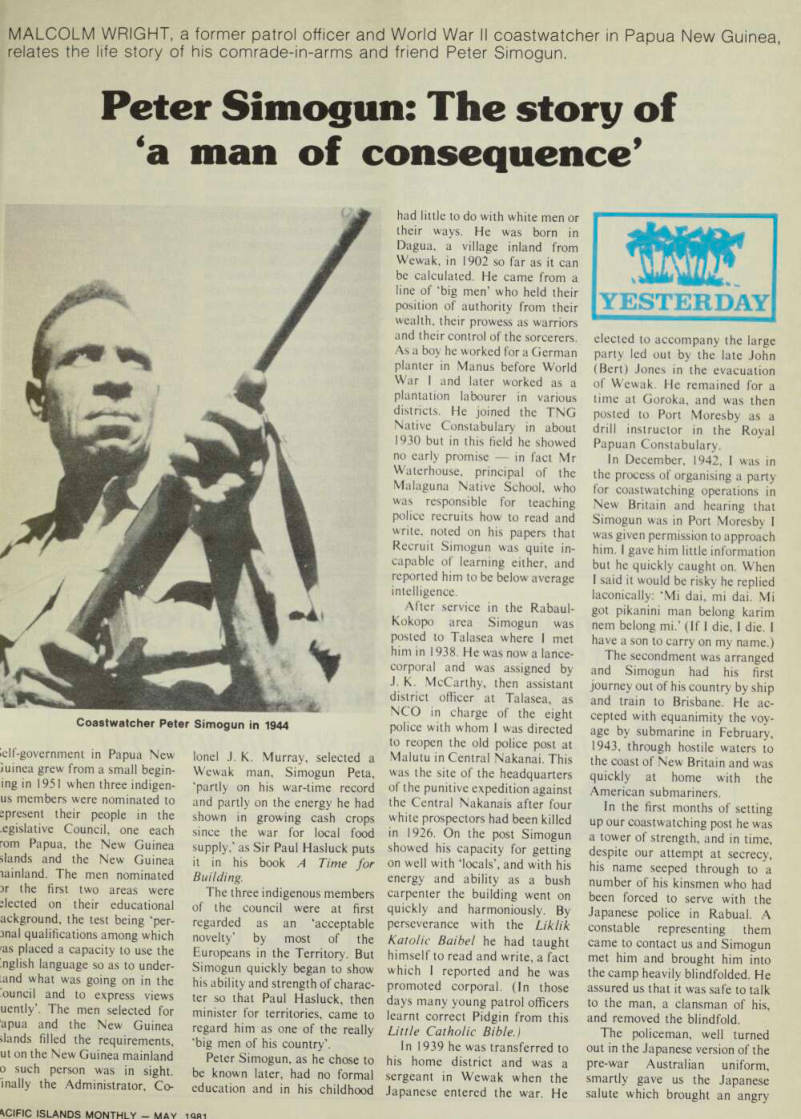
Coastwatcher Peter Simogun in 1944
bark from Simogun. The man apologised and swung a British salute. From this contact we built up a nucleus of informants inside the fortress who would have been valuable if Rabaul had been attacked.
In September, 1943, reinforce ments were brought in for the Allied advance, and five ad ditional coastwatching parties were organised for operations in New Britain. My party moved across the island into Central Nakanai where Simogun and I had worked five years before.
We were given a warm wel come and renewed old acquaint ances, Simogun now a sergeant major being received with great respect and his rank contracted to ‘Mesa’ (Major).
Alerted of our presence by the capture of one of the parties on the south coast the Japanese sent a patrol in strength against us.
Our spies gave us warning of their coming and we moved into hiding with some supplies. The patrol burnt our camp and all the supplies they could find, then returned to the coast.
It was then that Simogun
told us that without consulting us he had left a note with a gift of tobacco for one of the New Guineans serving with the Japanese. It said that we had had enough and were moving out to join the Americans at Arawe on the south coast. The patrol made no further attempt to find us and return to their base at Cape Hoskins.
With strong backing from the local people we quickly reorgan ised. But as Rabaul had been heavily hit, and the air base destroyed, our function as coaslwatchers was reduced. The Japanese were now retreating eastwards along the coast road to Rabaul. They moved in well organised groups, and our scouts reported them to be relatively fit.
After Allied Headquarters had given approval and weapons had been supplied, village groups were formed into sections, and given some quick training. We began guerrilla operations against the Japanese in January, 1944. By February the com mand. now named Tiger Force, consisted of more than 200 men.
The village sections were led by their own headmen and were
armed with shotguns, rifles, hand grenades and captured weapons of all types. There were also a number of spearmen who had either not made the grade as riflemen or preferred the traditional weapons.
Each section had its portion of road to cover and a headquarters group under Simogun covered the approaches to the camp. The first action was against a Marine patrol that came into the mountarns against us. Not knowing where we were, they halted at Umu village and waited for signs of activity. There were many villages in the area, but all gave the appearance of being descried. Only when the afternoon clouds came down did they spring into life.
Simogun and a party of local riflemen were sent to scout the Japanese movements, but afler doing so for one day Simogun decided to attack. It caught the Japanese unprepared but failed as Simogun’s submachine gun jammed and the locals, not yet confident of their new weapons, hung back. His gun cleared, Simogun continued the attack
and some Japanese were seen to be hit. It was not a successful operation but the effect on the local men was good as it had given them confidence. It also discouraged the guides with the Japanese, and after that not a single native would dare come into the mountains with an enemy patrol.
A week later a second Japanese patrol, composed of Marines and larger than the earlier one, moved back into Umu and from the reports of our guides they were prepared for a long stay. They seemed intent on locating us. All approaches to our camp and the villages were covered by riflemen and every trick that the Nakanais could pull out of the bag was used spear pits were dug, rocks, logs and spears were set on trip ropes, and the entire population moved into the bush again leaving their villages deserted.
There was no movement either by the Japanese or the guerrillas for several days until one evening we saw a large bonfire in the Japanese camp: they appeared to be challenging us to attack them.
Shortly afterwards there were sounds from the village to the right where Simogun was in command; a large fire had been lit and figures could be seen dancing around it. I did not know what was happening but I had confidence in Simogun.
Next morning at first light there was the sound of rifle fire on the steep slopes below Umu, and shortly afterwards we saw the Japanese retreating through the village carrying several casualties with them. Later in the morning an excited Simogun reported that he felt sure that his fire and sing-sing would draw the Japanese to him. But instead of moving out at first light as he reckoned they would do, he and his men set out during the night and, knowing the country, took up ambush positions and hit the enemy when they came down the rough track in the early light of dawn.
Guerrilla attacks on the en emy moving along the coast road became daily affairs, and Simogun was in his element.
His appearance was magnifi cent: he wore an Australian slouch hat, a Japanese officer’s jacket studded with a variety of badges of rank, medal ribbons and regimental patches that he had taken from his victims, and light US Marine boots on his feet. His face was painted with red ochre, and of all the weapons now available to him he had selected the small cal ibre Japanese carbine.
The effect was both impress ive and startling and this figure emerging from the bush must have been a frightening sight for the already demoralised Japanese. It also had an effect on the Nakanais who regarded the ‘Mesa’ with almost worship ping awe. His tally of kills, authenticated by the guerrillas’ own council, was growing and by the time we handed over to our relief party after six weeks of operations he had 31 confirmed kills in a total of 286.
The selection of a fitting award was something of a problem for as a member of the RPC he was itill a civilian; he was awarded the British Empire Medal.
After the war he remained with the PNG Constabulary for a time but his ability and his nfluence were wasted in this service. He returned to his
village and organised his people in the growing of cash crops. In the process he emerged as a man of considerable business acumen and did well as a planter and truck operator. His wife, Berta, also showed a keen eye for business and success fully took over the management of his interests when he became immersed in politics.
Simogun, adding the pho netic version of his baptismal name to be called Simogun Peta, and later Peta Simogun, became known throughout the mainland of New Guinea as well as New Britain as a ‘big man’.
While he was a member of the Legislative Council he was a PNG delegate to the South Pacific Conference in Suva in 1956. Now if the situation required he could speak some English, he could understand it well, and could hold his own in any company officially or socially.
His intelligence, his lively personality and his sense of humour made him a most interesting companion. It is told that at one of the official dinners at the Suva conference the host, a Fijian of noble birth, Oxford education and great distinction asked Simogun to ‘press on’
‘Cannibals must stick together’
with him after the guests had left. ‘We cannibals must stick together,’ he told the PNG delegation leader.
Later Peta Simogun was a leading member of the PNG delegation to the United Nations and addressed the As sembly. He spoke in Melanesian Pidgin with the machine-gun delivery that he never lost. His speech was translated by Horace (now Sir Horace) Niall, himself well versed in rapid expression.
At home he became active in the affairs of the New Guinean ex-servicemen and attended a national RSL conference in Canberra where he attracted the interest of the Duke of Edinburgh. At a later such conference in Brisbane his ad dress was interpreted by Eric Feldt, the original commander of the Coastwatchers.
In the first general election in the Territory Simogun stood for
his home electorate and was returned with a good majority.
In the new Assembly he became Under-Secretary for Police and during his administration the Constabulary under the commissionership of Robert Cole emerged as a modern force. He was defeated in the next election, but at the age of (approximately) 65 he did not accept retirement or a govern ment sinecure but took on the job of spearheading the oil palm industry in New Britain near the area where he had led guerrillas 15 years before. The scheme was successful and Simogun remained there until 1977 when he returned to his village.
After his retirement from politics the people of Wewak, both black and white, combined to show their appreciation of Peta Simogun’s efforts for his country. A large number of people gathered in the town and during the festivities Simogun was presented with a sizeable sum of money collected in a public subscription. He ac knowledged the gesture but donated the money to his people for the purchase of school books.
In 1965 Peta Simogun was a guest at the launching of my
book If I Die which told of our war experiences and in which he figured prominently. His com ing was well advertised by the publisher, and as visits of PNG politicians to Melbourne were then rare occurrences he was much sought by radio and TV interviewers.
One TV personality in Syd ney asked him what he thought of the Chevron where we were staying. He replied: ‘All right.
Just like the Hilton in New York.’ The interviewer told us afterwards that it was some thing he had never realised before: The Chevron was just like the New York Hilton.
A number of ill-informed questions on PNG politics were put to him and he answered them as blandly as a Canberra veteran would. To the one on his views on the newly formed Pangu Party he replied slowly and carefully: ‘Me no lookim constitution yet. Me lookim, all
right me can talk.’ The inter viewer understood this: no translation was required and no further question necessary.
Over a cup of coffee in the Cross after we had inspected
photographs advertising the en
tertainment available in one of the dens he told me that when he had been in one such place in San Francisco he had been approached by a big blonde woman. ‘Flow much?’ he asked her. ‘A hundred bucks,’ she replied. ‘How many times?’ he continued. ‘One time, of course.’ ‘Jees,’ said Simogun, T could get a second hand truck for that in Wewak.’
This visit meant for Peta Simogun and for me the revival of our earlier friendship. In the old days we were ‘kiap’ and ‘sergeant-major’. There existed between us a close understand ing and a deep appreciation, but always there was the barrier of the times, the barrier between white man and native. In 1965 happily this was gone and we were on even terms. In the spirit of the occasion we made an agreement regarding our famil ies, to take on each other’s in a sort of adoptive parenthood. In this arrangement he got my two and I got his eight. My wife asked for assurance that spouses were not included in this agreement.
Now Peter Simogun lives in his village, Dagua, in dignity, enjoying the prestige that his life has entitled him to expect.
He tells me that his trucking and bus business is doing well and he is considering going into the liquor trade. His back gives him pain occasionally and he is losing his teeth.
His family are all doing well and he is content, except for the complaint that present-day poli ticians in PNG no longer take the advice of the ‘big men’. He is happy with the way things have gone, and, although he does not say it, is well satisfied with the part he has played in the rise of his country to nationhood.
In 1966 in a letter to me Lord Casey, then Governor-General, told of his meeting with Peter Simogun, and described him as a ‘man of consequence’. Of the man who was in 1930 ‘incapable of learning to read and write’ this is truly so.