political planner
pp. 45-47 · Read in the full issue

Books
The many hassles of a political planner
Practice Without Policy: The Genesis of Local Government in Papua New Guinea. By DM.
Fenbury. Published by Aust ralian National University Press. Price not indicated.
Isbn 0 7081 0210 7.
This valuable book by the late David Fenbury tells how he ittempted to cope with the task )f establishing and maintaining vhat were then called native ullage councils among the folai people from the Rabaul Tea of New Britain in Papua slew Guinea. It deals with the ears 1950-1955 when Fenbury eld the position of Senior Native Authorities Officer, first 1 Rabaul and later Port Moresby.
It contains much continuing nd detailed material concern ig local government right up to tie time of his retirement in 973, although by then he was o longer a direct participant. It dls of the obstacles that barred is way in the early years in •cal government, the apathy nd ignorance of most of his :nior officers and contem nraries, the active hostility of any sections of the white immunity towards local ivernment for Papua New uineans, and the resistance to lange exhibited by a minority oup of the Tolai people them- Ives.
Despite these handicaps ere is little doubt, and the >ok reflects this, that during mbury’s time in Rabaul and r some years afterwards the •uncil system seemed to be the ost , successful and firmly tablished of any of the insti tions introduced by Australia r the political, economic and cial development of the ople of Papua New Guinea. ie Tolai experiment, as it was lied, was indeed highly satis ctory. No VIP ever visited ibaul without being shown e councils in action, and few the visitors failed to be pressed.
But from 1967 this bright
:ture became increasingly
tarnished. A number of factors contributed. The adoption of strictly legalistic solutions to inevitable conflicts was one.
Another was the submersion of the purely Tolai councils into a single large multi-racial body, a target sought by the Minister for Territories Paul Hasluck later Sir Paul Hasluck and Governor-General of Australia.
Many factors combined to shat ter the confidence of the Tolai people in the integrity and viability of the system which they had done so much to get off the ground.
And what of Fenbury himself while this was happening? For five years before his retirement in 1973 he was removed from active involvement in the events. He had become Sec retary of the Department of the Administrator, but even from this he was side-tracked into a newly-created ragbag of a de partment known as Social De velopment and Home Affairs.
As an Assistant District Officer and later as a District Officer I was closely associated with Fenbury and with most of the issues and events he writes about. He was my senior officer in Rabaul during my time there, I was proud to serve with him and I kept in touch with him
after he left. 1 did not always agree with his way of doing things, and although he was a tough fighter and a rough one I never found him mean or under hand, and he never went back on his word. He consistently kept everyone concerned with the situation his superiors and his staff fully informed.
He was a careful and competent planner who was fully aware of the realities and consequences implicit in the setting up of the councils.
He was always un compromisingly honest. In the preface to his book he states: ‘The reader will be aware of the limitations inherent in an ac count of the present kind. It is bound to be marred by faded memories, subjective judge ments and personal discontents ... at least I have tried to minimise post hoc rationalis ations and distortions. . .’
In my opinion he has faith fully carried out this intention throughout the whole book. He also modestly claims for his book that, among other things: It may amuse my contempor aries’. It certainly has done that for me. The book abounds in examples of his inimitable tal ent for writing sharply with great facility. His pungent pricking of the balloon of false logic and glib assertions which permeated the 1960 Derham Report into the PNG justice system will be enjoyed by all who know the personalities and issues involved.
For instance, Fenbury refers to senior officers of the Depart ment of Territories in 1946 as ‘ageing clerks, unfitted for plan ning brave new worlds’. And referring to policy conflicts and difficulties he writes: ‘As the officer immediately responsible for implementing the local government policy, I have fre quently felt rather like a myopic forward scout whose platoon commander, without recalling him, has decided not to ad vance.’
Fenbury died before he had completed the book, and the final editing and production was undertaken by Professor R. S.
Parker of the Research School of Social Sciences at the Aust ralian National University. Fie was aided by Fenbury’s widow Helen, a charming and talented lady who will be remembered by many officers of the Aust ralian administration in PNG as Helen Shiels, a lecturer from 1947 to 1949 at the then Australian School of Pacific Administration in Sydney.
Other assistance was given b> members of Professor Parker’s department and by Colin Fiddle who had worked with Fenbury in the Tolai experiment The book is unusual and valuable, and Professor Parker refers to it as follows: ‘lt is a work quite unusual among the published writings on Aust ralian government activity in
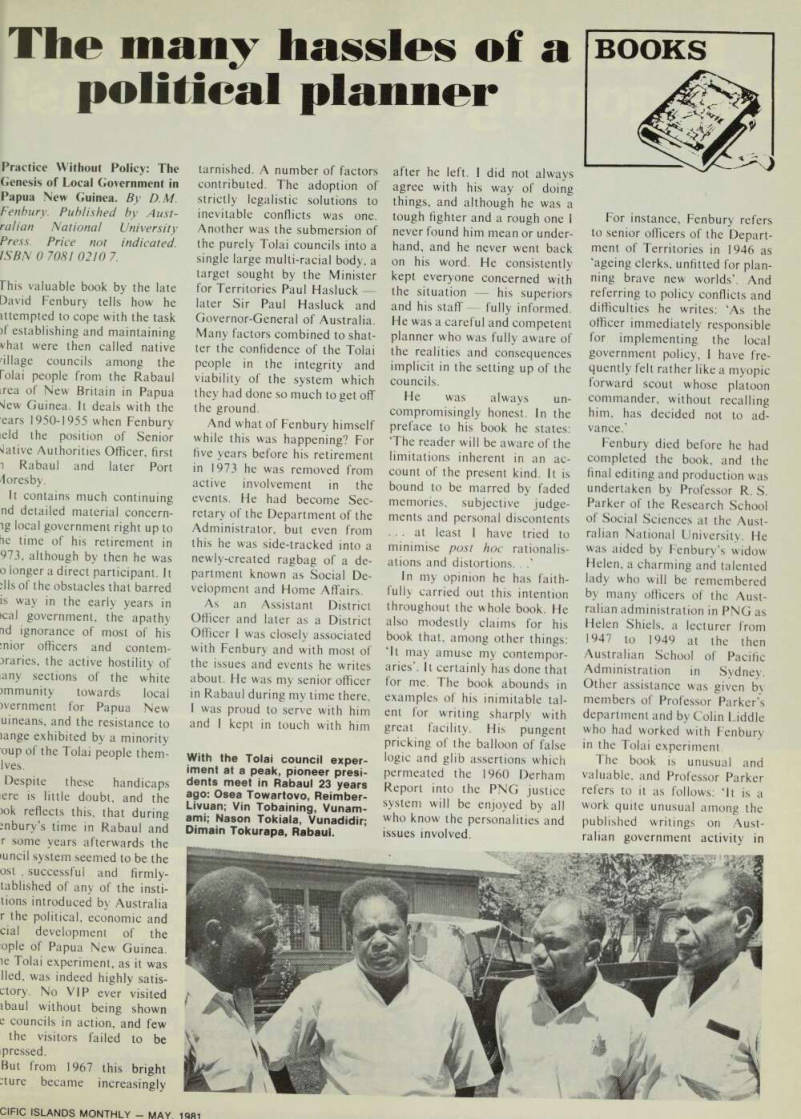
With the Tolai council exper iment at a peak, pioneer presi dents meet in Rabaul 23 years ago: Osea Towartovo, Reimber- Livuan; Vin Tobaining, Vunam ami; Nason Tokiala, Vunadidir; Dimain Tokurapa, Rabaul.
Papua New Guinea. We have had books by and about politi cal and administrative heads in Canberra and Port Moresby, and by and about bush kiaps.
We have no books (except this one) by senior officers who were involved in framing policy and pulling it into practice in settled districts.' Fenbury’s basic philosophy )n councils is told in closely casoned terms in chapters deal ng with the background to ntroducing the council system, he implementation of policy, he native courts system, the mergence of anti-council orces, and the channelling of ouncil activities into welfare nd development work. His philosophy emerges in these irms; If you really want the )cal people to accept freely and omprehendingly that your pol ical, social and economic plans re worthwhile, then you must ;ad them to a system which ill inculcate in them (1) a aspect for democratic pre sses, (2) a desire to evolve om traditional economic and >cial practices to new practices hich will lift and maintain ving standards, and (3) the :ceptance of a rule of law.
The book consistently argues lal if the council system were roperly understood and sin :rely supported by the govern ent’s maximum resources, icn there was a real chance lat the fine words about politi d, economic and social devel imcnl could be turned into a ality. Not that he put the mncils forward as a panacea an easy road to success. He lew, better than anybody else, e long, hard, slogging, iglamorous job it would be to :rsuade or, the last resort, to ipose change on the New uinean villager. His book re als that he failed in getting s point of view accepted, and is sad in the extreme to realise at this remarkably talented d practical man, and his best
brls, were ultimately ignored
d rejected.
David Fenbury, and all con rned in the production of this ok, are to be congratulated on work which will assuredly <e its place as one of the ndamental documents in the :ording of Papua New Jinea history. Max Or ken.