People
pp. 39-44 · Read in the full issue
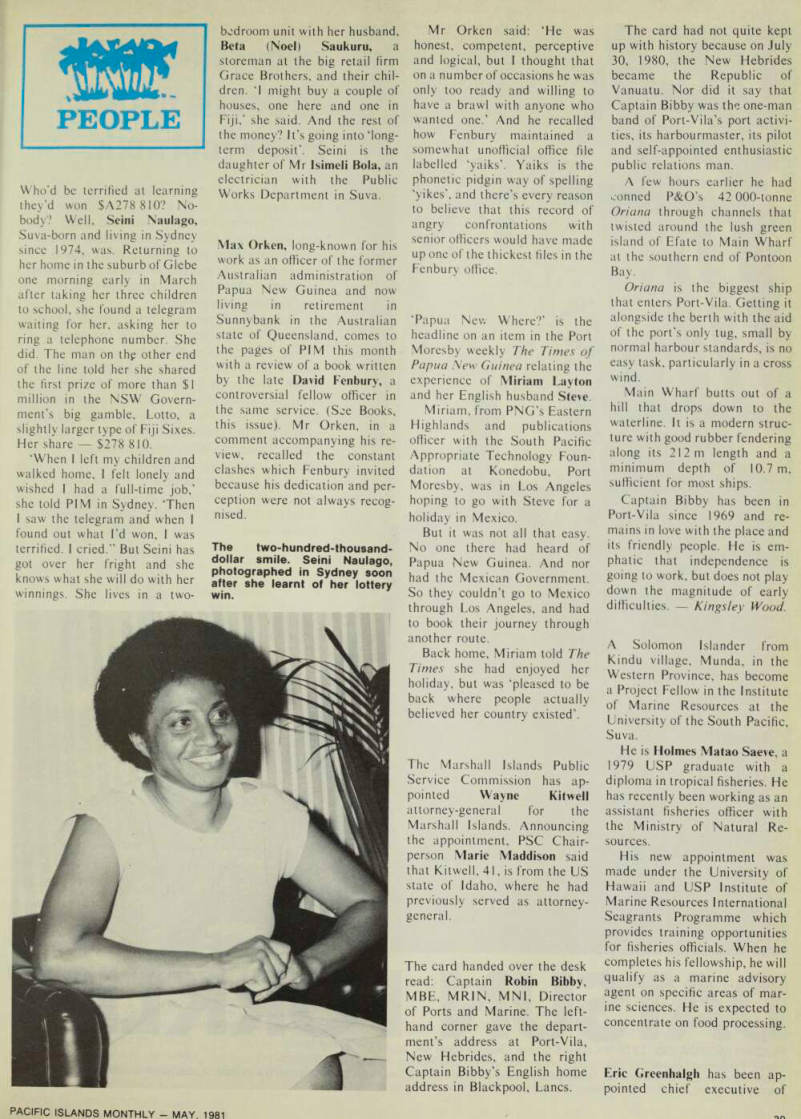


Who’d be terrified at learning they’d won SA27B 810? No body? Well, Seini Naulago, Suva-born and living in Sydney since 1974, was. Returning to her home in the suburb of Glebe one morning early in March after taking her three children to school, she found a telegram wailing for her, asking her to ring a telephone number. She did. The man on thp other end of the line told her she shared the first prize of more than $1 million in the NSW Govern ment’s big gamble. Lotto, a slightly larger type of Fiji Sixes.
Her share $278 810. ‘When I left my children and walked home, I felt lonely and wished I had a full-time job,' she told PIM in Sydney. Then I saw the telegram and when I found out what I’d won, I was terrified. 1 cried.” But Seini has got over her fright and she knows what she will do with her winnings. She lives in a two
bedroom unit with her husband, Beta (Noel) Saukuru, a storeman at the big retail firm Grace Brothers, and their chil dren. ‘I might buy a couple of houses, one here and one in Fiji,’ she said. And the rest of the money? It’s going into ‘long term deposit'. Seini is the daughter of Mr Isimeli Bola, an electrician with the Public Works Department in Suva.
Max Orken, long-known for his work as an officer of the former Australian administration of Papua New Guinea and now living in retirement in Sunnybank in the Australian state of Queensland, comes to the pages of PIM this month with a review of a book written by the late David Fenbury, a controversial fellow officer in the same service. (See Books, this issue). Mr Orken, in a comment accompanying his re view, recalled the constant clashes which Fenbury invited because his dedication and per ception were not always recog nised.
Mr Orken said; ‘He was honest, competent, perceptive and logical, but I thought that on a number of occasions he was only too ready and willing to have a brawl with anyone who wanted one.’ And he recalled how Fenbury maintained a somewhat unofficial office file labelled ‘yaiks’. Yaiks is the phonetic pidgin way of spelling ‘yikes’, and there’s every reason to believe that this record of angry confrontations with senior officers would have made up one of the thickest files in the Fenbury office. ‘Papua New Where?’ is the headline on an item in the Port Moresby weekly The Times of Papua New’ Guinea relating the experience of Miriam Layton and her English husband Steve.
Miriam, from PNG’s Eastern Highlands and publications officer with the South Pacific Appropriate Technology Foun dation at Konedobu, Port Moresby, was in Los Angeles hoping to go with Steve for a holiday in Mexico.
But it was not all that easy.
No one there had heard of Papua New Guinea. And nor had the Mexican Government.
So they couldn’t go to Mexico through Los Angeles, and had to book their journey through another route.
Back home, Miriam told The Times she had enjoyed her holiday, but was ‘pleased to be back where people actually believed her country existed’.
The Marshall Islands Public Service Commission has ap pointed Wayne Kitwell attorney-general for the Marshall Islands. Announcing the appointment, PSC Chair person Marie Maddison said that Kitwell, 41, is from the US state of Idaho, where he had previously served as attorney general.
The card handed over the desk read: Captain Robin Bibby, MBE, MRIN, MNI, Director of Ports and Marine. The left hand corner gave the depart ment’s address at Port-Vila, New Hebrides, and the right Captain Bibby’s English home address in Blackpool, Lancs.
The card had not quite kept up with history because on July 30, 1980, the New Hebrides became the Republic of Vanuatu. Nor did it say that Captain Bibby was the one-man band of Port-Vila’s port activi ties, its harbourmaster, its pilot and self-appointed enthusiastic public relations man.
A few hours earlier he had conned P&O’s 42 000-tonne Oriana through channels that twisted around the lush green island of Efale to Main Wharf at the southern end of Pontoon Bay.
Oriana is the biggest ship that enters Port-Vila. Getting it alongside the berth with the aid of the port’s only tug, small by normal harbour standards, is no easy task, particularly in a cross wind.
Main Wharf butts out of a hill that drops down to the waterline. It is a modern struc ture with good rubber fendering along its 212 m length and a minimum depth of 10.7 m, sufficient for most ships.
Captain Bibby has been in Port-Vila since 1969 and re mains in love with the place and its friendly people. He is em phatic that independence is going to work, but does not play down the magnitude of early difficulties. Kingsley Wood.
A Solomon Islander from Kindu village, Munda, in the Western Province, has become a Project Fellow in the Institute of Marine Resources at the University of the South Pacific, Suva.
He is Holmes Matao Saeve, a 1979 USP graduate with a diploma in tropical fisheries. He has recently been working as an assistant fisheries officer with the Ministry of Natural Re sources.
His new appointment was made under the University of Hawaii and USP Institute of Marine Resources International Seagrants Programme which provides training opportunities for fisheries officials. When he completes his fellowship, he will qualify as a marine advisory agent on specific areas of mar ine sciences. He is expected to concentrate on food processing.
Eric Greenhalgh has been ap pointed chief executive of
The two-hundred-thousand dollar smile. Seini Naulago, photographed in Sydney soon after she learnt of her lottery win.
W. R. Carpenter Holdings Ltd’s South Pacific operations.
Mr Greenhalgh, who recently resigned as managing director of the big Sydney retail group David Jones Ltd, will take up his position on August 2.
Until that time he will con centrate on the management of the retail and wholesale activi ties of Morris Hedstrom Ltd, which represents the most im portant business activity of the Carpenter group in the region.
Mr Greenhalgh replaces Lyle Cupit who has retired as chief executive of W. R. Carpenter (South Pacific) after 27 years with the group (PIM Dec p 57).
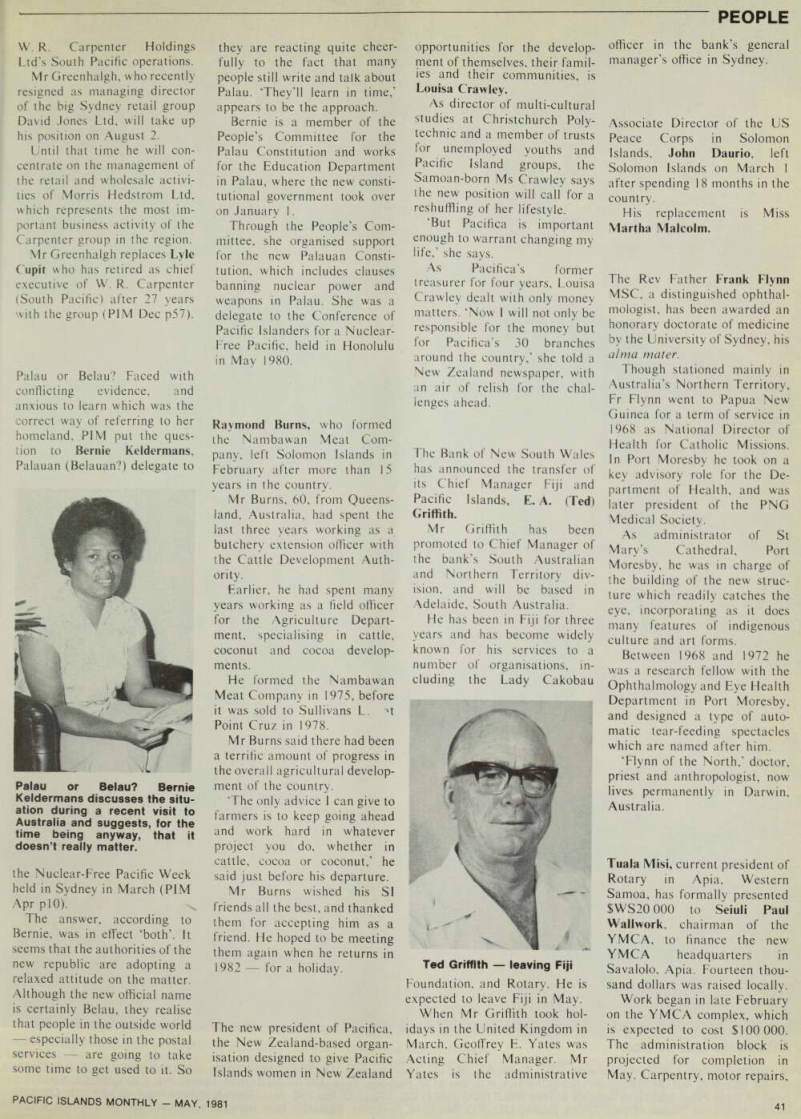
Palau or Belau? Faced with conflicting evidence, and anxious to learn which was the correct way of referring to her homeland, PIM put the ques tion to Bernie Keldermans, Palauan (Belauan?) delegate to
the Nuclear-Free Pacific Week held in Sydney in March (PIM Apr plO).
The answer, according to Bernie, was in effect ‘both’. It seems that the authorities of the new republic are adopting a relaxed attitude on the matter.
Although the new official name is certainly Belau, they realise that people in the outside world especially those in the postal services are going to take some time to get used to it. So
they are reacting quite cheer fully to the fact that many people still write and talk about Palau. ‘They’ll learn in time,' appears to be the approach.
Bernie is a member of the People’s Committee for the Palau Constitution and works for the Education Department in Palau, where the new consti tutional government took over on January 1.
Through the People’s Com mittee, she organised support for the new Palauan Consti tution, which includes clauses banning nuclear power and weapons in Palau. She was a delegate to the Conference of Pacific Islanders for a Nuclear- Free Pacific, held in Honolulu in May 1980.
Raymond Burns, who formed the Nambawan Meat Com pany, left Solomon Islands in February after more than 15 years in the country.
Mr Burns, 60, from Queens land, Australia, had spent the last three years working as a butchery extension officer with the Cattle Development Auth ority.
Earlier, he had spent many years working as a field officer for the Agriculture Depart ment, specialising in cattle, coconut and cocoa develop ments.
He formed the Nambawan Meat Company in 1975, before it was sold to Sullivans L. M Point Cruz in 1978.
Mr Burns said there had been a terrific amount of progress in the overall agricultural develop ment of the country. ‘The only advice 1 can give to farmers is to keep going ahead and work hard in whatever project you do, whether in cattle, cocoa or coconut,’ he said just before his departure.
Mr Burns wished his SI friends all the best, and thanked them for accepting him as a friend. He hoped to be meeting them again when he returns in 1982 for a holiday.
The new president of Pacifica, the New Zealand-based organ isation designed to give Pacific Islands women in New Zealand
opportunities for the develop ment of themselves, their famil ies and their communities, is Louisa Crawley.
As director of multi-cultural studies at Christchurch Poly technic and a member of trusts for unemployed youths and Pacific Island groups, the Samoan-born Ms Crawley says the new position will call for a reshuffling of her lifestyle. ‘But Pacifica is important enough to warrant changing my life,’ she says.
As Pacifica’s former treasurer for four years, Louisa Crawley dealt with only money matters. ‘Now I will not only be responsible for the money but for Pacifica’s 30 branches around the country,’ she told a New Zealand newspaper, with an air of relish for the chal lenges ahead.
The Bank of New South Wales has announced the transfer of its Chief Manager Fiji and Pacific Islands, E. A. (Ted) Griffith.
Mr Griffith has been promoted to Chief Manager of the bank’s South Australian and Northern Territory div ision, and will be based in Adelaide, South Australia.
He has been in Fiji for three years and has become widely known for his services to a number of organisations, in cluding the Lady Cakobau
Foundation, and Rotary. He is expected to leave Fiji in May.
When Mr Griffith took hol idays in the United Kingdom in March, Geoffrey E. Yates was Acting Chief Manager. Mr Yates is the administrative
officer in the bank’s general manager’s office in Sydney.
Associate Director of the US Peace Corps in Solomon Islands. John Daurio, left Solomon Islands on March 1 after spending 18 months in the country.
His replacement is Miss Martha Malcolm.
The Rev Father Frank Flynn MSC, a distinguished ophthal mologist, has been awarded an honorary doctorate of medicine by the University of Sydney, his alma mater.
Though stationed mainly in Australia’s Northern Territory, Fr Flynn went to Papua New Guinea for a term of service in 1968 as National Director of Health for Catholic Missions.
In Port Moresby he took on a key advisory role for the De partment of Health, and was later president of the PNG Medical Society.
As administrator of St Mary’s Cathedral, Port Moresby, he was in charge of the building of the new struc ture which readily catches the eye, incorporating as it does many features of indigenous culture and art forms.
Between 1968 and 1972 he was a research fellow with the Ophthalmology and Eye Health Department in Port Moresby, and designed a type of auto matic tear-feeding spectacles which are named after him. ‘Flynn of the North,’ doctor, priest and anthropologist, now lives permanently in Darwin, Australia.
Tuala Misi, current president of Rotary in Apia, Western Samoa, has formally presented SWS2O 000 to Seiuli Paul Wallwork, chairman of the YMCA, to finance the new YMCA headquarters in Savalolo, Apia. Fourteen thou sand dollars was raised locally.
Work began in late February on the YMCA complex, which is expected to cost $lOO 000.
The administration block is projected for completion in May. Carpentry, motor repairs,
Palau or Belau? Bernie Keldermans discusses the situ ation during a recent visit to Australia and suggests, for the time being anyway, that it doesn’t really matter.
Ted Griffith - leaving Fiji
sports, rural development pro grammes, and staff training will all be catered for in the new building.
The donation was the result of two years’ fund-raising by Rotary under the presidencies of John McDonald and the Rev Joe Pusateri.
L. G. M. (Gordon) Latimer ar rived in Solomon Islands in February to take over as the first general manager and a director of the National Bank of Solomon Islands (NBSI) on a three-year appointment.
The NBSI took over the Solomon Islands banking oper ations of the (Australian) Com monwealth Banking Corpor ation from March 2.
Mr Latimer will be on secondment from the CBC, where he has had wide experi ence in many aspects of the bank’s operations.
Nadi lawyer Manikam Pillai has been appointed Fiji’s new attorney-general. He succeeds Andrew Deoki who has resigned to live in Australia.
A senior economist with Fiji’s Ministry of Commerce and Industry, Arvindra Rao, is on a three-year scholarship to do a master’s degree in economics at the University of New England, New South Wales, Australia.
Mr Rao graduated with a bach elor’s degree from the Univer sity of Canterbury, New Zea land, in 1973. The new course has been made possible under an Australia aid programme.
Count and Countess Bernadette of Sweden visited Fiji in March.
The countess said the visit was a 70th birthday present for the count, who, as a member of the Swedish royal family, is related to most of Europe’s royalty.
The couple said that while in many countries tourists were ‘merely tolerated’ they felt that in Fiji ‘people were pleased to have us’.
Alan Hannay has been named the new regional manager for Fiji of the Bank of New Zea
land. He succeeds John Galt, who returns to Wellington to take up a head office post.
James Vaiagina Makasiale, a Fijian with 20 years experience in rural development in his own country, has been appointed to the East-West Center staff as administrator of the insti tution’s new Pacific Islands Development Program.
Mr Makasiale, 43, served as
director of extension services and as a district commissioner in Fiji before joining the East- West Center. He will be in charge of a programme of education, research and train ing which is being organised as the result of a policy conference of government heads and plan ning directors of 20 Pacific Islands states at the Center last year.
'Mr Makasiale is uniquely qualified to direct this exciting new programme at the East- West Center,’ said Acting President Lee-Jay Cho in an nouncing the appointment. ‘He is a good example of the new breed of administrative leader ship that has been emerging not only in the independent states of the South Pacific but in the new governments of the Micro nesian Trust Territory.’
After serving for three years in Fiji’s early rural development programmes, Mr Makasiale came to the East-West Center in 1963 to study for a bachelor’s degree in agricultural science at the University of Hawaii. Re turning to Fiji, he served as a district agricultural officer, earned a post-graduate diploma in agricultural extension at the University of Queensland,
Australia, and in 1975 was appointed director of extension services and lecturer at the University of the South Pacific in Suva.
In 1976, he was appointed commissioner for Fiji’s Eastern Division, and in 1978 became commissioner for the Central Division, the largest of the country’s four divisions. As commissioner, he was the highest ranking government official of the division, with overall responsibility for the administration of his region, responsible directly to the prime minister.
The Olbiil Era Kelulau (Palau National Congress) during its first regular session in February adopted a joint resolution awarding Rechucher Charlie W. Gibbons (PIM Mar p 39) the title of an honorary senator of the first Olbiil Era Kelulau of the Republic of Palau.
The resolution, introduced by Senator Edobo (Edward) Temengil, said it was designed to honour Rechucher Charlie W. Gibbons ‘for many years of outstanding contributions to the art, culture and heritage of Palau’.
The resolution added that Gibbons had worked as a black smith in Yap, was employed by the German administration in Yap and Palau in laying the first cable between Guam, Min danao and Shanghai, spent seven years in Ponape working with the Japanese constabulary, became director of the agriculture training programme for the Japanese adminis tration, was employed by the US military administration as an interpreter after the war, then became special assistant to the military governor under the navy administration, became the first Palauan ever appointed assistant district agriculturist in 1945, served as associate judge from 1948 to 1959, joined the staff of the Palau Museum, and launched his career as wood carver. At the age of 70, Gibbons took up water colour painting, and became an excel lent painter.
His paintings depict the cul ture and heritage of Palau, including scenes of important rituals, and have been exhibited
in the United States, Europe, Guam, Saipan, Palau and Papua New Guinea.
Gibbons was born in Ngaraad State, Palau, on April 1, 1894. In 1945 he was made Rechucher of Koror State, a title he still bears.
The resolution concluded: 'The people of Palau through their elected extend their best wishes for continued good health and boundless happiness to Rechu cher Charlie W. Gibbons.’
Da\id Caffin has taken over as New Zealand High Com missioner to Western Samoa from Douglas Law, who is returning to Wellington on com pletion of his term of office.
Mr Caffin, 41, took up his new appointment in April.
Joe Lynch, an Australian law yer who has spent 28 years drafting law in Papua New Guinea and Kiribati, has been appointed legislative counsel to the Marshall Islands Nitijela (parliament).
Mr Lynch went to the Marshall Islands in mid-1980 to draft legislation and has now been appointed part-time legis lative counsel pending appoint ment of a fulltime officer.
Ken Bidwell recently took up the position of manager of the Fiji operations of the insurance
broking company Reed Stenhouse Ltd, formerly known as Stenhouse Sullivan (Pacific Islands) Ltd. He replaces Kevin Fowlie, who has become service manager at the company’s Auckland office.
James Makasiale
Ken Bidwell