PNG party system
p. 35 · Read in the full issue
Expediency rules in PNG party system
Although Papua New Guinea has produced and scrapped a greater number of political parties than any other Pacific Island country and despite the strong influence of party-type politics on the style of government, the party system there continues to exhibit a high degree of disorder.
There are now seven party factions in parliament, but they are tending to become stepping stones for politicians instead of being bodies of political atti tude.
The history of PNG political parties- before and since inde pendence has included a degree of firm commitment from a handful of politicans. By and large however there has been an excessively casual approach to policy and party commitments, to the requirements of party discipline, to loyalties and to alignments. Parties have been used as organisations of expedi ency in political dealing, and have shown a decreasing role in basic political thought.
The casual commitment to the party system takes two forms, both of which have been disruptive in the national parlia ment. One of these is the constant movement of poli ticians from one faction to another so that few parties ever know where they stand in the numbers game. The other is a movement of alignments be tween party groupings. It has been known, too, for only half the parliamentary membership of a single party to align itself with another party. The fact that a party can split itself in
this way and still consider itself a single party illustrates the extraordinary ambivalency of the party community. -. --ugh PNG has a West minster system of parliament with party groupings, a govern ment and an opposition, party numbers can never be used with safely to assess whether a con tentious vote will be successful in parliament. The government can lose a vote through de fections in its ranks, but this does not mean the defeat of the government from office and often the defections are toler ated in a fatalistic way. The party whip merely shrugs his shoulders and hopes for better luck next time. To bring down the government requires the nomination of a new prime minister by parliament as a whole. This was the process which defeated the foundation prime minister, Mr Michael Somare, just over a year ago.
Shifting party alignments and individual defections both played a part in the result.
The history of parties in the PNG parliament is studded with examples of politicians who have switched loyalties not for a particular political prin ciple but simply for immediate or anticipated strategic advan tage. Sometimes the motive behind the switch has involved personal political advantage, but often the switch is forced on
politicians by electorate pres sures which themselves are ex tremely fluid. But whatever the motive, the result has always been the same: the party system has failed to demonstrate politi cal continuity.
A contributing factor to the history of changing loyalties is the nature of the political plat forms endorsed by the parties.
With a few interesting excep tions, most of which are now historical rather than active, PNG parties have not rep resented significant policy differences. ‘A fair go for all (including women) and more of everything for every one’ was how a visiting Australian journalist paraphrased the range of party policies in PNG three years ago. Behind the flippancy the description was a compliment to attitudes rather than a criticism, and the de scription remains true today.
It is true there are mounting allegations that too many PNG politicians today are playing a game of ‘more of everything for everyone, especially politicians’ but this is criticism of a different type. It does not affect the stated policies of the par ties, or the similarities which the stated policies bear to each other.
One of the true divisions of policy which once existed was the call for immediate home rule which the Pangu Party made more than a decade ago and before independence.
Pangu made this call alone and in opposition to the attitude of other parties.
As a doctrine of division from other parties it is no longer relevant, and Pangu’s present
development-type platform
does not materially differ from the platforms of other parties.
Papua Besena also had a
distinct pre-independence pol icy when it sought indepen dence for Papua without New Guinea union. The party re mains a Papua interest group, but its separation policy is symbolic rather than active.
The general lack of any real differences in doctrine between the parties has contributed to the casual attitude of politicians towards party loyalties. To some extent the parties tend to represent regional localities, but this is not generally an inherent part of their platforms. The result is that blocks of poli ticians can remain collectively faithful to regional loyalties while at the same time switch ing party loyalties.
PNG adopted party politics before independence despite some doubts expressed by a number of political leaders. In the final event parties evolved because they became the most expedient way of moving towards a new and agreed national structure. But there is now a growing opinion that they are disruptive, or at least that they have a long way to go before they become a stable central element in the political scene. The last general election contained many candidates who freely announced that they would ‘join a suitable party after being elected’. The prob lem is that definitions of ‘a suitable party’ change from month to month as a matter of expediency. Individual atti tudes and ambitions and elec torate pressures continue to outweigh party loyalties and
alignments.
Angus Smales.
US affirms its
Pacific links
President Ronald Reagan of the United States, inaugurated in January, has confirmed his in tention to maintain and foster close ties with Pacific Island countries. His intention is con tained in messages of thanks which he sent to a number of Island countries which had con gratulated him on his inaugur ation. He said he looked for ward to continued close and co operative relations with the Island countries * part of a shared goal world-wide peace and prospen /.
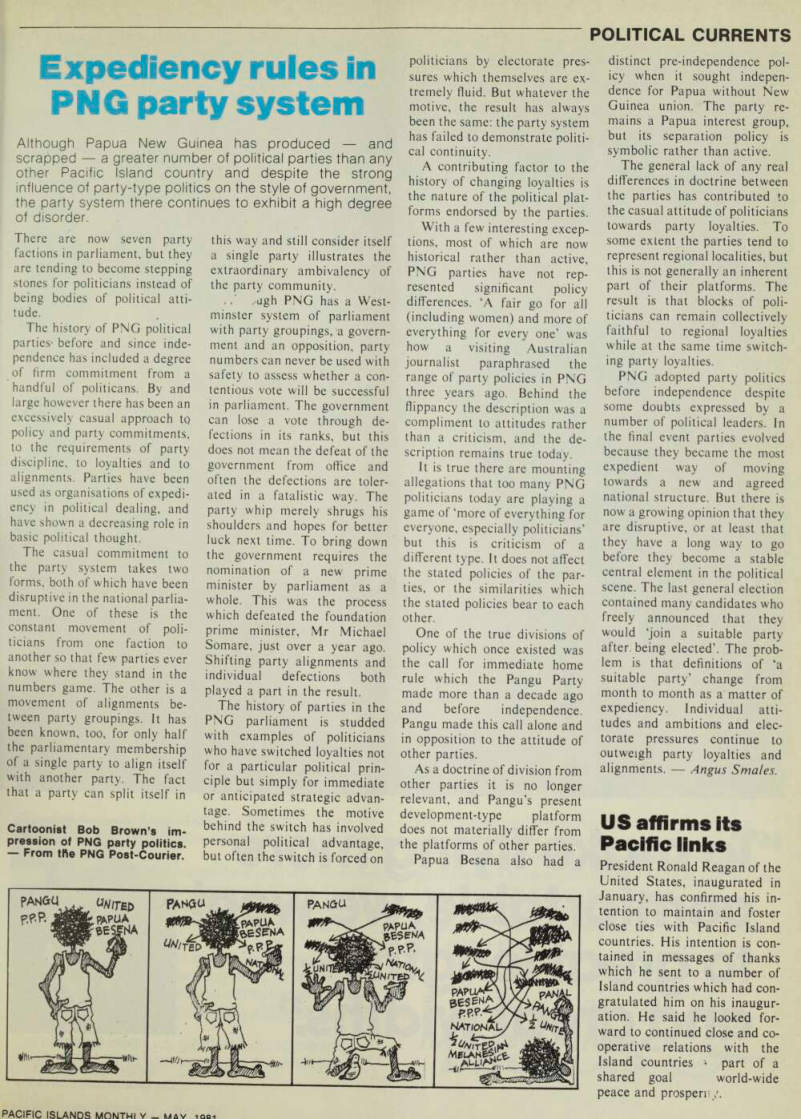
Cartoonist Bob Brown’s im pression of PNG party politics.
From the PNG Post-Courier.