concerns PNG
pp. 31-33 · Read in the full issue

Political
Currents
Rebel arms plot concerns PNG
One of the most sensitive issues in Papua New Guinea home and foreign affairs, the anti-Indonesian rebel movement in adjoining Irian Jaya, has been revived just when it seemed to be settling down. This report from Port Moresby tells of an apparently ham-fisted but potentially serious attempt to smuggle arms through PNG to the rebels.
Papua New Guinea police and security officials claimed in March to have discovered a plot to smuggle weapons from com munist sources to rebels in the Indonesian province of Irian Jaya. PNG was to be used as the transfer point for getting the weapons to the rebels, investi gators said. The investigations included the interception of a letter in the mails, police raids on two houses, and the seizing of a number of documents from the houses.
Irian Jaya, once known as West New Guinea, shares a land border with PNG. It con tains rebel cells of the Free Papua Movement (OPM) which opposes Indonesian sov ereignty in Irian Jaya and is calling for independence.
Because of ethnic links the OPM looks to Papua New Guineans for support, but the PNG government recognises Irian Jaya as part of Indonesia and supports the Indonesian attitude of outlawing the rebels.
PNG has given permissive resi dence to some Irianese who have been able to establish refugee status under inter national protocol, but has banned them from any involve ment in rebel politics. The
recent investigations suggest
however that some of the Irianese living in PNG have
broken their undertaking and
lave been giving secret support :o the rebels across the border.
The investigation started ifter security officials in PNG :ame into possession of a letter vhich had been mailed from 3 NG to Turkey. It had alleg edly been sent to a Russian contact in Turkey but had been eturned to PNG through postal channels after being indelivered.
The letter said ‘with the issistance of communist countries the imperialist dog
Indonesia can be driven out of Irian Jaya’.
The secretary of the prime minister’s department, Mr F.
Reiher, who is also chairman of the national security advisory committee, said the government took a serious view of what had been disclosed. ‘We are not treating this merely as a hoax’ he said.
As a result of information contained in the letter police raided two houses occupied by Irianese, one in Port Moresby and the other in Madang. They took possession of documents and other letters. There was no immediate decision on the nature of any prosecutions which might follow the police action.
There have been two develop ments since the prime minis ter’s office confirmed that it was taking a serious view of OPM activity involving PNG.
In the first development the PNG foreign minister, Mr Noel Levi, played down the significance of the documents which had been seized. ‘There is not enough evidence at this stage we only have a few letters' he said.
In the other development one of the Irianese whose homes were raided confirmed that the OPM was seeking arms from Russia and from Cuba also but he strongly denied that there was any intention to involve PNG as a smuggling point. The statement came from Mr Henk Joku of Port Moresby who said the suggestion that PNG would be involved was ‘humiliating’. The decision to seek arms had been made outside PNG and the intention was that the arms should be landed directly in Irian Jaya.
PNG and its sovereignty were not involved, he said.
Members of the OPM have long carried out military-type
drill in camps which they have established in isolated parts of Irian Jaya. However they have had few rifles and their drill exercises have involved carry ing sticks on their shoulders like rifles. The number of active rebels is believed to have dwindled considerably in the past three years. There have been occasional reports of rebel patrol attacks on Indonesian military outposts. On these oc casions most of the rebels were reported to have been armed with bows, arrows and spears, although a few were said to have old rifles and shotguns.
Indonesian officials deny that there has been any rebel ac tivity since 1978 when one of the key men in the OPM, Jacob Prai, crossed illegally into PNG and was captured by PNG police. Prai served a gaol term in Port Moresby for being a prohibited migrant and was able to establish refugee status.
PNG however refused to give him permissive residence be cause of the sensitivity of re lations with Indonesia and he was eventually granted permiss ive residence in Sweden where
he still lives.
Michael Praia
in Port Moresby.
W. Samoa move
for parties
‘I have washed my hands of the two existing parties in parlia ment that is the government and the opposition like Pilate who washed his hands to prove himself innocent of Christ’s blood.’ A Western Samoan member of parliament, Mapuilesua Pelenato, used this Bible-based imagery when he announced plans in February for the formation of a new political party. No name has yet been give to the proposed party, but its name will be announced when the expected formal in auguration is carried out in May.
At present Western Samoa has only one formally constituted political party, the Human Rights Protection Parly, which unofficially sees itself as the opposition in parlia ment. The constitution does not provide for a formal opposition, and all members of parliament are technically independents.
The emergence of the Human Rights Party led to the creation of a loosely-allied group in
government known simply as ‘the government party’.
Mapuilesua’s newly-planned party will attempt to gain office at the next general election in 1982, but it could move for power earlier. The parliament has 47 members, and Mapuilesua claims to have 11 supporters already from the present membership of parlia ment.
The Samoa Weekly quoted him as saying The main aim of this new party is to change the government so that righteous ness and lawful judgment are carried out for the benefit of everyone. We will fight the people’s rights.’
Mapuilesua was elected to parliament only last year at a by-election for a seal in Savaii.
He cut short a visit to USA to stand for election and ostensibly was a strong supporter of the Prime Minister, Tupuola Efi.
Western Samoa has been independent since 1962 and its constitution makes no provision for political parties. This was a deliberate move on the basis that party politics could be nationally disruptive. It was a direct contrast to the manner in which some other Pacific Island countries planned their political independence. Papua New Guinea, for instance, delib erately fostered political parties in the belief that this was the most effective manner to de velop an active nationalism. It was not until the elections of 1979 that the first party-type groupings emerged in Western Samoa when the veteran poli tician Vaai Kolone led a dissent ing group away from Tupuola Efi. The new party became the Human Rights Protection Party and made a bid for government, but Tupuola Efi defeated Vaai Kolone by one vote for the position of prime minister.
Mapuilesua claims that in the immediate future his planned party will not ally itself with either of the two existing group ings but will take its own stand
on individual issues ‘in the interests of the people’.
Its specific policies are not yet clear and there are no indications of the names of the 11 members of parliament who are said to have given their support. If the inaugural meet ing in May is a success, how ever, some observers believe that the party might test its strength by making a direct challenge to the present parlia mentary leadership of Tupuola
Efi.
William Sharpe-Dunn.
Union calls of
Guam strike
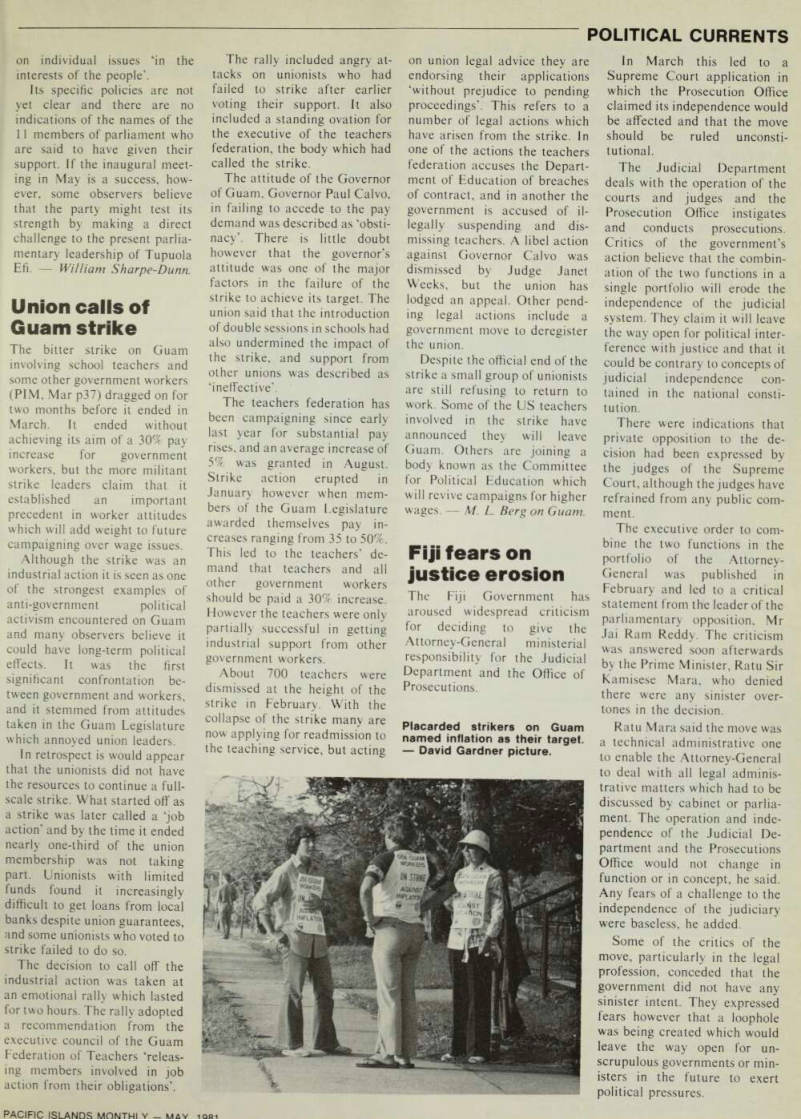
The bitter strike on Guam involving school teachers and some other government workers (PIM, Mar p 37) dragged on for two months before it ended in March. It ended without achieving its aim of a 30% pay increase for government workers, but the more militant strike leaders claim that it established an important precedent in worker attitudes which will add weight to future campaigning over wage issues.
Although the strike was an industrial action it is seen as one of the strongest examples of anti-government political activism encountered on Guam and many observers believe it could have long-term political effects. It was the first significant confrontation be tween government and workers, and it stemmed from attitudes taken in the Guam Legislature which annoyed union leaders.
In retrospect is would appear that the unionists did not have the resources to continue a full scale strike. What started off as a strike was later called a ‘job action’ and by the time it ended nearly one-third of the union membership was not taking part. Unionists with limited funds found it increasingly difficult to get loans from local banks despite union guarantees, and some unionists who voted to strike failed to do so.
The decision to call off the industrial action was taken at an emotional rally which lasted for two hours. The rally adopted a recommendation from the executive council of the Guam Federation of Teachers ‘releas ing members involved in job action from their obligations’.
The rally included angry at tacks on unionists who had failed to strike after earlier voting their support. It also included a standing ovation for the executive of the teachers federation, the body which had called the strike.
The attitude of the Governor of Guam, Governor Paul Calvo, in failing to accede to the pay demand was described as ‘obsti nacy’. There is little doubt however that the governor’s attitude was one of the major factors in the failure of the strike to achieve its target. The union said that the introduction of double sessions in schools had also undermined the impact of the strike, and support from other unions was described as ‘ineffective’.
The teachers federation has been campaigning since early last year for substantial pay rises, and an average increase of 5% was granted in August.
Strike action erupted in January however when mem bers of the Guam Legislature awarded themselves pay in creases ranging from 35 to 50%.
This led to the teachers’ de mand that teachers and all other government workers should be paid a 30% increase.
However the teachers were only partially successful in getting industrial support from other government workers.
About 700 teachers were dismissed at the height of the strike in February. With the collapse of the strike many are now applying for readmission to the teaching service, but acting
on union legal advice they are endorsing their applications ‘without prejudice to pending proceedings’. This refers to a number of legal actions which have arisen from the strike. In one of the actions the teachers federation accuses the Depart ment of Education of breaches of contract, and in another the government is accused of il legally suspending and dis missing teachers. A libel action against Governor Calvo was dismissed by Judge Janet Weeks, but the union has lodged an appeal. Other pend ing legal actions include a government move to deregister the union.
Despite the official end of the strike a small group of unionists are still refusing to return to work. Some of the US teachers involved in the strike have announced they will leave Guam. Others are joining a body known as the Committee for Political Education which will revive campaigns for higher
wages.
M. L Berg on Guam.
Fiji fears on
justice erosion
The Fiji Government has aroused widespread criticism for deciding to give the Attorney-General ministerial responsibility for the Judicial Department and the Office of Prosecutions.
In March this led to a Supreme Court application in which the Prosecution Office claimed its independence would be affected and that the move should be ruled unconsti tutional.
The Judicial Department deals with the operation of the courts and judges and the Prosecution Office instigates and conducts prosecutions.
Critics of the government’s action believe that the combin ation of the two functions in a single portfolio will erode the independence of the judicial system. They claim it will leave the way open for political inter ference with justice and that it could be contrary to concepts of judicial independence con tained in the national consti tution.
There were indications that private opposition to the de cision had been expressed by the judges of the Supreme Court, although the judges have refrained from any public com ment.
The executive order to com bine the two functions in the portfolio of the Attorney- General was published in February and led to a critical statement from the leader of the parliamentary opposition, Mr Jai Ram Reddy. The criticism was answered soon afterwards by the Prime Minister, Ratu Sir Kamisese Mara, who denied there were any sinister over tones in the decision.
Ratu Mara said the move was a technical administrative one to enable the Attorney-General to deal with all legal adminis trative matters which had to be discussed by cabinet or parlia ment. The operation and inde pendence of the Judicial De partment and the Prosecutions Office would not change in function or in concept, he said.
Any fears of a challenge to the independence of the judiciary were baseless, he added.
Some of the critics of the move, particularly in the legal profession, conceded that the government did not have any sinister intent. They expressed fears however that a loophole was being created which would leave the way open for un scrupulous governments or min isters in the future to exert political pressures.
Placarded strikers on Guam named inflation as their target. - David Gardner picture.