Wollongong
pp. 25-29 · Read in the full issue


Tropicalities
Pukapukans at home in Wollongong
Word about good earnings available in the steelworks soon reached the people on the lonely island, where average income may total $2OO a year mostly from copra. So in 1980 Metara Phillip and his wife Porora set out for Australia, bringing their two-year-old daughter Okera.
Metara soon found a good job in the steel industry, and the family settled down happily.
They were soon followed by 67year-old Torea Manea, Anita’s uncle. Torea had never left the atoll during his life as a fisherman and copra worker. He decided it was time to travel and see the world. With him came Tipora Uatai, a lovely young woman in her early 20s, bringing her two-year-old daughter from a broken mar riage. And before long they were followed by Nakui Yalau and Makea Matau’s youngest daughter Emma.
Astute Pukapukans in Auck land soon became aware of the Australia-New Zealand Trans- Tasman agreement, and, as New Zealanders, they knew they could travel freely to Australia. So Pukapukan Ruria Junior and his wife also came to Wollongong during this period, and Ruria too got work in the steel industry. Four or five other Pukapukans came in 1980, bringing the community’s num ber to near two-dozen.
All the Pukapukans have decided to become Australians.
They have adapted readily to their new life. Metera, Nakui, and the other younger men play rugby for Wollongong Techni cal College and enjoy trips all over New South Wales. The older men fish and gather shell fish on the coast just as they did back home. The women enjoy housework, shopping, sewing and crocheting, and on rugby weekends the whole com munity turns out to cheer their
Wollongong, Australia, is a rather unexpected place to find a thriving colony of some 20 Cook Islanders from the re mote, far-flung atoll of Puka puka, also known as Danger Island, which lies 1220 km northwest of Rarotonga. But, roving to new places is in keep ing with the character of Polynesians, and the people of Pukapuka are among the purest remaining members of this sea faring race. Their superbly con structed nine to 11m long sennit-fastened ocean-going canoes may still be seen, resting under palm thatches on the shores of their lovely island.
The Wollongong colony started in the mid-1960s when Urutapu, the attractive daugh ter of Matau Makea, Puka puka’s best known fisherman, departed for New Zealand on the monthly supply ship Moana Roa. She met her Australian husband from Wollongong in Auckland, and together they returned t€ the New South Wales steel town where they settled.
Urutapu, more commonly
known as Anita away from her island, sent her family letters and money, and in 1978 Matau Makea and his wife Porora decided to visit their daughter.
They flew to Wollongong, bring ing their five-year-old adopted son. They soon found that the climate and wonders of Aust ralia suited them, and decided to stay. The word soon reached the large Pukapukan com munity in Auckland, and in 1979 a young Pukapukan, Nooangatau, met and married an Australian girl. They de cided to come to Australia and Nooangatau logically decided to settle near his countrymen.
He took up work in the local
steel industry.
boys.
W. H. Hambuechen.
• For a glimpse of the Pukapukans at home, see Travel section
Saving the Haus
Tambarans
The Architecture and Survey ing Departments of the Papua New Guinea Institute of Tech nology, Lae, have embarked on an ambitious joint project to record the fast disappearing
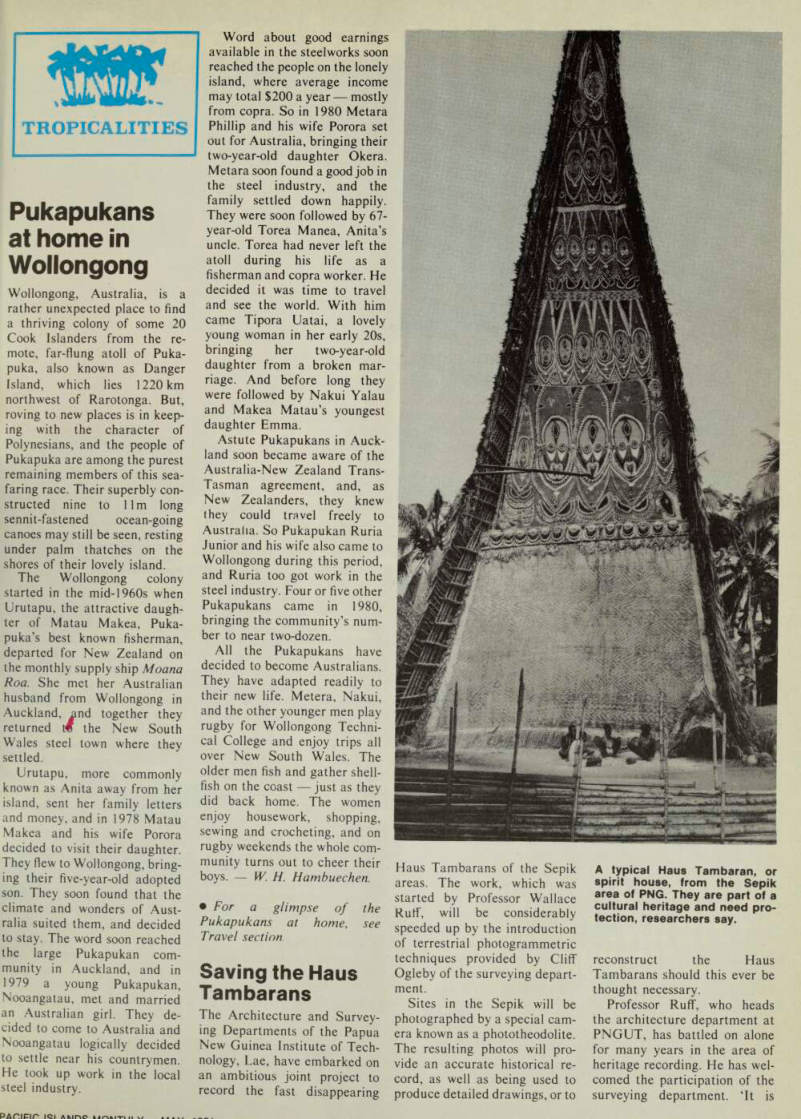
Haus Tambarans of the Sepik areas. The work, which was started by Professor Wallace Ruff, will be considerably speeded up by the introduction of terrestrial photogrammetric techniques provided by Cliff Ogleby of the surveying department.
Sites in the Sepik will be photographed by a special camera known as a phototheodolite.
The resulting photos will provide an accurate historical record, as well as being used to produce detailed drawings, or to
reconstruct the Haus Tambarans should this ever be thought necessary.
Professor Ruff, who heads the architecture department at PNGUT, has battled on alone for many years in the area of heritage recording. He has wel corned the participation of the surveying department. ‘lt is
A typical Haus Tambaran, or spirit house, from the Sepik area of PNG. They are part of a cultural heritage and need pro tection, researchers say.
gratifying to find someone else interested in this work,’ he told the PNGUT paper, The Re porter. ‘Members of the National Government, person nel from the Museum and the PNG Cultural Council, have all expressed keen interest in the programme of work we have laid out this year.’
Mr Ogleby, who is an archeologist, has amassed very considerable experience in ar chival recording in Australia photographing Aboriginal his toric and ceremonial sites in NSW and the Northern Terri tory. While he is in the PNGUT, Mr Ogleby will train a national technical officer.
Zebedee Sombo, in the tech niques of terrestrial photogram metry. ‘lt is essential that a national surveyor be adequately trained so that the work can be carried on after Professor Ruff and I have finished our respect ive contracts,’ he said. ‘The Haus Tambarans are deteriorating at an alarming rate and unless we can record them on a film from which measurements can be taken, a whole chapter of PNG’s heri tage will be lost forever,’ Mr
Ogleby added.
Mr Sombo has welcomed the chance to be trained by Pro fessor Ruff and Mr Ogleby. ‘They are two of the world’s leading figures in their fields,’ he said. ‘I am proud to have been given the opportunity to learn from them and to carry on the work of recording my people’s culture.’
Mr Sombo went on: ‘Fifty years from now, Papua New Guineans will say thank good ness someone had the foresight to record our culture so that generations of the future can link to the generations of the past.’
Both the architecture and surveying departments are busy seeking financial backing for the projects planned for 1981- 82. The best sites are always in the most remote areas, which always means costly and difficult access for the scientific recording instruments. Organis ations or individuals interested in financially participating in this work should contact Pro fessor Ruff of the Architecture Department, PNGUT, Lae, as soon as possible.
Taking tennis to
the Australs
Taking tennis to the Austral Islands of French Polynesia was the pleasant task of Maka’ala Yates and his Tahitian associ ate, the noted sportsman Nefi Tahei, on an assignment for the Peter Burwash International or ganisation late last year.
Maka’ala Yates at the time was the head tennis professional at the Maeva Beach Hotel in Papeete. He is also a veteran of the well-known Hawaii-Tahiti voyage of the Hawaiian double hull canoe Hokule’a in 1976.
His account of his tennis coach ing experience in the Australs follows: On the morning of our depar ture from Papeete, during a practice session with my travel ling partner, Nefi Tahei, we were given bad news. There seemed to be a slight weather problem in Tubuai and no chance of any tennis there that day. Our trip to Rurutu, how ever, was confirmed. We de cided to keep our part of the commitment and we began our two-man travelling tennis clinic to the Austral Islands. ‘Fasten your seat belts and no smoking, please, we are ap proaching the island of Tubuai,’ announced the stewardess, Tubuai, a small island with a population of about 1500, is dependent on farming as the main source of income. It is 670 km south of Papeete, a two hour trip by plane.
We were greeted at the airport by a large group of people who were anticipating the excitement of the visit of a travelling tennis clinic of pro
fessionals. Among the crowd was the administrator of Tubuai, who was to co-ordinate our activities. He is president of many of the island’s sporting groups.
We arrived on the island to find the weather was indeed bad, but in the afternoon the rain eased enough to allow us to think about tennis. So we set out to conquer the flooded courts, and, despite the weather, do what we came here to do teach tennis! The courts were so wet that if we didn’t move slowly we risked ending up on our backs. I guess it was out of curiosity that one by one the islanders started to come to the courts and listen and watch Nefi and myself demonstrate our tennis skills. Because of the weather we adjusted our teach ing to include ‘How to play in the rain’. ‘Tennis en petit’ is an excel lent way to establish your con tact area and gain a better understanding of ball control, we explained. Using this con cept, combined with their en thusiasm and eagerness, we played ‘mini-tennis’.
Each day thereafter brought more laughter, enjoyment, and a greater understanding of the game of tennis to the islanders of Tubuai.
Their excitement and willingness to learn made it hard for us to leave. They finally bade us farewell, presenting us with gifts and shell wreaths, pressing us to bring tennis back to them again.
Stepping off the plane in Rurutu made me feel as if I was back in Kona, Hawaii. It was not only because of the veg-
elation or the mountains, it was more the inner feeling of warmth coming from the people there. Rurutu, much like Tubuai, has a population of about 1500, and is south of Papeete by about 570 km. The cold weather that greeted us was unexpected, and became more evident as we made our way to the village of Moerai.
When we reached it, we found our accommodation very comfortable, and this made us forget the cold outside.
But we soon set out for the next village, Avera. By jeep, we passed many fields of neatly terraced taro, and lands of coffee and fruit farms. We went over a mountain, down a beach, and at last reached the tennis courts. They were built of harsh sand, coral and cement, and when we arrived, we were greeted by 32 anxious tennis players. Because of the setting sun and the cold south wind, we briefly went over basics and invited them back for the morn ing’s instruction.
Early next day, Nefi and I were surprised to be met by 128
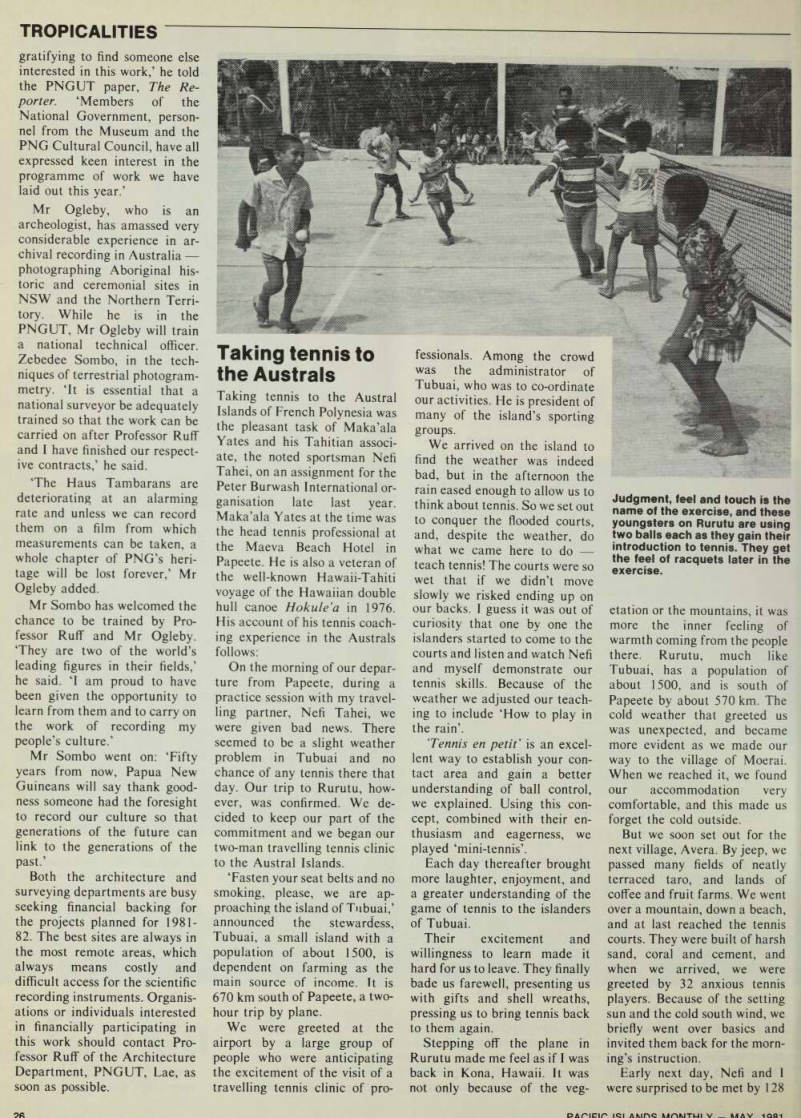
Judgment, feel and touch is the name of the exercise, and these youngsters on Rurutu are using two balls each as they gain their introduction to tennis. They get the feel of racquets later in the exercise.
enthusiasts, many of whom were lifting a tennis racquet for the first time in their lives.
Their progress in the clinics was amazing and enabled us to move quickly. Before the day was done they were playing doubles.
We began some team compe tition, having one team on either side of the net, encourag ing them to use all the skills they had learned during the earlier clinic. We had them playing a game that allowed two racquets per team. As the finals were about to be played, the shouting and laughter brought almost everyone from their homes and their work in the taro fields. The teams got more and more excited as they were allowed only one racquet now, which automatically brought out a more complete team effort. The day, with all of its excitement, seemed to end too quickly, but the players all left anxious for the next day’s instruction.
The next morning was filled with the energy and excitement of the young students. We introduced the ‘J.F.T.’ (Judg ment, Feel and Touch) drills concept. These drills allowed everyone to become quickly aware of their physical abilities relating to racquet and ball co ordination. By the end of the day the students were well able to direct the ball to specific parts of the tennis court.
As it came time for us to leave Rurutu, once again it was difficult for us to say goodbye to its friendly and caring people.
Two days spent in Tubuai and the three days on Rurutu al owed Nefi and me to share with ;hese people something of their vay of life. We certainly look orward to returning one day.
We left the Austral Islands md returned to Papeete. But we elt we had built an understand ng of the game of tennis and he way it relates to life and lappiness among people who md never had the chance to )lay and enjoy the game before. • The trip was sponsored by he Comite Territorial de la 'eunesse (CTJ) of French Poly nesia. It was co-ordinated by 'deques Teheiura, a territorial ndviser and member of the Municipal Council of Rurutu.
A bad deal for
card players
Hundreds of Papua New Guineans who have been gaoled or fined for gambling with cards in recent years may have been handed a wrong deal, if a legal irregularity is confirmed. The irregularity was detected by a legal officer for the Morobe Provincial Government, Miss Tracy Doherty. She was asked to appear on behalf of eight women who were being held in custody in Lae after they had been found playing cards.
The women were charged with gambling on ‘an illegal game’ but Miss Doherty found that cards had not been ga zetted among illegal games. She told a magistrate that although the women admitted playing cards, the prosecution would have to prove that playing cards was illegal. The police sought legal advice and then withdrew the charges.
The Morobe Premier, Mr Utula Samana, drew the atten tion of the national government to the situation, claiming that hundreds of people had been subjected to hardship, penalties and wrongful conviction under an apparently faulty process.
More honour to
RLS in Apia
Robert Louis Stevenson is to be honoured in a project under taken by the Congregational Church of Jesus.
The project, the Robert L.
Stevenson Cultural Centre, will be on two hectares owned by the church behind its Vailima school The first phase, to cost SWSIOO 000, will consist of a Stevenson museum, a small restaurant which will serve Samoan food to visitors, three arts and crafts buildings, two storage buildings, a malae (open ground) for the perform ance of Samoan music and dancing, an auditorium for cul tural performances, and a VIP fale.
Funds for the project will come initially from the church.
The rest it is hoped to raise from contributions by churches in the United States and other chari ties. Chairman of the project board is Aumua loane, MP.
Project director is William Pili Collins, an American with a background in marketing and business management.
Eventually it is hoped that a cable car will be installed to take visitors up Mt Vaea to see Stevenson’s tomb.
Big maths comp,
on again
Secondary schools in the Southwest Pacific in March received invitations for students to enter the 1981 Australian Mathematics Competition for the Wales awards.
The competition, which in 1980 attracted 155 000 entries, including 15 000 from countries in the Pacific outside Australia, is jointly sponsored by the Canberra College of Advanced Education, the Bank of New South Wales, and the Canberra Mathematical Association.
Special features of the com petition this year include • SA2O 000 in prize money; • 45% of entrants receive merit certificates; • Special Bank of New South Wales book awards to the best entrant from each participating school in the smaller Southwest Pacific countries; • Braille and large print ver sions of the competition papers for visually handicapped students; • French version of the com petition papers available for students from New Caledonia, Vanuatu and French Polynesia.
If a secondary school in the Southwest Pacific has not re ceived an invitation and wishes to have one, contact should be made with Mrs Sally Bakker, School of Information Sciences, Canberra CAE, PO Box 1, Belconnen, ACT, Australia, 2616.
A real champion
windsurfer
Unlike the Terrible Baron Arnaud de Rosnay, whose ‘honest cheating’ at windsurfing around French Polynesia has been amply covered in PIM, American windsurfer Bill Hyman can claim a genuine windsurfing record: in February he rode his board from Ameri can Samoa to Western Samoa
to become the first person ever to do so. His time was 10 hours 46 minutes. The distance: about 170 km.
The Apia newspaper The Observer reports that at Tam one February morning three men, including Hyman, left American Samoa to attempt to windsurf their way to Aleipata on the westernmost end of the Western Samoa island of Upolu.
A back-up vessel, with friends of the three men and a Pago newspaper reporter on board, trailed the men in order to provide rescue emergency services if required.
At about 5.45 in the after noon Hyman, who had sped off to a good lead at the start of the trip, became the only one to complete the crossing.
Tired and bruised, Hyman, who was met at the Satitoa wharf by a small group of onlookers and government officials from the immigration, customs and agriculture depart ments, was reported to be in good health and very much elated by his success.
After a brief rest in Apia, he returned to Pago.
Radio Australia
tops in Vila
About 80% of radios in the Port- Vila area of Vanuatu are now regularly tuned to Radio Aust ralia’s Neo-Melanesian service.
The estimate was given in the 48th annual report of the Aust ralian Broadcasting Com mission (ABC). Radio Aust ralia is the overseas section of the ABC.
The report said that during 1979-80 there was an increased number of Neo-Melanesian/ Bislama interviews, and an ac tive search for public affairs material from this region had resulted in increasing corre spondence in English and Bislama to Radio Australia.
Radio Australia broadcasts 75 minutes daily in Neo- Melanesian. It also broadcasts English 24 hours a day, Indonesian nine hours, Stan dard Chinese three hours, Cantonese and Japanese two hours each, Basic English 105 minutes, French 150 minutes and Thai and Vietnamese one hour each.