Old Levuka opens
p. 15 · Read in the full issue
a door to history
At Levuka, once the capital of Fiji, the Levuka Historical and Cultural Society has embarked on an ambitious programme to preserve the past. VICTOR CARELL, who is associated with the movement, writes here about the annual re-enactment of an important occasion and about the projects which are being undertaken today.
Just over 106 years ago Sir Hercules Robinson, then Governor of New South Wales, arrived on Ovalau Island at Levuka which was to become the first recognised capital of Fiji. There he accepted the deed of cession under which Ratu Seru Cakobau, Chief Ma’afu and 11 other leaders transferred sovereignty of their country to the British Crown an ar rangement which was to last for nearly a century.
Every year now the ceremony is re-enacted, and the story of ;he re-enactment captures the spirit of the past. This is the story of a modern re-enactment ceremony, but equally it is the story of the first ceremony.
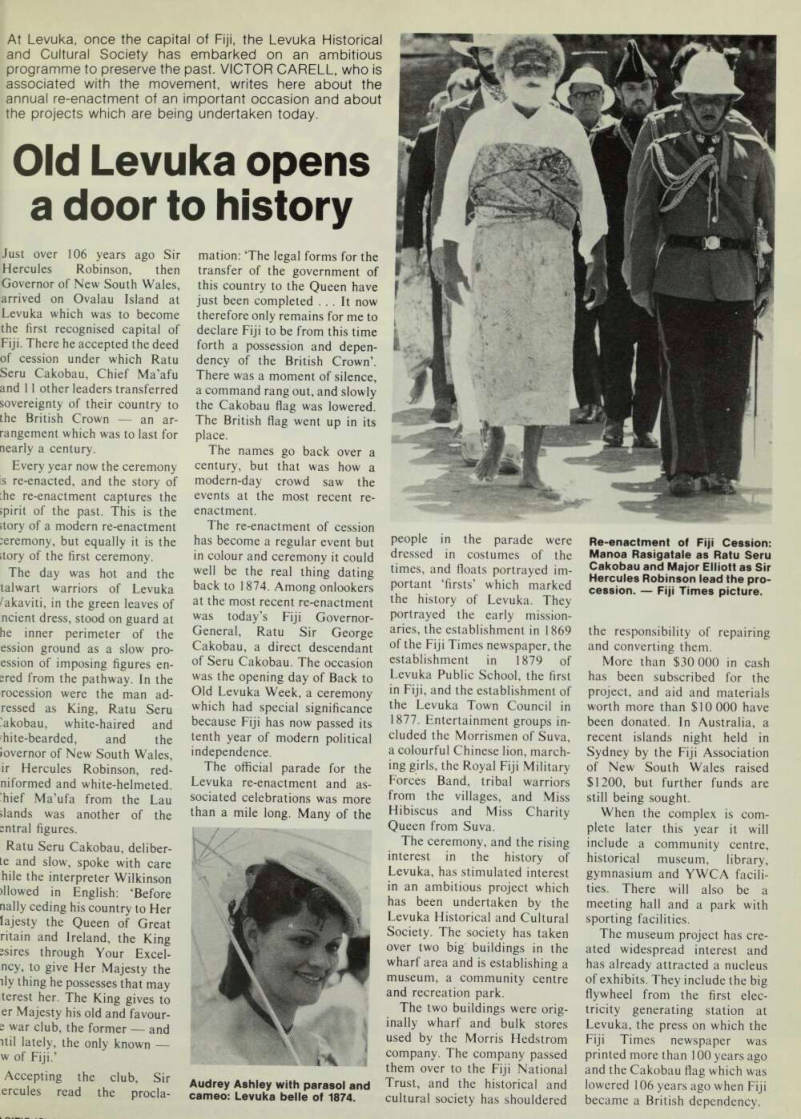
The day was hot and the talwart warriors of Levuka in the green leaves of ncient dress, stood on guard at he inner perimeter of the ession ground as a slow pro ession of imposing figures en ured from the pathway. In the recession were the man ad ressed as King, Ratu Seru 'akobau, white-haired and 'hite-bearded, and the iovernor of New South Wales, ir Hercules Robinson, red niformed and white-helmeted.
'hief Ma’ufa from the Lau slands was another of the antral figures.
Ratu Seru Cakobau, deliber te and slow, spoke with care hile the interpreter Wilkinson )llowed in English: ‘Before nally ceding his country to Her lajesty the Queen of Great ritain and Ireland, the King -sires through Your Excel ncy, to give Her Majesty the ily thing he possesses that may terest her. The King gives to er Majesty his old and favour “ war club, the former and itil lately, the only known w of Fiji.’
Accepting the club, Sir ercules read the procla
mation: The legal forms for the transfer of the government of this country to the Queen have just been completed ... It now therefore only remains for me to declare Fiji to be from this time forth a possession and depen dency of the British Crown’, There was a moment of silence, a command rang out, and slowly the Cakobau flag was lowered.
The British flag went up in its place.
The names go back over a century, but that was how a modern-day crowd saw the events at the most recent re enactment.
The re-enactment of cession has become a regular event but in colour and ceremony it could well be the real thing dating back to 1874. Among onlookers at the most recent re-enactment was today’s Fiji Governor- General, Ratu Sir George Cakobau, a direct descendant of Seru Cakobau. The occasion was the opening day of Back to Old Levuka Week, a ceremony which had special significance because Fiji has now passed its tenth year of modern political
independence.
The official parade for the Levuka re-enactment and as sociated celebrations was more than a mile long. Many of the
people in the parade were dressed in costumes of the times, and floats portrayed im portant ‘firsts’ which marked the history of Levuka. They portrayed the early mission aries, the establishment in 1869 of the Fiji Times newspaper, the establishment in 1879 of Levuka Public School, the first in Fiji, and the establishment of the Levuka Town Council in 1877. Entertainment groups in cluded the Morrismen of Suva, a colourful Chinese lion, march ing girls, the Royal Fiji Military Forces Band, tribal warriors from the villages, and Miss Hibiscus and Miss Charity Queen from Suva.
The ceremony, and the rising interest in the history of Levuka, has stimulated interest in an ambitious project which has been undertaken by the Levuka Historical and Cultural Society. The society has taken over two big buildings in the wharf area and is establishing a museum, a community centre and recreation park.
The two buildings were orig inally wharf and bulk stores used by the Morris Hedstrom company. The company passed them over to the Fiji National Trust, and the historical and cultural society has shouldered
the responsibility of repairing and converting them.
More than $3O 000 in cash has been subscribed for the project, and aid and materials worth more than $lO 000 have been donated. In Australia, a recent islands night held in Sydney by the Fiji Association of New South Wales raised $l2OO, but further funds are still being sought.
When the complex is com plete later this year it will include a community centre, historical museum, library, gymnasium and YWCA facili ties. There will also be a meeting hall and a park with sporting facilities.
The museum project has cre ated widespread interest and has already attracted a nucleus of exhibits. They include the big flywheel from the first elec tricity generating station at Levuka, the press on which the Fiji Times newspaper was printed more than 100 years ago and the Cakobau flag which was lowered 106 years ago when Fiji became a British dependency.
Audrey Ashley with parasol and cameo: Levuka belle of 1874.
Re-enactment of Fiji Cession: Manoa Rasigatale as Ratu Seru Cakobau and Major Elliott as Sir Hercules Robinson lead the pro
cession. - Fiji Times picture.