Presidential poll:
p. 17 · Read in the full issue
Caledonians look three ways
Dariel Tardieu's
Noumes
Notebook
Among those called upon to vote in the first round of the French presidential election on April 26 were the 300 000 inhabitants of the French speaking islands of the South Pacific, including the 140 000 New Caledonians or rather the approxi mately 69 000 of them whose names appear on the electoral rolls.
However, the final result of the contest will not be known until the evening of May 10, after completion of counting of votes in the second round. The second round will clearly be a race involving two contestants only Giscard d’Estaing, the incumbent president of the republic, and Francis Mitterand, the veteran leader of the French Left, who stands for the French Socialist Party in particular, but who also, in the second round, will represent all other opposition forces as well.
In New Caledonia, once again, the theme of indepen dence will be the backdrop to the election. But not for all electors many Melanesians, for example, retain a favourable attitude to President Giscard d’Esta ing, who in 1979 visited Noumea, the interior, and the Loyalty Islands (Lifou), where he was very well received.
In the most recent elec tion for the 36 members of New Caledonia’s Territorial Assembly (June 1979), the five parties supporting inde pendence of the territory gained 17 243 votes votes which one may assume went to the candidate of the French Left in the April 26 polling, and will go his way again in the decisive vote of May 10. The pro-French parties collected 29 062
votes in the June 1979 Terri torial Assembly elections.
In the same elections in 1977 independence sup porters got 20 664 votes. In 1978, in the voting to choose the two deputies to repre sent New Caledonia in the National Assembly in Paris, independence supporters re ceived 21 359 votes. It re mains to be seen whether the trend to reduced support for this current of Caledonian opinion will be affirmed once again in the May 10 voting.
At present the most ‘French’ party, the RPCR (Rassemblement pour la Caledonie dans la Republique) is inclined to support Jacques Chirac, the mayor of Paris, in the presi
dential race. The centrist parties led by Senator Lionel Cherrier favour Giscard d Estaing, and the Union Caledonienne of Deputy Roch Pidjot has declared itself in favour of Francis Mitterand who, in Mr Pidjot’s view, is of all the candidates the most likely to look favourably on the idea of an independent New Caledonia.
Caledonian voters are the first to make their views known in elections, given that the time of day (or night) in the territory is 10 hours ahead of Paris.
Death of Emile
Mercier
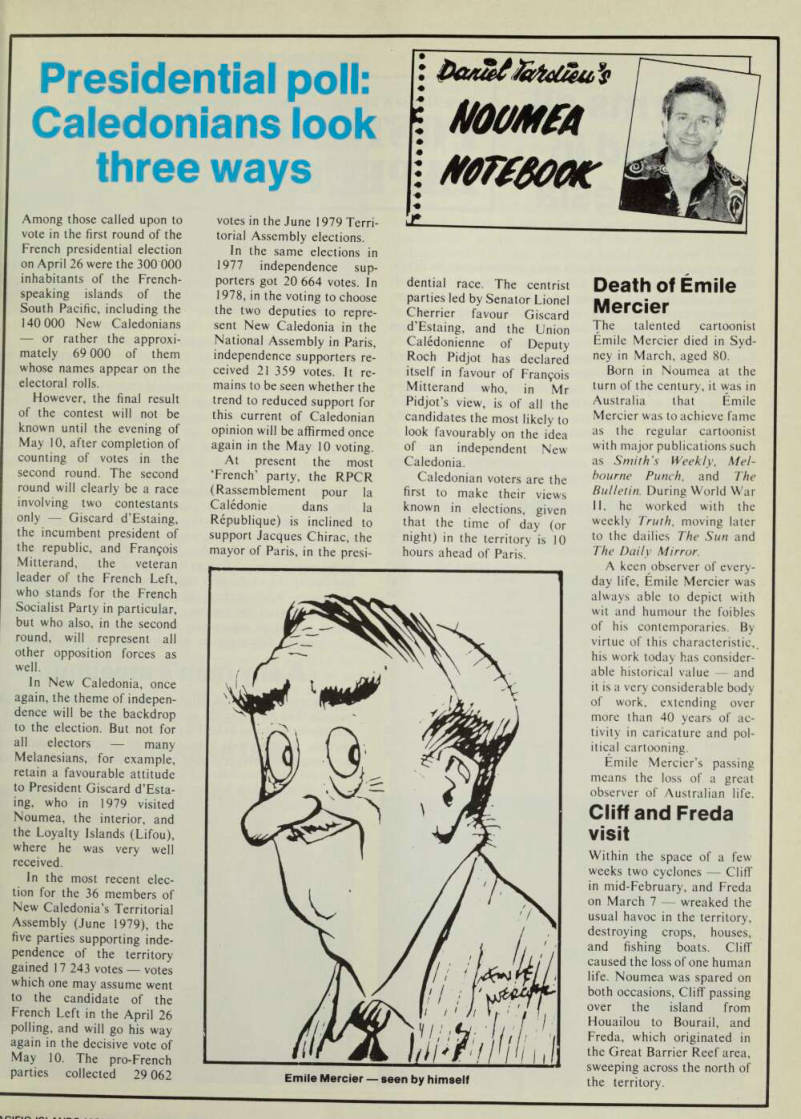
The talented cartoonist Emile Mercier died in Syd ney in March, aged 80.
Born in Noumea at the turn of the century, it was in Australia that Emile Mercier was to achieve fame as the regular cartoonist with major publications such as Smith’s Weekly. Mel bourne Punch, and The Bulletin. During World War 11, he worked with the weekly Truth, moving later to the dailies The Sun and The Daily Mirror.
A keen observer of every day life, Emile Mercier was always able to depict with wit and humour the foibles of his contemporaries. By virtue of this characteristic,, his work today has consider able historical value and it is a very considerable body of work, extending over more than 40 years of ac tivity in caricature and pol itical cartooning.
Emile Mercier’s passing means the loss of a great observer of Australian life.
Cliff and Freda
visit
Within the space of a few weeks two cyclones Cliff in mid-February, and Freda on March 7 wreaked the usual havoc in the territory, destroying crops, houses, and fishing boats. Cliff caused the loss of one human life. Noumea was spared on both occasions, Cliff passing over the island from Houailou to Bourail, and Freda, which originated in the Great Barrier Reef area, sweeping across the north of
the territory.
Emile Mercier - seen by himself