Coconut charcoal
p. 14 · Read in the full issue
could fuel ships
Writing from Papua New Guinea, DENNIS RICHARDSON* looks at a fascinating aspect of the fuel and energy scene: the possibility of making charcoal from coconut palm wood and using the charcoal as a fuel or fuel additive in coastal motor ships, or in a new breed of coastal steam ships.
One of the heaviest costs facing countries with isolated coast lines and numerous islands is the operation of vital inter island and coastal shipping ser vices. This is a typical Pacific Islands situation, and today the costs are rising steeply as the price of petroleum-based fuel increases.
The South Pacific Agricul tural Survey (SPAS) sponsored by the Asian Development Bank (ADB) and published earlier this year identified the high cost of inter-island ship ping as a major constraint to economic development through agriculture. The east-west spread of the islands of Kiribati, for example, extends over 3000 km. The cost of maintaining a regular transport system for people and commodities is pro hibitive for such a country with a population of only 50,000, and with export earnings projected at SUS 3 million a year by 1982.
Similarly, the 2100 islands which until recently made up the US Trust Territory of the Pacific Islands support a total population of 100,000 and ex tend over millions of square kilometres. Even Fiji and Papua New Guinea, which many tour ists think of as single islands, have, in fact, respectively 320 and over 800 islands to be serviced by production from populations totalling 0.5 million and 3.5 million. Except for the mineral-exploiting countries (Nauru and New Caledonia) there is no way that the Pacific Islands have been able to ac commodate increased costs of transportation stemming from the OPEC-controlled oil price
rises begun in 1973, and they cannot see their way to doing so in future.
The cost of Arabian light crude oil has risen from SUS2.6B a barrel in 1973 to a current price approaching $4l a barrel, but the price of copra (the principal export earner of most of the Islands) has not risen at all over the same period.
Copra prices have fluctuated wildly from year to year and from month to month. The other major Island export, fish, has increased in price by over 100% but the Islanders are only incidental beneficiaries of this resource.
There have been several studies of island shipping prob lems but they do not address the major issue of hard currency cost reduction, other than through suggestions for the elimination of services or the expensive modernisation of vessels.
In a forest economy profile for Kiribati prepared by ADB in 1979, the suggestion was made for a feasibility study of charcoal-powered inter-island shipping, which echoed a con tention made in the bank’s forestry sector paper issued in 1978. It is repeated in the forestry section of SPAS and is of some significance in the light
of current programmes to re place old coconut palms by higher-yielding varieties. Most copra producers are committed to coconut replacement pro grammes and, if the pro grammes are implemented, large quantities of stems will have to be utilised or destroyed.
The stems cannot be left to rot because of the risk of infes tation by the rhinoceros beetle which breeds in the old stems but attacks the newly planted nuts.
While many of the Islands have much to teach the rest of us about coconut stem utilis ation, it is unlikely that uses can be found for more than a fraction of the replaced stems.
As fuelwood, coconut leaves much to be desired (it has a high moisture content, and is bulky) but in the form of charcoal it has a high thermal efficiency. Thus, even the coral atolls which have no wood resource could produce and store supplies of coconut stem charcoal until such time as they could establish conventional tree plantations to produce it.
The technology of production is simple and well known. Short billets are split and air-dried, and can be burned in simple kilns or even in 40-gallon drums.
The technology for using charcoal in ships is also avail able. There are at least three possible systems. The first is to pulverise charcoal and mix it with fuel oil for use in unmodified diesel engines. It can be mixed up to 20% by volume without any significant loss of engine efficiency. The second method is to use it to fire a steam engine, and thus use a
technology which is more highly developed than moon rocketry. The third is to gener ate producer gas, which will fire an ordinary internal combustion engine.
With all systems, the major technical problem is that the space required to store the charcoal in relation to cargo capacity is greater than that needed for oil or coal. This should not be an insuperable problem in the case of short inter-island hauls, with locally manufactured charcoal dumps on every island. On the longer hauls, bigger ships are in any event necessary and there may be a case for returning, if not to sail, to a combination of steam and sail such as was common in the 1850-1900 era.
The economics of charcoal fired shipping are not known and, in any event, the feasibility of the operation would vary with circumstance. A priori, however, a case can be made for its inclusion in any further studies of Pacific Island trans portation. In view of the SPAS suggestions, the ADB might be persuaded to finance such a study if requested by a member country. Alternatively, it could be an appropriate field for the South Pacific Commission or the South Pacific Bureau for Economic Cooperation. A feasi bility study of this nature could appropriately be carried out by the University of Technology in Papua New Guinea. The engin eering and forestry departments there have considerable exper tise in charcoal production and utilisation, and the university already operates a pilot pyrolig neous oil rig. If the economic feasibility matched the techni cal promise, a pilot-scale oper ation could be started using a producer-gas unit (several are available) or pulverised char, without significant modification of existing engines.
If the use of coconut stem charcoal develops, there could be some spin-off from the sub sequent production in the islands of coconut shell char coal. Coconut shells produce a very high grade, pharmaceut ical charcoal, eminently suit able for activation. High value, low volume commodities such as this are ideal products for export from the islands.
* Professor Dennis Richardson, M.A., B.Sc., D. Phil., is head of the department of forestry in the faculty of natural resources at the Papua New Guinea University of Technology, Lae.
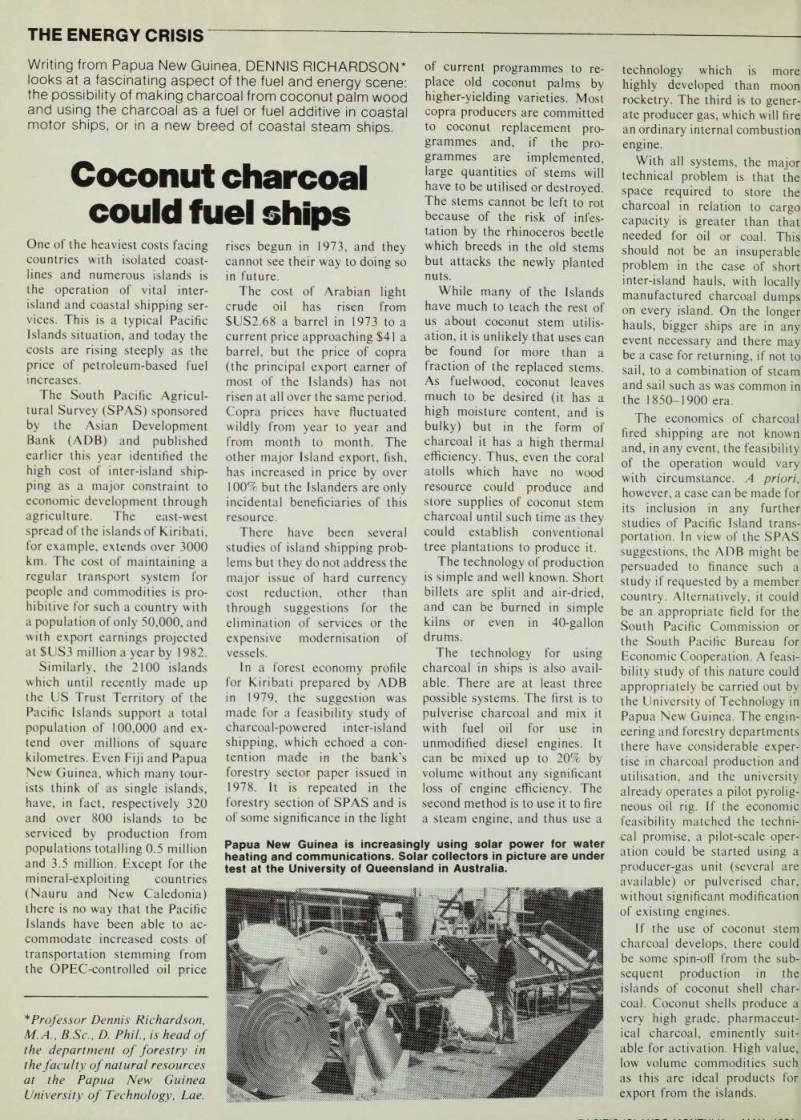
Papua New Guinea is increasingly using solar power for water heating and communications. Solar collectors in picture are under test at the University of Queensland in Australia.