Wood: The poor
p. 13 · Read in the full issue
The Energy Crisis
Wood: The poor man’s oil, if he can get it
Wood, where it can be found, is ‘the poor man’s oil’. It is used for cooking, heating and most house hold chores.
But wood is rapidly disappear ing as world forests are destroyed for fuel, timber and agriculture.
In its study Global 2000 the US Government estimated that if current trends continue, 40% of the remaining forests in develop ing countries would be gone in 20 years. Soil erosion, rapid silting of water resources, desertification, flooding and loss of important plant and animal species are among the consequences of defor estation.
Coupled with the scarcity of wood is the inefficient manner in which it is now used where it can be found. In Asia, for example, much wood is burned wet, using valuable energy to drive off steam rather than supply cooking heal. And traditional
stoves burn wood inefficiently,
ising only 5% to 10% of the heat energy of combustion for actually soiling rice or cooking. Finally, he yield of wood particularly n the natural forests of Asia is extremely low.
The problems and solutions are
eomplex. Research and develop
ment are required in each of the developing countries where trees can be a primary source of heat, In addition, international research centres might be established simi lar to the International Rice Research Institute in Los Banos in the Philippines.
Reforestation is a necessity, of course. And high-yield, fast growing trees are one answer. But should, for example, the ecology of the tropical forests be altered by replacing indigenous species with high-yield trees? Which trees are best suited for particular soils, climate and topography? These are among the questions that research could answer, A variety of such trees have been discovered in recent years in different parts of the world, Among them is the ‘Hawaiian Giant’, or the Salvadoran variety of the green tropical legume, Leucaena Leucephala.
The Leucaena is especially well suited for humid and semi-humid lowland tropics. It is able to withstand long dry seasons and tolerate a wide array of soil conditions except that it does not grow well in very acid soils or at high altitudes. The stumps readily regrow, defying the wood
cutter. And the tree can tolerate moderate shade and does not excessively shadow lower plants.
Furthermore, the leaves are good fertiliser. It has been estimated that six bags of Leucaena leaves contain as much nitrogen as one bag of expensive ammonium sul phate fertiliser made from fossil fuels.
Philippine officials plan an energy plantation of several thou sand hectares of Leucaena for electrical power generation, and a Japanese steel company has planted over 5000 hectares of Leucaena as a source of smelling charcoal.
In Indonesia, Bangladesh and Sri Lanka, trees for fuelwood and livestock are grown together in family gardens with vegetables, fruits and spices. The plants have a complex three-dimensional ecol ogy. The tallest trees provide desirable partial shade for the lower trees and crops grown near the ground. Falling leaves fertilise the small plants.
In some areas, village ‘woodlots’ are being planted with fast-growing trees for fuel. How ever, because of pressures on food production to feed growing popu lations, it is essential to avoid diverting good cropland for that purpose, and to try instead to increase the yield of wood from forested areas that are not suit able for agriculture due to steep slopes, rocky or thin soil, or other reasons.
Improved cookstoves that burn
wood charcoal and other fuel and that can be used inside or out doors and are two to three times more efficient than traditional stoves have been developed in different parts of the world. If they were universally substituted for traditional stoves, they would reduce domestic energy use by 50%. But they have not been widely accepted. Research might reveal why this is so. One sugges tion is that some of these stoves were designed without the consul tation and advice from the people who use them the village women. In one African country, where women themselves de signed more efficient stoves, the stoves are being used.
The inefficient use of wood in cooking is an example of the universal problems of energy con version, which are as prevalent in developed countries as in the developing nations. But the prob lems are especially urgent in poor countries. Besides the combustion of wood, they include the conver sion of wood to charcoal, the heating (pyrolysis) of organic wastes to produce charcoal, gas and oil; the bacterial production of methane from human, animal and vegetable waste; the role of micro-organisms in converting nitrogen in the air to nitrogen usable by plants, and the con version of organic material to transportation fuel.
Charcoal is preferable to wood as a household fuel. It converts two to three times more energy to heat than wood; it creates less smoke, and it is easier to trans port.
Charcoal is made from peanut shells and sawmill wastes in Georgia in the United States, from rice husks and the wood of mangrove forests in Thailand and from coconut husks in Sri Lanka, to mention a few. Research and development are needed to adapt existing highly efficient charcoal kilns, which convert 50 to 60% of the heat energy from the feedstock into usable energy but operate on a large scale, to smaller kilns that can be used in villages or by households.
Indonesia has developed equip ment to convert rice hulls and straw to charcoal, oil and gas; efforts could be made to adapt this kind of equipment as well for use in villages throughout the developing world. Roger Revelle.
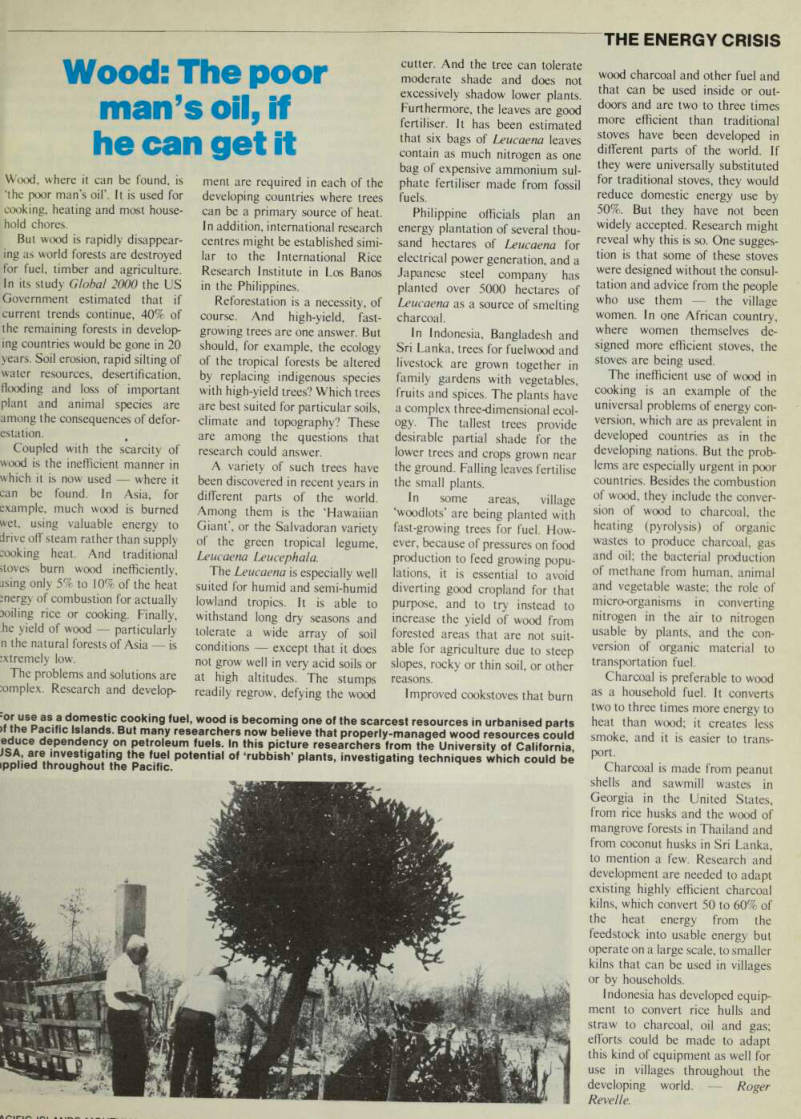
[?]or use as a domestic cooking fuel, wood is becoming one of the scarcest resources in urbanised parts of the Pacific Islands. But many researchers now believe that properly-managed wood resources could [?]educe dependency on petroleum fuels. In this picture researchers from the University of California, USA , are investigating the fule potential of 'rubbish' plants, investigating techniques which could be
[?]pplied throughout the Pacific.