of independence
p. 55 · Read in the full issue
Trade
Winds
French Polynesia
Businessmen run up flag of independence
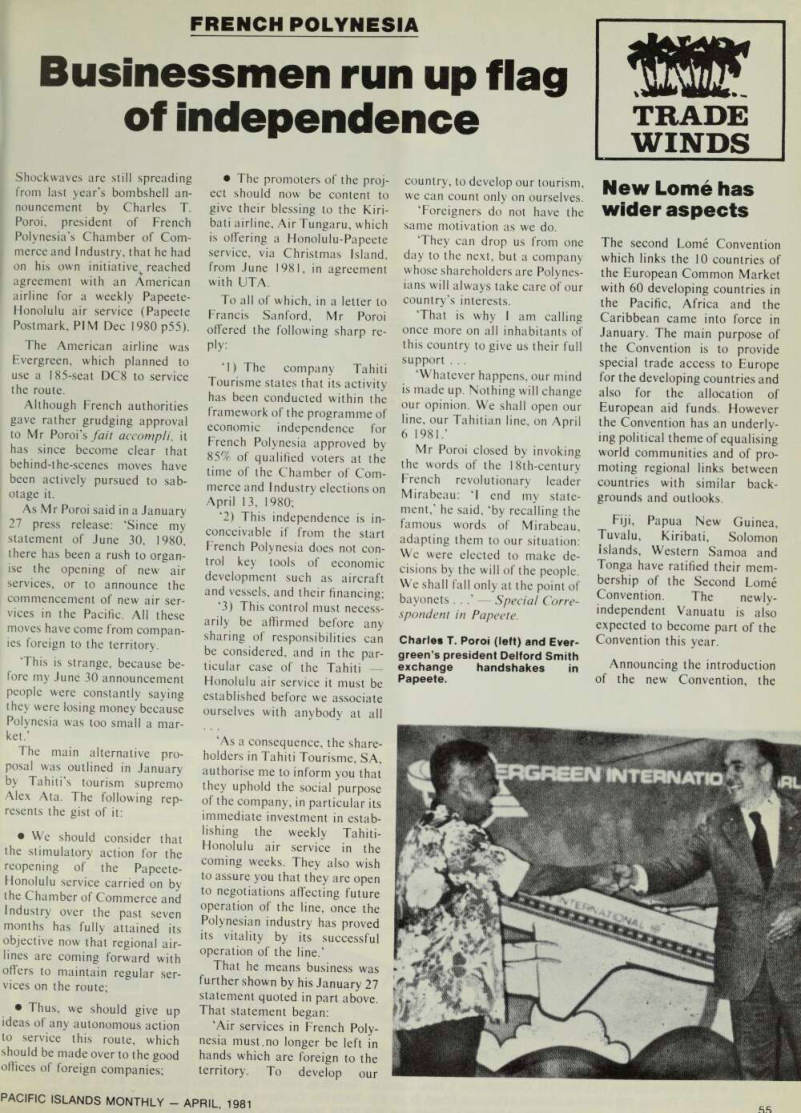
S Shockwaves are still spreading from last year’s bombshell an nouncement by Charles T. ; Poroi, president of French Polynesia’s Chamber of Com [ merce and Industry, that he had I on his own reached agreement with an American ! airline for a weekly Papeete- Honolulu air service (Papeete Postmark, PIM Dec 1980 p 55).
The American airline was Evergreen, which planned to use a 185-seat DCS to service the route.
Although French authorities gave rather grudging approval to Mr Poroi’s fait accompli, it has since become clear that behind-the-scenes moves have been actively pursued to sab- I otage it.
As Mr Poroi said in a January 27 press release: ‘Since my statement of June 30, 1980, there has been a rush to organ ise the opening of new air services, or to announce the commencement of new air ser vices in the Pacific. All these moves have come from compan ies foreign to the territory. ‘This is strange, because be fore my June 30 announcement people were constantly saying they were losing money because Polynesia was too small a mar ket.’
The main alternative pro posal was outlined in January by Tahiti’s tourism supremo Alex Ata. The following rep resents the gist of it: • We should consider that the stimulatory action for the reopening of the Papeete- Honolulu service carried on by the Chamber of Commerce and Industry over the past seven months has fully attained its objective now that regional air lines are coming forward with offers to maintain regular ser vices on the route; • Thus, we should give up ideas of any autonomous action to service this route, which should be made over to the good offices of foreign companies;
• The promoters of the proj ect should now be content to give their blessing to the Kiri bati airline, AirTungaru, which is offering a Honolulu-Papeete service, via Christmas Island, from June 1981, in agreement with UTA.
To all of which, in a letter to Francis Sanford, Mr Poroi offered the following sharp re ply: ‘1) The company Tahiti Tourisme states that its activity has been conducted within the framework of the programme of economic independence for French Polynesia approved by 85% of qualified voters at the time of the Chamber of Com merce and Industry elections on April 13, 1980; ‘2) This independence is in conceivable if from the start French Polynesia does not con trol key tools of economic development such as aircraft and vessels, and their financing; ‘3) This control must necess arily be affirmed before any sharing of responsibilities can be considered, and in the par ticular case of the Tahiti Honolulu air service it must be established before we associate ourselves with anybody at all ‘As a consequence, the share holders in Tahiti Tourisme, SA, authorise me to inform you that they uphold the social purpose of the company, in particular its immediate investment in estab lishing the weekly Tahiti- Honolulu air service in the coming weeks. They also wish to assure you that they are open to negotiations affecting future operation of the line, once the Polynesian industry has proved its vitality by its successful operation of the line.’
That he means business was further shown by his January 27 statement quoted in part above.
That statement began; ‘Air services in French Poly nesia must.no longer be left in hands which are foreign to the territory. To develop our
country, to develop our tourism, we can count only on ourselves. ‘Foreigners do not have the same motivation as we do.
They can drop us from one day to the next, but a company whose shareholders are Polynes ians will always take care of our country’s interests. ‘That is why I am calling once more on all inhabitants of this country to give us their full support . . . ‘Whatever happens, our mind is made up. Nothing will change our opinion. We shall open our line, our Tahitian line, on April 6 1981.' Mr Poroi closed by invoking the words of the 18th-century French revolutionary leader Mirabeau; ’I end my state ment,’ he said, ‘by recalling the famous words of Mirabeau, adapting them to our situation: We were elected to make de cisions by the will of the people.
We shall fall only at the point of
bayonets .. .’
Special Corre-
spondent in Papeete.
New Lome has
wider aspects
The second Lome Convention which links the 10 countries of the European Common Market with 60 developing countries in the Pacific, Africa and the Caribbean came into force in January. The main purpose of the Convention is to provide special trade access to Europe for the developing countries and also for the allocation of European aid funds. However the Convention has an underly ing political theme of equalising world communities and of pro moting regional links between countries with similar back grounds and outlooks.
Fiji, Papua New Guinea, Tuvalu, Kiribati, Solomon Islands, Western Samoa and Tonga have ratified their mem bership of the Second Lome Convention. The newly independent Vanuatu is also expected to become part of the Convention this year.
Announcing the introduction of the new Convention, the
Charles T. Poroi (left) and Ever green’s president Delford Smith exchange handshakes in Papeete.