The hidden injustice on the A’asu
pp. 47-53 · Read in the full issue

Yesterday
The hidden injustice on the A’asu massacre memorial plaque
JOSEPH THEROUX, after some heavy detective work, exposes a hidden injustice on the memorial plaque for French victims of the massacre of A’asu, in which 12 members of the explorer La Perouse’s expedition, and 39 Samoans, died at A’asu village on the island of Tutuila on December 11, 1787. American Mr Theroux’s research has been done on the spot in American Samoa, where he now lives.
In 1882, when Julien Vidal, a French priest and later the Bishop of Fiji, found the bones of the massacred French sailors of the ill-fated La Perouse expedition of 1787, he per formed a long-delayed funeral service. Two years later, a bronze plaque carrying the names of the slain crewmen arrived from the French Admir alty. A formal naval burial was held in the little cove at A’asu, on the north side of the island of Tutuila, where the massacre had taken place nearly a cen tury before a fitting ending
to that sad and mysterious event. But no one seemed to notice, or at least no one remarked on the fact, that there was a name missing on the plaque. One sailor’s name was not and is not on the monument.
Why was he left out?
La Perouse had written sev eral times in his narrative that there were 12 men murdered. ‘Messrs de Lamanon and de Langle were massacred with unexampled barbarity; as were Talin, the master-at-arms of the Boussole, and nine other per sons of the two crews.’ And yet the plaque, which you can see to this day in A’asu village, bears only II names. Who was num ber 121 The expedition was already
full of mystery before I came up with this problem. No one knows for sure, first of all, why the massacre happened. There are several possible expla nations, in addition to one La Perouse himself implied (though one wonders if he told the whole story) in his account.
And, after leaving Eastern Samoa and refitting in Sydney, his expedition simply disap peared. It was finally estabished that the two ships in La Perouse’s expedition, the Astro labe and the Bousolle, met their end in a “terrible hurri cane’’ off Vanikoro, Solomon Islands (PIM Feb 1965).
According to La Perouse, this is what happened on December 11, 1787, as they lay anchored off Fagasa Bay, not far from A’asu Bay; After several days of barter ing for pigs, fruits and fresh water, M de Langle, the second in-command, persuaded La Perouse to make another visit to shore with empty casks and those members of the crew who had symptoms of scurvy. A number of natives in canoes ringed the ship and continued to barter as two long boats and two barges under the command of de Langle made for the cove.
After filling the long boats with water casks for an hour and a half, de Langle made ready to return to the ships.
Meanwhile the number of natives swelled incredibly. ‘ln stead of two hundred persons, including women and children . . . there were ten or twelve hundred . . .’
And here his narrative be comes very vague, probably from trying to piece the story together later on from more than 40 excited sailors.
Even though there was no sign of trouble, de Langle told his men to hold their fire. Why he should think they would be likely to fire is not clear, though La Perouse says later that the
natives’ motive may have been ‘to search (the longboats) for our supposed wealth’.
Then, for apparently no reason at all, ‘stones flew about’.
De Langle withheld his order to fire ‘and the Indians (sic) .. . surrounded the boats within less than two yards . . . Presently a shower of stones, thrown from a very short distance . . . struck almost every person in the longboat. M de Langle had only time to discharge the two bar rels of his piece before he was knocked down; and . . . two hundred Indians instantly mass acred him with clubs and stones.’
Out of 61 sailors, 12 were killed, and 20 wounded. The 12 were left and the other 41 swam for the barges. Nearly everyone had been hit with stones; those who fell ‘on the side next the Indians were instantly dis patched with clubs’. On the side next the Indians? But hadn’t the ‘lndians’ (at least 1000 of them) surrounded the long boats?
The narrative continues: ‘. . . the ferocious Indians, after having killed them, sought to satiate their rage on their dead bodies, and continued to beat them with clubs . . . and at length the boats escaped from this den, more fearful from its treacherous situation and the cruelty of its inhabitants than the lair of a lion or tiger.’ La Perouse, a good Christian, re jected all ideas of revenge, though 39 Samoans died also.
And all this hostility unpro voked?
It’s highly unlikely. Early
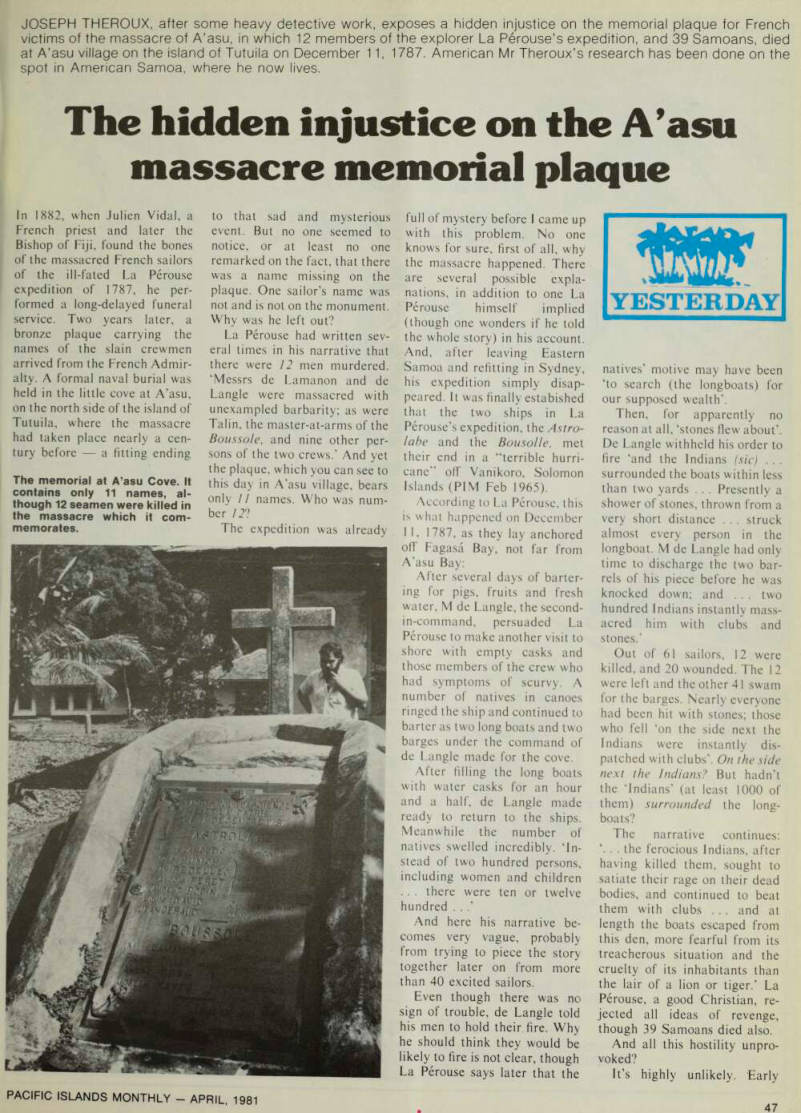
The memorial at A’asu Cove. It contains only 11 names, al though 12 seamen were killed in the massacre which it com memorates.
missionaries in Samoa made many inquiries and each came up with stories, mixtures of fact and fiction. The following seem the most likely; J.B. Stair, in Old Samoa, or Flotsam and Jetsam from the Pacific Ocean, 1897, said: ‘An eyewitness to the trouble said that the French, by way of punishment for some petty theft, hoisted a Samoan one of a visiting party from Falelatai in Upolu to the top of the mainmast of one of the long boats by his thumbs or hand. This apparently led to the attack.’ (Quoted in Rowe’s Samoa Under the Sailing Gods, 1930.) George Turner, in Samoa, A Hundred Years Ago and Long Before, 1884, said: ‘The origin of the quarrel was not with the party who went on shore in the boats. A native who was out at the ship was roughly dealt with, for some real or supposed case of pilfering. He was fired at and
mortally wounded, and when taken on shore bleeding and dying, his enraged friends roused all on the spot to seek instant revenge.’ (La Perouse does speak of a visiting troublemaker who was thrown overboard, but this was days before, and the Samoans seemed to feel this was just.) An early Marist priest, Father Padel, wrote: ‘One native told me that the Samoans wanted the uniforms of the mariners and the only way to get them was to take them off their dead bodies. Some of the Samoan men resented the fact that their sisters had freely given of their “favours” to the French sailors, but the girls maintained that they had been forced into it by the old women . . . There was a scuffle in which one young lady lost an eye, and this was the beginning of the hostilities.’ (Quoted in Bro.
Herman’s Massacre at A’asu, March, 1965.) Stair’s and Turner’s accounts sound plausible, though La Perouse does not mention any such events. It sounds like the problems Cook encountered with theft or, to put it more politely, the Polynesian notion of ownership and gamesplaying.
Cook handled the problem by
taking hostages until the stolen article was returned. This method worked well until he returned to Hawaii and tried the same thing with unfortunate results.
What probably happened to La Perouse was this: After the longboats left for shore, there was a case of theft on ship board. The native was severely punished and sent back to shore. On land, the native aroused his fellow islanders, who began stoning the long boats. La Perouse probably considered the first incident unimportant, neglected to write it down, and, finally, did not relate it to the massacre.
Stair’s mention of a visiting party ( malaga ) from Falelatai could account for some of those ‘ten or twelve hundred’ it’s the only way to account for them: the tiny village of A’asu could not support more than 200 people.
William Churchward, writ ing in My Consulate in Samoa, observed: ‘This, like many other massacres reported, if the truth were known would be found to have been more of an outrage of the Samoans than one commit ted by them. Anyhow, it is acknowledged that the quarrel began with the slaughter of a
native visiting the ship who had been detected in some slight act of theft by the French; but no statement has ever been made of the lives lost by the natives in return. They only carried out one of the first and best known laws of nature, not to say a scriptural injunction, and, to show that it was merely what they considered to be a just act of retaliation, the bodies, as is not the invariable custom amongst Pacific Islanders, were left unmutilated.’
He does not say who ‘ac knowledged’ that it all started with a killing. Certainly La Perouse did not.
Charles Wilkes wrote in his Narrative of the United States Exploring Expedition (1844): ‘. . . Of this conflict I ob tained the following particulars from the Rev Mr Murray, who had them from an old man, who was a witness of the affray. The latter is the only individual now alive in the settlement who was present when it occurred, and his testimony was corroborated by others who had heard it from those who witnessed the scene. ‘On the morning of the mass acre, the vessels stood in towards the land. At noon the boats went ashore, as recorded by La Perouse, and while on shore, a number of canoes be longing to the island of Upolu (to which Tuluila was at the time subject), went from the shore, and proceeded directly to the vessels. When these canoes were alongside, a young man in one of them laid his hand on an iron bolt in some part of the ships, with the intention, it is supposed, of stealing it. He was fired upon by the French. The ball passed through his shoulders, and mortally wounded him. The natives, on seeing the effect of the shot on one of their number, were greatly enraged, and immedi ately left the vessels, and hastened to the shore, where they found the boats that had gone to get water. On reaching them, they began the attack, which resulted in the massacre of M De Langle, and of those who were with him on shore . . .
How the carpenter’s son es caped is not known. He is said to be still living at a village on the eastern part of the island. There appears to be mention made of
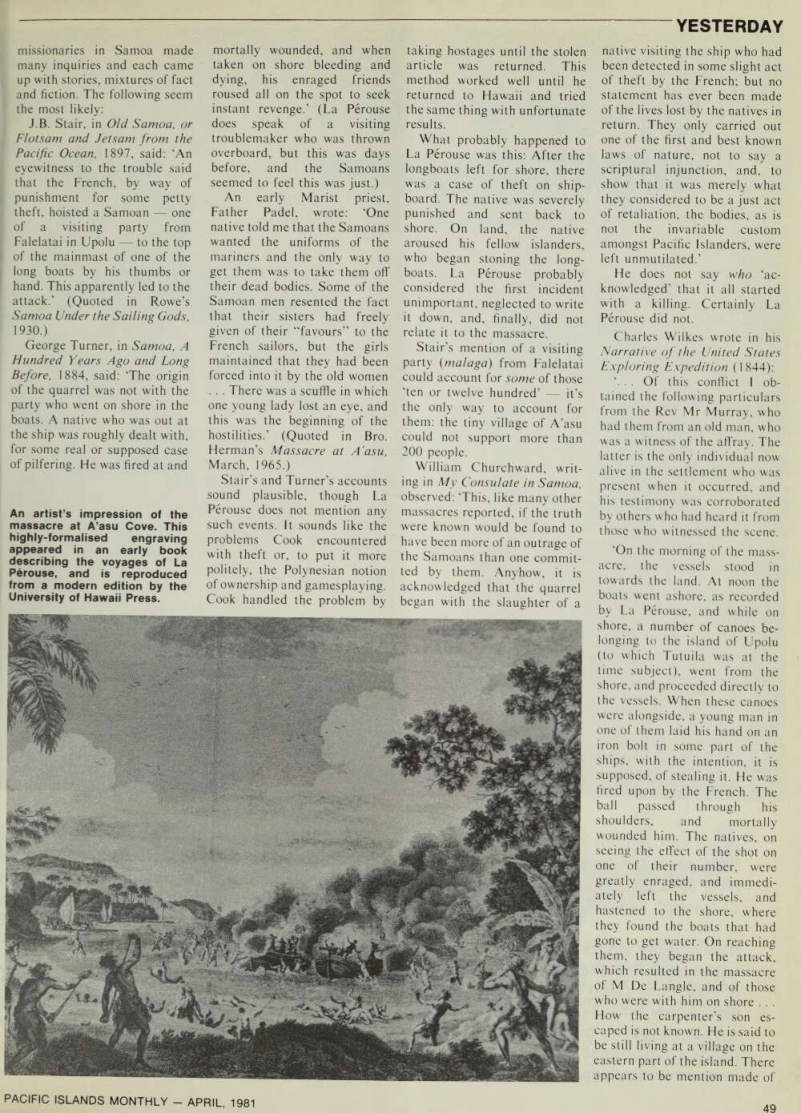
An artist’s impression of the massacre at A’asu Cove. This highly-formalised engraving appeared in an early book describing the voyages of La Perouse, and is reproduced from a modern edition by the University of Hawaii Press.
a boy among the missing, in La Perouse’s account.’
But this is all the mention that Wilkes makes of a missing boy. Another mystery. He does I agree that the Samoans in volved were from Falelatai and the Tutuilians gave the dead chiefly burials. And the murder may be that mentioned by Churchward.
Over the years more missionaries asked about it and got no clear answers. The Samoans in A’sau remained quiet about it. They buried the 12 in tapa cloths and told no one where.
In 1882, Fr Vidal decided to erect a chapel on what he believed the site to be. He had tried to discover the grave for years without any success. As Vidal dug the foundation near a stream, an 80-year-old man pointed out the grave-site he had learned of from his father.
He told Vidal: ‘we would not tell you before because, according to our traditions, exhuming the bodies of old enemies is equivalent to a declaration of war. You may go ahead, for we know that you only want to honour your dead.’ Digging
down, the priest found the bones.
Vidal wrote to the French Admiralty to tell them of his find. The Admiralty had a plaque made which says (see accompanying box); Only 1 1 names. I have come across no mention of this anomaly and yet it is nearly 100 years since the plaque was made, and 200 years since the (mutual) massacre.
After questioning several lo cal pundits, I was put in touch with the Rev Simon Bourke, SM, who has been in the Pacific since 1940. He is the Acting Secretary of the Episcopal Con ference of the Pacific and a kindly, brusque gentleman.
I explained my problem and he dug out a tattered, brittle transcript. The History of the Leone Station (parish) by Alexander Coupillaud. It was in French, but Fr Bourke trans lated as rapidly as if he were reading English. It recounted the massacre and the efforts of Er Vidal. Then he found what I was looking for. Evidently it was an early draft of what the plaque should look like. It was just like the words on the plaque, except for a longer heading, misspellings and the mention of an extra person (see accompanying box):
Can you read this? 4 Fr Bourkc pointed to one line. My French is shaky at best, but good enough to translate Un Chinois’ A Chinese!
A Chinese would never be missed on the plaque, the Ad miralty or the engraver must have thought. So they tele scoped the heading, changed the order of the names, correc ted the spellings and left out one man because he was only a Chinese and no job was listed for him.
Checking the 1807 edition of La Pcrouse’s A Voyage Round the World, volume 111, chapter XXIV, I found Un Chinois listed as a matelot, a sailor, or seaman. There is no other
reference to him. A check into the ship's log would probably yield nothing. He may still be referred to only as Un chinois..
I n a 1 799 edition of A Voyage .. . there is a map showing where the Boussole (Compass) and the Astrolabe (Quadrant) were anchored outside Fagasa Bay. A short distance down the coast. A'asu Bay is labelled ‘Assassins Bay’, which may refer to the Samoans or the French.
It's the old problem who were the savages? There was brutality on both sides, but it was the French who refused to honour one of their own slain men.
French navigator La Perouse, a picture from one of his own books published nearly 200 years ago.