Timber project
pp. 57-58 · Read in the full issue
European Economic Com munity committed itself to the support of the developing countries in the Pacific, Africa and the Caribbean. The EEC said that through the Conven tion it would continue to play a role in providing financial and technical resources which would not be a burden on future generations and which would not interfere with the sover eignty of the recipient countries.
The EEC said it appreciated that differing countries had differing approaches to how development should be im plemented, but this was recog nised in basic planning. A team of experts had already toured the Pacific area countries in volved and had drawn up lists of priorities on the basis of what the Pacific countries wanted.
Under the Lome Convention the developing countries have duty-free access to European markets for more than 99% of their exports. They also had the benefit of the scheme known as STABEX which was effectively an insurance system against
unexpected low returns from agricultural products. The STABEX scheme under the First Lome Convention was restricted to agricultural prod ucts, but under the new Conven tion the insurance is also ex tended to mining products.
The EEC also announced that it was preparing a pro gramme to increase its assist ance to Pacific regional tele communications and to the Pacific Forum Shipping Line.
In Fiji, EEC aid has mainly gone towards improving rural services, including roads, air strips and jetties. Other aid has gone towards hurricane recon struction and in interest subsidies for loans which are
developing hydro-electricity
projects.
In Western Samoa, EEC aid has also assisted hydro-electric development mainly the Samasoni scheme and has gone to small-scale rural ven tures and agricultural develop ment. The STABEX scheme has paid compensation for shortfalls in Western Samoa’s
copra, cocoa, timber and banana exports.
In Tonga, EEC funds have assisted the development of port facilities at Vava’u and have been used to purchase equipment for the Department of Works. Tonga has also received STABEX compensation for reduced returns from copra, bananas and vanilla.
In Tuvalu, the major proportion of EEC aid has been used for increasing the generaling capacity of electricity plants at Funafuti and for providing copra storage facilities.
STABEX funds in Tuvalu have covered shortfalls in the export of copra.
Timber project
for w. Samoa
A major timber project in Western Samoa is to be supported by a foreign aid grant from New Zealand and a low interest concessional loan from the Asian Development Bank.
The total funds from the two sources SUSI. 74 million from the Development Bank
and SUSI.2B million from New Zealand will be used for forest conservation, re-affore station, timber logging and mill ing.
The development bank loan will be over 40 years with no repayments for the first 10 years, no interest and a service charge of 1% a year. The loan and the grant will completely cover the foreign exchange costs of the project and part of the local currency costs, The project will be on Upolu and Savai’i Islands. Western Samoa estimates that when the project is fully established the re-afforestation areas will be capable of the continuous pro duction of timber valued at SUSI.S million a year on '“E'fs.™ „„ rorall on more than half of its land area, but a third of the forest land is on steep terrain where forests are considered protec live rather than productive, Announcing approval of the concessional loan, the develop ment bank said last month that most of the land was under
customary ownership and was being cleared in a random way by farmers moving from place to place. The bank’s announce ment continued: ‘Shifting cultivation and the growing demand for logs, sawn wood and fuelwood are deplet ing the country’s forest re sources, making an increasing amount of land marginally pro ductive, and endangering water catchment areas. The project will substantially contribute to improved land use by demon strating systematic timber ex traction and reforestation on margin land. It will also stimu late the conservation and man agement of forests in catchment areas to ensure adequate supplies of water for hydro electric generation. It will pro vide access roads and tracks, equipment, plant and mainten ance facilities, and appropriate overseas training for local for estry personnel. The annual output of sawn timber at full production will have a value of $1.5 million.’
The total cost of the project
will be SUS 4.7 million, with Western Samoa providing $1.76 million. In addition to the direct costs of re-afforestation and conservation the project will include road construction, logging and milling facilities and overseas training for West ern Samoans.
Cattle project
planned in PNG
Two major cattle-raising proj ects are to be established in Papua New Guinea with grants
and soft loans provided by the European Economic Com munity. The total EEC commit ment to the scheme is K 1.7 million, of which 71.5% will be in loans and 28.5% will be in
grants. The loan will be at only 1% annually with an initial 10year grace period and to be paid off within 40 years. PNG itself will also contribute to the estab lishment of the projects.
The cattle properties are to be established at Rigo on the south coast of the PNG main land not far from the PNG capital, Port Moresby, and at Bogia in the Madang Province in the north of the mainland.
The Rigo property will be on 10 000 hectares of grassland and the Bogia property on 2200 hectares. Between them they will run about 10 000 head.
The projects are to be shareholding ventures involving the traditional land owners and their families in the two areas.
The Rigo project will involve about 3500 shareholders and the Bogia project about 1500.
The shares will be allocated on the basis of capital subscribed and on the value of land made available. Many of the share holders and members of their families will also become wage earners from the projects.
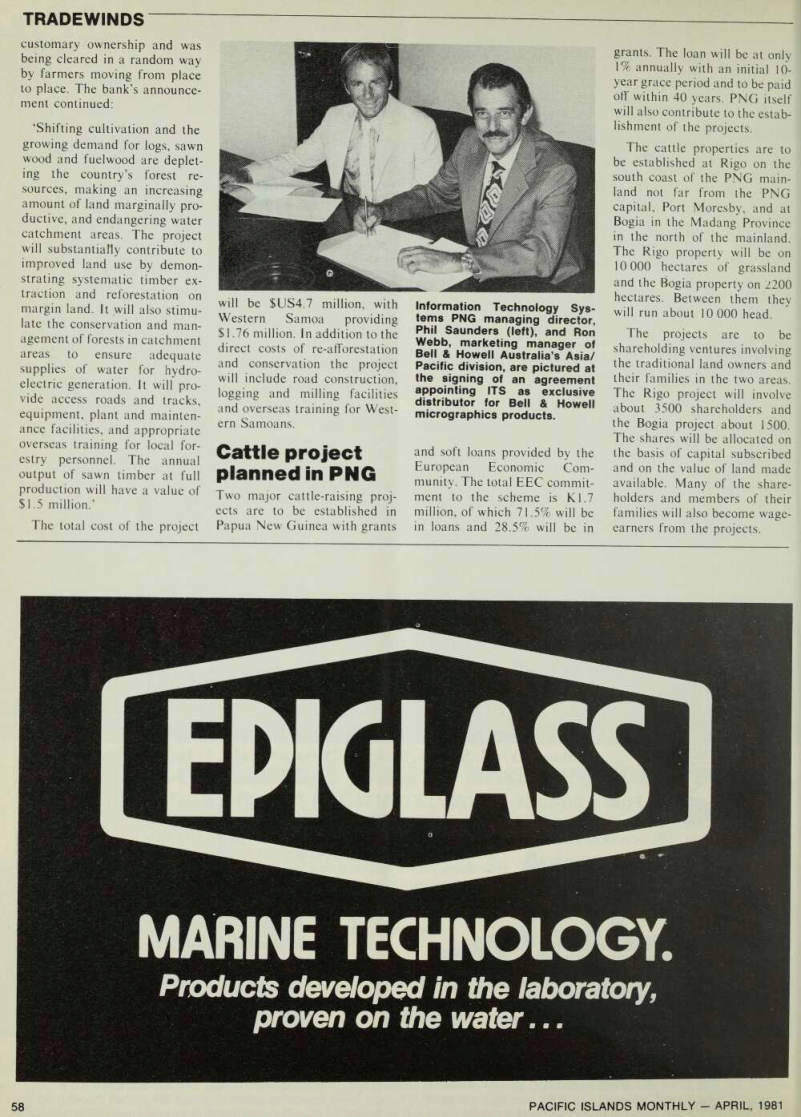
Information Technology Sys tems PNG managing director, Phil Saunders (left), and Ron Webb, marketing manager of Bell & Howell Australia’s Asia/ Pacific division, are pictured at the signing of an agreement appointing ITS as exclusive distributor for Bell & Howell micrographics products.