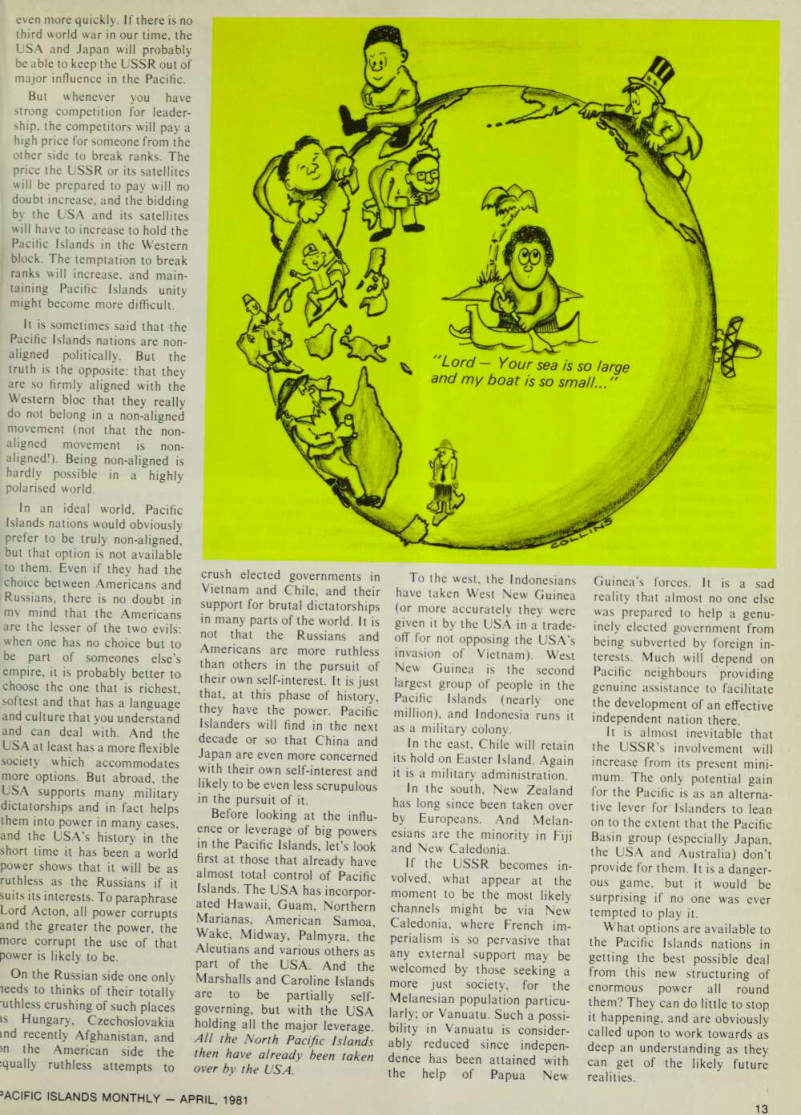
"Lord - Your sea is so large
pp. 13-14 · Read in the full issue
even more quickly. If there is no third world war in our time, the USA and Japan will probably be able to keep the USSR out of major influence in the Pacific.
But whenever you have strong competition for leader ship, the competitors will pay a high price for someone from the other side to break ranks. The price the USSR or its satellites will be prepared to pay will no doubt increase, and the bidding by the USA and its satellites will have to increase to hold the Pacific Islands in the Western block. The temptation to break ranks will increase, and main taining Pacific Islands unity might become more difficult.
It is sometimes said that the Pacific Islands nations are non aligned politically. But the truth is the opposite: that they are so firmly aligned with the Western bloc that they really do not belong in a non-aligned movement (not that the non aligned movement is non aligned!). Being non-aligned is hardly possible in a highly polarised world.
In an ideal world, Pacific Islands nations would obviously prefer to be truly non-aligned, but that option is not available to them. Even if they had the choice between Americans and Russians, there is no doubt in my mind that the Americans are the lesser of the two evils; when one has no choice but to be part of someones else’s empire, it is probably better to choose the one that is richest, softest and that has a language and culture that you understand and can deal with. And the USA at least has a more flexible society which accommodates more options. But abroad, the USA supports many military dictatorships and in fact helps them into power in many cases, and the USA’s history in the short time it has been a world power shows that it will be as ruthless as the Russians if it suits its interests. To paraphrase Lord Acton, all power corrupts and the greater the power, the more corrupt the use of that power is likely to be.
On the Russian side one only iceds to thinks of their totally uthless crushing of such places
is Hungary, Czechoslovakia
md recently Afghanistan, and )n the American side the :qually ruthless attempts to
crush elected governments in Vietnam and Chile, and their support for brutal dictatorships in many parts of the world. It is not that the Russians and Americans are more ruthless than others in the pursuit of their own self-interest. It is just that, at this phase of history, they have the power. Pacific Islanders will find in the next decade or so that China and Japan are even more concerned with their own self-interest and likely to be even less scrupulous in the pursuit of it.
Before looking at the influ ence or leverage of big powers in the Pacific Islands, let’s look first at those that already have almost total control of Pacific Islands. The USA has incorpor ated Hawaii, Guam, Northern Marianas, American Samoa, Wake, Midway, Palmyra, the Aleutians and various others as part of the USA. And the Marshalls and Caroline Islands are to be partially self governing, but with the USA holding all the major leverage.
All the North Pacific Islands then have already been taken over by the USA.
To the west, the Indonesians have taken West New Guinea (or more accurately they were given it by the USA in a tradeoff for not opposing the USA’s mvasion of Vietnam). West New Guinea is the second largest group of people in the Pacific Islands (nearly one million), and Indonesia runs it as a military colony.
In the east, Chile will retain its hold on Easter Island. Again it is a military administration.
In the south. New Zealand has long since been taken over by Europeans. And Melanesians are the minority in Fiji and New Caledonia.
If the USSR becomes invdved, what appear at the moment to be the most likely channels might be via New Caledonia, where French impenalism is so pervasive that any external support may be welcomed by those seeking a more just society, for the Melanesian population particularly; or Vanuatu. Such a possibility in Vanuatu is considerably reduced since independence has been attained with the help of Papua New
Guinea’s forces. It is a sad reality that almost no one else was prepared to help a genu inely elected government from being subverted by foreign in terests. Much will depend on Pacific neighbours providing genuine assistance to facilitate the development of an effective independent nation there, it is almost inevitable that the USSR’s involvement will increase from its present mini mum. The only potential gain for the Pacific is as an alterna tive lever for Islanders to lean on to the extent that the Pacific Basin group (especially Japan the USA and Australia) don’t provide for them. It is a danger ous game, but it would be surprising if no one was ever tempted to play it.
What options are available to the Pacific Islands nations in getting the best possible deal from this new structuring of enormous power all round them? They can do little to stop it happening, and are obviously called upon to work towards as deep an understanding as they can get of the likely future realities.
"Lord - Your sea is so large and my boat is so small..."
One urgent need is for a Pacific Islands ‘think tank’ an institution geared to collect ing data, sorting out options, heightening public awareness, and drawing on the best minds available. Japan’s Nomura Re search Institute is one of several that have been doing their homework on the future of the Pacific, and very effectively it seems. The Brookings Institute in the USA is one of the many that have been helping the Americans find the best sol utions for them in the Pacific.
New Zealand has its Com mission on the Future, and so on. Perhaps the University of the South Pacific should take the initiative and start some more focused thinking on the future, perhaps in co-operation with the South Pacific Bureau for Economic Co-operation and the South Pacific Commission.
So far, the Pacific has had to respond belatedly to the big powers’ proposals. It would be in a much stronger position if it clarified its own options and to do so needs a continuous, open, responsive programme.
The danger is that those with big power interests in the Pacific would want to fund it and influence its direction.
Obviously the Pacific Islands states are likely to gain more from fuller co-ordination which does not necessarily mean unified action. Compared with most parts of the world.
Pacific regional co-operation so far has been relatively success ful, but it would be unrealistic to expect (or even to aim for) too high a degree of co operation when interests are so diverse, and when the short term payoff to the country that plays the role of Judas is so high.
All Pacific Islands nations are very weak in world terms. A closed Pacific Islands region would be a club of the weak, and that would be of little value.
One doesn’t get strength from joining only with the weak, more strength can come from joining with the strong though that usually means pay ing a higher price in depen dency on a range of fronts.
In monetary terms at least, the largest short-term gains will come from splitting, and each attaching itself to one major power, with multiple strings to at least some other powers. This
is already the case: the USA controls the North Pacific almost totally (and is likely to aim to attain maximum lever age over Kirabati and to a lesser extent Western Samoa); Aust ralia is the overwhelming exter nal influence for Papua New Guinea and increasingly for the rest of Melanesia; New Zealand is for the Cooks, Niue and Tokelau; France is in New Caledonia, Tahiti, Wallis and Futuna. Japan is going to find a place in this a very powerful place but the stronger Japan’s role becomes the more the small Islands states are likely to see common interests with their present big partners.
While in the short term the Pacific Islands nations could do best by playing off one big power against the other, the Western bloc powers are likely to limit that by developing a co ordinated strategy towards the Pacific Islands. And playing outside the Western bloc is a much bigger gamble involving very high stakes.
It comes back to the need, as part of the complex network of linkages, for the strengthening of common interests of the Pacific Islands, and flexibly co ordinating some of the crucial external bargaining.
But regional co-operation in the Pacific Islands will only succeed in the long term to the extent that the benefits from it are shared. The central nation usually becomes the main beneficiary, usually playing down its benefits and over rating its costs, until the peripheral smaller countries turn elsewhere at which stage the central nation is likely to be the main loser. A major reason for the collapse of the Caribbean Federation was the disproportionate benefits de rived by Jamaica. Likewise Kenya’s taking of the lion’s share was a major issue in the collapse of the East African Community. Unless the benefits of Pacific regional co-operation are more realistically shared, not only will the Pacific nations be worse off, but the leverage of the super-powers will be so much greater.
Pacific Islands universities and other Islands institutions can make an important contri bution by understanding, ana lysing and publicising the emerging new pattern of power relations in the Pacific, promot ing realistic forward thinking with creative options, and work ing towards more effective co operation among all the diverse peoples of the Pacific Islands.