‘spec[?]
pp. 14-15 · Read in the full issue
Papua Ne[?]
Pacifi[?] ‘spec[?]
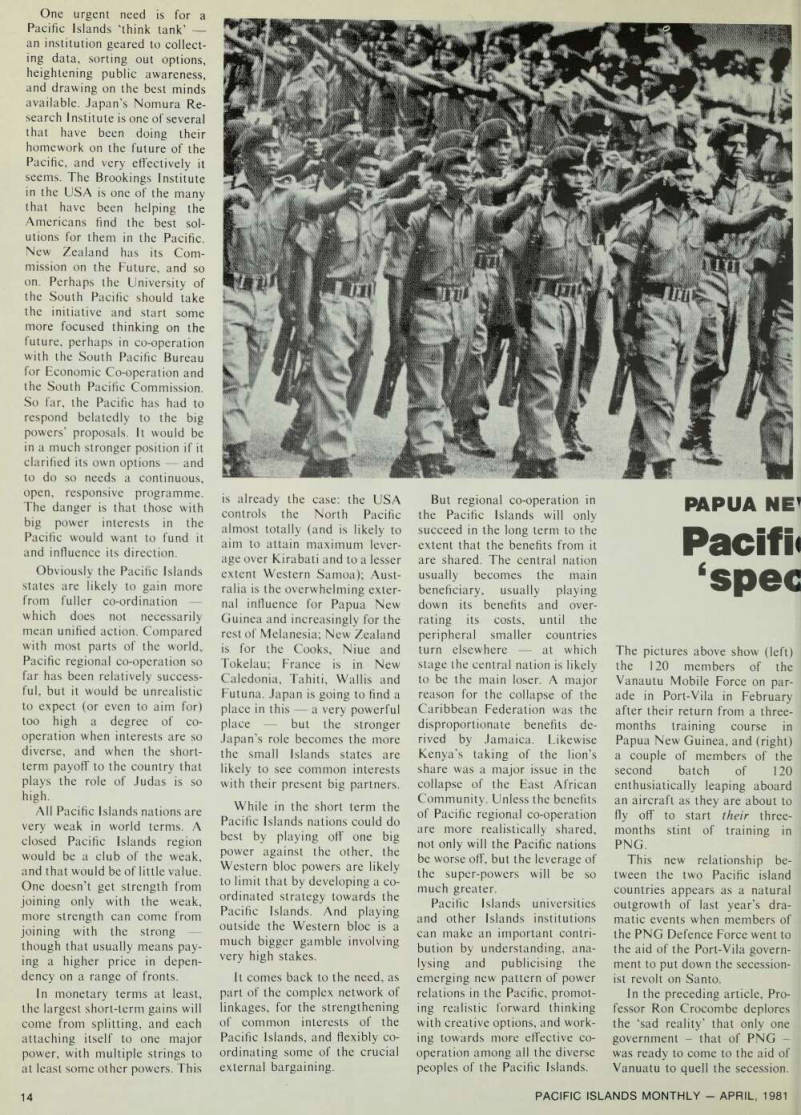
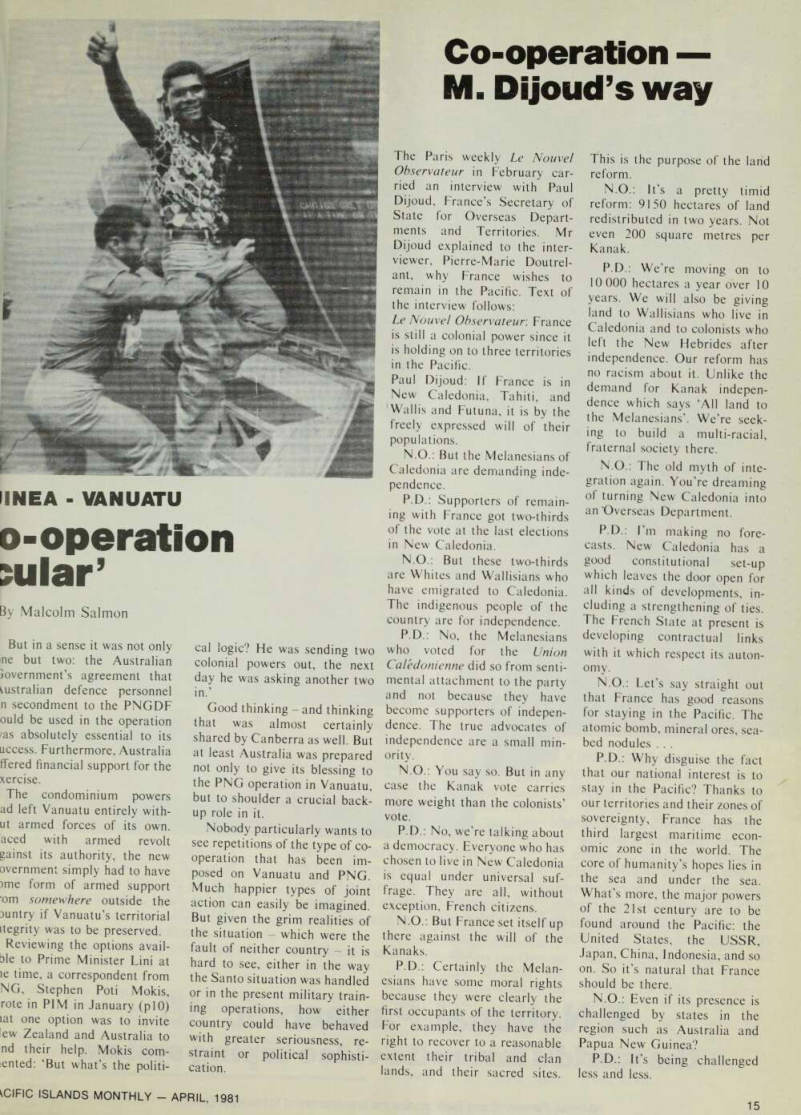
The pictures above show (left) the 120 members of the Vanautu Mobile Force on par ade in Port-Vila in February after their return from a three months training course in Papua New Guinea, and (right) a couple of members of the second batch of 120 enthusiatically leaping aboard an aircraft as they are about to fly off to start their three months stint of training in
Png.
This new relationship be tween the two Pacific island countries appears as a natural outgrowth of last year’s dra matic events when members of the PNG Defence Force went to the aid of the Port-Vila govern ment to put down the secession ist revolt on Santo.
In the preceding article, Pro fessor Ron Crocombe deplores the ‘sad reality’ that only one government - that of PNG was ready to come to the aid of Vanuatu to quell the secession.
By Malcolm Salmon
But in a sense it was not only ne but two: the Australian Jovernment’s agreement that Australian defence personnel n secondment to the PNGDF ould be used in the operation ' as absolutely essential to its uccess. Furthermore, Australia ffered financial support for the xercise.
The condominium powers ad left Vanuatu entirely withut armed forces of its own. aced with armed revolt gamst its authority, the new overnment simply had to have )me form of armed support om somewhere outside the Duntry if Vanuatu’s territorial itegnty was to be preserved.
Reviewing the options avail- 51e to Prime Minister Lini at ie time, a correspondent from NG, Stephen Poti Mokis, rote in PIM in January (plO) iat one option was to invite ew Zealand and Australia to nd their help. Mokis comcated: But what’s the politi-
cal logic? He was sending two colonial powers out, the next day he was asking another two in.’
Good thinking - and thinking that was almost certainly shared by Canberra as well But at least Australia was prepared not only to give its blessing to the PNG operation in Vanuatu, but to shoulder a crucial back up role in it.
Nobody particularly wants to see repetitions of the type of co operation that has been im posed on Vanuatu and PNG Much happier types of joint action can easily be imagined But given the grim realities of the situation - which were the fault of neither country - it is hard to see, either in the way the Santo situation was handled or in the present military train ing operations, how either country could have behaved with greater seriousness, re strain! or political sophisti cation.