doesn’t fit
pp. 48-49 · Read in the full issue
A school cap that doesn’t fit
American Schools for the Natives of Ponape: A Study of Education and Culture Change in Micronesia. By Nat J.
Colletta. Published by the Uni versity Press of Hawaii. 1980.
No price provided. ISBN 0 8248 0634 4.
In these days of indictment of American schools for their fail ure to impart fundamentals to an ever-increasing number of students, it is not surprising to learn that the same system transplanted to the many small islands of Micronesia hasn’t worked well either. Using the case of Ponape in the Eastern Carolines, author Colletta takes us through a presentation of
Ponapean traditional society as
a backdrop for understanding
the evolution of formal school ing there. One could use the early chapters to become quite well and concisely informed onr Ponapean culture, and this con tribution renders the book use ful in a wider range of intellec tual considerations than only\ education. Drawn from a good! collection of authoritative: sources in history, anthro pology, and linguistics, this* scholarly agglomeration is bothi punctuated and made more; attractive by Colletta’s owm observations which were made; while he was a Peace Corps* teacher on the island from 1968* to 1970, and later as am
interdisciplinary researcher
during 1972 gathering data for his dissertation at Michigan) State University.
Dr Colletta set out to prepare;
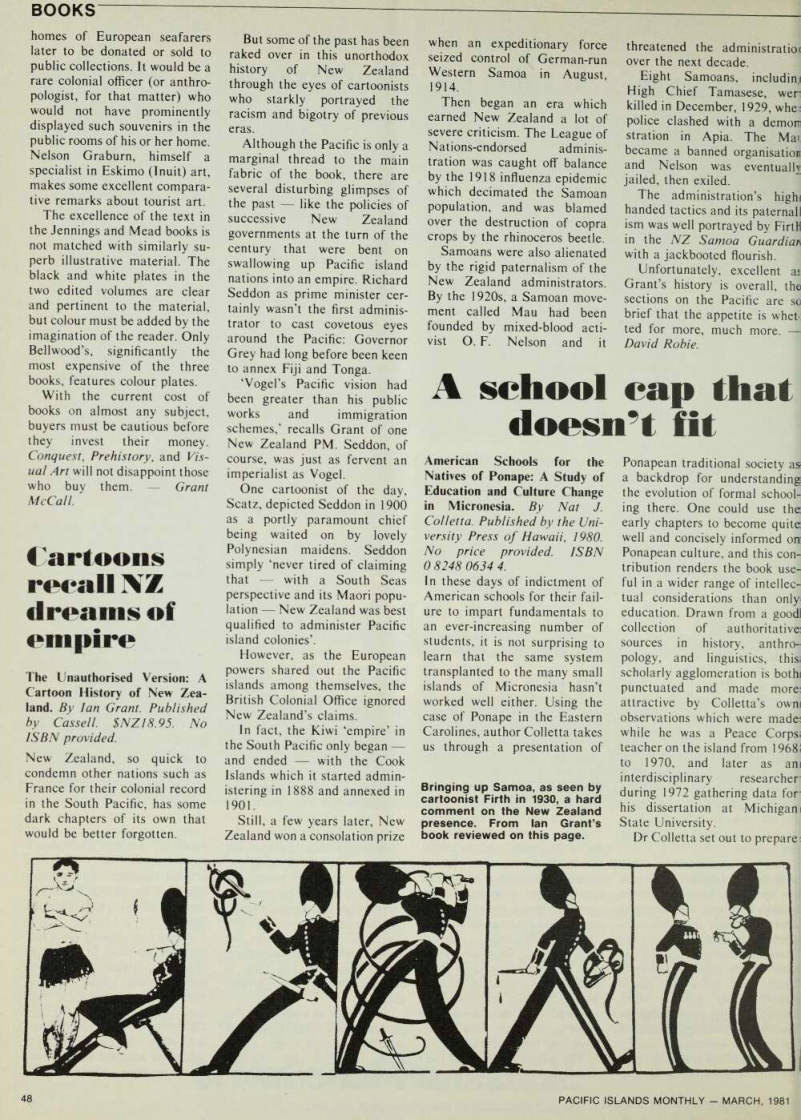
Bringing up Samoa, as seen by cartoonist Firth in 1930, a hard comment on the New Zealand presence. From lan Grant’s book reviewed on this page.
a book which traces the devel opment of the American school system on Ponape and to dem onstrate how and why it has largely failed by showing how inconsistent and paradoxical it is and has been as juperimposed on this island jociety. This he has done. The •eader can see both implicitly md explicitly why the failure las taken place through a regression of events beginning vith the post-war establish nent, and coming down to 972.
Professor A. Richard King of he University of Victoria has rovided an excellent preface vhich is the only written ac ount this reviewer has seen of eflections by a former American educator in Micro esia, couching his own experi nces and hopes of yesteryear gainst the current reality of lie now-blossomed seeds he elped to sow.
The book will probably be Dmething of a classic on the übject of Ponapean education uring the American tutelege, artly due to Colletta’s compre ensiveness, but also because, s Professor King has observed, t is a second-generational udy at a level of sophistication nd insight which was unattain
ble during earlier years . ..
md) it represents a transitional eriod which will probably be )llowed ultimately by a third deration of studies from landers themselves’.
One might think that the udy since it was concluded -arly 10 years ago is now ited. Not so. The visitor to onape today will find con ations the same as, if not worse tan, Colletta’s analysis Drtrays. Although the author akes no direct assertions )out how to alter the schooling
catastrophe, this need not be a criticism of the work. Certainly those who would attempt this, however, would have to read Collelta carefully.
Lest this work be used incorrectly by some particu larly on the mainland it should be stated that the failure of American-style education on Ponape is not a complete indict ment of the system as such though it is true, as indicated earlier, the system is in deep trouble on the mainland. Its failure is as a superimposition on a society where its funda mental precepts of individual achievement, competition, and specialisation, have an entirely different credence within the Ponapean and Micronesian social fabric. That this actually happened is rather remarkable given the abun dance of anthropological studies which went on in the early days of the American administration. Clearly many failed to listen, analyse, and adapt.
The deep disfunctions of the system on the mainland more over, while endemic, have not debilitated American society like they have in their Ponapean transplant. Taken in the wide view, America’s system is still producing high-quality man power after subtracting all the wastage capable of leading efforts to see and ex plore outer space, identify or create new energy sources, and extend the frontiers of science based industry. In Micronesia and on Ponape nothing like this happens as a function of edu cation. At a time when island leaders are planning and nego tiating new political arrange ments for themselves, they are
without their own skilled tech nicians, social scientists, and managers, and must resort to hiring consultants to fill the void. Even the traditional approaches to instruction and passing on of knowledge which yielded exemplary fishermen, canoe-builders, and sooth sayers, are stifled or have de teriorated. The need for Micronesian trained manpower continues to go unmet with no real signs of change. This con dition has led one political leader to exclaim: ‘The Americans have not succeeded in producing one single capable person in an executive, leader ship role.’ (Senator Bailey Olter, Pacific Daily News May 28, 1979).
In his closing chapters Colletta describes the results, in part, of the clash in values: what the schools teach juxtaposed against what Ponapeans are or are becoming. The picture is altogether dismal. A planner at any level and under any aus pices would be at a loss to grapple seriously with the morass of social repugnancy which has resulted.
Throughout, the book is illus trated with pictures of histori cal and contemporary value, including some taken by the award-winning photographer of Micronesia, Carlos Viti. The book has references which will be an aid to scholars, and also a glossary of Ponapean terms.
As for its catalytic effect as a change instrument? Professor King’s statement is appropriate: T remain skeptical ... but, if there is any hope for a positive reversal of these patterns, it lies in action resulting from studies such as this and possibly the
yet to come third generation of
analyses.’
Dirk Anthony
Ballendorf
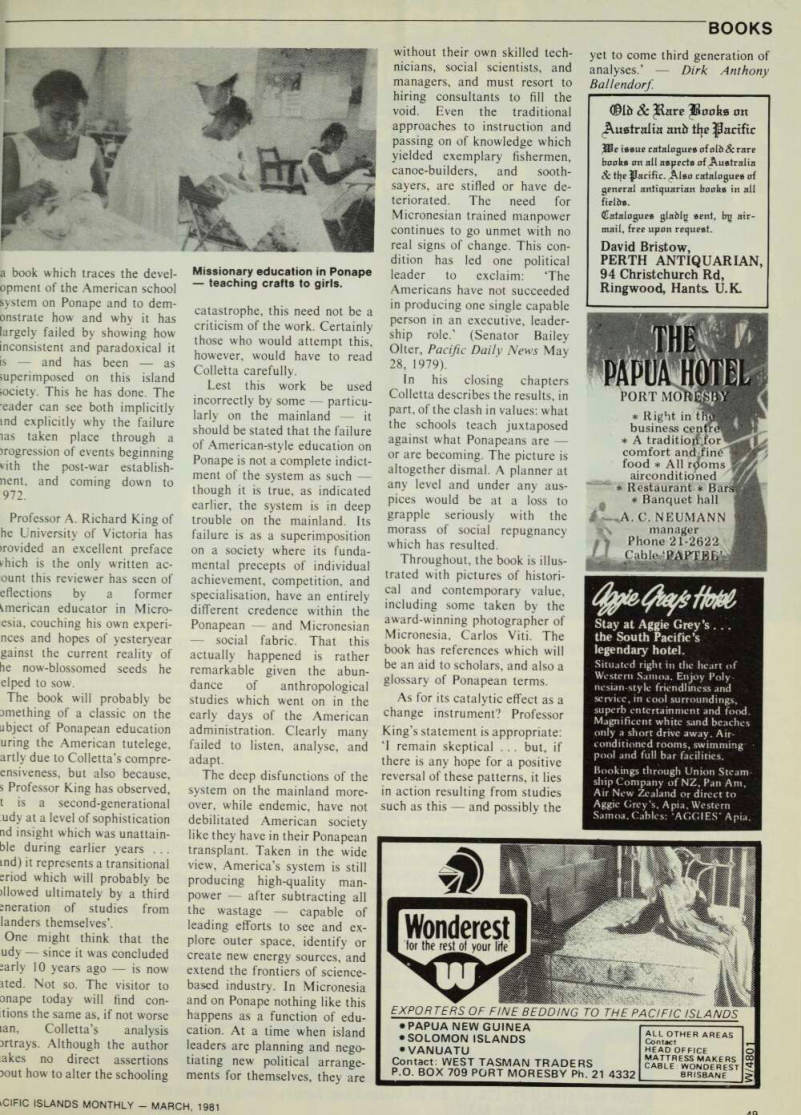
Missionary education in Ponape - teaching crafts to girls.