Polynesia’s body language:
pp. 51-52 · Read in the full issue
Travel
Polynesia’s body language: A tourist’s guide
JOSEPH THEROUX* dishes out some handy advice to travellers in Polynesian lands who may often be mystified and may in turn mystify their hosts by their failure to understand the significance of various physical gestures which are conventional in these societies.
There was a lime when the cliche ‘every movement has a meaning', referring to Polynesian dancing, was wel comed as an interesting conver sational ice-breaker. Some times it was meant earnestly, as a prelude to a catalogue of explanations, sometimes as a pedantic cover to conceal leers.
The following is not about dancing movements that subject has been done to death.
But the cliche also has much truth in it if it is taken to refer to everyday gestures, the un studied, the acquired though later almost instinctual movements that supplement and even often replace language.
They arc the ways of a people who, although their spoken language has been raised to the level of an art form, can still speak volumes through subtle gestures and twitches from the vulgar to the witty, the vicious to the tender. For the uninitiated, a moment of silence observed between two Polynesians will suddenly erupt into violence, laughter, or result in a midnight tryst. There are movements that, if not closely looked for, are sometimes invis ible.
I have seen Europeans (as all white foreigners are called by Samoans, and I will adopt the lerm here) question Samoans, and. thinking they have had no reply, continue to repeat the question. Finally, they either Twc a shrug of incomprehen sion and walk off, or curse and walk off. Actually, the Somoan lad been answering, according o his own lights, all the time. \sked the question, the
Samoan answered in the affirmative by flicking up his eyebrows so quickly that the European never saw it. If he remained on the island long enough, the European would pick up the habit himself, at first self-consciously and awk wardly. later automatically.
It comes as a shock to Europeans that the nod is not universal: indeed, there are some who say that it is the raised eyebrows that is the more common. When a north ern Indian nods, in contrast to a southern Madrasi, he means no.
According to context and dur ation, the raising of eyebrows has other meanings: an inter rogative (with an accompany ing open mouth), a challenge (with eyes defiantly half closed), a greeting, or, along with a jerk of the head, a directional gesture.
Much has been made of the German influence in Western Samoa. There is still talk of their contributions in agriculture, warfare and poli tics. But at least one of their social mannerisms was also picked up. People in the French-influenced islands greet in the continental embrace a slight hug, a peck on each check. Germans are the only Europeans to shake hands with only one, formal shake. And that is the way Western Samoans do it.
When Commander Wilkes
arrived at Manu'a in 1839. he tells us that ‘the king or chief, who was old and decrepit . . . (named) Lalelah .. . (used a) mode of salutation ... by tak ing my hand and rubbing the back of it against his nose.' That this style of greeting has died out is not surprising: much of it has as much to do with fashion as anything else. How many Americans now kiss a lady's hand.
Mouth kissing has not always been universal. Samoans almost certainly did not do it until instructed by the Europeans.
Their word for it, kisi, is straight from the English. But like Maoris or Eskimos, they pressed, not rubbed, noses, and called it feasogi, from the root word sogi, To smell'. Sogi itself is a loving, non-sexual touching of opposite cheeks, acceptable between men as well as women.
Tongans adopted ‘French’ kiss ing but call it kai'alelo, ‘to eat the tongue'.
Europeans beckon by crook ing one or several fingers or jerking the head to the side.
Polynesians flap down the hand or drop the head in a half-nod.
You can wave frantically at a taxi or bus driver all day, but he won’t stop until you flap your
hand down. Tongans merely raise their hands.
The hands, as one would expect, convey the most mean ing. When a boy makes a suggestive comment to a girl, she can shame him in two movements. She raises her ankle behind her and slaps it. It is the contemptuous equivalent of ‘go jump in the lake'. The boy. properly shamed, will jok ingly draw his hand down over his face. If he does not. some one is sure to do it for him. drawing their hand over his face. It is optional at this point for the third parly to say, Waah. maah!, which is some thing like. ‘You should be ashamed of yourself.' for that is what the gesture means. Of course it may not have been anything he said. He may have clutched an imaginary body and drawn it against himself in rhythmic movements, or made the universal onanist's gesture.
While the backside has no sexual significance to Samoans except, possibly, during a homosexual phase during pu berty. when the sexes are segre gated it does not have comic or insulting import. At the end of a late-night festival, it is a great joke to turn your back to the crowd and bend over, like the jesting Can-Can's rear ac tion. At one lime, in fact just up to a few years ago it was acceptable to bend over and raise the lavalava, whether there was clothing underneath or not. Usually it is not necess ary to bend over, but merely to tug an inch or so at the rear waistline of the trousers or skirt and slightly thrust out the bottom at the object of one’s contempt the butt of one’s joke, so to speak.
The greatest and most endur ing laughter I ever heard at the Tivoli Theatre in Apia was at a scene in an American comedy in which a character bent down and pulled down his drawers, a gesture known in America as ‘mooning’. The stomping and hooting, the pounding of seats
* US-born Joseph Theroux now 'ives in American Samoa. His ihort story A Samoan Head dress won first prize in the 'iter ary competition at the 1980 Third South Pacific Fes ival of Arts.
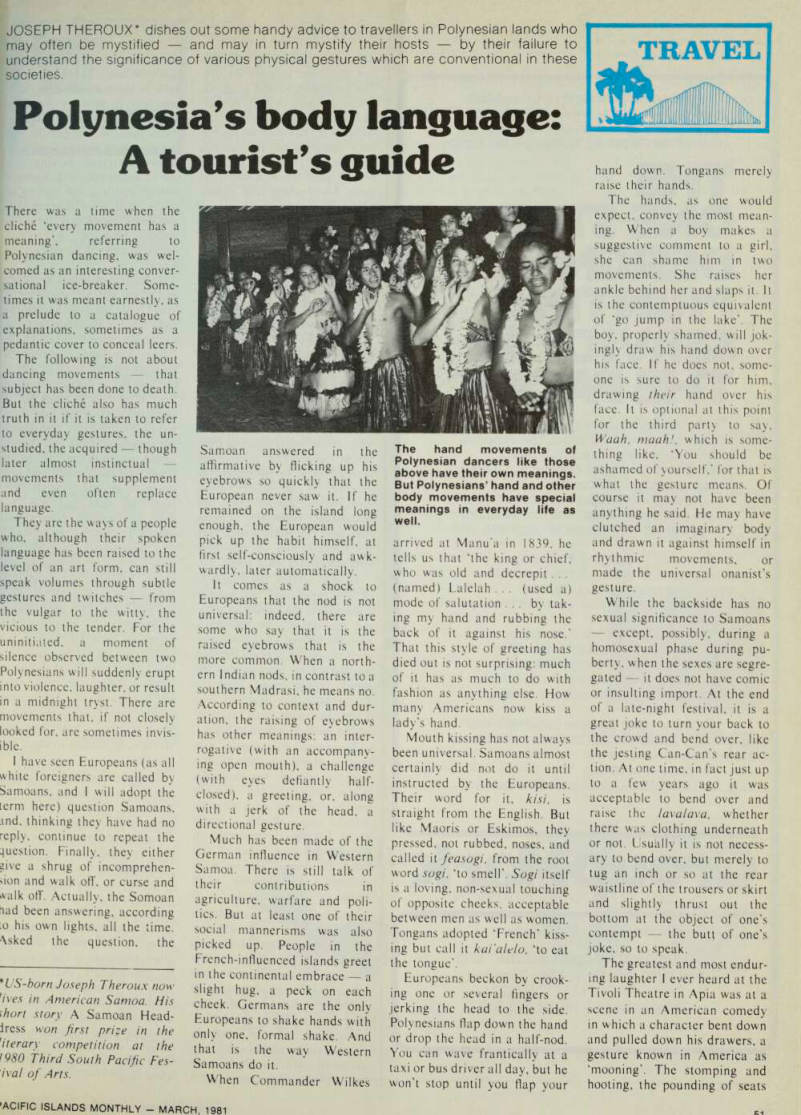
The hand movements of Polynesian dancers like those above have their own meanings.
But Polynesians' hand and other body movements have special meanings in everyday life as well.
and walls, shook the old barn and made me fear for its life.
The mournful, almost religious reverence with which Romeo and Juliet was watched, the students in the crowd saying the lines along with the actors, reminiscent of a liturgy, was broken only when Romeo put aside his doublet and tights.
Chaos.
It is also a traditional insult, if done in anger, and, by extension, a challenge. After the Hawaiian chiefs had mur dered Cook, this gesture was called into play by a warrior.
Gavan Daws writes in his his tory of Hawaii, Shoal of Time: ‘As King was being rowed back to his ship a native standing on a rock “had the Insolence to turn up his backside and make other signs of Contempt,” and King had to be restrained from shooting him.' One wonders what those ‘other signs of Con tempt' were. The sailors had learned how to interpret the gesture, if it wasn’t plain enough, for earlier they had witnessed Hawaiian boxing matches. The victor would ‘turn his backside' on his opponent and arrogantly walk away.
In any culture, the language of the eyes has an infinite vocabulary, the subtleties defy ing description. In Polynesia, with the help of a go-between to start things off, a courtship can be carried on from across the room, amidst crowds, and the first anyone has heard of it is when the couple have taken off to the bush to live together.
To arouse someone’s am orous attention, the Maoris covertly scratch the desired's elbow. Samoan and Tongan youths tickle the palm with the middle finger during a hand clasp, but this is probably an imported gesture. When all else fails, or where proximity is ditficull, the reliable wink knows no cultural limits.
As words are subject to misinterpretation, so are ac tions. The vulgar European gesture of thrusting up the forearm and clasping the upper arm is only a sign of strength to a Maori. Sticking out the longue is a Maori’s symbolic gesture of defiance, wrongly interpreted by non-Maoris as an action to instil fear. It no more accomplishes this than when a
child does it in an infantile; insult. When it is necessary to< walk in front of someone, it is, improper to pass by standing erect. You bend down, some times squat if the person you are passing is sitting, and dart across, scurrying, bowing, not out of deference a Samoan assures you it is not bowing as such but to avoid being seen and heard, much as a European avoids blocking a movie projector light as he crosses the room.
A European enters an office and does not sit until he is asked, only the boss having the right to sit in his office until the visitor is bidden to take a chair.
I have witnessed a bewildered Samoan ejected from an office, the boss in the doorway mutter ing, ‘Who does he think he is?’ and deduced what had hap pened. The Samoan, transplant ing manners from his home, would not speak until he has sat down: you don’t stand and talk down to anyone, you sit first, right? his face said. Yes, but only in Samoan homes and offices, I wanted to tell him.
A European expresses size with his hands, measuring the space between his hands. A Polynesian begins by showing the first joint of his index finger to indicate the smallest. He clasps his wrist, his forearm, his elbow, points to his shoulder and then the next shoulder, while holding the other arm out, to show the varying degrees of size. Significantly, the arm or hand is always kept perfectly straight, as though to assist the imagination.
In a poetic gesture of thanks, a gift is raised to the top of the forehead. This has two pur poses. It is a display of the gift for all to see, and, at the same time, a self-deprecatory action, as though to say that he who receives the gift is not really worthy of it.
Language is learned through study, memorising, writing and listening. But there is also that silent language of the body and its movements that is only learned through observation.
And if this increases our knowl edge and understanding of other peoples, it may not bring a halt to wars or suffering, but it may stop miscommunication.
Or a taxi.