empire
p. 48 · Read in the full issue
Cartoons recall NZ dreams of empire
The Unauthorised Version: A Cartoon History of New Zea land. By lan Grant. Published by Cassell. SNZ 18.95. No ISBN provided.
New Zealand, so quick to condemn other nations such as France for their colonial record in the South Pacific, has some dark chapters of its own that would be better forgotten.
But some of the past has been raked over in this unorthodox history of New Zealand through the eyes of cartoonists who starkly portrayed the racism and bigotry of previous eras.
Although the Pacific is only a marginal thread to the main fabric of the book, there are several disturbing glimpses of the past like the policies of successive New Zealand governments at the turn of the century that were bent on swallowing up Pacific island nations into an empire. Richard Seddon as prime minister cer tainly wasn’t the first adminis trator to cast covetous eyes around the Pacific: Governor Grey had long before been keen to annex Fiji and Tonga. ‘Vogel’s Pacific vision had been greater than his public works and immigration schemes,’ recalls Grant of one New Zealand PM. Seddon, of course, was just as fervent an imperialist as Vogel.
One cartoonist of the day, Scatz, depicted Seddon in 1900 as a portly paramount chief being waited on by lovely Polynesian maidens. Seddon simply ‘never tired of claiming that with a South Seas perspective and its Maori popu lation New Zealand was best qualified to administer Pacific island colonies’.
However, as the European powers shared out the Pacific islands among themselves, the British Colonial Office ignored New Zealand’s claims.
In fact, the Kiwi ‘empire’ in the South Pacific only began and ended with the Cook Islands which it started admin istering in 1888 and annexed in 1901.
Still, a few years later, New Zealand won a consolation prize
when an expeditionary force seized control of German-run Western Samoa in August, 1914.
Then began an era which earned New Zealand a lot of severe criticism. The League of Nations-endorsed adminis tration was caught off balance by the 1918 influenza epidemic which decimated the Samoan population, and was blamed over the destruction of copra crops by the rhinoceros beetle.
Samoans were also alienated by the rigid paternalism of the New Zealand administrators.
By the 19205, a Samoan move ment called Mau had been founded by mixed-blood acti vist O. F. Nelson and it
threatened the administration over the next decade.
Eight Samoans, including High Chief Tamasese, wen killed in December, 1929, whei; police clashed with a demom stration in Apia. The Mau became a banned organisation and Nelson was eventually jailed, then exiled.
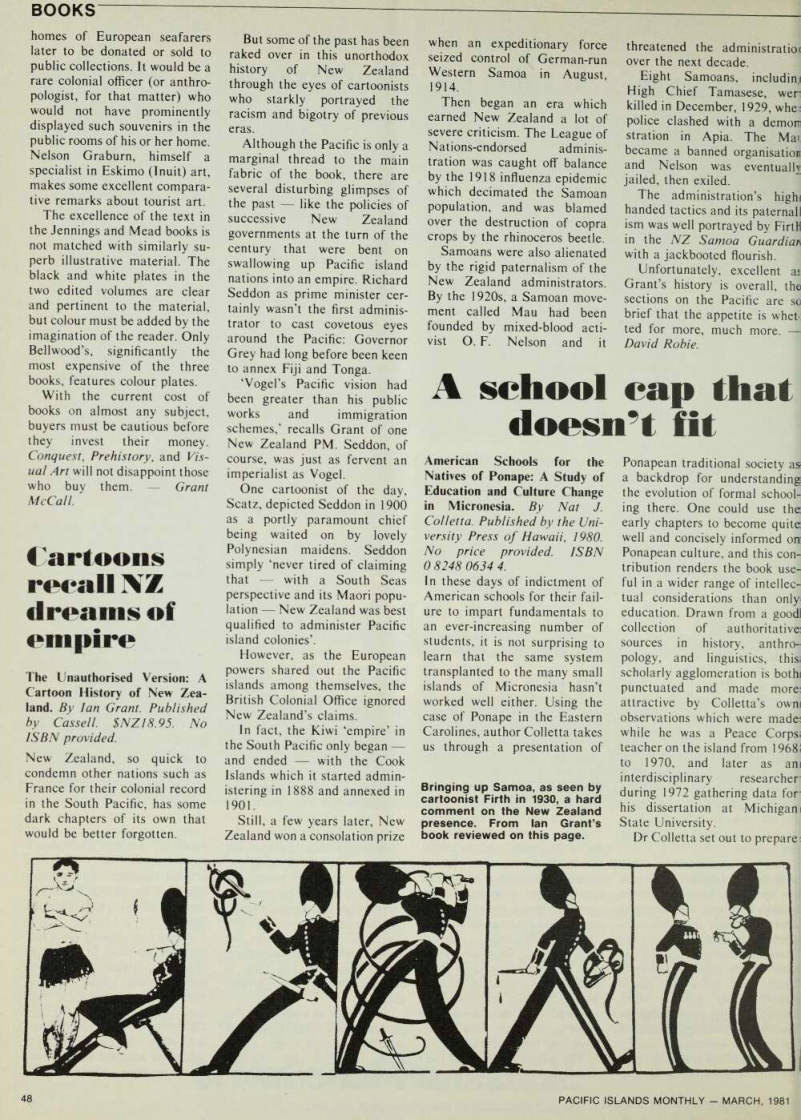
The administration’s high) handed tactics and its paternal! ism was well portrayed by Firth in the NZ Samoa Guardian with a jackbooted flourish.
Unfortunately, excellent as Grant’s history is overall, the sections on the Pacific are so brief that the appetite is whet-; ted for more, much more. —|
David Robie.