Problems in selling
pp. 26-32 · Read in the full issue


Tropicalities
Problems in selling up a famous hotel
Aggie Grey’s hotel in Apia up for sale?
The question has been bandied about the Pacific for several months now since Mrs Grey said in an interview last September with a New Zealand TV team that she would con sider selling the hotel if ‘the right offer’ was given.
Her son Alan Grey told the Apia weekly The Observer that he thought she might be con sidering selling because, at more than 80 years of age, she wants to ‘split some money around the family’.
But selling off what is prob ably the most celebrated hotel in the Pacific is proving much more complicated than most real estate transactions.
Former Apia correspondent W. Sharpe-Dunn commented for PIM in Sydney: The prob lem about having established a good reputation is: what hap pens to it when you pull out of the job? When the repute of the hotel concerned is inter nationally known, and the hotel has become a national symbol, the problem is compounded.
At this stage (early February), there have been no major developments made pub lic about the suggested sale of Aggie Grey’s hotel.
Following the New Zealand TV statement by the redoubt able Aggie Grey, offers appar ently ‘poured in’, and a great amount of sifting was done, with the number of bids reportedly being reduced to a short list of three by December.
Although manager and well known sportsman Alan Grey is not averse to leaving the hotel business in which all his youth and adult life have been spent, he and many locals fear for the reputation of the establishment once it leaves the hands of the Grey family.
The Western Samoa Govern ment does not want the hotel to become part of an international chain because of loss of revenue to the country. Immigration officials would be unhappy about an influx of foreigners working permanently there.
The departments of Econ
omic Development and Tourism fear ‘a loss of image’ for Samoa’s premier hotel if it goes into other, less sympathetic hands.
If Aggie Grey finally decides to sell, it would probably be to a local consortium, with the government holding 50% of the shares or, following on from previous experience with the Tiafau and Tusitala hotels, with the backing and interest of the Nauruan Government.
Revived casino
debate in PNG
There’s been a revival in Papua New Guinea of a long-discussed controversy over whether a hotel-casino should be estab lished to give a boost to the tourist industry and to provide new government revenue from gambling tax. This time how ever parliament is to have the final say, and if approval emerges from the debate a group of investors are prepared to build a 150-room inter national standard hotel with a casino on the top two floors.
The move to enable casinos to be licensed has come from a parliamentary back-bencher, Mr Karl Stack, who was min erals and energy minister when the Somare government was in power. Mr Stack has given notice of a private member’s bill to legalise and regulate casinos. His bill is an amend ment to existing gambling legis lation in PNG. The major responsibility of the existing legislation is the licensing and regulation of privately-owned betting shops which pay betting taxes to the government and operate mainly on Australian horse-racing.
For many years there have been sporadic proposals to es tablish hotel-casinos, but most of the moves have met with heavy opposition from churches, civic organisations and some politicians. One pro posal was for the establishment of a hotel-casino on a small island just outside Port Moresby harbour. Three years ago a draft report on tourism recommended a hotel-casino as
a potential big money earner for the government. The report said that ‘careful examination indi cated a casino would not be deleterious’, and that a casino would heavily attract tourists from Australia and further afield. There was immediate public opposition and no action was taken.
Mr Stack now claims that his proposal to legalise casinos has the support of 14 of PNG’s 15 provincial governments. He has suggested that in addition to the investors who are prepared to back the scheme, equity should be available to the national government and to provincial governments. His proposal en visages the construction of one hotel-casino on a five-year trial basis, to be followed by others if warranted. Four possible lo cations one in Port Moresby have been selected, he says.
Highlands fight
rules broken
A provincial government leader in the Western Highlands of Papua New Guinea has criti cised tribesmen for ‘breaking the traditional rules of tribal fighting’ during several recent clashes between tribes. The rules are sacred and shouldn’t be broken, the Premier of the Western Highlands, Mr Nambuga Mara, said. He ap pealed to the national govern ment to make sure that if tribes must fight, then they should stick to the rules enshrined in tradition.
Mr Mara, who is also a village chief, said one of the traditional rules being broken was that women, children and chiefs should not be injured or killed in tribal fights. As well, warriors were not obeying the rule that no person killed in a clash should .be ‘cooked or burnt’. He added: ‘Another significant rule which has not been observed lately is that feuding groups are not sup posed to make surprise attacks before 6am and after spm.’
Mr Mara was in Port Moresby to rally support for the introduction of a state of emerg ency in the Highlands in a bid to stop rising tribal fighting and other lawlessness. He said tribal fights were a custom of High lands people and could not be stopped overnight. However, he was disappointed the national government had not found ways
to curb tribal clashes. Mr Mara said the Highlands economy was suffering because of the
fighting.
In talks with Mr Mara, the Prime Minister, Sir Julius Chan ruled out a state of emergency for the Highlands, but promised the concentrated use of police in areas ‘in most need of it’.
Meanwhile, police have re ported four deaths in recent tribal fights in three highlands areas. Two people died and several were wounded in a fight over land in the Western High lands. About 300 tribesmen were involved and they dam aged houses and food crops. In the Southern Highlands a 10year-old boy was speared to death in one of the incidents which Mr Mara said were breaking the traditional rules of inter-tribal fighting. A 35-year old man was killed in a tribal clash in the Enga Province.
Michael Prain in Port Moresby.
Theatre group
for Kiribati
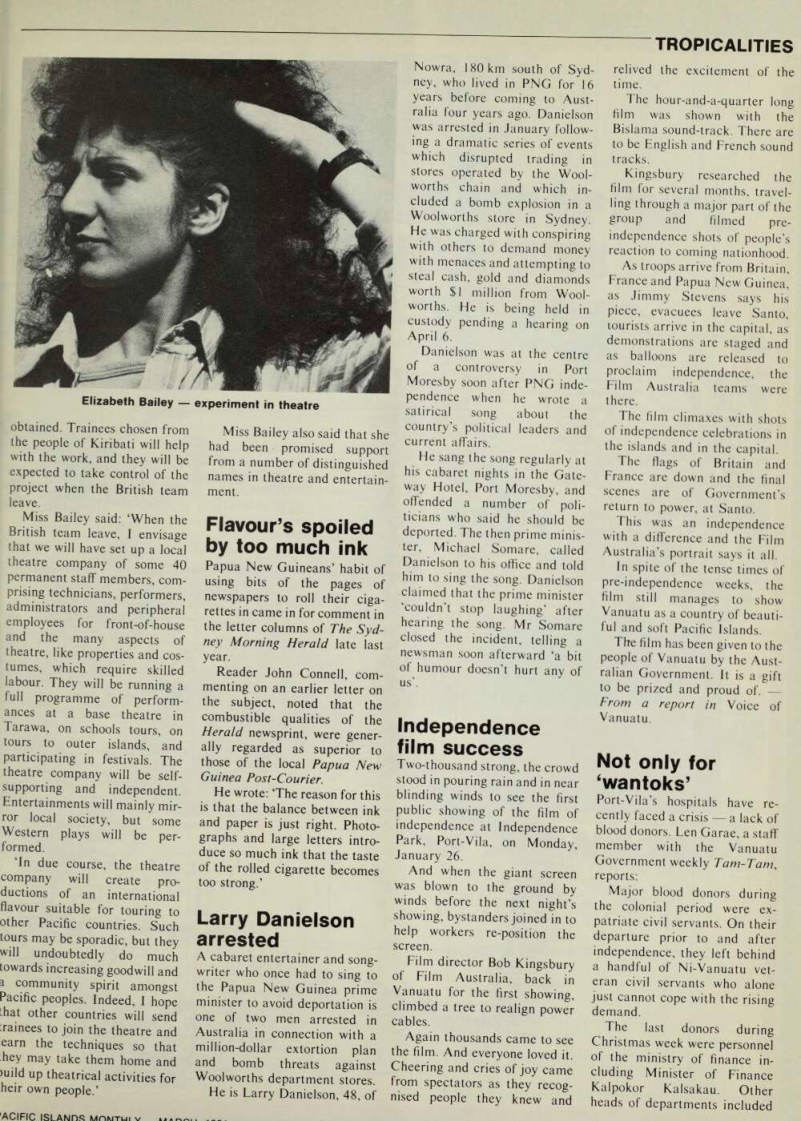
An unusual experiment in pro fessional theatre is being spon sored by the British actress Elizabeth Bailey. She plans to establish what she has named Theatre Kiribati, a theatre com pany based in Kiribati.
Miss Bailey told PIM from London that she ‘fell in love with Kiribati’ during a Pacific tour which also took in Micronesia and Hawaii. She described her proposed Theatre Kiribati as ‘a meld of Western technolog> and local traditional culture’. It will be started by a team of British actors and technicians who will go to Kiribati as volunteers but will leave five years later when they hope the project will be self supporting.
The work of the visitors will be to seek out local myths, legends and stories of actual events, study the social cus toms, and create theatrical pro ductions from the information
obtained. Trainees chosen from the people of Kiribati will help with the work, and they will be expected to take control of the project when the British team leave.
Miss Bailey said; ‘When the British team leave, I envisage that we will have set up a local theatre company of some 40 permanent staff members, com prising technicians, performers, administrators and peripheral employees for front-of-house and the many aspects of theatre, like properties and cos tumes, which require skilled labour. They will be running a full programme of perform ances at a base theatre in Tarawa, on schools tours, on tours to outer islands, and participating in festivals. The theatre company will be self supporting and independent.
Entertainments will mainly mir ror local society, but some Western plays will be per formed.
Tn due course, the theatre company will create pro ductions of an international flavour suitable for touring to other Pacific countries. Such tours may be sporadic, but they
will undoubtedly do much
towards increasing goodwill and
a community spirit amongst Pacific peoples. Indeed, I hope that other countries will send rainees to join the theatre and earn the techniques so that hey may take them home and mild up theatrical activities for heir own people.’
Miss Bailey also said that she had been promised support from a number of distinguished names in theatre and entertain ment.
Flavour’s spoiled
by too much ink
Papua New Guineans’ habit of using bits of the pages of newspapers to roll their ciga rettes in came in for comment in the letter columns of The Syd ney Morning Herald late last year.
Reader John Connell, com menting on an earlier letter on the subject, noted that the combustible qualities of the Herald newsprint, were gener ally regarded as superior to those of the local Papua New Guinea Post-Courier.
He wrote; ‘The reason for this is that the balance between ink and paper is just right. Photo graphs and large letters intro duce so much ink that the taste of the rolled cigarette becomes too strong.’
Larry Danielson
arrested
A cabaret entertainer and song writer who once had to sing to the Papua New Guinea prime minister to avoid deportation is one of two men arrested in Australia in connection with a million-dollar extortion plan and bomb threats against Woolworths department stores.
He is Larry Danielson, 48. of
Nowra, 180 km south of Syd ney, who lived in PNG for 16 years before coming to Aust ralia four years ago. Danielson was arrested in January follow ing a dramatic series of events which disrupted trading in stores operated by the Wool worths chain and which in cluded a bomb explosion in a Woolworths store in Sydney.
He was charged with conspiring with others to demand money with menaces and attempting to steal cash, gold and diamonds worth $1 million from Wool worths. He is being held in custody pending a hearing on April 6.
Danielson was at the centre of a controversy in Port Moresby soon after PNG inde pendence when he wrote a satirical song about the country’s political leaders and current affairs.
He sang the song regularly at his cabaret nights in the Gate way Hotel, Port Moresby, and offended a number of poli ticians who said he should be deported. The then prime minis ter. Michael Somare, called Danielson to his office and told him to sing the song. Danielson claimed that the prime minister ‘couldn’t stop laughing’ after hearing the song. Mr Somare closed the incident, telling a newsman soon afterward ‘a bit of humour doesn’t hurt any of us’.
ndependence
film success
Two-thousand strong, the crowd stood in pouring rain and in near blinding winds to see the first public showing of the film of independence at Independence Park, Port-Vila, on Monday, January 26.
And when the giant screen was blown to the ground by winds before the next night’s showing, bystanders joined in to help workers re-position the screen.
Film director Bob Kingsbury of Film Australia, back in Vanuatu for the first showing, climbed a tree to realign power cables.
Again thousands came to see the film. And everyone loved it.
Cheering and cries of joy came from spectators as they recog nised people they knew and
relived the excitement of the time.
The hour-and-a-quarter long film was shown with the Bislama sound-track. There are to be English and French sound tracks.
Kingsbury researched the film for several months, travel ling through a major part of the group and filmed pre independence shots of people’s reaction to coming nationhood.
As troops arrive from Britain, France and Papua New Guinea, as Jimmy Stevens says his piece, evacuees leave Santo, tourists arrive in the capital, as demonstrations are staged and as balloons are released to proclaim independence, the Film Australia teams were there.
The film climaxes with shots of independence celebrations in the islands and in the capital.
The flags of Britain and France are down and the final scenes are of Government’s return to power, at Santo.
This was an independence with a difference and the Film Australia’s portrait says it all.
In spite of the tense times of pre-independence weeks, the film still manages to show Vanuatu as a country of beauti ful and soft Pacific Islands.
The film has been given to the people of Vanuatu by the Aust ralian Government. It is a gift to be prized and proud of.
From a report in Voice of Vanuatu.
Yot only for
‘wantoks’
Port-Vila’s hospitals have re cently faced a crisis a lack of blood donors. Len Garae, a staff member with the Vanuatu Government weekly Tam-Tam , reports: Major blood donors during the colonial period were ex patriate civil servants. On their departure prior to and after independence, they left behind a handful of Ni-Vanuatu vet eran civil servants who alone just cannot cope with the rising demand.
The last donors during Christmas week were personnel of the ministry of finance in cluding Minister of Finance Kalpokor Kalsakau. Other heads of departments included
Elizabeth Bailey - experiment in theatre
Radio Vanuatu Director Joe Carlo. ‘We are glad to see that Ni- Vanuatus are now responding to our appeals,’ says a senior official of Port-Vila Base Hos pital, Daniel Kalorib. He says the idea is to give to save, regardless of whose life it is. Mr Kalorib says there exists a system at the hospital which he called a ‘wantok system’, where a person prefers only to donate his blood within his own family circle. This, says Mr Kalorib, is not right. ‘The hospital provides the service, but the community must support it,’ he says. He estimated the hospital’s present needs at between 40 to 70 pints a week. ‘Young people must get into the idea of donating blood,’ he stresses.
He says they were lucky at the hospital last Christmas be cause there were no seriously ill people in need of blood except one woman.
Two women, a Tannese and a Fijian, were both heavy with child. Both were told they would be operated on for the deliveries. The Fijian lady’s husband brought in six friends to donate some blood since it was likely his wife might need it. But luck was with him as his wife did just fine without the six pints of blood. However it was lucky all the same that the men donated their blood when they did. Those pints all went to the lady from Tanna and saved her life. She would not have lived had they not donated their blood. Thanks to those strangers.
Len Garae closed with the question: ‘Now do you see what I mean?’
Expedition to
Pitcairn
The Sir John Barrow Commem orative Expedition, 1980, named after one of the founders of the Royal Geographical So ciety, who was also the author of the first authoritative ac count of the Bounty mutiny, was on Pitcairn island late last year.
Financed by a variety of travel and other organisations in several countries, its chief in spirer was Glynn Christian, a great-great-great-great grand
son of Fletcher Christian, who is hard at work on his cherished project of writing a biography of his famous ancestor.
The expedition made up of 11 members, and the four-man crew of their ship Taiyo aimed to map and photograph the three settlements made by Fletcher Christian and Bounty after the mutiny. Glynn Christian writes in an article in Pitcairn Miscellany. ‘We wish to record both the original and current state of sites where possible; the former so that conflicting stories of events can be more carefully dealt with.
This mapping is a useful en deavour in itself and here 1 must acknowledge those who have done the earlier work (especially on Pitcairn) on which we are building. The maps and a collection of photo graphs from the expedition will be presented to the Royal Geo graphical Society of London.’
Glynn’s aim is to ‘discard publicly the romance and the irrelevancies’ in previous writ ings on the subject. He says that in all the 2500 books devoted to the mutiny, there is no biogra phy of Fletcher Christian.
He adds: ‘During two years’ research and two trips around the world, 1 have discovered Christian family papers that bring to life our ancestors as far back as 1380, and then some.
With such additional finds as a diary of Fletcher’s first cousin and an autobiograpy of his brother Charles, I can at last say that a biography of Fletcher is possible. Finally it is to add solid fact to Sir John Barrow’s book.’
Glynn Christian’s work is due to be published in the USA, Britain and Australia at the end of this year. It is tentatively called Fragile Paradise The Life and Death of Fletcher Christian. In addition, a film on Pitcairn Island is in preparation by US film-maker Ted Cochran who was on the expedition.
Glynn comments: ‘. . . the film will illustrate far better than any words I can write that Fletcher found one of the world’s most wonderful spots . . . We found (on Pitcairn) one of the world’s happiest com munities, and nothing remotely like the sad village that previous films showed.’