Papeete:';
pp. 22-23 · Read in the full issue
Toto Tupuna Boys Retried
Dissecting a Versailles political trial
Bengt Danielsson's ■
Postmark
Papeete:';
The retrial in January in Versailles, France, of the leader of the Tahitian Independence Party, Charlie Ching, and six of his most ardent supporters who in 1977 bombed the Papeete telephone exchange and mur dered a former French naval officer, closely followed the pat tern of the previous trial in Papeete (PIM Apr 1979 p 9).
The only difference was that the sentences meted out on the 10th day in Versailles were slightly reduced. Thus, the trial was from beginning to end domi nated by furious clashes be tween the state attorney (procureur), who against all the evidence and all logic stubbornly maintained that the accused were common crimi nals, and the defence lawyers, who constantly placed the ac tions of the accused in their true political context: as protests against French colonial domi nation and nuclear pollution of their islands.
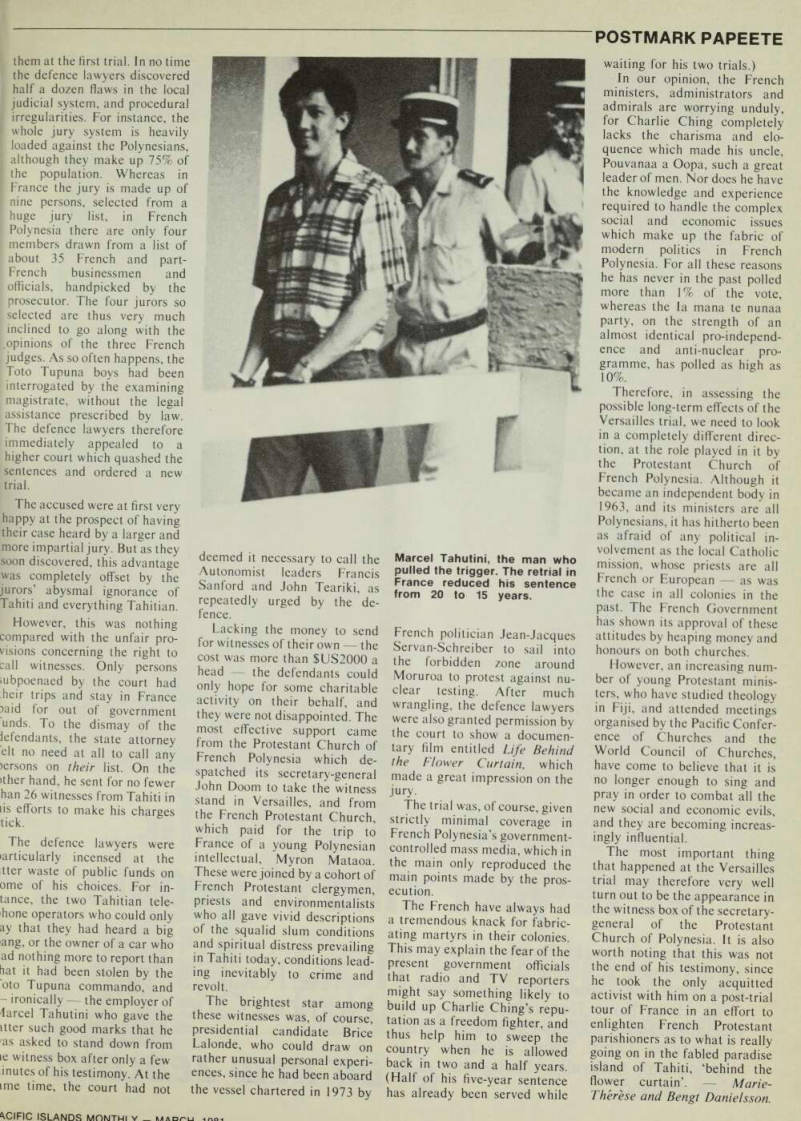
The nine members of the jury (five women and four men), who at the outset knew nothing of Tahitian affairs, were finally sufficiently convinced of the political motivation of the ac cused to consider this an ex tenuating circumstance, justify ing slightly reduced sentences: 15 years instead of 20 for the self-confessed killer Marcel Tahutini, and 12 years instead of 18 for his accomplices. Al though no proof at all was adduced that Charlie Ching had planned or participated in the two commando raids, he was sentenced to a five-year term as against 10 years at the first trial once more on the rather vague charge of ‘having consorted with known criminals’.
The political character of the terrorist acts was always evi dent to all concerned except the French state attorneys.
None of the accused had, for instance, any personal griev ance against their victims, whom they didn’t even know.
They stole nothing from the buildings in which they commit ted their acts. As for the bombing of the telephone exchange, it is sufficient to look at its timing to grasp the reason for it: it took place at the precise moment when the then Minister for French Overseas Territories, Olivier Stirn, was attending a function at the High Com missioner’s residence across the street. To avoid any misunder standing or misinterpretation, the bombers left the following message behind: Take your flag, your people and your constitution, Stirn, and go home.’
The avowed purpose of the second commando raid of the Toto Tupuna boys, as they called themselves, was to scare the daylights out of the thou sands of French immigrants who keep flocking to French Polynesia, to the detriment of the islanders. What they actu ally did fully bears out such a purpose, for they drove one night to an exclusive French residential area on the west coast of Tahiti, entered several villas at random, and threatened to shoot the French women they found in them before eventually letting them free. At the end of the road they came to a particularly plush villa and tried to repeat this scenario. However, it so hap pened that the owner, a former French naval officer turned businessman, was sound asleep in bed. Without the approval of the others, Marcel Tahutini fired two shots at him but spared his Tahitian-Chinese wife. Before leaving the house the intruders pasted the follow ing message on the wall; ’We do not want any more Frenchmen in our country.’
Why then did the French prosecutors during the two trials, first at Papeete and then at Versailles, so steadfastly maintain that the Toto Tupuna boys are common criminals, without political motivation?
The answer is not hard to find: by acting in this manner, the prosecutors hoped to counter the strategy of the defence lawyers, who were bent on putting the whole colonial system on trial. As we have seen, the court once more agreed with the prosecutors which means, among other things, that the six Tahitians sentenced will not enjoy the various privileges accorded to political prisoners.
Another strange fact requir-
ing explanation is why there was a retrial at all, and why it was held in France. The answers constitute yet another indict ment of colonial-style French justice. At the root of it all is the unprecedented step taken by relatives and friends of the Tahitian activists in 1979 when they hired a couple of bright metropolitan lawyers to defend
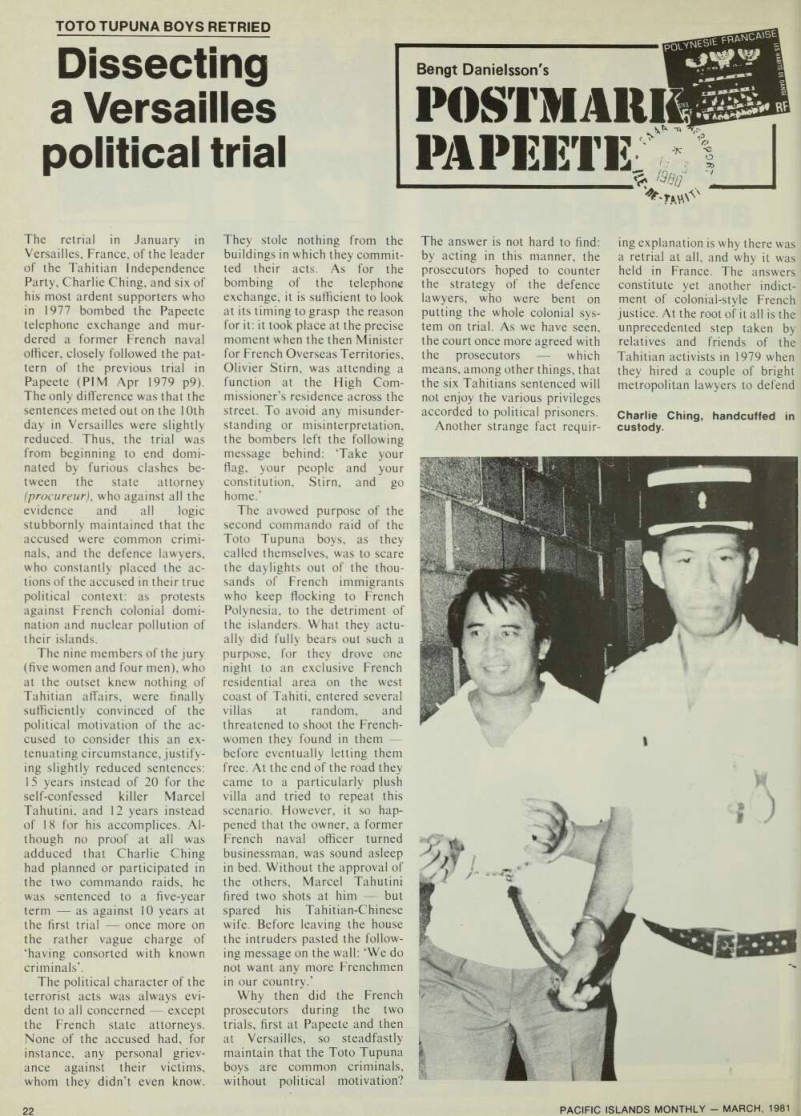
Charlie Ching, handcuffed in custody.
them at the first trial. In no time the defence lawyers discovered half a dozen flaws in the local judicial system, and procedural irregularities. For instance, the whole jury system is heavily loaded against the Polynesians, although they make up 75% of the population. Whereas in France the jury is made up of nine persons, selected from a huge jury list, in French Polynesia there are only four members drawn from a list of about 35 French and part- French businessmen and officials, handpicked by the prosecutor. The four jurors so selected are thus very much inclined to go along with the .opinions of the three French judges. As so often happens, the Toto Tupuna boys had been interrogated by the examining magistrate, without the legal assistance prescribed by law.
The defence lawyers therefore immediately appealed to a higher court which quashed the sentences and ordered a new trial.
The accused were at first very happy at the prospect of having their case heard by a larger and more impartial jury. But as they soon discovered, this advantage was completely offset by the jurors’ abysmal ignorance of Tahiti and everything Tahitian.
However, this was nothing compared with the unfair pro visions concerning the right to call witnesses. Only persons subpoenaed by the court had heir trips and stay in France said for out of government unds. To the dismay of the lefendants, the state attorney elt no need at all to call any )ersons on their list. On the >ther hand, he sent for no fewer han 26 witnesses from Tahiti in lis efforts to make his charges tick.
The defence lawyers were particularly incensed at the tter waste of public funds on ome of his choices. For in tance, the two Tahitian tele hone operators who could only ay that they had heard a big ang, or the owner of a car who ad nothing more to report than hat it had been stolen by the oto Tupuna commando, and - ironically the employer of Parcel Tahutini who gave the itter such good marks that he 'as asked to stand down from ic witness box after only a few inutes of his testimony. At the ime time, the court had not
deemed it necessary to call the Autonomist leaders Francis Sanford and John Teariki, as repeatedly urged by the de fence.
Lacking the money to send for witnesses of their own the cost was more than SUS2OOO a head the defendants could only hope for some charitable activity on their behalf, and they were not disappointed. The most effective support came from the Protestant Church of French Polynesia which de spatched its secretary-general John Doom to take the witness stand in Versailles, and from the French Protestant Church, which paid for the trip to France of a young Polynesian intellectual, Myron Mataoa.
These were joined by a cohort of French Protestant clergymen, priests and environmentalists who all gave vivid descriptions of the squalid slum conditions and spiritual distress prevailing in Tahiti today, conditions lead ing inevitably to crime and revolt.
The brightest star among these witnesses was, of course, presidential candidate Brice Lalonde, who could draw on rather unusual personal experi ences, since he had been aboard the vessel chartered in 1973 by
French politician Jean-Jacques Servan-Schreiber to sail into the forbidden zone around Moruroa to protest against nu clear testing. After much wrangling, the defence lawyers were also granted permission by the court to show a documen tary film entitled Life Behind the Flower Curtain, which made a great impression on the jury.
The trial was, of course, given strictly minimal coverage in French Polynesia’s government controlled mass media, which in the main only reproduced the main points made by the pros ecution.
The French have always had a tremendous knack for fabric ating martyrs in their colonies.
This may explain the fear of the present government officials that radio and TV reporters might say something likely to build up Charlie Ching’s repu tation as a freedom fighter, and thus help him to sweep the country when he is allowed back in two and a half years. (Half of his five-year sentence has already been served while
waiting for his two trials.) In our opinion, the French ministers, administrators anc admirals are worrying unduly for Charlie Ching completely lacks the charisma and elo quence which made his uncle, Pouvanaa a Oopa, such a great leader of men. Nor does he have the knowledge and experience required to handle the complex social and economic issues which make up the fabric of modern politics in French Polynesia. For all these reasons he has never in the past polled more than 1% of the vote, whereas the la mana te nunaa party, on the strength of an almost identical pro-independ ence and anti-nuclear pro gramme, has polled as high as 10%.
Therefore, in assessing the possible long-term effects of the Versailles trial, we need to look in a completely different direc tion, at the role played in it by the Protestant Church of French Polynesia. Although it became an independent body in 1963, and its ministers are all Polynesians, it has hitherto been as afraid of any political in volvement as the local Catholic mission, whose priests are all French or European as was the case in all colonies in the past. The French Government has shown its approval of these attitudes by heaping money and honours on both churches.
However, an increasing num ber of young Protestant minis ters, who have studied theology in Fiji, and attended meetings organised by the Pacific Confer ence of Churches and the World Council of Churches, have come to believe that it is no longer enough to sing and pray in order to combat all the new social and economic evils, and they are becoming increas ingly influential.
The most important thing that happened at the Versailles trial may therefore very well turn out to be the appearance in the witness box of the secretary general of the Protestant Church of Polynesia. It is also worth noting that this was not the end of his testimony, since he took the only acquitted activist with him on a post-trial tour of France in an effort to enlighten French Protestant parishioners as to what is really going on in the fabled paradise island of Tahiti, ‘behind the
flower curtain’.
Marie-
Therese and Bengt Danielsson.
Marcel Tahutini, the man who pulled the trigger. The retrial in France reduced his sentence from 20 to 15 years.