Noumea
p. 21 · Read in the full issue
Dariel Tardieu's
Notebook
Tribes get land and a prediction
‘lt is very clear to me; New Caledonia will stay French for good.’
Statement in January by Paul Dijoud. French secretary of state.
The French Secretary of State for Overseas Territories, Mr Paul Dijoud. spent 10 days in the Pacific in January, three of them on the islands of Wallis and Futuna, and the rest in New Caledonia.
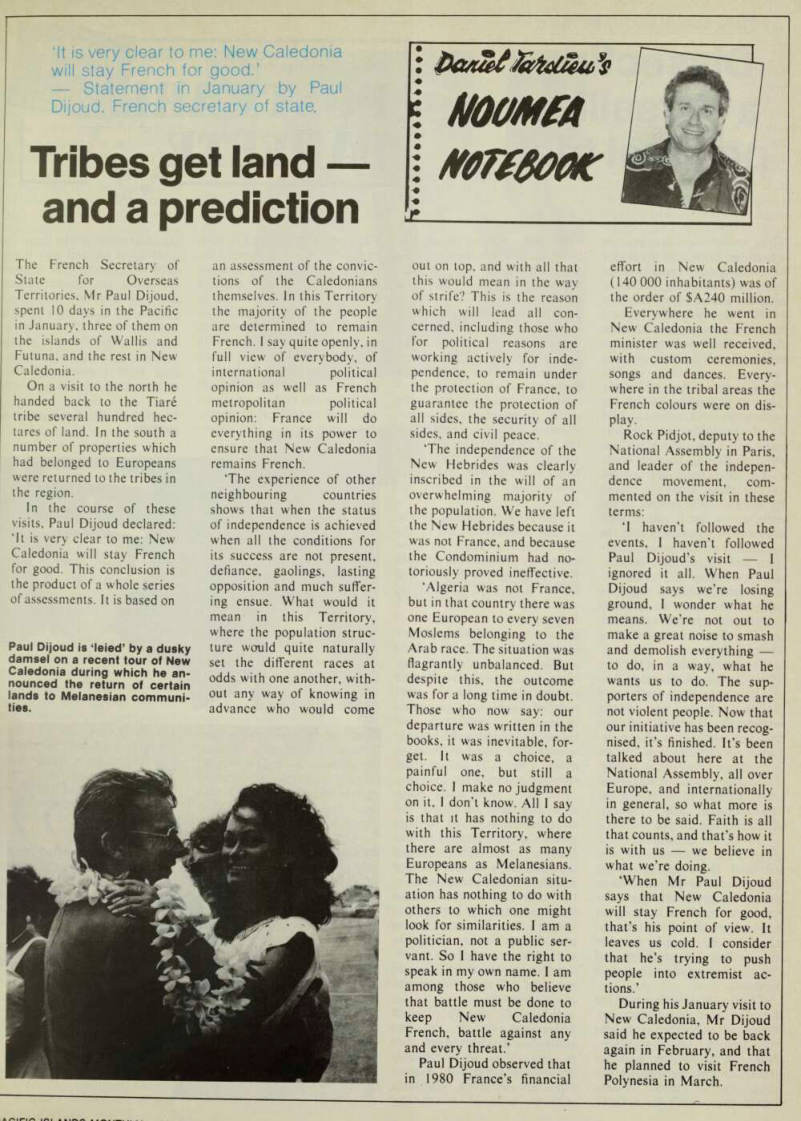
On a visit to the north he handed back to the Tiare tribe several hundred hec tares of land. In the south a number of properties which had belonged to Europeans were returned to the tribes in the region.
In the course of these visits, Paul Dijoud declared: ‘lt is very clear to me: New Caledonia will stay French for good. This conclusion is the product of a whole series of assessments. It is based on
an assessment of the convic tions of the Caledonians themselves. In this Territory the majority of the people are determined to remain French. I say quite openly, in full view of everybody, of international political opinion as well as French metropolitan political opinion; France will do everything in its power to ensure that New Caledonia remains French. ‘The experience of other neighbouring countries shows that when the status of independence is achieved when all the conditions for its success are not present, defiance, gaolings, lasting opposition and much suffer ing ensue. What would it mean in this Territory, where the population struc ture would quite naturally set the different races at odds with one another, with out any way of knowing in advance who would come
out on top, and with all that this would mean in the way of strife? This is the reason which will lead all con cerned, including those who for political reasons are working actively for inde pendence, to remain under the protection of France, to guarantee the protection of all sides, the security of all sides, and civil peace.
The independence of the New Hebrides was clearly inscribed in the will of an overwhelming majority of the population. We have left the New Hebrides because it was not France, and because the Condominium had no toriously proved ineffective. ‘Algeria was not France, but in that country there was one European to every seven Moslems belonging to the Arab race. The situation was flagrantly unbalanced. But despite this, the outcome was for a long lime in doubt.
Those who now say: our departure was written in the books, it was inevitable, for get. It was a choice, a painful one, but still a choice. I make no judgment on it, I don’t know. All I say is that it has nothing to do with this Territory, where there are almost as many Europeans as Melanesians.
The New Caledonian situ ation has nothing to do with others to which one might look for similarities. I am a politician, not a public ser vant. So I have the right to speak in my own name. I am among those who believe that battle must be done to keep New Caledonia French, battle against any and every threat.’
Paul Dijoud observed that in 1980 France’s financial
effort in New Caledonia (140 000 inhabitants) was of the order of SA24O million.
Everywhere he went in New Caledonia the French minister was well received, with custom ceremonies, songs and dances. Every where in the tribal areas the French colours were on dis play.
Rock Pidjot, deputy to the National Assembly in Paris, and leader of the indepen dence movement, com mented on the visit in these terms: ‘I haven’t followed the events, I haven’t followed Paul Dijoud’s visit I ignored it all. When Paul Dijoud says we’re losing ground, I wonder what he means. We’re not out to make a great noise to smash and demolish everything to do, in a way, what he wants us to do. The sup porters of independence are not violent people. Now that our initiative has been recog nised, it’s finished. It’s been talked about here at the National Assembly, all over Europe, and internationally in general, so what more is there to be said. Faith is all that counts, and that’s how it is with us we believe in what we’re doing. ‘When Mr Paul Dijoud says that New Caledonia will stay French for good, that’s his point of view. It leaves us cold. I consider that he’s trying to push people into extremist ac tions.’
During his January visit to New Caledonia, Mr Dijoud said he expected to be back again in February, and that he planned to visit French Polynesia in March.
Paul Dijoud is ‘leied’ by a dusky damsel on a recent tour of New Caledonia during which he an nounced the return of certain lands to Melanesian communi ties.