Santo events spark a memorable
pp. 17-19 · Read in the full issue
war of words in Noumea paper
On November 27 1980, and again on January 15 1981, the Noumea daily Nouvelles Caledoniennes published documents of absorbing interest to all who have tried to follow the recent history of the new nation of Vanuatu. They were first an interview with the prominent Noumea barrister MaTtre Jean Leder, who defended Jimmy Stevens and other Santo accused at their trials, then an open letter replying to Me Leder written by the last French Resident Commissioner in the New Hebrides, Inspector-General Jean-Jacques Robert, and finally a further interview with Me Leder who commented on Mr Robert’s letter. In its capacity as a journal of record, RIM publishes below a full translation of the three documents. The first is the November 27 1980 interview with Me Leder.
With the 14‘h-years gaol sen tence imposed on Jimmy Stevens, the Santo trials have come to an end. Malt re Leder, who handled 400 briefs in the space of two months, is now back in the Territory and has told us of his feelings about the
whole sorry Santo epic, as well as the conclusions he has drawn from it. His account points very directly to the responsibility of the French Government in the Santo rebellion, and makes a forthright denunciation of France’s abandonment of those who had believed in her, her promises and her assistance. ‘From the formal viewpoint,’
Me Leder says, ‘the trials were conducted correctly. No pres sure was put on anyone to prevent the truth being told.
and I was not prevented from saying what I wished. But I would make two qualifications, ‘I) The presiding judge was constantly saying: “We’re here to deal ■ with breaches of the joint regulations. I don’t want politics brought into it.’’ I was obliged to reply that for Ravulia, for example, who was charged with being the No. 3 figure in the Vemarana, it was difficult not to talk politics. ‘2) Another disagreeable aspect was the system of translation. For the Jimmy Stevens trial I had a good interpreter, but there was a problem: I had to stop every 30 seconds for the translation, so my presentation of the defence case lasted two ours - On the deficiencies in the translation system, the barrister pointed out that France had done nothing to help its former friends; ‘I saw that France, although fully responsible for what had happened (there is serious, precise and consistent evidence of this) was taking absolutely no interest in the Santo people and had simply dumped them. Look, I ve defended some of the “Milieu” people in France, and the Milieu look an interest in them right up to the trial and even after. (The Milieu is a term popularly applied to an organisation in France generally believed to have links with the Mafia. PIM.) ‘Given its responsibilities in the Santo affair, I believe that France could at least have given some moral support to Jimmy Stevens. There’s a thousand and one ways of letting a friend know you haven’t forgotten him. Jimmy Stevens said at his trial that the reason he was training troops on Santo was
because he believed that France would set up a military base on the island. He added: “France was to settle in, I wanted to provide her with soldiers.’ ’’
But Me Leder goes further on the matter of responsibility: ‘I was greatly put out by the complete absence of France from the trials of people who would never have done what they did if they hadn’t been pushed into it by representative French authorities. When I speak of serious, precise and consistent evidence, I mean that I have proof, and have gathered the evidence.
Take the case of Inspector- General Robert, for instance.
One could well say that he went mad and that, when he spoke to the Luganville people and then the Fanafo people, he was in a state of dementia. But he wasn’t the only one. Others did worse things than he did. For example, there was this major who did the rounds of Santo to show people how to stage a rebellion. At meetings he drew sketches on a blackboard to demonstrate the mechanics of a campaign of subversion. Then there was this other major who explained to Man Santo that a man armed with a bow and arrow was more dangerous than a man with a gun because an arrow makes no noise. Imagine; and there were the Papuans’ (term invariably used by the French to describe Papua New Guinean soldiers PIM) ‘equipped with bullet-proof vests! The bow-and-arrow fel lows simply took to the scrub at the first sound of gunfire.
There’s also the message sent from Noumea on May 27 giving the green light for insurrection.
It was certainly sent through military radio channels. To
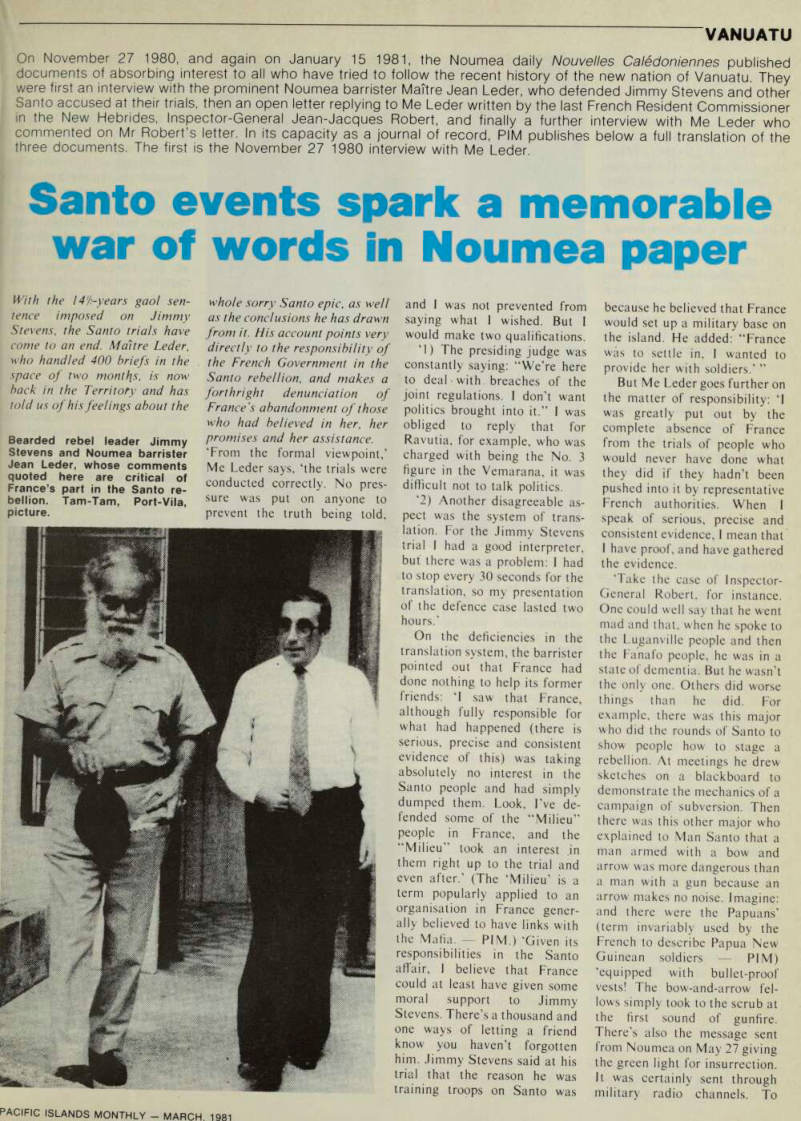
Bearded rebel leader Jimmy Stevens and Noumea barrister Jean Leder, whose comments quoted here are critical of France's part in the Santo re bellion. Tam-Tam, Port-Vila, picture.
check on this message, there is no doubt that Guy Prevost did the round trip to Noumea and back in an aircraft made avail able to him by the adminis tration. Among those waiting to greet him at Santo’s Pekoa airport when he returned was the gendarme. He wasn’t there of his own volition. ‘When Arnaud Lizop went with the Arribaud-Donald mission, he was a legal adviser to the government, charged with an official mission. At the Stevens trial, the minutes of a meeting between Lizop, Stevens and Maliu were pro duced in evidence. The talk at the meeting concerned the con stitution and organisation of a secessionist state. This is why Arnaud Lizop is now banned from visiting Vanuatu. Taking all these factors into account, it is hard to say that the French Government was not the pro moter of the Santo rebellion.’
The regulations under which those who are called ‘the Santo rebels’ were charged are Condo minium regulations. They are joint regulation No. 12 of 1962 dealing with riot situations, and No. 11 of 1974 on disturbances of public order. Me Leder asks: ‘Why were these texts used?
Simply because in the Consti tution set up by Messrs Dijoud and Blaker, which was voted into being at breakneck speed in one night, there is article 93: Joint regulations in force on the day of independence will re main applicable as if they had been decided in application of the Constitution. This clearly shows that the French adminis tration, after pushing the Santo people into staging a rebellion, gave Walter Lini the stick to beat them with.’
Me Leder sums up: ‘This is what makes me doubt the competence and discernment of the French officials working in the Hebrides at the time. I prefer to put it down to incom petence, because if all this had been done advisedly, with full knowledge of the facts, they would be liable to face trial in the common law courts.’
On January 15, 1981, Les Nouvelles published an open letter by I nspector-General Jean-Jacques Robert replying to Me Leder, a reply introduced
by the newspaper in the follow ing way: In reply to an inter view with Me Leder which appeared in Les Nouvelles on November 27 last, Inspector- General Robert has sent us the letter published below. Oddly, he also sent copies to other local newspapers we can only wonder why. If he dis played subtlety and tact of the same order in his political and diplomatic dealings, always wanting to run with the hare and hunt with the hounds, many things can perhaps be explained ...’ Mr Robert’s letter said: MaTtre, I have only just become aware of your statements to the Caledonian press, most particu larly those published in the November 27 issue of Les Nouvelles. I confess that I was astonished to read the charges you make concerning my activi ties, and those of some of my
assistants, in the New Hebrides.
Certainly I realise that it was tactically sound for you to base your defence of J. Stevens and the other Santo accused on a shifting of responsibility for the actions with which they were charged on to other persons who ran no risk of being called before the court. But that should not have led you into giving wide currency in the press to statements which are not only contrary to the truth, but which could well prove damaging to France’s future relations with Vanuatu and the other South Pacific countries.
I was perhaps in a state of dementia (since you say so) when I addressed the Santo people, and I did so many a time during the crisis which pre ceded independence. But one would require a particularly vivid imagination to read into the cautionary words I used on these occasions any encourage ment to a rebellion which 1 knew would meet with the complete disapproval of the French Government. Until the very last minute 1 strove to achieve a just accommodation between the government in Port-Vila and the de facto
government set up in Luganville by J. Stevens. 1 did not succeed, but ! would hope that every honest witness would agree that I did everything I could to reach an agreement.
You also state that French army officers went to Santo to ‘demonstrate the mechanics of a campaign of subversion’. A careful checking of your sources would probably have shown you that these officers, who took no personal initiatives at all, and who were only carrying out my orders, were charged with no such mission.
As for the statement alleging that an aircraft chartered by the administration, or military radio facilities, were used to carry messengers or transmit messages from Noumea to Luganville on May 27,1 declare that it too is completely ground less. Need I remind you that, on the contrary, the New Cale donian authorities strove to ensure scrupulous respect for the decisions taken by the Port- Vila government in relation to the blockade of Santo’s port and airport, as well as the isolation of the island.
Nor did Mr Lizop have the task, as you have said, of setting up ‘the constitution and organis ation of a secessionist state’.
Together with Messrs Arribaud, Donald and Yash Ghai his duty was to seek a form of understanding between Walter Lini and Jimmy Stevens in an effort to reach a compro mise which would have pro vided the island of Santo with a certain number of administrat ive and political freedoms within the state structure of Vanuatu.
If the persons mentioned by you in the article in Nouvelles Caledoniennes had been guilty of the actions alleged by you they would have been disobey ing express instructions issued by the Secretary of State for Overseas Departments and Territories; they did not do so, I can vouch for it.
Moreover none of them to my knowledge has been implicated in any of the procedures and judicial proceedings instituted in Vanuatu after independence by the governmental authorities who, what is more, hastened to deny the rumours then being put about that I, together with
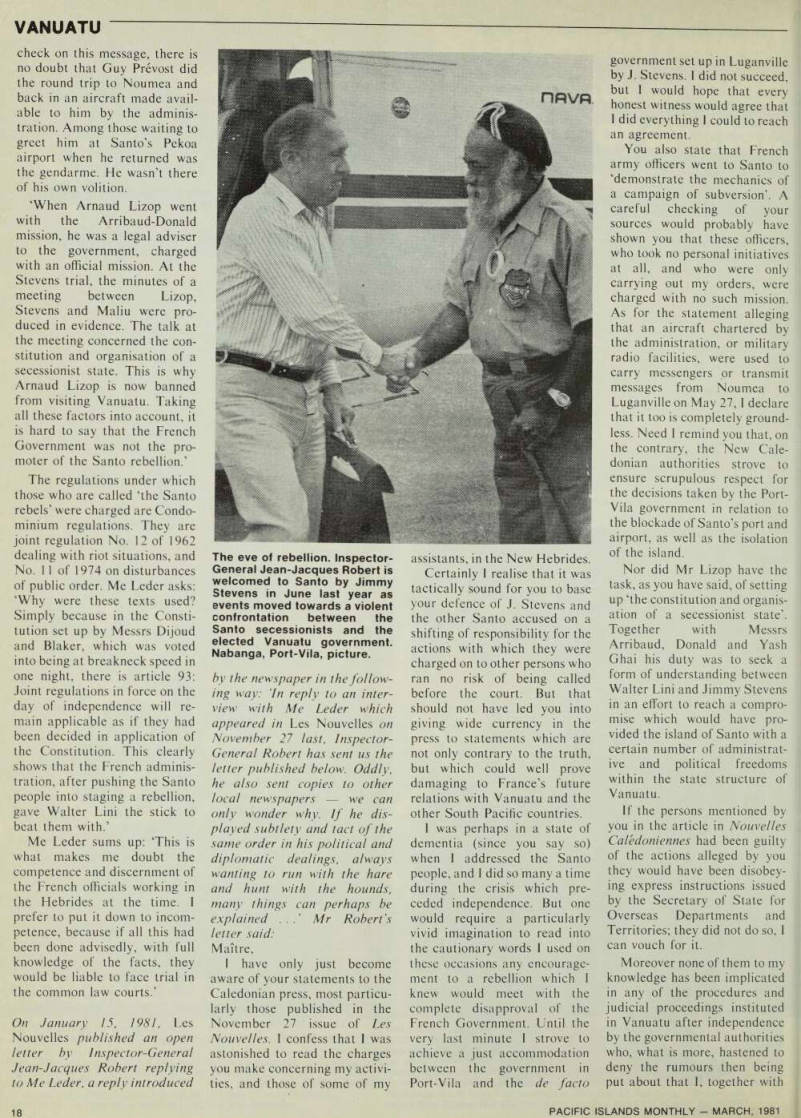
The eve of rebellion. Inspector- General Jean-Jacques Robert is welcomed to Santo by Jimmy Stevens in June last year as events moved towards a violent confrontation between the Santo secessionists and the elected Vanuatu government.
Nabanga, Port-Vila, picture.
Arnaud Lizop, had been de clared a prohibited immigrant.
I understand better than any one the sense of having been left to their fate felt by people who were arrested, gaoled, beaten and sentenced. But however great their misfortune and dis tress, it is completely contrary to the service of the truth to assert, and give countenance to the idea, that the French Government was ‘the promoter of the Santo rebellion’.
In any case, Maitre Leder, do you think that if the French authorities had decided to sup port a real revolt on Santo, they would not have seen to it that the rebels were provided with adequate means to face up to the Papuan detachment — whose intervention, it should be stressed, encountered no resist ance at all.
The fact is that the Santo rebellion was not seditious in the true sense. It was a move ment of grumblers against the Vanuaaku Party’s policies of state centralisation, which some people considered excessive, and nothing more.
The Port-Vila government’s mistake was that it treated these dissidents as if they were serious rebels instead of seeking a compromise solution by the peaceable and liberal methods so familiar in Melanesian societies.
As a result there occurred on the island of Santo many in fringements of basic freedoms which have been condemned by moral authorities as diverse as :he Pacific Council of Churches md Amnesty International. We 'an only deplore the situation, 3ut neither the French Govern ment nor the French officials in Santo bear responsibility for it.
Please be assured, Maitre, of ny very high regard.
J.-J. Robert
Inspector-General of Overseas Affairs I longside Mr Robert’s letter n January 15, Les Nouvelles üblished the following further Uerview with Me Leder: )n receiving this letter, we sked Me Leder for his reac ons. Generally speaking, he as surprised, indeed amused, lat 1.-G. Robert had written it.
Lit he pointed out: ’And I still iven’t told it all .. .’
When I began to study this brief. Me Leder explained, 1 had no idea what I was going to find in it, and certainly I was a million miles from suspecting that I was going to discover the kinds of things I did. I waited until the trials were over, and the final sentence, that on Jimmy Stevens, was pro nounced, before speaking to the press. Then I dealt only with matters made public during the hearings. And I haven’t told it all!
Mr Robert’s speech at Santo was delivered at a public meet ing and the fact that Guy Prevost had arrived on May 27 in a private aircraft which had brought him from Noumea was known to all and sundry. Re turning from an overseas trip (he'd been seeking aid) James
Garae, the Vemarana minister of foreign affairs, was on the same flight. He referred to this at his trial, and others testified to it from the witness box. As I told you, being the only Frenchman at these hearings, I have been loath to say all that I knew about the responsibility of French officials serving in Santo.
As for the activities of French officers Santo, it will be recalled that the French mili tary adviser Major Mansion (dubbed by the English ‘Mr Spy’) held meetings, using sketches and diagrams, to ex plain the techniques of subver sion. I personally received the testimony of a missionary father who had attended one such meeting, and no doubt there are people in the Towers at St Quentin (the apartment build ing on the outskirts of Noumea where about 700 of the ‘refu gees’ from Santo are lodged PIM) who heard this officer explain the anatomy of a re bellion.
Noram I revealing any secret by saying that the gendarmerie’s radio was used both for communications be tween Vemarana and the Port- Vila government, and for com munications with Noumea. In the case of Arnaud Lizop, he is a colleague and I respect him. I recall him making a quite shattering statement in Noumea which impressed me.
But at the Santo trials I had in my hands exhibits produced by the Public Prosecutor. They included in particular the min
utes of a meeting between J.
Stevens, Maliu and Lizop, at which the latter explained to them how to prepare the consti tution of a secessionist state. All this was publicly stated and is part of the record. Moreover, in the Sydney Morning Herald of December 27 last, the Aust ralian journalist Peter Hastings published an interview with Stevens in which the Nagriamel leader says that 1.-G. Robert encouraged him in the idea of making Santo an independent island.
All this has led me to the conclusion that a number of French officials certainly did encourage the Santo people to rebel. In his letter, Mr Robert says that if France had wished to support a rebellion, it would have provided the means necessary to stand up to the Papuans. But what the Santo people hold against Mr Robert and the others is precisely that they pushed them into the secession and then failed to provide them with the promised means. Here again, 1 have not told everything, because there are still French people in Vanuatu ...
When Mr Robert speaks of a ‘movement of grumblers’ I can only smile; the assault on the British Paddock, the looting of warehouses, the burning of the copra mill, the ambush on the Melcofe road, the dynamiting of the Unelco plant, all these things were part of a grumblers’ movement? Just as well they were only grumbling!
As for the reprisals undertaken against the Santo people which are described by Mr Robert as a mistake, it should be stated that the Vila government was doing nothing but applying the Constitution prepared by France and Great Britain, which stipulated that joint regulations would remain in force, in particular those relating to the repression of native revolts!
In conclusion, I will only say that Mr Robert’s letter sur prised me, because I didn’t think he’d have the cheek to write it. The letter outlines Mr Robert’s own feelings, but has failed utterly to convince me. • The documents above were translated by PIM Associate Editor Malcolm Salmon.
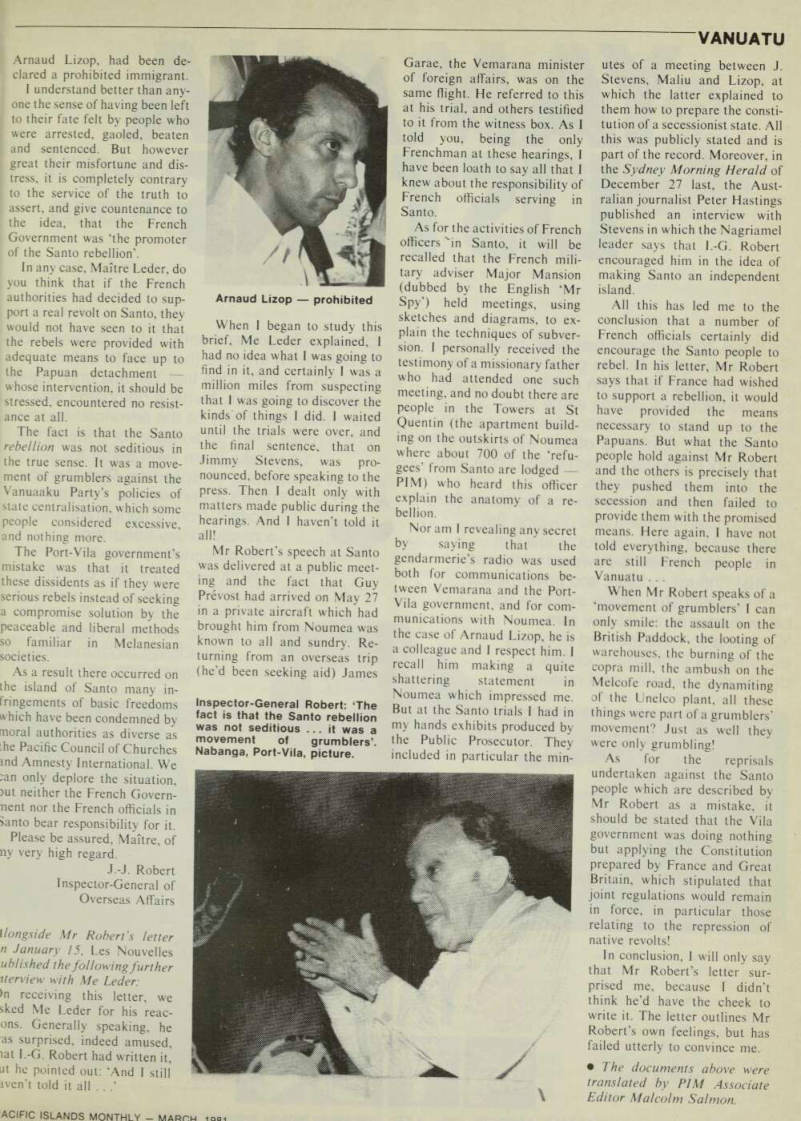
Arnaud Lizop - prohibited
Inspector-General Robert: 'The fact is that the Santo rebellion was not seditious ... it was a movement of grumblers’.
Nabanga, Port-Vila, picture.