pine plans
pp. 33-37 · Read in the full issue


Political
Currents
Political threat in pine plans
In a situation involving politics and the economy, Fiji faces a serious threat to its much-vaunted pine timber project Does the government take in an unwanted partner or does it fly in the face of electorate opinion? Either way would seem to be inviting trouble. Writing from Suva, CHRISTY SILLS has a look at the situation.
Political concern is growing in Fiji over the manner in which a little-recognised development company from USA entered Fiji under the government’s guard, won the support of an influential group of land owners and is now using this support in an attempt to become a major partner in the big Fiji pine timber project.
The government, which had planned to invite an established and recognised company to be a partner in the timber project, has been forced into a corner and has still not resolved the situation. It is frankly sus picious of the manner in which the US firm, United Marketing Corporation, won the support of the land owners. It also has doubts about UMC’s capacity to meet all the commitments which would be involved. But the land owners, won over by promises from UMC, are putt ing strong electorate pressures on the government to accept a UMC partnership and are using independent political support in parliament.
To add to the government’s concern there are now alle gations that UMC, which can vassed support at the village level, is linked with the contro versial US-based Phoenix Foun dation. The Phoenix Foun dation is an authoritarian free enterprise group which preaches the elimination of all government control in business and commerce. In 1972 it clashed with the King and government of Tonga when it attempted to take possession of a Tongan reef. Later the Phoenix Foundation was ac ively involved in support for he Vanuatu rebel leader limmy Stevens, and it has been iccused of meddling in the tffairs of other Pacific Island md some Caribbean countries.
The timber project in Fiji
which is at the centre of the controversy involves the plant ing, logging, milling and pro cessing of new pine forests under a scheme controlled by a statutory organisation, the Fiji Pine Commission. The first stands matured last year and have already brought in over seas earnings of about SFI million. The next stage of the project will be the establish ment of a complete industrialis ation system to process the increasing volume of pine which will become available. To bring in the necessary expertise and capital the government pro posed a three-way partnership.
The partnership is to consist of the government itself through pine commission, the land owners who control 85% of the land on which the pine is growing, and an industrial de veloper.
By the middle of last year the government had a short list of three applicants to become its industrial partner. All three have recognised expertise and financial backing, and they have prepared proposals for making sawn timber, fibre board, wood-chemical products, paper, pulpwood, wood chip and alternative fuels.
The three short-listed con tenders were British Petroleum South West Pacific Ltd, Shell Fiji Ltd in association with New Zealand Forest Products, and the M.K. Hunt Foundation Ltd of New Zealand.
Shortly before the govern ment was to make its choice, UMC entered the field as a fourth contender. UMC officials earlier had sidestepped official channels and worked directly at the village level enlisting support from the land owners. Their efforts were so persuasive that many of the land owners were prepared to assign marketing rights uni
laterally to UMC. Concerned at the trend, the Prime Minister, Ratu Sir Kamisese Mara, warned ‘foreign timber hi jackers, beware’. The pine com mission also warned the land owners not to act unilaterally on the grounds that such action would have no legal standing.
Pressures from the land owners became so great how ever that the government was forced to allow UMC to submit a late proposal for partnership in the scheme. The land owners flocked to the Ministry of Finance building and held a prayer meeting in the base ment, praying for the success of the UMC application. UMC’s 84-page proposal was submitted to the government by the UMC president, Mr Paul Sandblom, who was accompanied by the man described as his timber adviser, Mr Jay Gruinfeld. The government has yet to announce its decision.
UMC was incorporated in Arizona in 1975. Inquiries about its background have not indicated any experience in the timber industry, and the com pany s activities were described to one inquirer as ‘undeter mined’. Sandblom owns an automotive firm in Glendale, Arizona, and it is linked to what is described as a ‘training insti tute’.
The extent to which UMC had been successful in selling its position at grassroots level be came evident in August last year when tensions mounted over the assignment of market ing rights.
Increasing speculation about Phoenix Foundation links is supported by the involvement of a controversial figure in Fijian politics, Ratu Osea Gavidi, a high chief in the western div ision of Viti Levu, independent member of parliament and an influential leader of the land owners.
Initially the land owners were not enthusiastic about the pine scheme because they are subsistence farmers with little knowledge of long-term rural development projects. But as the trees began to grow and increasing reference was made to the potential earnings the land owners became anxious in case the money passed them by.
However they remained sus picious of government motives and became emotional about
their rights as land owners.
Against this background they became receptive to many influences including the UMC ‘sales drive’.
Working through Ratu Osea Gavidi, UMC chose from the start to bypass official channels and instead sold its industrialis ation plans at village level.
Meeting across the yaqona bowl, Paul Sandblom and other representatives reportedly talked of profits of up to $5O million a year to be divided equally between UMC and the land owners if UMC were assigned the marketing rights.
Such a figure exceeds even the most optimistic estimates.
Presenting its proposal, UMC admitted that it may ‘seem unusual that we would be willing to share 50% of the profit from the operation while still paying slumpage for the right to harvest trees, retiring the debt and paying all the capital works.’
UMC’s proposed capital in vestment is $2.5 million, a figure which government ad visers describe as ‘a gross understatement of what is needed . It contrasts sharply with figures of $lOO million and more offered by other con tenders.
UMC won much of its sup port by advocating sawmills and other industrial installations at village level, rather than the establishment of a central pro cessing complex. But here, 100, government advisers are con cerned. They say that if Fiji wants a reliable and efficient export industry from the project a central technologically developed plant is essential.
Ratu Osea, the politician who has been acting as a liaison man for UMC, is a powerful force in Fiji politics and his involvement has added to the government’s concern. He has a persuasive personal manner, is a good speaker and has gained much of his reputation in the present controversy because of his
earlier studies in forestry at an Australian university. He was ordered out of the New Hebrides (now Vanuatu) in 1976 because of his links with the Santo Island secessionist Jimmy Stevens, and it was later found that the private aircraft which flew him home to Fiji had been allocated for Stevens’ use through Phoenix Foundation links in USA. Eight of the land owners involved in the contro versy were recently flown to Hawaii for what was described as a ‘fact-finding mission’. Over seas interests, which have not been named, paid for the tour.
The pine scheme is seen as vital to the rural development of Fiji, particularly as it is already well established and is heavily committed.
The land owners are digging in their heels and insist that the partnership must go to UMC, claiming that their own govern ment is interested only in ex ploiting them. The political and economic consequences of the situation are becoming increas ingly serious as the government looks for a solution.
G. A. Henry new
party leader
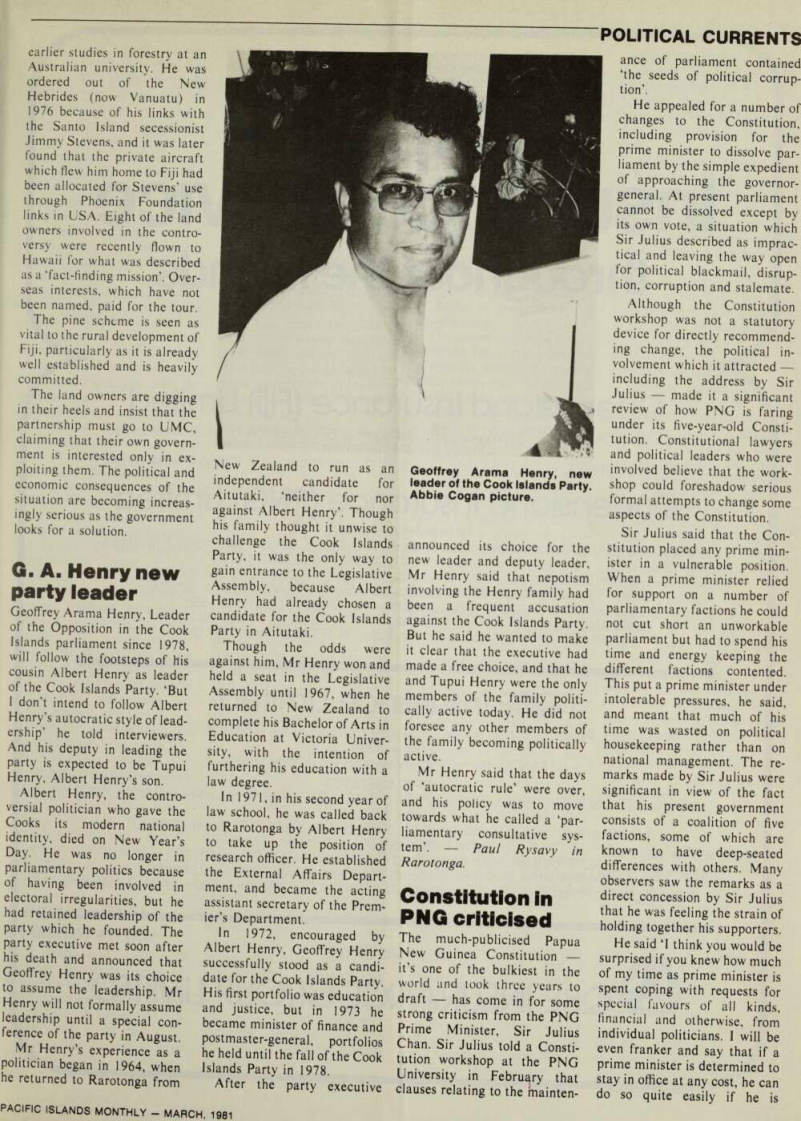
Geoffrey Arama Henry, Leader of the Opposition in the Cook Islands parliament since 1978, will follow the footsteps of his cousin Albert Henry as leader of the Cook Islands Party. ‘But I don’t intend to follow Albert Henry’s autocratic style of lead ership’ he told interviewers.
And his deputy in leading the party is expected to be Tupui Henry, Albert Henry’s son.
Albert Henry, the contro versial politician who gave the Cooks its modern national identity, died on New Year’s Day. He was no longer in parliamentary politics because of having been involved in electoral irregularities, but he had retained leadership of the party which he founded. The party executive met soon after his death and announced that Geoffrey Henry was its choice to assume the leadership. Mr Henry will not formally assume leadership until a special con ference of the party in August.
Mr Henry’s experience as a politician began in 1964, when he returned to Rarotonga from
New Zealand to run as an independent candidate for Aitutaki, ‘neither for nor against Albert Henry’. Though his family thought it unwise to challenge the Cook Islands Party, it was the only way to gain entrance to the Legislative Assembly, because Albert Henry had already chosen a candidate for the Cook Islands Party in Aitutaki.
Though the odds were against him, Mr Henry won and held a seat in the Legislative Assembly until 1967, when he returned to New Zealand to complete his Bachelor of Arts in Education at Victoria Univer sity, with the intention of furthering his education with a law degree.
In 1971, in his second year of law school, he was called back to Rarotonga by Albert Henry to take up the position of research officer. He established the External Affairs Depart ment, and became the acting assistant secretary of the Prem ier’s Department.
In 1972, encouraged by Albert Henry, Geoffrey Henry successfully stood as a candi date for the Cook Islands Party.
His first portfolio was education and justice, but in 1973 he became minister of finance and postmaster-general, portfolios he held until the fall of the Cook Islands Party in 1978.
After the party executive
announced its choice for the new leader and deputy leader, Mr Henry said that nepotism involving the Henry family had been a frequent accusation against the Cook Islands Parly.
But he said he wanted to make it clear that the executive had made a free choice, and that he and Tupui Henry were the only members of the family politi cally active today. He did not foresee any other members of the family becoming politically active.
Mr Henry said that the days of ‘autocratic rule’ were over, and his policy was to move towards what he called a ‘par liamentary consultative sys tem’. Paul Rysavy in Rarotonga.
Constitution in
PNG criticised
The much-publicised Papua New Guinea Constitution it’s one of the bulkiest in the world and look three years to draft has come in for some strong criticism from the PNG Prime Minister, Sir Julius Chan. Sir Julius told a Consti tution workshop at the PNG
University in February that
clauses relating to the mainten
ance of parliament contained ‘the seeds of political corrup tion’.
He appealed for a number o changes to the Constitution including provision for the prime minister to dissolve par liament by the simple expedient of approaching the governor general. At present parliament cannot be dissolved except by its own vote, a situation which Sir Julius described as imprac tical and leaving the way open for political blackmail, disrup tion, corruption and stalemate.
Although the Constitution workshop was not a statutory device for directly recommend ing change, the political in volvement which it attracted including the address by Sir Julius made it a significant review of how PNG is faring under its five-year-old Consti tution. Constitutional lawyers and political leaders who were involved believe that the work shop could foreshadow serious formal attempts to change some aspects of the Constitution.
Sir Julius said that the Con stitution placed any prime min ister in a vulnerable position.
When a prime minister relied for support on a number of parliamentary factions he could not cut short an unworkable parliament but had to spend his time and energy keeping the different factions contented.
This put a prime minister under intolerable pressures, he said, and meant that much of his time was wasted on political housekeeping rather than on national management. The re marks made by Sir Julius were significant in view of the fact that his present government consists of a coalition of five factions, some of which are known to have deep-seated differences with others. Many observers saw the remarks as a direct concession by Sir Julius that he was feeling the strain of holding together his supporters.
He said ‘I think you would be surprised if you knew how much of my time as prime minister is spent coping with requests for special favours of all kinds, financial and otherwise, from individual politicians. I will be even franker and say that if a prime minister is determined to stay in office at any cost, he can do so quite easily if he is
Geoffrey Arama Henry, new leader of the Cook Islands Party.
Abbie Cogan picture.
prepared to grant enough favours. But if he follows that course, what happens to the good of the country and the people as a whole?’
Sir Julius said that when a prime minister reached the stage of being unable to govern effectively, and realised this because of conflict among his supporters and in parliament, he should have the power to seek and obtain a dissolution of parliament by approaching the head of state. (Under the consti tutional structure and as a member of the Commonwealth of Nations PNG recognises Queen Elizabeth as head of state represented by a governor general who is a PNG citizen elected by parliament).
Sir Julius said that under the present system where only par liament could dissolve itself, it was possible for a dissident parliament to deliberately keep itself in office and at the same time deny the government a stable base from which to govern. Potential corruption then arose because a prime minister had to resort to politi cal favours to hold together some form of support.
Sir Julius also criticised the constitutional situation which allowed frequent attempts to unseat a government and prime minister by ambitious poli ticians. He was referring to the process of no-confidence which has been exercised repeatedly in the PNG parliament. Sir Julius himself came to power through this process, although the man behind the move was not Sir Julius himself. The move came from Mr lambakey Okuk, now deputy to Sir Julius.
Sir Julius said there was a need to carefully re-examine the situation and provide greater restraints on when and how votes of no-confidence could be initiated.
Angry politics
in Guam strike
In a deep-seated strike with political, industrial and even cultural overtones, 700 teachers and supporting workers walked off the job on Guam in mid- January over a pay claim.
It was the biggest walkout Guam has known and was the first serious test of union
strength in opposition to politi cal leadership. It was also the first strike against the govern ment on Guam. It led to angry picketing incidents, to fluctuat ing loyalties by some workers who had never before experi enced industrial action and to allegations that political agi tation from outside had contrib uted to the problem. There were also claims that the strike had broken traditional Micronesian cultural attitudes towards work.
Four death threats were re ceived by the Director of Edu cation, Mrs Aguon, although no violence was reported.
At last report the strikers were still standing out after three weeks off the job, and there were threats of calling for union support from as far away as Australia, Japan, Hawaii and west coast USA.
Although members of the Guam Federation of Teachers were the central figures in the strike there was also some support from other government workers and from supporting workers in the education sys tem. A series of huge rallies fanned the strike fever. The teachers claimed they were striking on behalf of the entire government workforce.
The origin of the strike went back to protracted claims last year for higher rates of pay. The original claim was for an across the board increase of 30%, but in August the immediate heat was taken out of the claims when government workers were granted a flat increase of $7OO on annual salary. This amounted to about 5% on aver age pay packets.
The situation erupted angrily in December however when members of the 15th Guam Legislature awarded them selves pay rises ranging from 35 to 50%. A rally and a union vote followed, calling a strike of all members of the federation of teachers. About three-quarters of the membership voted, and of these 70% supported strike action. The strike went ahead despite a series of delaying legal and political tactics. Port workers threw in their lot with the teachers, and there were picketing incidents on the wharves involving port workers and truck drivers.
Suspension notices were
served on 700 Department of Education employees, followed by threats of dismissal which only entrenched the confron tation between the government and the strikers. Legal penalty actions were also filed against the unionists.
A representative of the American Federation of Teachers, Mr Stephen Porter, flew from USA and addressed a rally in which he urged the teachers to maintain their picket lines at schools and offices ‘for as long as it takes’.
He also outlined financial aid available to them from US union sources.
The government was heavily criticised for alleged attempts to split the strikers on a racial basis. Governor Paul Calvo of Guam made a television plea to the local Chamorro people in volved in the strike not to follow the lead of the American teachers involved. Mrs Marcia Hartsock, executive director of the teachers federation accused him of ‘pitting Statesiders against Chamorros’ in what was essentially a Guam issue.
M. L Berg on Guam.
New Zealand’s
Pacific role
A German academic believes that New Zealand is taking an increasingly important role as a stabilising influence in the de velopment of small island nations in the South Pacific. He is Professor Ulrich Schwein furth, director of the geography department at the South Asia Institute of Heidelberg Univer sity in Germany. His views on New Zealand’s relationships in the Pacific are contained in a recent issue of Aussen Politik, a German foreign affairs review.
He said that New Zealand influence had been a factor in controlling the spread of ‘alien and undesirable’ influences in the South Pacific.
Professor Schweinfurth said that with 200-mile economic zones, New Zealand had a completely new future, with a position of dominance in the South West Pacific. He claimed that the people of New Zealand had yet to realise this, but the small island states were already looking to New Zealand as a stabilising factor.
Noting the continuous chain of islands, all with 200-mile zones, from Tokelau to the sub- Antarctic, the writer said all the states in-between had worked in close co-operation for some time. ‘All these islands look mainly to New Zealand for economic and other forms of support and New Zealand has made a good name for itself in these and other islands in the course of the years’. Professor Schweinfurth said.
New Zealand, as a ‘reliable partner’ of the West, had man aged to control alien influences in the region, as well as advise states ‘which because of their difficult economic situation are especially susceptible’.
Professor Schweinfurth said ‘New Zealand, thanks to its geographical situation and the skilful use of the possibilities the law of the sea conference allowed, as well as its experi ence in the South West Pacific area, has become a political factor in tropical and subtropi cal South West Pacific, though it does not have great techno logical power. It exerts influence by pragmatic use of the given possibilities’.
The professor said that Pacific states prefer ‘little’ New Zealand to the immensely larger Australian continent. ‘Australia’s tasks, assuming agreement can be reached on a sensible division of labour be tween the antipodean neigh bours, especially in the South West Pacific, lie towards Melanesia, and mainly New Guinea, Indonesia and South
East Asia.’
Michael Field in
Wellington.
Tonga election
set for May
Tonga will hold elections on May 1 for the seven people’s representatives in its Legislat ive Assembly. The Assembly is made up of a speaker and cabinet appointed by the King, seven nobles elected by the 33 nobles in the kingdom, and the people’s representatives. The assembly will meet soon after the May elections to swear in the new people’s representatives and to prepare estimates for the 1981/82 financial year.