Ships
pp. 65-66 · Read in the full issue

Tago’s fellow ministers refused to accept the compromise.
The acting foreign affairs minister, Mr Korowi, acknowl edged the loss of revenue but said that a principle of far greater concern was involved.
As part of its other sanctions against Russia PNG is refusing to be involved in fisheries co operation, has banned official visits between the two countries and is refusing to allow its citizens to accept scholarships or training facilities sponsored by Russia.
Sail and power
for cruiser
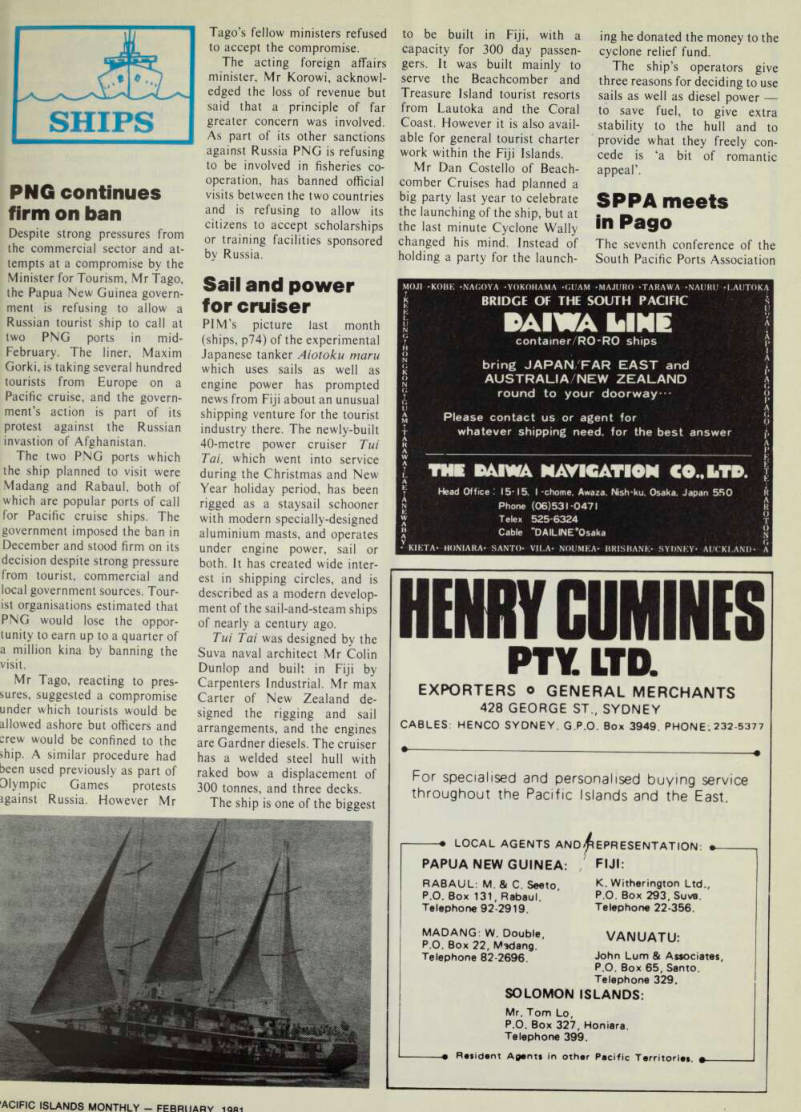
PI M’s picture last month (ships, p 74) of the experimental Japanese tanker Aiotoku maru which uses sails as well as engine power has prompted news from Fiji about an unusual shipping venture for the tourist industry there. The newly-built 40-metre power cruiser Tui Tai, which went into service during the Christmas and New Year holiday period, has been rigged as a staysail schooner with modern specially-designed aluminium masts, and operates under engine power, sail or both. It has created wide inter est in shipping circles, and is described as a modern develop ment of the sail-and-steam ships of nearly a century ago.
Tui Tai was designed by the Suva naval architect Mr Colin Dunlop and built in Fiji by Carpenters Industrial. Mr max Carter of New Zealand de signed the rigging and sail arrangements, and the engines are Gardner diesels. The cruiser has a welded steel hull with raked bow a displacement of 300 tonnes, and three decks.
The ship is one of the biggest
PNG continues
firm on ban
Despite strong pressures from the commercial sector and at tempts at a compromise by the Minister for Tourism, Mr Tago, the Papua New Guinea govern ment is refusing to allow a Russian tourist ship to call at two PNG ports in mid- February. The liner, Maxim Gorki, is taking several hundred tourists from Europe on a Pacific cruise, and the govern ment’s action is part of its protest against the Russian invastion of Afghanistan.
The two PNG ports which the ship planned to visit were Madang and Rabaul, both of which are popular ports of call for Pacific cruise ships. The government imposed the ban in December and stood firm on its decision despite strong pressure from tourist, commercial and local government sources. Tour ist organisations estimated that PNG would lose the oppor tunity to earn up to a quarter of a million kina by banning the visit.
Mr Tago, reacting to pres sures, suggested a compromise under which tourists would be allowed ashore but officers and crew would be confined to the ship. A similar procedure had been used previously as part of Dlympic Games protests igainst Russia. However Mr
to be built in Fiji, with a capacity for 300 day passengers. It was built mainly to serve the Beachcomber and Treasure Island tourist resorts from Lautoka and the Coral Coast. However it is also available for general tourist charter work within the Fiji Islands.
Mr Dan Costello of Beachcomber Cruises had planned a big party last year to celebrate the launching of the ship, but at the last minute Cyclone Wally changed his mind. Instead of holding a party for the launch-
ing he donated the money to the cyclone relief fund.
The ship’s operators give three reasons for deciding to use sails as well as diesel power to save fuel, to give extra stability to the hull and to provide what they freely con cede is ‘a bit of romantic appeal’,
SPPA meets
- D
POflO
The seventh conference of the South Pacific Ports Association
was held in Pago Pago, American Samoa, late last year.
Official delegates attended from Australia, New Zealand, Papua New Guinea, Kiribati, New Caledonia, Western Samoa, Fiji, Saipan, Yap, Kosrae, the Cook Islands and Solomon Islands.
The association was set up to promote regional co-operation,
friendship and understanding
between port members and port users, and to promote measures to increase the efficiency and harmonious development of ports in the South Pacific.
Anchor threat to
drunk goes
Suva City Council in December took drastic action to remove two massive iron anchors which had stood for about a year outside the city’s Old Town Hall. The reason? They were judged to be a possible ‘hazard to passing inebriates’.
The council’s action was hotly contested by Malcolm Brain, a director of Fiji Biomarine Ltd, which leases the Old Town Hall and uses it as an aquarium. It also owns the anchors.
But Suva’s Mayor Cr Maan .Singh said Fiji Biomarine had been warned more than six months ago to remove the anchors, but had made no move to do so.
The anchors had been placed in a footpath reserve outside the defined area leased by the company.
A variety of alternative ar rangements had been discussed, but nothing happened. Hence the council’s direct action on December 7.
Writing in The Fiji Times on the affair, the columnist ‘Beach comber’ added a new and slightly sinister dimension to it. ‘Beachcomber’ said: The saga of the Suva Aquarium’s anchors, in which the Suva City Council appears not to have covered itself with glory may have another, darker aspect.
The anchors are from the ship, Cardinia, which left Levuka, on September 22, 1921.
She was becalmed and drifted in the current on to the Toberua Reef.
Her captain, a mariner named Smith, is said to have ordered that five big anchors be dropped to prevent his ship being driven on to the reef.
The anchors failed to hold and the ship was lost, but not before the enraged Captain Smith had placed a sailor’s curse upon the offending anchors.
The curse, believed by some to be active until this day, is that if ever the anchors were removed in anger from their place of rest the person or persons responsible would suffer severe ill-health and financial trouble until the anchors once again were in their rightful place.
A mariner’s curse is taken very seriously in certain parts of the world. Who knows, now, what may happen?
Meantime Suva waits with bated breath to see what next their city fathers are about to decree for the safety of our city’s revellers.
Anchors, they say, are aweigh!
Diamantina
gift to Qld
HMAS Diamantina, the Royal Australian Navy frigate on which the Japanese forces in Nauru and Ocean Island officially surrendered in 1945 at the end of World War 11, has been presented by the Aust ralian Government to the Queensland Maritime Museum Association.
Diamantina, now decommis sioned, will be installed as a permanently dry-berthed exhibit within the old graving dock at South Brisbane.
The ship had spent her last 20 years of active life as an oceano graphic research vessel.
Australian Prime Minister Malcolm Fraser said it was fitting that Queensland should be the final home for Diaman tina.
The ship had been built in Queensland by Walkers Ltd at Maryborough, was named after the wife of Queensland’s first Governor Sir George Bowen, and carried the same name as one of Queensland’s major rivers.