Yachts
pp. 67-69 · Read in the full issue
• WINDSTAR. This 12.6 m Sparkman & Stephens fibreglass sloop was in Funafuti, Tuvalu, in December, reports Peter McQuarrie. She was sailed by owner/skipper Wally Sanger and son Greg from the Hawaiian Yacht Club, with crew Richard Dempsey of the Lahaina Yacht Club.
Windstar called at Funafuti from Rotuma, and after visiting some northern Tuvalu islands expected to sail to Tarawa, Kiribati, then to Nauru. • RAIL! 111. A report from Japan by merchant marine officer Gordon Grey brings us up to date with the doings of the yacht Raili 111, and of those who sail in her, Arvo and Raili Nokelainen. Gordon Grey writes: ‘Raili 111 visited Port Sudan as planned, and the Nokelainens were able to or ganise a trip to the ancient city of Suakin nearby through which port the Queen of Sheba once travelled. From there through the Suez Canal to the Mediterranean, where the boat
• ALBATROSS. A Valiant 40 fibreglass cutter arrived at Tubuai, Austral Islands, in November, 1980, reports Don Travers. On board were Chuck and Hertha Stotts of Seattle, Washington, USA. They bought their yacht new in Washington in 1977 and made a shakedown cruise in 1978 in Canadian waters before leav ing Seattle in 1979 for Cali fornia, Mexico, Costa Rica, Galapagos Islands, Easter Island, Pitcairn Island, Mangareva and Tahiti. Plans from Tubuai were to sail to Raivavae and the southern Tuamotus and return to Tahiti before heading west towards Australia in April on a planned circumnavigation.
Their present voyage is actu ally the continuation of an earlier round-the-world cruise which commenced in 1968 on an earlier Albatross, a 10m wood-planked Colin Archer cutter purchased in Norway. At that time Chuck met the Danish Hertha and they cruised the canals of Europe, and then the Mediterranean, Scandinavia, Canaries, West Indies, Panama, Galapagos, Marquesas, Tuamotus, Tahiti and Hawaii, where they arrived in 1973 and sold the earlier boat. Chuck decided to accept a job for an American com pany in Saudi Arabia for five /ears, permitting the purchase af a larger yacht to continue
their circumnavigation.
Bad luck struck during their time at Tubuai, with Chuck suffering from a serious infec ion of the foot. On December he was flown, accompanied ay Hertha, to Tahiti where the aetter hospital facilities would, t was hoped, speed up his Jure. Hurried plans were made or me, accompanied by a Tench cruising couple, Gilles Borgnon and Chantal Morin, yho are schoolteachers at übuai, to sail the Albatross to 'ahiti for the Stotts.
wintered. During the spring, Arvo and Rail! visited Greece, Turkey, Cyprus, Italy and Spain, and were in Tenerife in late October 1980. From there, plans were to sail to Barbados, being in Bridgetown until mid- December. After that, they intend cruising in the West Indies and the Gulf of Mexico, before heading for the Panama Canal and the Pacific.’ • FRAUKEN. A Bremen registered gaff-rigged 10m yacht, is on the hard for refit at Oram’s Marina in Whangarei, New Zealand, taking time out from a second voyage around the world, reports Jane Deßidder. The first was a two year circumnavigation for which solo sailor Utz Mailer- Treu was awarded the Blue Water Cruising Medal in 1976.
He was the seventh man to sail single-handed around the world. MUIIer-Treu’s route is undecided: ‘I am at a cross roads here. I can carry on by way of the Roaring Forties or via the Great Barrier Reef and the Indian Ocean, or I can go north to Alaska and home by way of the Panama Canal.’ The German-born blue water voy
ager has spent most of his life at sea. Shipwrecked at 21 years of age when a Belgian motor yacht on which he was serving as engineer foundered in bad weather in the Bay of Biscay, he was picked up by a passing British ship and left in Port-of-Spain, Trinidad. Here he was taken on by a Nor wegian ship. As a result, he was to serve in the Norwegian merchant marine for 25 years.
Sixteen years ago, Utz bought a fishing boat hull of Norwegian pine, sturdily con structed to withstand ice, iron fastened on oak frames. Work ing behind his house in Bremen, he put on a keel, mast and cabin, and outfitted the sloop with cotton sails which he personally hand-stitched.
He installed a 16hp Saab diesel engine. He installed Aries self-steering gear only recently in Las Palmas, a piece of equipment slightly out of harmony with the orange clinker-hulled vessel’s var nished spars and tanned sails, dead eyes and baggy wrinkle.
Describing Frauken as ‘the smallest and youngest of the Tall Ships’, Utz says, ‘I wouldn’t change with any boat in the harbour’. • SEAFREE. This is Lloyd and Jaquie Grime’s 16m, 50-tonne, double-ended ketch. She’s a steel adaptation of an Alden design, built in Huntington Beach, California, in 1965 by George Sutton, finished off by the Grimes themselves. Lloyd, a plant engineer, found that his welding and machining back ground came in handy.
Seafree carries 1275 gallons of fuel, 940 gallons of water. A Daimler-Benz engine is situ ated in the keel, and she’s equipped with a Wood- Freeman auto pilot of the ‘hunting’ type. ‘We’ve always wanted to go cruising. When our two boys were grown, we became runaway parents!’
Between Socorro Island off Mexico and the Marquesas, Seafree reeled off 200 and 240 nautical mile days before they reduced sail. Lloyd lost more than 20kg as a result of hepatitis contracted in the Tuamotus. ‘We wouldn’t rec ommend Polynesia. It’s an expensive rip-off. There seems to be one price for tourists and yachties, another for locals.’
Samoa was a pleasant surprise
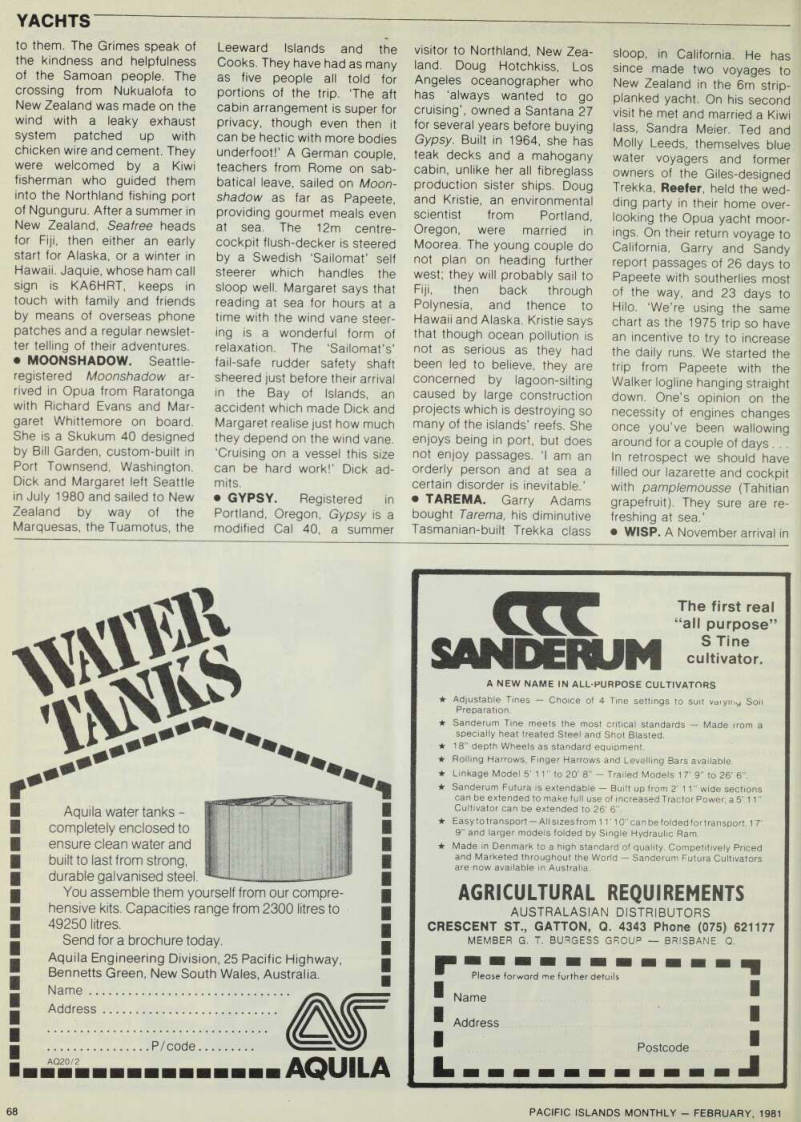
Hertha and Chuck Stotts with Albatross in the Austral Islands. -Picture Don Travers.
to them. The Grimes speak of the kindness and helpfulness of the Samoan people. The crossing from Nukualofa to New Zealand was made on the wind with a leaky exhaust system patched up with chicken wire and cement. They were welcomed by a Kiwi fisherman who guided them into the Northland fishing port of Ngunguru. After a summer in New Zealand, Seafree heads for Fiji, then either an early start for Alaska, or a winter in Hawaii. Jaquie, whose ham call sign is KA6HRT, keeps in touch with family and friends by means of overseas phone patches and a regular newslet ter telling of their adventures. • MOONSHADOW. Seattle registered Moonshadow ar rived in Opua from Raratonga with Richard Evans and Mar garet Whittemore on board.
She is a Skukum 40 designed by Bill Garden, custom-built in Port Townsend, Washington.
Dick and Margaret left Seattle in July 1980 and sailed to New Zealand by way of the Marquesas, the Tuamotus, the
Leeward Islands and the Cooks. They have had as many as five people all told for portions of the trip. ‘The aft cabin arrangement is super for privacy, though even then it can be hectic with more bodies underfoot!’ A German couple, teachers from Rome on sab batical leave, sailed on Moon shadow as far as Papeete, providing gourmet meals even at sea. The 12m centre cockpit flush-decker is steered by a Swedish ‘Sailomat’ self steerer which handles the sloop well. Margaret says that reading at sea for hours at a time with the wind vane steer ing is a wonderful form of relaxation. The ‘Sailomat’s’ fail-safe rudder safety shaft sheered just before their arrival in the Bay of Islands, an accident which made Dick and Margaret realise just how much they depend on the wind vane. ‘Cruising on a vessel this size can be hard work!’ Dick ad mits. • GYPSY. Registered in Portland, Oregon, Gypsy is a modified Cal 40, a summer
visitor to Northland, New Zea land. Doug Hotchkiss, Los Angeles oceanographer who has ‘always wanted to go cruising’, owned a Santana 27 for several years before buying Gypsy. Built in 1964, she has teak decks and a mahogany cabin, unlike her all fibreglass production sister ships. Doug and Kristie, an environmental scientist from Portland, Oregon, were married in Moorea. The young couple do not plan on heading further west; they will probably sail to Fiji, then back through Polynesia, and thence to Hawaii and Alaska. Kristie says that though ocean pollution is not as serious as they had been led to believe, they are concerned by lagoon-silting caused by large construction projects which is destroying so many of the islands’ reefs. She enjoys being in port, but does not enjoy passages. ‘I am an orderly person and at sea a certain disorder is inevitable.’ • TAREMA. Garry Adams bought Tarema, his diminutive Tasmanian-built Trekka class
sloop, in California. He has since made two voyages to New Zealand in the 6m strip planked yacht. On his second visit he met and married a Kiwi lass, Sandra Meier. Ted and Molly Leeds, themselves blue water voyagers and former owners of the Giles-designed Trekka, Reefer, held the wed ding party in their home over looking the Opua yacht moor ings. On their return voyage to California, Garry and Sandy report passages of 26 days to Papeete with southerlies most of the way, and 23 days to Hilo. ‘We’re using the same chart as the 1975 trip so have an incentive to try to increase the daily runs. We started the trip from Papeete with the Walker logline hanging straight down. One’s opinion on the necessity of engines changes once you’ve been wallowing around for a couple of days. . .
In retrospect we should have filled our lazarette and cockpit with pamplemousse (Tahitian grapefruit). They sure are re freshing at sea.’ • WISP. A November arrival in
the Bay of Islands is a 13m cutter belonging to Conrad and Charlotte Skladol from San Francisco, unique in that it was designed by first mate I Charlotte who is a mechanical engineer. Wisp’s glass hull is laid up with Sea Flex. Her interior is all wood ash overheads, teak floor, Honduras mahogany panelling the meticulous part-time work of Conrad, an aeronaut ical engineer. Charlotte says; ‘lt seems we’ve done nothing but build boats together all our married life. We had to get married because we owned a boat together!’ The Skladols spent four months in Hawaii, left at the end of February 1980 for French Polynesia, sailed to American Samoa, Rarotonga, (‘lt was so full of boats and there was so much surge in such a small harbour that we stayed only 15 minutes . . .’), then on to Tonga, Fiji and New Zealand. About their way of life, Charlotte says; ‘We live like millionaires even if we aren’t.’ • KIM. A sturdy 12 m steel ketch whose crew was in Whangarei, making last minute preparations for a year in Antarctica. They are four young men from Montelimar on the Rhone, France Bruno Maroux, Daniel Gazaneon, Michel Chopard, and Claude Monchaud. The four adven turers built the brown multiple chine yacht near Avignon on evenings and weekends over a period of a year. Three years ago they left France, pausing for eight months on Africa’s Ivory Coast to work. They then sailed to Brazil where they spent six months exploring Amazonia, venturing up sev eral of the rivers, before con tinuing on to the Caribbean.
The boys love to dive, and have managed to earn their way as they go, seeking and selling rare shells. Cypraea surinamensis, one of the rarest Df all cowries, they found in Martinique.
The boys’ aim has been all along to sail Kim to Antarctica.
Fhey received much valuable advice from Antarctic voyager, Jerome Poncet, of yacht Damien and his Tasmanian aorn wife, Sally, whom they spent time with in Australia.
The Poncets’ baby was born in Antarctica. The lads from Kim hope to meet up with them again soon in Antarctica.
Upon leaving New Zealand, Kim will sail south as far as possible. The well-found, well stocked vessel is insulated with 4cm of polystyrene. An iron pot-bellied stove with a gim balled carburettor heats the interior even underway. The ports are sealed with clear plastic so that a 5 cm airspace guards against condensation.
Kim’s self-steering system is a stainless steel version of the Aries gear built by All Marine in Sydney. A sledge, skis, and a strong tent are unusual items to be carried on a cruising yacht, but Kim has them and much more, for the lads want to be entirely self-sufficient.
For that reason they do not have a radio transmitter.
Bruno, a 27-year-old land sur veyor explains: ‘We do not expect any help from anyone.’
If the Antarctic voyage goes according to plan, Kim will be back on the Rhone for the summer of ’B2, having touched upon South Georgia, the Falkland Islands and Rio de Janeiro en route. • VAPAY.An Allied 36 glass ketch from Salem, Massa chusetts. A hard beat down from Suva to Opua in the Bay of Islands took a week longer than Bob and Ginny Gross had planned, but Ginny says: ‘lt was no hardship. We had plenty of paperbacks to read.’
Bob, an amateur radio oper ator (WIENH) kept in touch with other yachts making the same passage against heavy headwinds, and with Colin Busch (ZLIBKD), a Kiwi ham who keeps track of the pos itions of offshore yachts, pass ing on weather info and fore casts. Bob and Ginny left the US east coast in 1975 with the intention of going to the Bahamas, *. . . and look where we are now!. . . We’ll probably keep going on around.’ Ginny was a nurse, Bob a career military man trained in elec tronics. He worked with Honeywell Computers before he and Ginny left their grown family and set off to sea.
• Rainbow. An 11M
Norman Cross-designed tri maran from San Diego, Cali
fornia. Steve and Sharry Glass took five years to build her, two and a half years of which they reckon was spent thinking about how to go about it. Rain bow is well planned, superbly built and finely finished, so the system obviously paid off.
Sharry and Steve cruised Mexico, the Marquesas, the Tuamotus and Tonga before sailing to New Zealand. Their best cruising was in Vavau, and in French Polynesia where they spent 13 months in all, their only regret being not having taken French lessons before setting off from California.
Charmed with New Zealand, (‘the Kiwis have time for each other’), they spent the southern winter in the Bay of Islands. They report oc casional ice on deck and almost a month of steady rain . . .
Sharry is blind. She had always dreamed of cruising the islands of the South Pacific on her own boat and did not let the disability stop her from enjoying the experience, though she finds the long passages trying. The young couple have a 10 speed tan dem bicycle for shopping and for exercise. Steve and Sharry will probably become land based before too long so that Sharry will be able to devote more time to helping the newly blind. • BELLE POULE. Flies the Canadian maple leaf. She’s a wooden gaff schooner —l5 m
overall, 12 m on deck on a round-the-world trip with Montrealers Eddie Seifred and Francine Blain. Eddie bought the juniper-hulled schooner in Mississippi in 1977 where she had been built two years be fore, fitted her out in Fort Lauderdale, and left Florida at Christmas of ’7B for the Caribbean. Eddie’s 18-year old son Mark who joined the ship on the Caribbean island of St Vincent will reluctantly head back to Montreal from New Zealand to finish his studies.
Mark says that he has main tained his bilingualism by read ing alternatively a book in French, then one in English, during their passages. After a haulout, paint-up and stock up, Belle Poule will carry on to Australia, then home by way of South-east Asia. • ERYNGO. The dictionary defines ‘eryngo’ as ‘an edible seaweed with aphrodisiac qualities’. It is also the name of a 12 m cold-moulded ketch of Sam Crocker design built h Toronto in ’67, now spending the southern summer in New Zealand. Andy Van Herk says: The name is an apt one. We had a couple of kids in The British Virgin Islands!’ They are Sandy, now three and a half, and 18-months-old Chad.
Andy and Carolyn Van Herk left Toronto via the St Lawrence in ’74, got thoroughly cold in the iceberg area, so Eryngo headed first for the Bahamas, then thoroughly explored the islands of the Caribbean.
Mechanical technician by trade, Andy got work as cap tain of a 15 m Gulf Star charter for a while. Then he and Sandy rented land on Cooper Island, one of the British Virgin Islands, where they converted a house into a restaurant for charter yachts. They were the only people living on the island.
Two years and two children later, with the cruising kitty filled, Eryngo set off for the South Pacific. They were de lighted to be permitted to stay eight days in the Galapagos Islands instead of the three which is all yachts are gener ally allowed these days. Seems the commanding officer of the naval academy at Wreck Bay was missing his own kids . . .
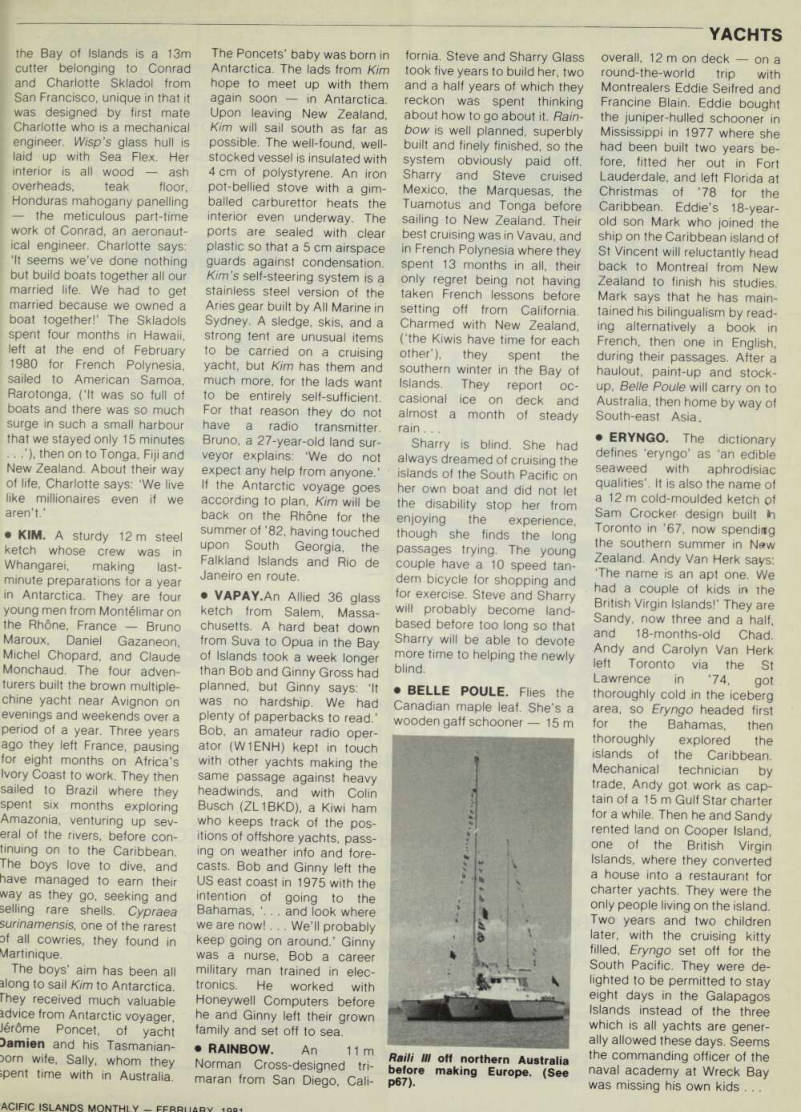
Raili III off northern Australia before making Europe. (See p67).