plans proposed
pp. 59-62 · Read in the full issue


Trade
Winds
New Zealand aid plans proposed
Vanuatu figures most promi nently in a list of proposed projects under New Zealand’s bilateral aid programme for Pacific Island countries re leased in Wellington just after New Year.
Being considered is a pro posal to give scientific assist ance with a survey of agricul tural pests and diseases in Vanuatu, and another to pro vide two mobile pressure units for timber treatment. The tim ber treatment project, which is almost certain to be im plemented, includes mainten ance of the plant and operator training.
New Zealand believes that suitably treated Vanuatu tim ber could replace all imported timber for construction pur poses.
A New Zealand forest ser vice engineer may also visit Vanuatu to examine the poten ial for coconut stem milling.
The service pioneered research into the utilisation of senescent coconut trunks, and is at pres ent overseeing the provision of a second coconut stem sawmill for Tonga, in the Ha’apai Group. The first Tongan coco nut sawmill is on Tongatapu.
Other Vanuatu projects ex pected to gain approval are the appointment of an adminis tration officer for the Ministry of Health to plan and co ordinate medical and public health administration. This is a rationalisation process as Vanuatu has inherited two sys tems, British and French, from its colonial days.
Another appointment in tended to be made under New Zealand aid is an ecomonic planning officer for Vanuatu’s Central Planning Office, to co ordinate and implements post
independence national develop
ment plan.
Appointment of a consultant
to study the requirements for a Vanuatu boatbuilding industry is also envisaged. His term is expected to be of two years’ duration, and his brief will also be to recommend appropriate design and construction methods.
Other proposals include $2O 000 for two woodgas power units to generate electricity in rural areas and there is a proposal to have $5O 000 on hand for various small projects.
The Vanuatu Government would liaise with the New Zealand High Commissioner, based in Honiara, to draw on the small projects fund.
Schemes for the Cook Islands under the bilateral aid pro gramme include the provision of two banana driers at Rarotonga, and a market survey of New Zealand areas where Cook Islands produce does not yet penetrate which for most purposes means outside Auck land and Wellington.
A Cook Islands Government request is being considered for cssistance in building a power house and providing electrical reticulation on Mangaia, at a cost of $3OO 000.
In Fiji, the programme is likely to provide a lecturer in business studies at the Fiji Institute of Technology, for the next two years, and an adviser to the Ika Corporation, Government-backed tuna fleet operator, also for the next two years. A Fiji Government re quest for funds and training for a project to ‘seed’ inland lakes and rivers with imported fish stocks to provide inland fisheries is also on the pro gramme. Only $lO 000 is in volved.
Proposals being considered for Niue, while modest, should make an impact on the small community, particularly those for the extension of the Niue Development Board’s factory, If approved they will provide space for a laboratory for the
factory’s food technologist, al lowing for improvements in quality controls. A new lime press, fruit washer, and copra drier are also proposed.
The Niue high school, built last year with New Zealand assistance, should get exten sions to its skills training build ing, as well as washrooms, toilet facilities and a roof water catch ment system. Improved tele phone facilities for villages on the western part of the island could be part of an upgrading of the national telephone system on Niue.
At Hanan International Air port on Niue assistance is pro posed to install new navigational aids to bring it up to the standard to handle Boe ing 7375, probably this year.
Runway resealing has already been undertaken with New Zea land help and with the 737 s in mind.
Proposed aid for Papua New Guinea includes expertise to improve and stimulate high lands horticultural production on behalf of the Food Market
ing Corporation which operates the Lae cool store.
PNG health projects include assistance for the redevelop ment of Vanimo General Hos pital and Oksapmin Health Centre in West Sepik Province, provision of equipment for an expanded nutrition section in the Department of Health, and provision of a 21-metre launch to provide health services to isolated coastal villages. This vessel is to be based in the Manus Province.
Other assistance to PNG to be approved involves several small-scale enterprises such as a shoe factory and a foundry, the appointment of an adviser to help restructure the small-boat building industry, help for an urban community assistance programme, a maintenance al location for the Lae cool store and assistance with pilot smallholder energy projects.
Proposals for Tonga under study include a further banana rehabilitation programme, but this is subject to an industry review now being carried out by
Tonga. If the review suggests that an aid proposal is war ranted, the aid will consist of quality incentive subsidies and chemicals.
Other projects for Tonga awaiting approval include further funding of experimental reading using a cheap method developed in the Caribbean and construction of agriculture access roads and finger wharves on outlying islands.
Tuvalu has one project await ing approval, for the employ ment of an electrical superviser at its power station.
Projects awaiting approval for Western Samoa are largely agricultural, and include pro vision of a poultry complex at the University of the South Pacific School of Tropical Agriculture at Alafua. The aim is to make Alafua a centre for extension activities which will strengthen village production and lessen Samoan dependence on imported poultry and eggs.
Assistance for the construc tion of an integrated livestock services centre at Avela and
support for the establishment oft an animal health sub-centre atl Salelolonga on Savaii are alsoc contemplated in Westernr Samoa.
Samoan industrial develop ment could be carried a stepc further with capital funding for factory buildings on the Vaitele; Estate, where a controversial! cigarette factory is already es tablished. Food processing andl engineering ventures are also( being considered. The Western!
Samoan Government has in vited New Zealand to contrib ute $5OO 000 to the $2.5 millioni copra-crushing mill scheme; backed already by the Asiam
Development Bank
Don
Bryant in Wellington.
Inquiry on big
sugar strike
Fiji has begun an inquiry into the big sugar mill strike which paralysed the milling industry in November and which led to the intervention of the Prime Minister. Ratu Sir Kamisese Mara. More than 200 members
of the Fiji Sugar Milling Staff Association went on strike in a situation which affected other workers and which led to wide spread political and industrial controversy. A board of inquiry has been convened and has been taking evidence from a wide cross-section of members of the industry.
Early evidence alleged anti white racial elements in the dispute. An engineer in training for the Fiji Sugar Corporation, Mr Kirit Mehta described anti white feelings at the Rarawai mill as being an element in early rumours that a strike was being planned.
Fie told the board ‘We in Fiji are anti-white. We do not like the white skins’.
He added however that he personally liked an Australian technician at the mill, but the jroblem appeared to be that the \sutralian was too efficient. ‘He iid the work of four local vorkers’ Mr Mehta said. He >elieved that early rumours of a trike , which had come to his ittention, stemmed from a plan icd protest against the Aust alian because of the amount of /ork he was doing.
The board took extensive vidence on the relative pos ions of local and foreign em loyees, their relationships, aining programmes, division • work and other factors in uding the degree to which cal employees were being lased into positions of skill, niority and responsibility.
The Industrial Manager for e Fiji Sugar Corporation, Mr Murti, told the board that a
•mmunication difficulty
isted with most of the Fiji ;ople employed in engineering •sitions. He believed, too, that ost of them did not have the ademic background needed become chief engineers, ost of the local industrial emists employed by the cor ration were properly alified graduates, but only 5 of the engineers were gradu- He described extensive orts made by the corporation employ an engineering train l officer who could help to srcome the problem. All the orts had come to nothing, he d, including efforts by the blic Service Commission, fhe board also took evidence
on whether the corporation should bond the trainees it employed. Some bonding is already done, but it is not general.
The Milling Staff Officers Association, the central body which was involved in the strike, told the inquiry that it approved a system of bonding and had made submissions along these lines for some time.
CDC’s big fund
in Pacific
The Commonwealth Develop ment Corporation now has more than $5O million invested in three Pacific Island countries, according to latest figures pro vided by the corporation. The corporation was established in UK by act of parliament to provide finance and expertise in the developing countries of the Commonwealth of Nations.
The three Pacific Island countries in which the corpor ation is involved are Papua New Guinea, Fiji and Solomon Islands, and in addition to the current capital investment a further $4O million is under commitment.
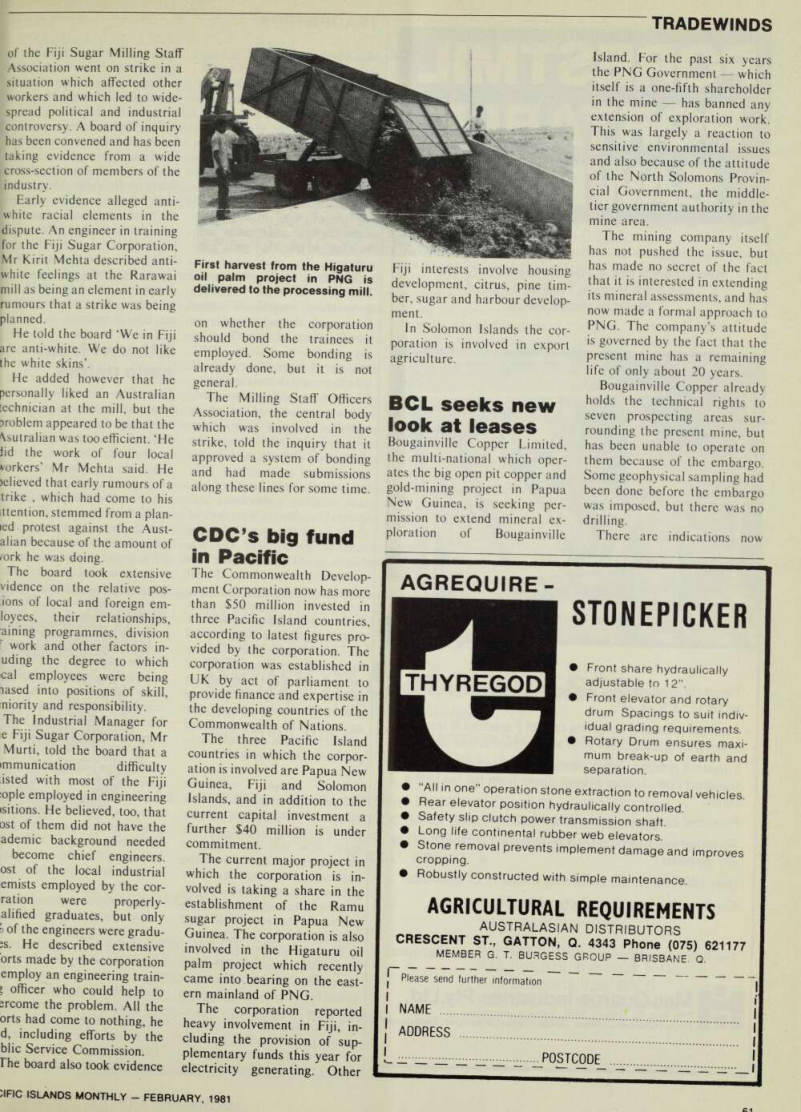
The current major project in which the corporation is in volved is taking a share in the establishment of the Ramu sugar project in Papua New Guinea. The corporation is also involved in the Higaturu oil palm project which recently came into bearing on the east ern mainland of PNG.
The corporation reported heavy involvement in Fiji, in cluding the provision of sup plementary funds this year for electricity generating. Other
Fiji interests involve housing development, citrus, pine tim ber, sugar and harbour develop ment.
In Solomon Islands the cor poration is involved in export agriculture.
BCL seeks new look at leases Bougainville Copper Limited, the multi-national which oper ates the big open pit copper and gold-mining project in Papua New Guinea, is seeking per mission to extend mineral ex ploration of Bougainville
Island. For the past six years the PNG Government which itself is a one-fifth shareholder in the mine has banned any extension of exploration work.
This was largely a reaction to sensitive environmental issues and also because of the attitude of the North Solomons Provin cial Government, the middle tier government authority in the mine area.
The mining company itself has not pushed the issue, but has made no secret of the fact that it is interested in extending its mineral assessments, and has now made a formal approach to PNG. The company’s attitude is governed by the fact that the present mine has a remaining life of only about 20 years.
Bougainville Copper already holds the technical rights to seven prospecting areas sur rounding the present mine, but has been unable to operate on them because of the embargo.
Some geophysical sampling had been done before the embargo was imposed, but there was no drilling.
There are indications now
First harvest from the Higaturu oil palm project in PNG is delivered to the processing mill.
that the company has already gained the tacit support of the PNG government which relies heavily on the present mine for its revenue.
This means that the attitude of the provincial government will largely decide the course of developments. The provincial government is not inherently opposed to any extension of exploration and mining, but wants certain safeguards and benefits before it will give approval.
The provincial government believes that the national government should be more generous in sharing the revenue which is derived from the min ing operation. (Under PNG mining policies the national government is the sole authority where major mining is involved, and the revenue share which any province gets from a mine within its boundaries must be negotiated with and paid out by the national government). This suggests that the future of any new mineral exploration will depend heavily on what sort of deal can be struck between the national government and the North Solomons Province.
North Solomons political leaders see their province as the treasury of PNG, because earn ings from the mine account for about a third of PNG’s total national revenue. However the former Somare government and the present Chan government policies insist that all revenue should be used to equalise national development, and should not allow one province to prosper while another is de pressed.
Two reviews of the Bougainville mine situation are scheduled to be carried out this year by the national govern ment. One will deal with the existing agreement between the national government and the provincial government, and the other will deal with the existing agreement between PNG and Bougainville Copper Limited.
The present exploration em bargo and the need to lift it are expected to be the main issues raised by the company when the review is undertaken.
Meanwhile PNG is soon ex pected to give its final approval for the establishment of a new copper and gold mine at Ok
Tedi, and is expected to seek am international loan of up to S6CC million to meet its commit ments for infrastructure and equity in the project.
Ok Tedi, close to the Indonesian border in the PNG Western Province, is at the other end of the country to the Bougainville mine. The consor tium which has been planning the mine consists of the govern ment itself, Amoco Minerals oft USA, BHP of Australia and Kupfer Exploration of West!
Germany. PNG’s decision will depend on the deal which cam be proposed by the three com mercial partners.
Ethanol from
sago palms
Extending its investigations into possible alternative sources of energy, Papua New Guinea has embarked on a pilot project! to produce ethanol from wild sago palms. Ethanol is an addi tive which can be used to stretch petrol supplies, and inr special installations it can be used on its own or with mixtures other than petrol. The wild saga palm grows extensively in the swampy coastal areas of west ern PNG, and in many areas is used as a source of food fon village communities.
The PNG ethanol project is to be based on the river plains of the Sepik region in the northwest of the PNG main land. The government has com missioned an Australian firm Shedden Pacific Pty Ltd tc establish the project with am initial annual production of twa million litres. There is no indi cation yet however when pro-i duction will begin, and the initial work will involve im provements in production and; harvesting of sago. This in itselft is expected to be of value to rural communities because it will reduce much of the hard work which is required at pres-; ent to harvest sago for food.
Technical consultants be-; lieve that by careful manage-; ment of existing stands of wild sago and by improvement to harvesting techniques the proj-j ect would be able to produce 10 tonnes of sago starch a hectare each year. The starch extracted from the palm is the source oh the food and ethanol.