Inder’S
p. 17 · Read in the full issue
Stuart
Pacific
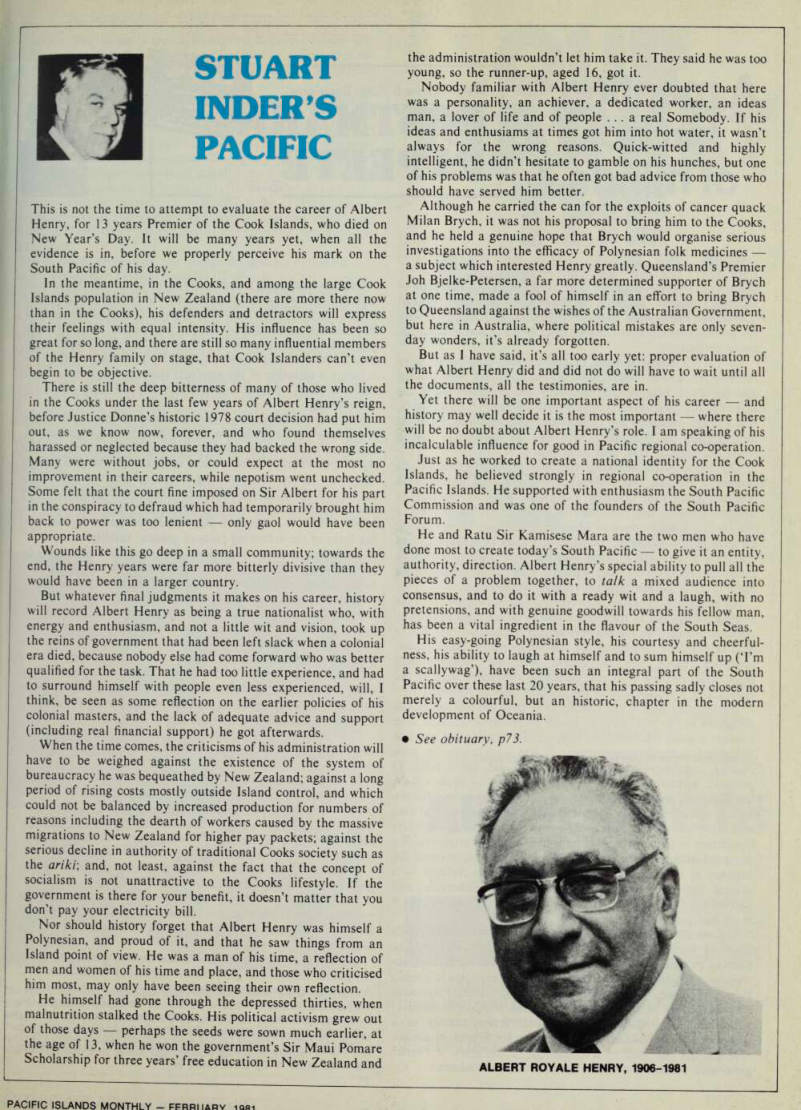
This is not the time to attempt to evaluate the career of Albert Henry, for 13 years Premier of the Cook Islands, who died on New Year’s Day. It will be many years yet, when all the evidence is in, before we properly perceive his mark on the South Pacific of his day.
In the meantime, in the Cooks, and among the large Cook Islands population in New Zealand (there are more there now than in the Cooks), his defenders and detractors will express their feelings with equal intensity. His influence has been so great for so long, and there are still so many influential members of the Henry family on stage, that Cook Islanders can’t even begin to be objective.
There is still the deep bitterness of many of those who lived in the Cooks under the last few years of Albert Henry’s reign, before Justice Donne’s historic 1978 court decision had put him out, as we know now, forever, and who found themselves harassed or neglected because they had backed the wrong side.
Many were without jobs, or could expect at the most no improvement in their careers, while nepotism went unchecked.
Some felt that the court fine imposed on Sir Albert for his part in the conspiracy to defraud which had temporarily brought him back to power was too lenient only gaol would have been appropriate.
Wounds like this go deep in a small community; towards the end, the Henry years were far more bitterly divisive than they would have been in a larger country.
But whatever final judgments it makes on his career, history will record Albert Henry as being a true nationalist who, with energy and enthusiasm, and not a little wit and vision, took up the reins of government that had been left slack when a colonial era died, because nobody else had come forward who was better qualified for the task. That he had too little experience, and had to surround himself with people even less experienced, will, 1 think, be seen as some reflection on the earlier policies of his colonial masters, and the lack of adequate advice and support (including real financial support) he got afterwards.
When the time comes, the criticisms of his administration will have to be weighed against the existence of the system of bureaucracy he was bequeathed by New Zealand; against a long period of rising costs mostly outside Island control, and which could not be balanced by increased production for numbers of reasons including the dearth of workers caused by the massive migrations to New Zealand for higher pay packets; against the serious decline in authority of traditional Cooks society such as the ariki ; and, not least, against the fact that the concept of socialism is not unattractive to the Cooks lifestyle. If the government is there for your benefit, it doesn’t matter that you don’t pay your electricity bill.
Nor should history forget that Albert Henry was himself a Polynesian, and proud of it, and that he saw things from an Island point of view. He was a man of his time, a reflection of men and women of his time and place, and those who criticised him most, may only have been seeing their own reflection.
He himself had gone through the depressed thirties, when malnutrition stalked the Cooks. His political activism grew out of those days perhaps the seeds were sown much earlier, at the age of 13, when he won the government’s Sir Maui Pomare Scholarship for three years’ free education in New Zealand and
the administration wouldn’t let him take it. They said he was too young, so the runner-up, aged 16, got it.
Nobody familiar with Albert Henry ever doubted that here was a personality, an achiever, a dedicated worker, an ideas man, a lover of life and of people ... a real Somebody. If his ideas and enthusiams at times got him into hot water, it wasn’t always for the wrong reasons. Quick-witted and highly intelligent, he didn’t hesitate to gamble on his hunches, but one of his problems was that he often got bad advice from those who should have served him better.
Although he carried the can for the exploits of cancer quack Milan Brych, it was not his proposal to bring him to the Cooks, and he held a genuine hope that Brych would organise serious investigations into the efficacy of Polynesian folk medicines a subject which interested Henry greatly. Queensland’s Premier Joh Bjelke-Petersen, a far more determined supporter of Brych at one time, made a fool of himself in an effort to bring Brych to Queensland against the wishes of the Australian Government, but here in Australia, where political mistakes are only seven day wonders, it’s already forgotten.
But as I have said, it’s all too early yet: proper evaluation of what Albert Henry did and did not do will have to wait until all the documents, all the testimonies, are in.
Yet there will be one important aspect of his career and history may well decide it is the most important where there will be no doubt about Albert Henry’s role. I am speaking of his incalculable influence for good in Pacific regional co-operation.
Just as he worked to create a national identity for the Cook Islands, he believed strongly in regional co-operation in the Pacific Islands. He supported with enthusiasm the South Pacific Commission and was one of the founders of the South Pacific Forum.
He and Ratu Sir Kamisese Mara are the two men who have done most to create today’s South Pacific to give it an entity, authority, direction. Albert Henry’s special ability to pull all the pieces of a problem together, to talk a mixed audience into consensus, and to do it with a ready wit and a laugh, with no pretensions, and with genuine goodwill towards his fellow man, has been a vital ingredient in the flavour of the South Seas.
His easy-going Polynesian style, his courtesy and cheerful ness, his ability to laugh at himself and to sum himself up (‘l’m a scallywag’), have been such an integral part of the South Pacific over these last 20 years, that his passing sadly closes not merely a colourful, but an historic, chapter in the modern development of Oceania.
• See obituary, p 73.