A meeting,
pp. 18-19 · Read in the full issue
but not of minds
Within the framework of the UNESCO project for the study of Oceanic cultures initiated in 1971, yet another regional conference was held in Papeete in December. Compared with the previous ones, it could best be described as a sort of scientific rump parliament.
Of the 18 island nations in the Pacific, only seven were represented, and of these Samoa, Vanuatu, Papua New Guinea and the Cook Islands each sent only one delegate, while the three French possessions provided no fewer than 10. In addition, half a dozen museums and international organisations, foremost among them the Australian Museum, the Bernice P. Bishop Museum, and I’ICOM, sent delegates.
The scope of the meeting, too, was extremely limited. As originally planned, the conference was supposed to deal with ‘the advisability of creating a regional body in Oceania to safeguard the cultural and natural heritage’. At the request of the International Council of Museums, Geoffrey Mosuwadoga, director of the National Museum of Papua new Guinea, had prepared in advance a ‘basic working document’ in which he made concrete proposals for achieving this aim and outlined the main tasks of such a regional cultural association.
All his key propositions, however, had been omitted from the conference agenda by the French hosts who are dead against all regional associations for the very simple reason that they will in all likelihood be dominated by the independent ‘Anglophone’ countries. Gone, too, of course were all Mosuwadoga’s paragraphs dealing with environmental problems, such as the radioactive pollution due to the nuclear tests at Moruroa.
Having thus been firmly steered away from the real issues, the delegates in the end, without much enthusiasm, adopted nine vaguely worded resolutions in support of a bewildering array of ill-defined cultural programmes. It was an exercise in pure futility, considering that they were all old pet UNESCO projects, already initiated a long time ago such as, for example, the training of Pacific islanders in museum adminis tration and conservation, the preservation of archaeological sites and historical monuments, and the introduction of appropriate legislation to prevent theft of and illicit trade in artefacts. For some unfathomable reason, one of the resolutions concerned the urgency of making an inventory of all Pacific artefacts a project begun in 1975 by Professor Peter Gathercole, and carried out in such a competent and determined manner that it is by now practically completed.
It is equally difficult to understand what prompted the French hosts to recommend so warmly the construction of multi purpose cultural centres for native performers in all fields, since they have not followed this sensible policy themselves in French Polynesia. Instead they have erected a foretress-like Polynesian Centre without Polynesians (except in the menial capacities of caretakers and washerwomen), which serves mainly as a depository of antiquities, working offices for French scientists, and last but not least as a monument to the glory of French governors, admirals, missionaries and other colonisers.
The only resolution which really made sense was the earnest request to all foreign museums to return a sizeable portion of the Pacific artefacts they hold. These are often so numerous that they cannot all be displayed, but are hidden away in large quantities in their basements or attics. The French representa tives could have shown the way here by promising on the spot to return a selection of the artefacts entombed in this way in a dozen or more museums in France. But no such offer was
forthcoming.
Much more interesting than the lame debates and vague resolutions were actually the tactics used by the organisers to avoid any open criticism of the cultural colonialism practised in the French Pacific territories, and to make sure that the foreign delegates did not contaminate the local natives with their subversive ideas, as happened, for instance, during the 1979 South Pacific Conference in Papeete. The main lessons of the 1980 UNESCO conference may therefore best be expressed in the form of the following rules of general validity: 1) Make sure from the beginning that you have a majority by enlarging your own delegation to the maximum extent possible.
In accordance with this vital principle, the host delegation from French Polynesia had well in advance been well larded with half a dozen French expatriate scientists and government officials, some of whom had never seen a living specimen of the Polynesian race before they were packed off to Tahiti. Together with the delegates from the other two French possessions, New Caledonia and Wallis and Futuna, the Francophones thus outnumbered the Anglophones by 10 to five. Quite useful to the former was also the general practice of nominating the head of the host delegation as chairman of the meeting. 2) When in such a position of strength, do not have any formal votes but adopt all decisions by ‘mutual consent’. It looks better this way. 3) Ask all participants to prepare lengthy position papers on the cultural policies of their respective countries. When all these papers more easily available as mimeographed documents have eventually been read, translated and discussed, there is only a very slight risk that the delegates will have time or strength left for more important questions. 4) Let the chairman rule that all embarrassing questions are ‘political’ in nature and therefore strictly taboo. 5) Forbid all outsiders from addressing or petitioning the meeting. The term ‘outsider’ denotes, of course, any person, however competent and knowledgeable he may be, who is not well regarded by the organisers. 6) Hold the meeting in the smallest available hall and fill up the public section with government-appointed ‘silent observers’.
A friendly and positive atmosphere may thus be guaranteed. 7) Limit the mass media coverage to ‘essential’ information.
In the present case, for instance, documents released to local newspapers consisted exclusively of papers in French submitted by French delegates. No Anglophones were ever interviewed by the local press or by local radio or TV.
8) See that the participants do not find time in between the sessions to get together with the local natives by taking them on an endless round of feasts, dinners, dance shows, cocktail parties and well-guided sight-seeing tours.
The hosts of the Papeete conference were particularly successful in this last respect. For instance, none of the Pacific delegates was invited to meet the group of young Polynesians responsible for the most important cultural revival movement in French Polynesia, Te pupu arioi. Taking their name from the famous pre-European society of sacred entertainers, they travel from island to island, performing plays, ‘musicals’ and ballets, reciting ancient legends and teaching the children long forgotten sports and games. The reason why the arioi was shunned is that their political ideas are officially perceived as ‘advanced’.
Even more surprisingly, the foreign delegates also missed out on the Polynesian Festival organised especially for their benefit by the Atonomist mayor of Papeete, Jean Juventin. It lasted for two days and consisted of an odd mixture of demonstrations of Tahitian healing techniques, a parade of old motor vehicles and horse carriages, a free-for-all display of ‘old things’, a fine exhibition of historical pictures, and, of course, much singing and dancing.
This festival for and by Polynesians was a genuinely popular event which attracted more than 5000 visitors. It was presided over with much gusto by the No 1 local politician, Vice- President Francis Sanford, while the French High Com missioner clearly demonstrated how little he cared for such uncontrolled outbursts of native elan by staying away from it altogether.
Following his lead, the conference organisers did not even bother to take the delegates over to the festival headquarters at the Town Hall only a couple of blocks away from the conference venue.
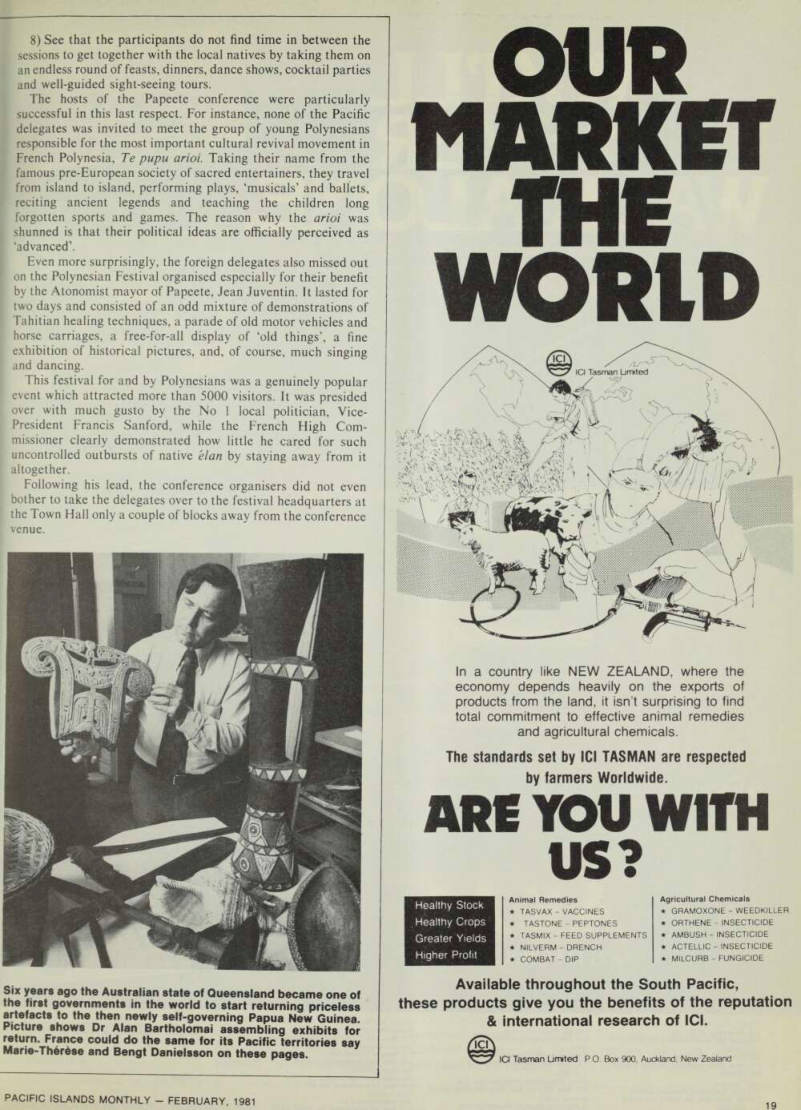
Six years ago the Australian state of Queensland became one of the first governments in the world to start returning priceless artefacts to the then newly self-governing Papua New Guinea.
Picture shows Dr Alan Bartholomai assembling exhibits for return. France could do the same for its Pacific territories say Marie-Therese and Bengt Danielsson on these pages.