Vanuatu: May 1981 be the year
pp. 13-15 · Read in the full issue
of national reconciliation
An expatriate resident of Vanuatu of several years standing who has now left the country reflects on his experiences, and writes on what he sees as the country’s most urgent problem: reconciliation of the various groups in the population which have been at loggerheads in the past. Not content merely to express pious hope, he lists without the least wish to interfere a number of practical steps which he believes, in the light of his experience, could well serve this purpose.
The independence of Vanuatu on July 30, 1980, was a deeply moving event for all involved.
After years of struggle the people of Vanuatu finally achieved a freedom for which many of them had worked over many years. \ Ten days before Indepen dence Week began, the French and British had still not given the final go-ahead for the cel ebrations, so the government of the country decided to carry on with the celebrations in any case, and, if necessary, make their own declaration of inde pendence with the backing of other Pacific Island states.
Fortunately, this was not necessary. The long-awaited agreement of the French was finally announced and the plan ned events went ahead exactly is planned.
There was however one hitch.
Mthough the new Vanuatu flag vas raised in 90 places through mt the new republic at noon on fuly 30, the flag had to be aised at Luganville (Santo fown) with a French and British guard, to ensure that it vas not hauled down again by epresentatives of the Vemarana Provisional Govern nent which had taken over the ‘land of Espiritu Santo in May.
To the amazement and dis ust of the government led by r Walter Lini, this secessionist overnment in Santo led by immy Stevens (leader of the Jagriamel Movement) was al )wed to continue up to and fter independence by the ritish and French, who could at agree what to do about it. übsequently, the Lini govern icnt became convinced that ie French administration in le condominium had actually sen encouraging the emarana government in an tempt to force the Lini overnment to make various
concessions. The most import ant of these demands was the formation of a confederal government with considerable devolution of power to local federations of islands. The Lini government saw this as an attempt to undermine the unity of the country and allow foreign interests to control certain parts of it.
The Lini government was furious that the French should attempt to impose a confederal system in their way as Mr Paul Dijoud, acting as representative of the French Government, had already signed the national constitution, drawn up by a wide cross-section of people from different parties and groups in 1979. In this consti tution everyone had agreed to the establishment of a unitary state with limited devolution of power to island governments, of which Santo and Tanna were to be the first.
Elections for the Santo and Tanna Regional Assemblies had taken place at the same time as the general election in November 1979, and the Vanuaaku Party had obtained a majority in both the national Representative Assembly and the two Regional Assemblies.
The Lini government there fore saw the moves to create secessionist or rival govern ments in Santo and other islands as a final attempt by the French administration, the co lons (settlers), American busi ness interests and opposition parties, to undermine its legal authority by any means avail able, as the opposition parties had been unable to gain a majority in the Santo and Tanna Regional Assemblies. (These Assemblies had been accepted by the Vanuaaku Party at the insistence of the French Minister for Overseas Departments and Territories,
Paul Dijoud, although the Vanuaaku Party group in the constitutional committee saw no reason why these two islands should be treated differently from the rest.) Immediately after indepen dence, therefore, the Lini government asked Papua New Guinea for help, and their army, together with a section of the recently united Vanuatu police force, put down the rebellion on Santo and many people, including Jimmy Stevens, were arrested. The PNG soldiers were disciplined and comparatively few com plaints were made about their behaviour. In the case of the Vanuatu police, however, it was quite a different story.
Resentment against Jimmy Stevens and the Vemarana government had been building up from the moment that the ‘British Paddock’ had been attacked on the night of the
take-over in Santo Town by the Vemarana forces. In spite of its name, the ‘British Paddock’ was mostly inhabited by New Hebrideans working in the dis trict administration and the police. Their houses had been ransacked, some of them had been taken off to Jimmy Stevens’ headquarters at Fanafo in the Santo bush, and some women had been mis treated.
In later developments, there had been much looting, as the French Resident Commissioner had insisted that the Vemarana government suspend its police,
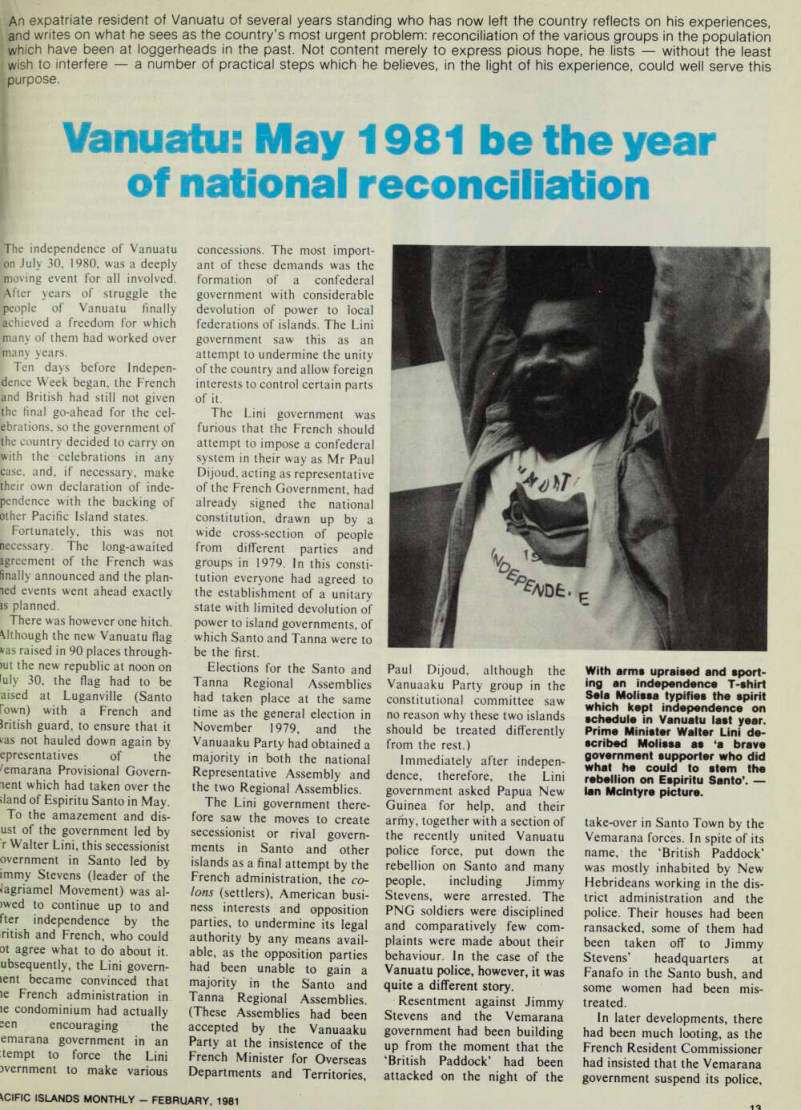
With arms upraised and sport ing an independence T-shirt Sela Molissa typifies the spirit which kept independence on schedule in Vanuatu last year.
Prime Minister Walter Uni de scribed Molissa as ‘a brave government supporter who did what he could to stem the rebellion on Espiritu Santo’.lan Mclntyre picture.
after he had persuaded it to accept the British and French troops being stationed in Santo Town (Luganville) to ‘protect the population’. There were reports that some church build ings had been used as toilets.
The New Hebrides Govern ment in Port-Vila, the British Resident Commissioner and the Australian Consul had pre viously called on government servants and Commonwealth citizens to leave Santo, so their properties had been left unpro tected. No such call was made for French citizens to leave the town. The staff of the Presbyterian, Anglican, Apos tolic and Adventist churches and the Churches of Christ had left the town; the Roman Cath olics remained. The bitterness which all this caused became apparent when the Vanuatu police were left on their own to continue ‘anti-rebel’ operations after the PNG troops had left.
They moved first to the island of Malakula, and news began to reach Port-Vila of arrests of the male inhabitants of certain Roman Catholic villages which had allegedly supported the Santo secessionists and at tempted to establish their own provisional government on the island. A reconciliation team consisting of leaders of all the main churches was at Port-Vila airport waiting to go to Malakula when they heard that the mobile police had arrived there, and their visit was can celled. Two Roman Catholic priests, one French and one Italian, were arrested and later
released. It appeared as if anybody who might have been implicated in any way in the setting up of provisional govern ments, or the receiving of stolen goods from Santo, or who was suspected of being sympathetic to the ‘rebels’, was likely to be arrested.
Conditions in the prisons were becoming very bad, as they were desperately over crowded with people waiting to be interrogated. The Roman Catholic Church was attempt ing to supply blankets and food to the prisoners, as these ap peared to be in short supply. It was reported that some people were being assaulted at the time of arrest, or while in prison, or under interrogation.
In these circumstances, the churches felt that they had to speak out.
The Vanuatu Christian Council made a formal protest to the Vanuatu Government, which was signed by the leaders of the council and heads of the Roman Catholic, Anglican and Presbyterian churches, and a representative of the Churches of Christ. The Pacific Church Leaders’ Conference, organised by the Pacific Conference of Churches, which happened to be meeting in Vanuatu in October, also discussed the matter at length and sent a delegation to the government to express their concern.
However, the government
was determined that police action should continue till all suspects had been rounded up, and after Malakula the police moved to Ambrym, Pentecost and Aoba. Arrests were on a much smaller scale, but there were still reports of maltreat ment of certain individuals.
Meanwhile, the cases of those held in prison were being heard, sometimes at the rate of 30 a day. The Chief Justice at first had judicial assistance, but after a while he was left as the only one trying to cope with the avalanche of judicial work. The court moved from Santo to Port-Vila where the final cases were heard. Jimmy Stevens received 14'/2 years; other leaders received lesser sen tences according to their degree of involvement.
What had been the action of the government in all this? Both the Prime Minister and the Minister for Home Affairs, Pastor Fred Timakata, had made broadcasts. Pastor Timakata, who was previously assembly clerk (general sec retary) of the Presbyterian Church and then (after his election in November 1979) chairman of the Representative Assembly, had become deputy prime minister and minister of home affairs at independence.
It was anticipated by many that he would be a moderating influence.
He asked for restraint to be exercised by the police, but only visited Malakula in order to call off the campaign there after all arrests had been made.
Some saw the lack of control of the police by his ministry as a sign of weakness on the part of the government. Others be lieved that the government had condoned some of the actions which had been taken against the Catholics.
Pastor Timakata vigorously denied that it was a ‘religious war’, as was being claimed by some Catholics in Vanuatu and New Caledonia, and it is im portant to note that when the police moved to Aoba the arrests there were mostly of those ex-members of the Churches of Christ who had allied themselves with Jimmy Stevens’ breakaway ‘Royal Church of Nagriamel’.
However, many of the arrests were of French-speaking ni- Vanuatu (the local term for
indigenous people), most o whom were Catholics, as well as of Jimmy Stevens’ immediatl followers who were mostll members of Nagriamel.
The opposition saw this as ar attempt to silence them; thri
French-speaking ni-Vanuatl
saw it as an effort to stamp ou all French influence; and thr Catholics saw it as an attemp by the Presbyterians to consoll date their influence.
The government did little sb first to demonstrate that these impressions were false, prefer ring to wait until all court case had been heard before begin ning attempts at reconciliation However, there were certaii important signs that the tidl had begun to turn.
The Independent Group ii the opposition, the onll effective opposition in parliaE ment, agreed to appoint one a their number (Vincent Boule kone) as official leader of thi opposition, and another mem ber of the three-man group Maxime Carlot (a Pres byterian) was elected aj speaker of parliament, an office he had held previously (aj Chairman of the Representai tive Assembly) under the Kalsakau Government in the first year of internal self! government.
Discussions aimed at rec: onciliation between rival politii cal groups were begun on Aobai Customary feasts for the same purpose were held on Santa Aoba, Maewo and elsewhere.
The government drew uj plans for an amnesty for some of the prisoners and discusseo ways of keeping Jimmy Stevem under surveillance, if releasee from prison. Reconciliation was in the air.
At the same time a comi mission of experienced police officers from overseas was ap< pointed to look into the reorgan-i isation and improvement of the Vanuatu police force.
The government hoped that by the end of 1980 a new spirit of co-operation and understand ing between different parties would begin to manifest itselft and that 1981 would be the yean of reconciliation, and provide aa better image for Vanuatu over seas.
However, reconciliation will not be easy and the government may be underestimating the difficulties.
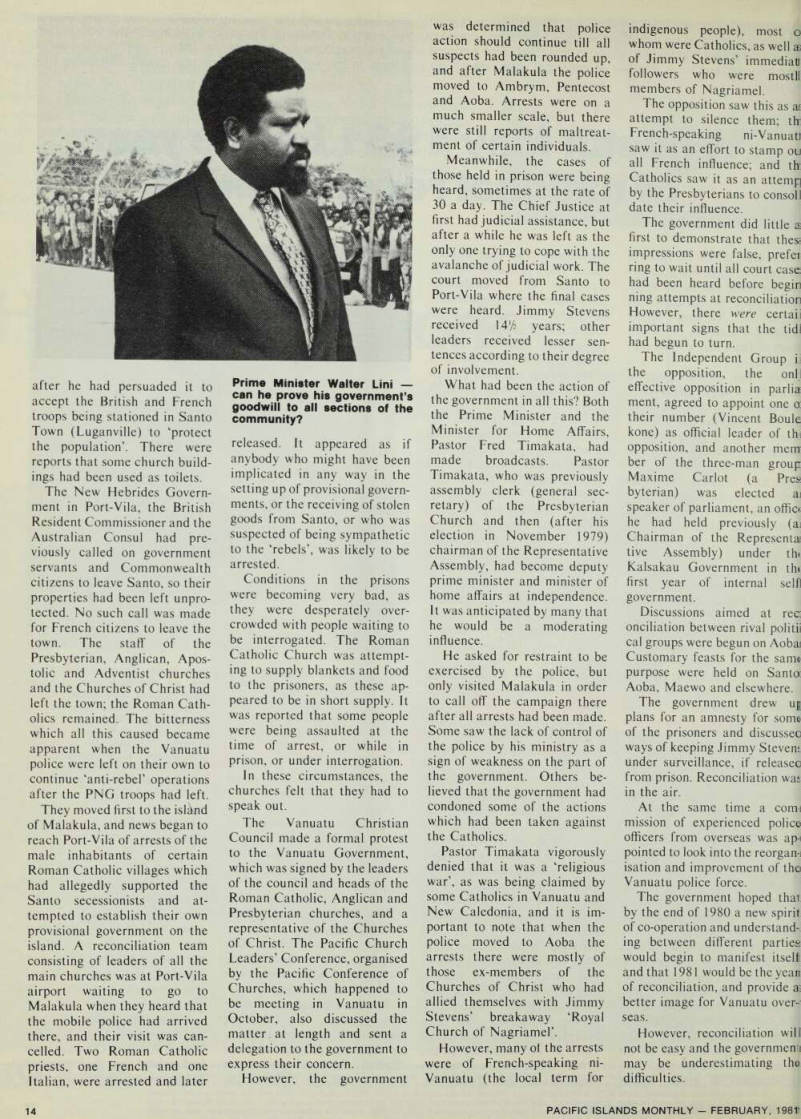
Prime Minister Walter Uni can he prove his government’s goodwill to all sections of the community?
The French-speaking ni- Vanuatu and the members of Nagriamel and other opposition i parties are uncertain about their future, and this feeling of insecurity has been deepened by the wave of arrests after independence, especially as many of those arrested were subsequently released because of insufficient evidence against them. These people cannot for get that the Vanuaaku Party once declared itself against the French language, a move which led Father Gerard Leymang, Jean-Marie Leye and Aime Malere to leave the National Party (as it then was) and form other parties.
The Vanuaaku Party still seems to have little understand ing of the fears of French speaking ni-Vanuatu. Although it has accepted French as an official language (with English and Bislama) the ‘Franco phones’ can point to many things which disturb them; the lack of any ‘Francophone’ min isters in the Lini government, the control of the party by local commissars who appear to limit the government’s ability to con ciliate between rival groups in the islands, and the presence in the government of four minis ters of religion (all Presbyterian, except Father Walter Lini, the prime minis ter, who is Anglican) who have not always spoken out strongly against the un-Christian actions of some of their followers, especially those in the Vanuatu police. In addition, they stress that the Vanuaaku Party itself set up a People’s Provisional Government in 1977, and that its vigilante groups in certain islands (especially Tanna) have been active in the past against the ‘Moderates’ (a general name for those in opposition to the government).
These things have made it hard for most of those who are not in the Vanuaaku Party really to believe in the goodwill of the government, and much more will need to be done to reassure the non-Vanuaaku Party people that the govern ment really sees an important place for them in the life of the nation in future.
The non-Vanuaaku Party groups must however make their position clear, and must reassure the government that they are willing to participate
and co-operate. They must clearly indicate that they will accept and abide by the consti tution, that they will not en courage any uprising in future against the legally elected government, and that they will cease to allow foreign elements to foment trouble in the country.
The churches and the Nat ional Council of Chiefs have a very special role to play in the work of reconciliation and nation-building, and this needs to be openly recognised and stated by the government. The leaders of the Roman Catholic Church in particular have a special responsibility to encour age their people to work together with other Christians, and to overcome the feeling that they have of being a persecuted minority.
Catholics who are members of parliament could give a lead by taking their seats in the House some of them have not even attended one sitting since the new parliament was elected in November 1979, and Vanuaaku Party members of
Parliament suspect them of being unwilling to voice their grievances in a democratic way.
The chiefs may be able to arrange customary ways of rec onciliation between opposing groups at village level, and encourage MPs representing ‘custom’ groups in various islands (especially Santo and Tanna) to play their full part in the work of parliament. They also have a special respons ibility to see that land problems are settled amicably, now that, since independence, all title to rural land has been returned to custom owners. Local people will have the opportunity to use the land (in co-operation with non-Melanesians in many places) for the economic and social development of the country.
Personally, my hopes for Vanuatu in 1981 are as follows: I would hope to see a greater emphasis on peace and under standing (rather than just law and order), and a more Christian spirit everywhere. 1 would hope that all parties and groups will try to root out the bitterness and hatred which have marked Vanuatu politics for too long, and that there may be an effort by French-speaking and English-speaking ni- Vanij|itu really to communicate their hopes and fears to one another and find a way forward acceptable to the great majority of the population.
I would like to see the government co-operate actively with the Vanuatu Christian
Council and the National Council of Chiefs in encourag ing a deeper understanding between rival groups, especially at the village level. Certain broad aims for the next few years need to be worked out by a process of consultation and consensus throughout the nation. The central government could involve the island govern ments, the churches, the chiefs, the business sector and other important groups in this pro cess, which should lead to a sharing of the power and wealth which seems to be concentrated in the hands of a few at the moment.
One hopes that in time sufficient key people suitably qualified will emerge to take over all the political work, and that the pastors at present involved in politics will be able to return to their pastoral du ties. And, not least, one hopes for a police force which will be respected rather than feared, and one in which discipline will be understood and upheld. I trust that my expression of these hopes will not be seen as a wish to interfere!
Vanuatu has many friends throughout the world who are longing that it may become a stable, peaceful and just country. The republic needs all the encouragement and support its friends can give it, without their meddling in its internal affairs: May 1981 be a year of new hope for the Republic of Vanuatu and its parliament, its government and its people.
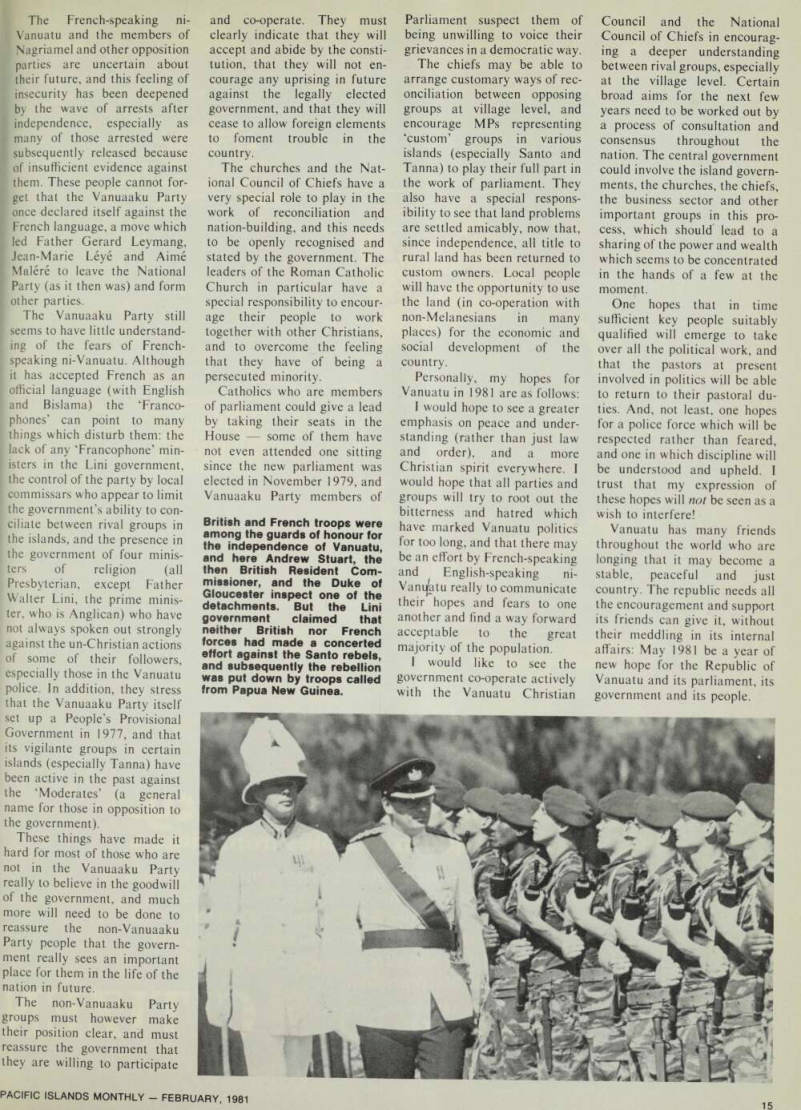
British and French troops were among the guards of honour for the independence of Vanuatu, and here Andrew Stuart, the then British Resident Com missioner, and the Duke of Gloucester inspect one of the detachments. But the Uni government claimed that neither British nor French forces had made a concerted effort against the Santo rebels, and subsequently the rebellion was put down by troops called from Papua New Guinea.