Letters
pp. 7-11 · Read in the full issue

Hokule’a: The case for the defence
In his review of my book Hokule’a: The Way to Tahiti (PIM Dec p 43), Bengt Danielsson spends an inordinate amount of time castigating me, and insulting just about every one else involved in the voyage of Hokule’a to Tahiti in 1976, including some fine Pacific Island seamen. Your reviewer, who professed to be warmly supportive of the project during the preparatory stages, and who appeared to welcome us sin cerely to Tahiti, vehemently turned against the project, and particularly me, once he had learned that the voyage had been a troubled one.
Fortunately, our Tahitian friends of the Tainui Society
stuck by us in that difficult period just after our arrival in Tahiti when we had to reorgan ise the crew and refit the canoe so that Hokule’a could sail back to Hawaii with honour.
Their commitment to the proj ect was genuine for they truly believed in the twin goals which guided our effort; I) to demon strate the worth of the ancient canoes and ways of navigating; 2) to help modern Polynesians rediscover their cultural heri tage as premier blue water sailors. A brief re-examination of our project in terms of these goals, rather than a point by point rebuttal of Danielsson’s distortions and prejudices is, I believe, the best way to balance your reviewer’s supercilious dia tribe.
Yes, an argument can be made that it was an error to try and combine two such difficult goals in one voyage. Why didn’t we just concentrate on sailing to Tahiti and back, and ignore the Hawaiian and Tahitian public?
I have been tempted many a time since the voyage to wish we had done just that. Yet, even though such an exclusive ap proach would probably have made for a smoother voyage, I still support the decision to make our voyage culturally meaningful. We wanted our voyage to be more than a Kon Tiki-Vike expedition in which a group of adventurers crash their raft over a reef to announce to the puzzled islanders that their ancestors had drifted there in just the same way. We were trying to recreate (however incompletely) a documented Polynesian sailing and naviga tional technology; we were at tempting to retrace a voyaging route celebrated in ancient legend; and we were working to
involve a wide spectrum of Hawaiians and Tahitians in the planning and execution of the voyage.
Because of errors committed during a period when some Hawaiians had become acutely sensitive to co-operating with persons from other ethnic groups, the voyage was very nearly scuttled before we left, and we had the utmost difficulty in reaching Tahiti without an all-out mutiny. Rather than tell that tale, Danielsson apparently would rather have me flagellate myself on every page for each and every mis-step along the way. Yet, while accepting as I do in the book my burden of blame, I cannot claim all of it, just as I cannot in any way claim sole credit for Hokule’a’s very real triumphs.
Here the group participation that was so disastrous tactically proved its strategic merit. The thousands of Tahitians who jammed Papeete harbour upon our arrival did not assemble to welcome some sleek racing yacht or visiting warship. They came, well informed by the Tainui Society of the nature of our experiment, to greet a Polynesian canoe, captained by Kawika Kapahulehua (a Hawaiian whose fluency in the Niihau dialect of Hawaiian allowed him to converse with the Tahitians), navigated by Mau Piailug (a Micronesian who used essentially the same non-instrument methods to guide Hokule’a as the ancient Polynesian navigators used to direct their canoes) and manned by a largely Polynesian crew including Rodo Williams (a Tahitian master mariner whose contributions Danielsson chooses to slight).
The Hawaiians too claimed Hokule’a as theirs upon her return to Hawaii and have not allowed her to moulder away on some beach, or suffer a slower death in some warehouse. Since her return Hokule’a has been used as a ‘floating classroom’ to teach the children of Hawaii about the maritime technology that made the first settlement of their islands possible, and, as readers of the June 1980 (p9l) PIM know, the canoe recently completed a second round-trip voyage to Tahiti and back.
Hokule’a is alive and well today, and so is the resurgence in Polynesian pride in their
oceanic heritage that she sparked.
Hokule’a has a life of her own and continually draws people to her. She is not the property of Herb Kane, Tom Holmes or myself, but of a public group, the Polynesian Voyaging Society, which we founded to sponsor the voyage and subsequent educational programmes. We have retired to the status of advisers to the society. New blood has taken over, and significantly much of it is contained in the veins and arteries of young Hawaiians who are literally re-discovering their maritime roots (or should that be ‘wakes’) through sailing aboard Hokule’a.
Twenty - seven - year - old Nainoa Thompson is an out standing but not a typical example of this movement. It was Nainoa who, under the tutelage of the Micronesian master Mau Piailug, navigated Hokule’a to Tahiti and back without instruments on the re cent voyage which confirmed and extended the accomplish ments of the earlier one.
There can be no doubt now that the Polynesians had a sailing technology superbly adapted to blue water voyaging.
Those who experienced the rancour and conflict of the 1976 voyage can rest, for the twin goals of research and cultural discovery are now meshing smoothly to expand our knowl edge and appreciation of Polynesia’s oceanic heritage.
Ben R. Finney
Honolulu Hawaii
Usa
Bengt Danielsson comments: It is really not very surprising that Professor Finney is unhappy about my review of his book Hokule’a: The Way to Tahiti (PIM Dec p 43), for when re lated in such a condensed form all his incredibly stupid mis takes and miscalculations stand out even more clearly. I can
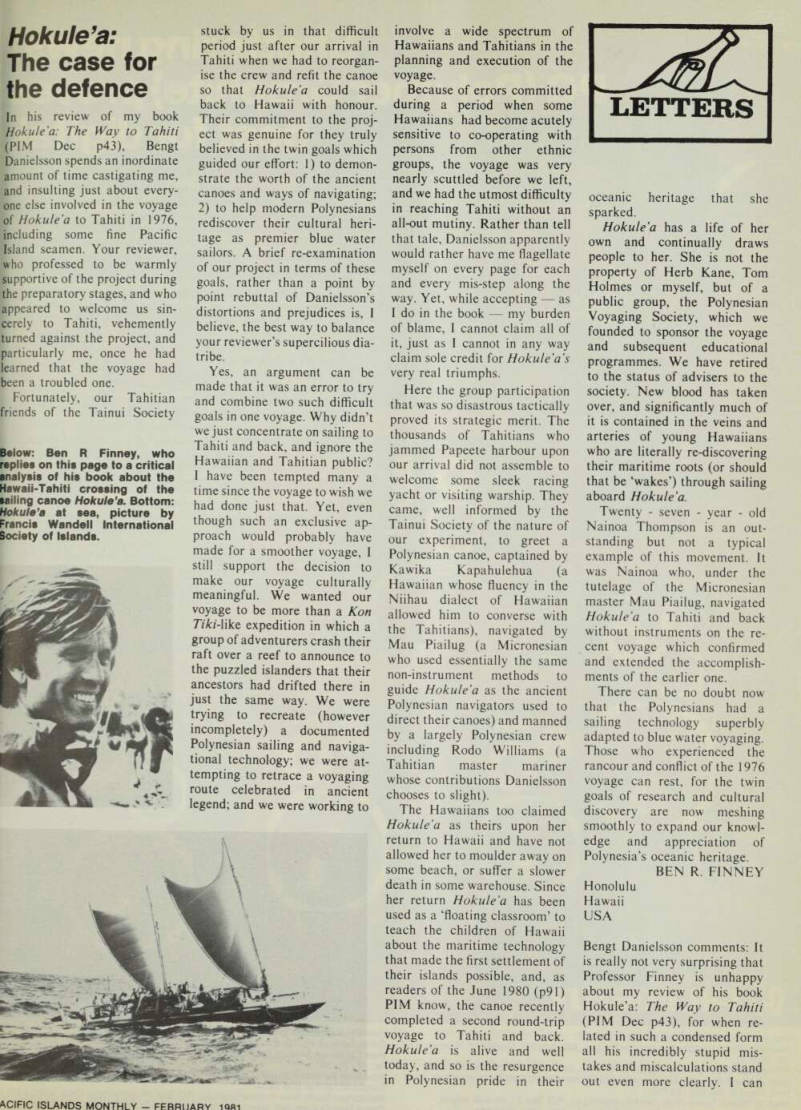
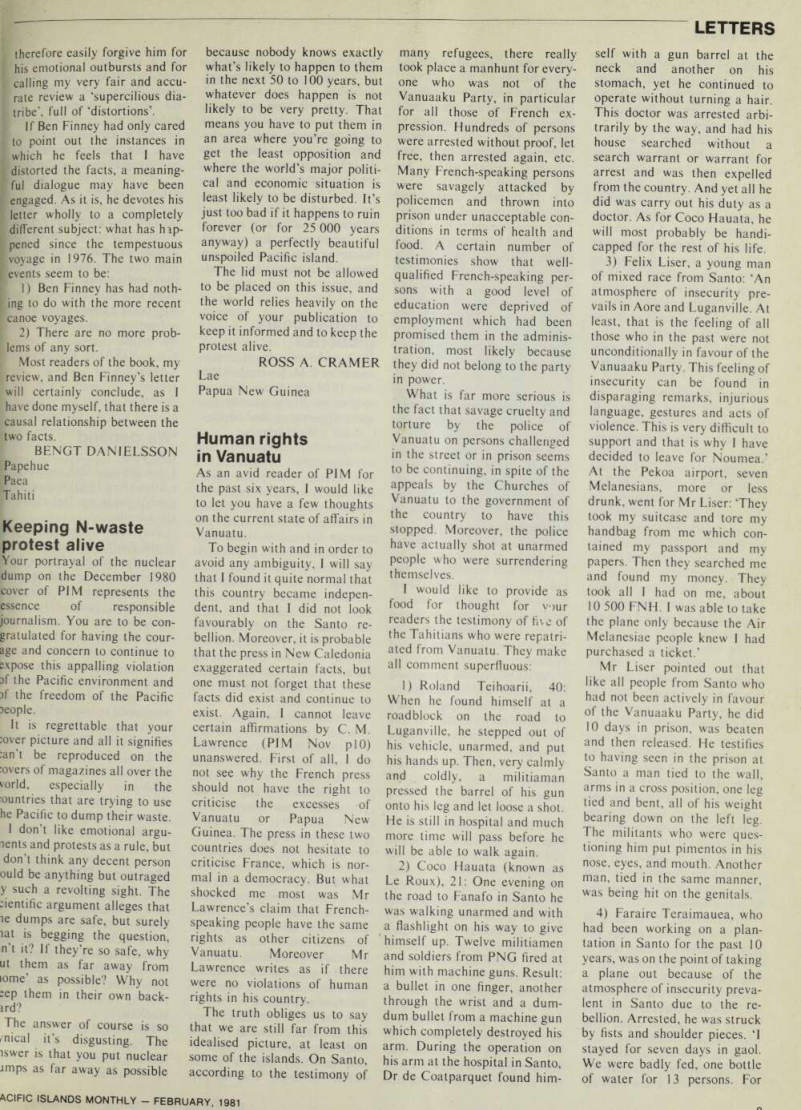
Below: Ben R Finney, who replies on this page to a critical snalysis of his book about the Hawaii-Tahiti crossing of the sailing canoe Hokule’a. Bottom: Hokule’a at sea, picture by Francis Wandell International Society of Islands.
therefore easily forgive him for v his emotional outbursts and for calling my very fair and accu rate review a ‘supercilious dia tribe’, full of ‘distortions’.
If Ben Finney had only cared to point out the instances in which he feels that I have distorted the facts, a meaning ful dialogue may have been engaged. As it is, he devotes his letter wholly to a completely different subject; what has hap pened since the tempestuous I voyage in 1976. The two main I events seem to be: 1) Ben Finney has had noth ing to do with the more recent canoe voyages. 2) There are no more prob lems of any sort.
Most readers of the book, my review, and Ben Finney’s letter will certainly conclude, as I have done myself, that there is a causal relationship between the two facts.
Bengt Danielsson
Papehue Paea Tahiti
Keeping N-waste
protest alive
Your portrayal of the nuclear dump on the December 1980 cover of PIM represents the essence of responsible journalism. You are to be con gratulated for having the cour age and concern to continue to expose this appalling violation the Pacific environment and af the freedom of the Pacific aeople.
It is regrettable that your 'over picture and all it signifies :an’t be reproduced on the :overs of magazines all over the vorld, especially in the countries that are trying to use he Pacific to dump their waste. 1 don’t like emotional argu ments and protests as a rule, but don’t think any decent person ould be anything but outraged y such a revolting sight. The :ientific argument alleges that te dumps are safe, but surely lat is begging the question, n’t it? If they’re so safe, why ut them as far away from iome’ as possible? Why not sep them in their own back ed?
The answer of course is so
/nical it’s disgusting. The
iswer is that you put nuclear imps as far away as possible
because nobody knows exactly what’s likely to happen to them in the next 50 to 100 years, but whatever does happen is not likely to be very pretty. That means you have to put them in an area where you’re going to get the least opposition and where the world’s major politi cal and economic situation is least likely to be disturbed. It’s just too bad if it happens to ruin forever (or for 25 000 years anyway) a perfectly beautiful unspoiled Pacific island.
The lid must not be allowed to be placed on this issue, and the world relies heavily on the voice of your publication to keep it informed and to keep the protest alive.
Ross A. Cramer
Lae Papua New Guinea
Human rights
in Vanuatu
As an avid reader of PIM for the past six years, I would like to let you have a few thoughts on the current state of affairs in Vanuatu.
To begin with and in order to avoid any ambiguity, I will say that I found it quite normal that this country became indepen dent, and that I did not look favourably on the Santo re bellion. Moreover, it is probable that the press in New Caledonia exaggerated certain facts, but one must not forget that these facts did exist and continue to exist. Again, I cannot leave certain affirmations by C. M.
Lawrence (PIM Nov plO) unanswered. First of all, I do not see why the French press should not have the right to criticise the excesses of Vanuatu or Papua New Guinea. The press in these two countries does not hesitate to criticise France, which is nor mal in a democracy. But what shocked me most was Mr Lawrence’s claim that French speaking people have the same rights as other citizens of Vanuatu. Moreover Mr Lawrence writes as if there were no violations of human rights in his country.
The truth obliges us to say that we are still far from this idealised picture, at least on some of the islands. On Santo, according to the testimony of
many refugees, there really took place a manhunt for every one who was not of the Vanuaaku Party, in particular for all those of French ex pression. Hundreds of persons were arrested without proof, let free, then arrested again, etc.
Many French-speaking persons were savagely attacked by policemen and thrown into prison under unacceptable con ditions in terms of health and food. A certain number of testimonies show that well qualified French-speaking per sons with a good level of education were deprived of employment which had been promised them in the adminis tration, most likely because they did not belong to the party in power.
What is far more serious is the fact that savage cruelty and torture by the police of Vanuatu on persons challenged in the street or in prison seems to be continuing, in spite of the appeals by the Churches of Vanuatu to the government of the country to have this stopped. Moreover, the police have actually shot at unarmed people who were surrendering themselves.
I would like to provide as food for thought for v«>ur readers the testimony of five of the Tahitians who were repatri ated from Vanuatu. They make all comment superfluous: 1) Roland Teihoarii, 40: When he found himself at a roadblock on the road to Luganville, he stepped out of his vehicle, unarmed, and put his hands up. Then, very calmly and coldly, a militiaman pressed the barrel of his gun onto his leg and let loose a shot.
He is still in hospital and much more time will pass before he will be able to walk again. 2) Coco Hauata (known as Le Roux), 21: One evening on the road to Fanafo in Santo he was walking unarmed and with a flashlight on his way to give himself up. Twelve militiamen and soldiers from PNG fired at him with machine guns. Result: a bullet in one finger, another through the wrist and a dum dum bullet from a machine gun which completely destroyed his arm. During the operation on his arm at the hospital in Santo, Dr de Coatparquet found him
self with a gun barrel at the neck and another on his stomach, yet he continued to operate without turning a hair.
This doctor was arrested arbi trarily by the way, and had his house searched without a search warrant or warrant for arrest and was then expelled from the country. And yet all he did was carry out his duty as a doctor. As for Coco Hauata, he will most probably be handi capped for the rest of his life. 3) Felix User, a young man of mixed race from Santo: ‘An atmosphere of insecurity pre vails in Aore and Luganville. At least, that is the feeling of all those who in the past were not unconditionally in favour of the Vanuaaku Party. This feeling of insecurity can be found in disparaging remarks, injurious language, gestures and acts of violence. This is very difficult to support and that is why I have decided to leave for Noumea.’
At the Pekoa airport, seven Melanesians, more or less drunk, went for Mr Liser: They took my suitcase and tore my handbag from me which con tained my passport and my papers. Then they searched me and found my money. They took all 1 had on me, about 10 500 FNH. I was able to take the plane only because the Air Melanesiae people knew I had purchased a ticket.’
Mr Liser pointed out that like all people from Santo who had not been actively in favour of the Vanuaaku Party, he did 10 days in prison, was beaten and then released. He testifies to having seen in the prison at Santo a man tied to the wall, arms in a cross position, one leg tied and bent, all of his weight bearing down on the left leg.
The militants who were ques tioning him put pimentos in his nose, eyes, and mouth. Another man, tied in the same manner, was being hit on the genitals. 4) Faraire Teraimauea, who had been working on a plan tation in Santo for the past 10 years, was on the point of taking a plane out because of the atmosphere of insecurity preva lent in Santo due to the re bellion. Arrested, he was struck by fists and shoulder pieces. T stayed for seven days in gaol.
We were badly fed, one bottle of water for 13 persons. For
clothing we had only our underpants and had to sleep on the floor.’ At the airport, he found his suitcase, emptied pf all its contents. 5) Paul Douyere, 17, son of a Tahitian mother: He was living on the island of Acre at the time the rebellion took place in Santo but was nevertheless arrested and stayed in prison for three months. T saw people coming back from interrogation with their faces covered in blood, with swellings on their faces and bodies. They would sit there in their blood with no medical care whatsoever. Three or four men would keep the “witness” on the floor while another would beat him with a long stick.' These witnesses have cer tainly not lied since on November 8, the Vanuatu Christian Council which com prises the Presbyterian, Anglican and Catholic churches of Vanuatu published the following unambiguous de claration: The rights of people and their property continue to be violated and this, often, by the peace-keeping forces them selves. Testimony of police brutality in the prisons of Santo and Lakatoro have become too numerous to be treated as mere rumours.’
The Christian Council ‘de plores the present policy of the government consisting in mak ing massive arrests, often on little or no proof, and insists that the government reopen the inquiry on the death of Alexis Yolu, deputy of the Opposition, assassinated in Tanna.’
Mr Lini replied that the government is unable to make selective arrests but it appears said nothing on the matter of police brutality, whereas the council had asked that an investigative commission be created to deal with the matter of police brutality.
In conclusion, on the basis of the above information, any ob jective person can ascertain: 1) That for the time being, at least on several of the islands of Vanuatu, there can be found second-class citizens, or human beings of a second class, who are insulted, mistreated, and living in a painful atmosphere with no apparent reaction by the government. French speak
ing persons are ruled out of the government. 2) That a certain number of sadists are making use-of their police uniforms in Vanuatu to satisfy their brutal instincts.
Moreover, civilians beat and rob other civilians without be ing disturbed.
It is therefore urgent and would be to the credit of Walter Lini’s government to have these breaches of human rights cease while affording a guarantee to one and all including all French-speaking persons and French citizens, residents of many years, of personal safety and the safety of property, of dignity and employment, while firmly pulling together its police force, the sadistic el ements of which ought to be fired and prosecuted in court.
I will finish by reminding you that a certain number of per sons born in Vanuatu live and work in Tahiti and in spite of the harm done to certain per sons from Tahiti by the police in Santo, no person born in Vanuatu has to date been molested in Tahiti either physically, or at the level of his property and employment. For indeed, in Polynesia, even foreigners benefit from the hu man rights which all states undertake to respect when be coming a member of the United Nations.
All that I wish for Vanuatu is that it may live in prosperity, making progress along the road to democracy which, among other things, implies respect for minorities.
Phil Lechat
Papeete French Polynesia In a statement replying to the churches’ statement referred to in Mr Lechat’s letter, the Vanuatu Government said: ‘With regard to a Commission of Inquiry concerning alle gations of the maltreatment of those in custody, it is stated again that the government does attach importance to such a Commission, but the timing of its establishment is important if it is to be effective and just. ’
Earlier, the government statement had declared that the churches’ statement, and one along similar lines made by the Leader of the Opposition
Vincent Boulekone, prompted it ‘to question why the ex pressions of concern for indi vidual rights not made when so many people were being terrorised and their hu man right to live in peace with their families was being abused by many of those who now face trial’. The government state ment added: ‘The principle existed then as it does now and the government has a legit imate expectation of consist ency in support of it.’
Editor.
‘Revolutionary
gibberish’
With reference to the com ments by C M. Lawrence (PIM Nov 1980 p 9), please allow me to give my Melanesian brother some urgently needed advice.
I am a West Irianese and in spite of all political and revolutionary hypocrisies, I shall remain a proud West Irianese as long as I live. What puzzles me about you. Brother Lawrence, is that while you express anti-colonial and anti racist sentiments in public, you appear to prefer a true white colonial name to your tra ditional Melanesian one. Are you, like many of your Wantoks, ashamed of your name? Or do you see yourself already as the new coming ‘Brown Masta’ who will oppress your own people in the old colonial fashion?
It also seems strange to me that while you still buy your rice and tinned fish at Steamships, Carpenters or BP, you make horrible noises about Tahiti, New Caledonia, and so on, places that are thousands of miles away. But at the same time you omit any mention of the fact that only a few hundred miles off a whole nation of your racial brothers and sisters has been fighting for years against colonial annihilation. Further more, you and your present Wantoks even seem to be seriously considering whether or not you should lend a hand in the extermination of your own brothers and sisters.
Allow me to remind you, my brother, that as long as you and your Wantoks are suckled and can only survive on ‘white’ handouts, and are pre
pared to betray and oppress your own people, all your talk about racism and revolution in the Pacific sounds like the gibberish of Lapun Meris who had too much Buai, or like the little dog that bares its fangs and savagely barks at the moor only to run like hell once his Master kicks his bottom.
May the Lord bless you just the same and enlighten you with wisdom and realism. Save your breath, and nourish those little grey cells, instead of blowing foul smells across the Pacific at those who still feed you and who could exterminate us all in a fraction of a second if they wanted to.
Vitalis Paingame
Cairns Qld Australia
‘We depend
on you’
I thought your 50th anniversary edition (Aug 1980) was superla tive! It made me feel closer to the islands.
For many throughout the world Pacific Islands Monthly is nearly the only way we have of forming ideas and opinions about the people and politics of the Pacific community. Your unbiased reporting is important to us. We depend on you.
It would, incidentally, help me if in each issue you would publish a small chart comparing the current value of currencies mentioned in your articles with the Australian dollar.
Thomas P. Butterfield
Pleasant Hill California
Usa
We're looking at the best way of meeting your request con cerning currencies. Editor.
More on PIM and the French As a PIM reader for nearly 30 years (I have a complete file going back to 1968) I must say I have observed a constant anti- French attitude in the maga zine, something not really in keeping with the Australian tradition.
Personally, after a career in the Papua New Guinea public service, after being naturalised as an Australian 22 years ago,
and having a PNG wife, 1 sup pose I could claim to be objec tive about international affairs.
For instance, I was even un popular with my former French countrymen in North Queens land when I supported cam paigns against nuclear tests in the Pacific.
I feel that, apart from the readers’ letters always inter esting in their variety PIM should be more unbiased in some of its editorial comments.
I For instance, Stuart Inder, (PIM Nov 1980 pi 7) denies that he is ‘anti-French’. Gener ally, I agree with his evaluation of French influence in the Pacific. However, when Mr Inder writes ‘. . . as citizens they’ (‘foreign’ Frenchmen J.H. deN.) ‘have the vote im mediately on arrival’ (in New Caledonia), he forgets that, in the reverse case, Pacific Islanders, or any persons from overseas territories of France, have the vote also on their arrival in France.
It is well known that the president of the French Senate was, for many years, Mr Monerville, a mixed-blood poli tician from Guiana. Can you imagine that, before PNG inde pendence, Sir John Guise, for example, could have been presi dent of the Senate in Canberra?
Or that Michael Somare could have been a minister in the Australian Government?
But Leopold Senghor, presi dent of Senegal for many years until he resigned in January his year), and Felix Jouphouet-Boigny, leader of he independent country of vory Coast, were in earlier imes members of the French jovernment in Paris.
These facts give a different >erspective on French ‘colonial snT. As far as the Pacific is oncerned, if the image of r rance is not perfect in Tahiti r New Caledonia, why is it that At Inder forgot that the USA as no more rights than anyone Ise in Hawaii, far from the American coast, or in Guam? )r that the Indonesians have no lore rights than anyone else in Vest New Guinea?
J. Huon De
Navrancourt
itherton )ld Australia
More memories of
Captain Musick
The letter from David Sievers in Pago (PIM Nov 1980 p 11) brought back memories of my experiences with Captain Edwin (not Lorenzo) Musick, and of his air adventures in the Pacific.
In 1963 Pan Am invited Captain Musick’s widow to visit American Samoa at their ex pense since she had never had the opportunity to visit the area in which her husband was killed. I was assigned by the governor to entertain Mrs Musick during her brief visit.
We were able to find a number of local people who had not only seen Captain Musick in Samoa, but had talked to him.
Typically, the Samoans had written a song about the cap tain’s air adventures. While 1 don’t remember all the words to their song, it ended with his tragic crash near Tutuila. Pan Am experts feel the explosion which destroyed both plane and crew was caused by petrol being jettisoned before landing in Pago after a malfunction devel oped shortly after taking off for Auckland.
Several Samoans told me that they paddled out in canoes immediately after the crash.
Nothing, unfortunately, was re covered.
Captain Edwin Musick was a trail-blazer for American avi ation not only in the Pacific but also in South America and the Far East. He pioneered not only the Pan Am Grace routes to South America, but also flew the first China Clipper to Hong Kong in 1936. (The date of the Pago crash was January 11, 1938).
Mrs Cleo Musick was so impressed by the traditional courtesy of the Samoan people that she asked me to help her set up some type of scholarship award for Samoan students. We agreed on a replica of the medal Captain Musick had been given in 1935 in connection with the Harmon Trophy for aviation pioneering. I have one of the medals in my possession.
Feeling that the Musick story should be told completely, I decided to ask Dr Eugene Burdick (Blue of Capricorn ), professor of English at the
University of California, to col laborate with me on the story.
On returning to California in 1964, however, I learned that he had died suddenly of a heart attack. As far as I know the story has never been fully writ ten.
Jack E. Harlan
Kona Hawaii
Usa
Oops! Our ‘nambas’
slipped
A short note about the cover photograph on your February 1980 edition of PIM.
The men in the picture are not Small Nambas men from Malakula, but come from the southern section of the island of Pentecost. ‘Nambas’ is the gen eral term in Bislama for a penis wrapper, but each of the ‘nambas-wearing’ areas of Vanuatu have their own language terms for the wrap pers.
The south Pentecost wrap pers in the photograph are made of woven and dyed pandanus, are known as ‘Peipis’ and indicate the wearer to be of medium social rank. The same area has other types of wrappers to indicate males of low and high rank. The so-called ‘Small Nambas’ peoples of the interior of southern Malakula wear a banana-leaf wrapper called ‘Nabu’kap’ in the Pot’gote
language-speaking area.
The wearing of the ‘nambas’ in Vanuatu seems to have been restricted to the areas in which there was traditionally circum cision or incision for the males.
In most other areas men wore various forms of woven mats drawn up between the legs to form a type of ‘breechclout’.
K.W. Huffman
Curator (Museum) Vanuatu Cultural Centre Port-Vila Vanuatu Many thanks for the correction.
Editor.
Dorothy won’t
go home Please allow me to reply to the letter from D. Ruimb of Mt Hagen (PIM Dec 1980 plO).
If I was in fact ‘wasting my time’, D. Ruimb, then why did you reply to me?
I have lived 12 years in the East Sepik, and eight in the West Sepik so what is the ‘true valuable identity’ I should respect? The fact that my Melanesian brothers betray their own brothers and sisters to foreign colonial expansionists?
Or, perhaps, the fact that 1 could be sold like a pig accord ing to our custom to the highest bidder, without my having any say in the matter?
To come back to the ‘real practical climate’ of our Melanesian society, dear D.
Ruimb: I went back a year ago to see my father and mother, only to be nearly raped in Port Moresby’s Jackson Airport while waiting for my plane to Wewak. On top of that, all my belongings were stolen.
If that is the ‘climate of the new Melanesian society’ you are talking about, D. Ruimb, you can keep it. At least here I can live like a human being, and not something that has less value than a pig.
Once Papua New Guinea es tablishes its true national iden tity in terms of morals and ethics towards its own women, and its own racial brothers and sisters across the border then perhaps 1 will return again. In the meantime I prefer to stay where 1 am perhaps as a ‘Nigger’ and a ‘Coon’, but still an equal human being with equal rights, and with a lot less chance of being raped by my own kind.
Dorothy Wakau
Cairns Qld Australia