McEwen’s
p. 65 · Read in the full issue
Sir John McEwen’s non-role
John Lawry. a former officer in Australia's foreign ser vice, was posted to Noumea in December 1940. only a few months after the events described in this article.
Now working in the Depart ment of Pacific and South east Asian history at the Australian National Univer sity, he disputes the late Sir John McEwen’s suggestion that he had something to do with the decision to send HMAS Adelaide on its September 1940 mission to Noumea. Mr Lawry writes: Declassified records now available from 1940 make it clear that the Australian support for the bloodless Free French coup in New Caledonia on September 19 1 940 did not spring from any initiative by Mr McEwen
(w ho was Minister for Exter nal Affairs from March 14 to October 28 1940).
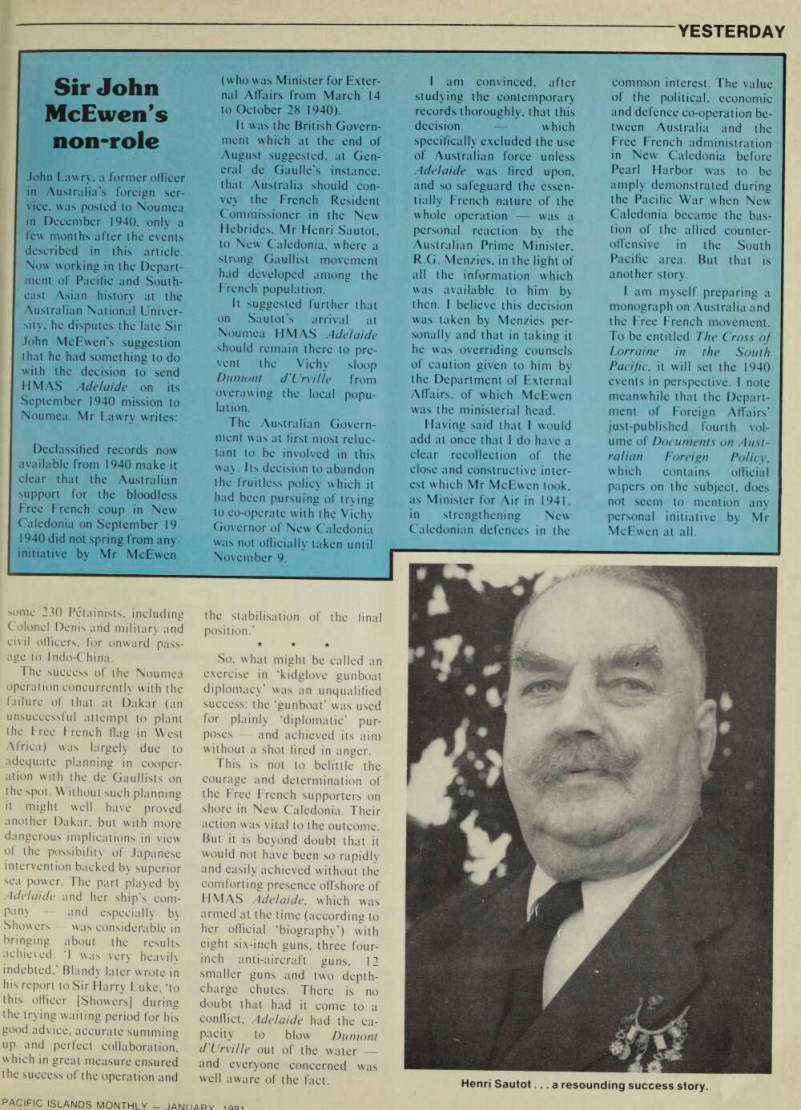
It was the British Govern ment which at the end of August suggested, at Gen eral dc Gaulle's instance, that Australia should con vey the French Resident Commissioner in the New Hebrides. Mr Henri Saulol, to New Caledonia, where a strong Gaullisl movement had developed among the French population.
It suggested further that on Saulol’s arrival at Noumea HMAS Adelaide should remain there to pre vent the Vichy sloop Dumont d'Urville from overawing the local popu lation.
The Australian Govern ment was at first most reluc tant to be involved in this way. Its decision to abandon the fruitless policy which it had been pursuing of trying to co-operate with the Vichy Governor of New Caledonia was not officially taken until November 9.
I am convinced, after studying the contemporary records thoroughly, that this decision which specifically excluded the use of Australian force unless Adelaide was fired upon, and so safeguard the essen tially French nature of the whole operation was a personal reaction by the Australian Prime Minister, R.G. Menzies, in the light of all the information which was available to him by then. 1 believe this decision was taken by Menzies per sonally and that in taking it he was overriding counsels of caution given to him by the Department of External Affairs, of which McEwcn was the ministerial head.
Having said that I would add at once that I do have a clear recollection of the close and constructive inter est which Mr McEwcn took, as Minister for Air in 1941, in strengthening New Caledonian defences in the
common interest. The value of the political, economic and defence co-operation be tween Australia and the Free French administration in New Caledonia before Pearl Harbor was to be amply demonstrated during the Pacific War when New Caledonia became the bas tion of the allied counter offensive in the South Pacific area. But that is another story.
I am myself preparing a monograph on Australia and the Free French movement.
To be entitled The Cross of Lorraine in the South Pacific, it will set the 1940 events in perspective. I note meanwhile that the Depart ment of Foreign Affairs’ just-published fourth vol ume of Documents on Aust ralian Foreign Policy, which contains official papers on the subject, does not seem to mention any personal initiative by Mr McEwcn at all.