Anti-nuclear stand by proposed
pp. 67-69 · Read in the full issue

Trade
Winds
Anti-nuclear stand by proposed Pacific Forum of Trade Unions
Unionists and observers from seven Pacific Island countries and from Australia, New Zealand and Japan, met in Fiji recently and decided to form a Pacific Trade Union Forum. The Forum, to be inaugurated at a conference'in Vanuatu in May, will link worker movements from Pacific and Pacific Rim countries and will include heavy emphasis on environmental and anti-nuclear issues. HELEN HILL writes from Fiji about the preparatory talks there.
The germ of an idea to form a Pacific Trade Union Forum emerged in May last year during informal talks between trade unionists who were attending the 1980 Nuclear-free Pacific Conference in Hawaii.
In the following months the idea was taken up by one of the Auslralians at the talks, Mr John Halfpenny, of Melbourne, who is Victorian Secretary of the big Australian Amalgamated Metal Workers and Shipwrights Union.
Mr Halfpenny made organisational visits to New Caledonia, Vanuatu and Fiji, and on his initiative a recent conference at Nadi in Fiji decided to go ahead with the proposal. A declaration from the conference outlined the following aims and principles of a proposed Pacific Trade Union Forum. To develop and coordinate regional activity on issues of common concern, to co-ordinate an intensive trade union campaign for a nuclearfree Pacific, to promote programmes for improved health and safety in the workplace, and to generally assist trade unions in the Pacific region.
T L n r- ... . , 6 , I he rorum will be independent of existing international trade union organisations Un 'on movement represent. lives to the Nadi meeting came
from Australia, New Zealand, Japan, New Caledonia, Hawaii, Guam, Vanuatu, Kiribati and Fiji. There were observers from the Papua New Guinea and Fiji governments, from the environ mental organisation Green peace New Zealand and from the Nuclear-free Pacific Con ference which plans to establish its secretariat in Vanuatu, The delegates decided to hold another conference in May in Vanuatu, during which the Forum will be inaugurated and its foundation membership es lablished.
Mr Halfpenny will be the convenor of the inaugural con ference, working with an in lerim secretariat and with a budget of SUS77SO which is being subscribed by trade unions in Australia, New Zea land, Japan, Hawaii, New Caledonia and Fiji. In addition to the countries which sent trade union delegates to the Nadi meeting, the inaugural meeing is expected to have representatives from Papua New Guinea, Solomon Islands,
Tahiti and possibly other Island countries. Observers will be invited from the trade union movement in France and main land USA to help explain any actions which the conference might lake against their govern ments.
The opening address to the Nadi meeting was given by Ralu David Toganivalu, Fiji’s Minister for Labour. He com mended the initiative taken by the trade unions and expressed his government’s support, in particular for any action the planned Trade Union Forum might lake against the prolifer ation of nuclear activities in the region. Such activities included the dumping of nuclear waste by Japan and USA, French nuclear tests and the passage through the Pacific of US and Soviet nuclear-powered ships.
The conference received mess ages of support from the Governor of Hawaii, Mr George Ariyoshi, and from the President of the Australian Council of Trade Unions, Mr Cliff Dolan.
Anti-nuclear campaigning was a major issue discussed at the conference, but varied priorities were expressed by the delegates. The Japanese Gen eral Council of Trade Unions told the conference that it supported a regional boycott of Japanese goods in protest against Japanese plans to dump nuclear waste in the Pacific.
However Mr James Raman of the Fiji Trades Union Congress said it would be unfair to single out Japan. France, he said, had been a worse offender for many years with an ‘arrogant’ nuclear testing policy.
The Union Syndicale des Ouvriers el Employes of New Caledonia said that although it was opposed to all forms of nuclear proliferation it believed that other matters were of greater immediate importance.
The other matters included
independence for all Pacific countries, ‘the struggle against multinational companies’ and the need for greater health and safety protection for workers.
But Mr Jim Knox, President of the New Zealand Federation of Labour, urged the meeting to confine itself to nuclear issues rather than to become bogged down in ideological differences.
The nuclear debate resulted in a decision to declare March I to March 8 as a week of action in support of a nuclear-free Pacific. Posters and petitions in English, French and Japanese will oppose Japanese and US nuclear waste dumping in the Pacific and will call for an end to French nuclear tests in the Pacific. Other action during Nuclear-free Week will be at the discretion of each trade union movement in its own country, but a co-ordinated campaign was tentatively plan ned for 1982 during the second special session on disarmament to be held by United Nations.
There had been published speculation that the Nadi meet ing would decide to spearhead a full-scale co-ordinated boycott of Japanese exports or to take other direct action against governments. On this basis, the proposal to hold unco-ordinated Nuclear-free Week campaigns emerged as a fairly mild course of action. Flowever there is significance in what has hap pened. The inference is that the emerging Pacific Trade Union Forum does not want to go off half-cocked at a lime when its
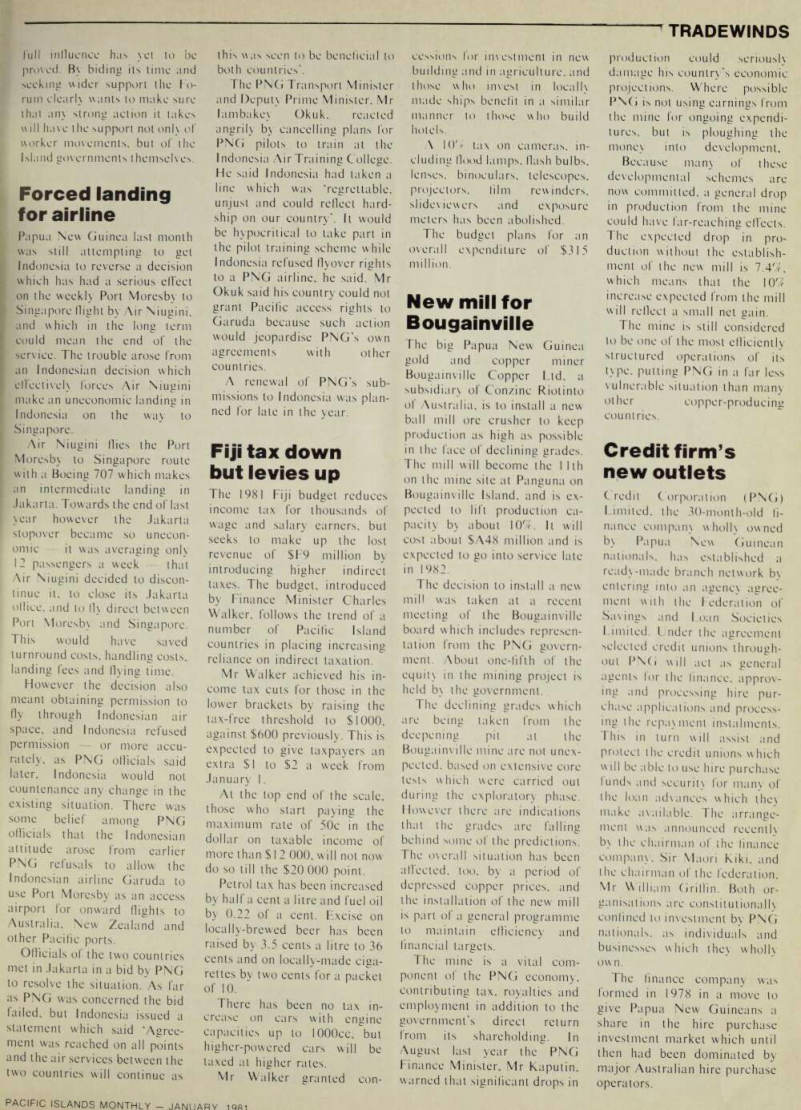
At the Nadi conference (from left): Australian union leader John Halfpenny, Fiji Labour Minister Ratu David Tongan ivalu, New Zealand Labour Fed eration president Jim Knox and Fiji TUC secretary James Raman.
full influence has yet to be proved. By biding its time and seeking wider support the f o rum clearly wants to make sure that any strong action it takes will have the support not only of worker movements, but of the Island governments themselves.
Forced landing
for airline
Papua New Guinea last month was still attempting to gel Indonesia to reverse a decision . which has had a serious effect on the weekly Port Moresby to Singapore flight by Air Niugini. and which in the long term could mean the end of the service. The trouble arose from an Indonesian decision which clTccliveK forces Air Niugini make an uneconomic landing in Indonesia on the way to Singapore.
Air Niugini flies the Port Moresby to Singapore route with a Boeing 707 which makes an intermediate landing in Jakarta. Towards the end of last year however the Jakarta stopover became so unecon omic it was averaging only 12 passengers a week that Air Niugini decided to discon tinue it, to close its Jakarta office, and to fly direct between Port Moresby and Singapore.
This would have saved lurnround costs, handling costs, landing fees and flying lime.
However the decision also meant obtaining permission to fly through Indonesian air space, and Indonesia refused permission or more accu rately, as PNG officials said later, Indonesia would not countenance any change in the existing situation. There was some belief among PNG officials that the Indonesian attitude arose from earlier PNG refusals to allow the Indonesian airline Garuda to use Port Moresby as an access airport for onward flights to Australia, New Zealand and other Pacific ports.
Officials of the two countries met in Jakarta in a bid by PNG to resolve the situation. As far as PNG was concerned the bid failed, but Indonesia issued a statement which said ‘Agree ment was reached on all points and the air services between the two countries will continue as
this was seen to be beneficial to both countries’.
The PNG Transport Minister and Deputy Prime Minister. Mr lambakey Okuk, reacted angrily by cancelling plans for PNG pilots to train at the Indonesia Air Training College.
He said Indonesia had taken a line which was ‘regrettable, unjust and could reflect hard ship on our country’. It would be hypocritical to take part in the pilot training scheme while Indonesia refused flyover rights to a PNG airline, he said. Mr Okuk said his country could not grant Pacific access rights to Garuda because such action would jeopardise PNG’s own agreements with other countries.
A renewal of PNG’s sub missions to Indonesia was plan ned for late in the year.
Fiji tax down
but levies up
The 1981 Fiji budget reduces income lax for thousands of wage and salary earners, but seeks to make up the lost revenue of SF9 million by introducing higher indirect taxes. The budget, introduced by Finance Minister Charles Walker, follows the trend of a number of Pacific Island countries in placing increasing reliance on indirect taxation.
Mr Walker achieved his in come tax cuts for those in the lower brackets by raising the tax-free threshold to $lOOO, against $6OO previously. This is expected to give taxpayers an extra $1 to $2 a week from January 1.
At the top end of the scale, those who start paying the maximum rale of 50c in the dollar on taxable income of more than $ 12 000, will not now do so till the $2O 000 point.
Petrol tax has been increased by half a cent a litre and fuel oil by 0.22 of a cent. Excise on locally-brewed beer has been raised by 3.5 cents a litre to 36 cents and on locally-made ciga rettes by two cents for a packet of 10.
There has been no lax in crease on cars with engine capacities up to IOOOcc, but higher-powered cars will be taxed at higher rales.
Mr Walker granted con
cessions for investment in new building and in agriculture, and those who invest in locally made ships benefit in a similar manner to those who build hotels.
A lON tax on cameras, in cluding flood lamps, flash bulbs, lenses, binoculars, telescopes, projectors. film rewinders, slideviewers and exposure meters has been abolished.
The budget plans for an overall expenditure of $315 million.
New mill for
Bougainville
The big Papua New Guinea gold and copper miner Bougainville Copper Ltd, a subsidiary of Conzinc Riolinlo of Australia, is to install a new ball mill ore crusher to keep production as high as possible in the face of declining grades.
The mill will become the I llh on the mine site at Panguna on Bougainville Island, and is ex pected to lift production ca pacity by about 10 %. It will cost about SA4B million and is expected to go into service late in 1982.
The decision to install a new mill was taken at a recent meeting of the Bougainville board which includes represen tation from the PNG govern ment. About one-fifth of the equity in the mining project is held by the government.
The declining grades which are being taken from the deepening pit at the Bougainville mine are not unex pected. based on extensive core tests which were carried out during the exploratory phase.
However there are indications that the grades are falling behind some of the predictions.
The overall situation has been affected, too, by a period of depressed copper prices, and the installation of the new' mill is part of a general programme to maintain efficiency and financial targets.
The mine is a vital com ponent of the PNG economy, contributing lax, royalties and employment in addition to the government’s direct return from its shareholding. In August last year the PNG Finance Minister, Mr Kaputin, warned that significant drops in
production could scriouslv damage his country's economic projections. Where possible PNG is not using earnings from the mine for ongoing expendi tures. but is ploughing the money into development.
Because many of these developmental schemes are now committed, a general drop in production from the mine could have far-reaching effects.
The expected drop in pro duction without the establish ment of the new mill is IAVr, which means that the increase expected from the mill will reflect a small net gain.
The mine is still considered to be one of the most efficiently structured operations of its type, pulling PNG in a far less vulnerable situation than many
other copper-producing
countries.
Credit firm’s
new outlets
Credit Corporation (PNG) Limited, the 3()-monlh-old fi nance companx wholly owned b\ Papua New Guinean nationals, has established a ready-made branch network by entering into an agency agree ment with the Federation of Savings and Loan Societies Limited. Under the agreement selected credit unions through out PNG will act as general agents lor the finance, approv ing and processing hire pur chase applications and process ing the repayment instalments.
This in turn will assist and protect the credit unions which w ill be able to use hire purchase lunds and security for many of the loan advances which they make available. The arrange ment was announced recently by the chairman of the finance company. Sir Maori Kiki. and the chairman of the federation.
Mr William Grillin. Both or ganisations are constitutionally confined to investment by PNG nationals, as individuals and businesses which they wholly own.
The finance company was formed in 1978 in a move to give Papua New Guineans a share in the hire purchase investment market which until then had been dominated by major Australian hire purchase operators.