diplomacy, kidglove style
pp. 59-65 · Read in the full issue
Noumea ’4O: Australian gunboat diplomacy, kidglove style
The presence of an Australian cruiser, HMAS Adelaide, in Noumea harbour in September 1940 played a crucial role in the ousting of a pro-Vichy administration in New Caledonia and the installing of a Free French administration. It thus played a significant part in strengthening Australia’s security in the Pacific War which was to break out 15 months later. PIM Associate Editor MALCOLM SALMON, who himself served in the Australian navy in the Pacific War, has been diving for the details. His quest was greatly helped by John Mackenzie of the Historical Studies Section of the Australian Department of Defence, and Robert Langdon, of the Pacific Manuscripts Bureau, Australian National University.
A dramatic episode in World War II relations between New Caledonia and Australia was recalled by a few paragraphs in an obituary article on the late Australian political leader. Sir John McEwen, which appeared in The Sydney Morning Herald on November 22, 1980.
Written by veteran Aust ralian political journalist, lan Fitchetl, the article said at one point: ‘John McEwen was Minister for External Affairs at the time of the fall of France in 1940 and in latter years he said that he was convinced that Japan would come into the war and that New Caledonia would de clare for Vichy France as French Indo-China had been quick to do and where they had allowed the Japanese to estab lish bases. ‘McEwen and his senior officers organised what he later
said “turned out to be an invasion and a revolution com bined in New Caledonia”. ‘“We had an Australian cruiser just accidentally come into Noumea Harbour, and what really happened after two or three days was that a pro-de Gaulle Government was estab lished,” he said later. ‘“We sailed the pro-Vichy Governor and his people off to Indo-China and put them on a beach. That disposed of the possibility of the Japanese be ing able to occupy New Cale donia with deterrent.'”
Of course, wartime censor ship at the time prevented the Australian public from getting any inkling of the affair.
One writer who gave a de tailed account of the events of September 1940 in New Cale donia which led to the ousting of the pro-Vichy administration in Noumea and its replacement by a Free French government but with never a word about the crucial ‘visit’ of the Aust ralian cruiser is the Aust ralian journalist Wilfred Burchett. He obviously chafed under the restrictions which prevented him from telling the full story. In the final chapter of his 1941 book Pacific Treasure Island New Caledonia, Burchett wrote: ‘When I was in the colony 1 should say that 90 per cent of the population would have welcomed open and obvious signs of Australian co operation in the defence of the colony, and with the handing over of Indo-China by Vichy to Japan this percentage has prob ably increased to 98 per cent. It is a matter of common know l edge that we are doing some thing about the matter, but there is some extraordinary secrecy about it which is far from encouraging.’ (Emphasis added.) He goes on; ‘Such close
secrecy could have two origins.
Either one is afraid that the New Caledonians might object to Australia taking a hand in helping to defend their colony, or one is afraid that such co operation between the two countries will give offence to some third Power. The first reason should be wiped out.
When a householder is expect ing to have his house burgled, the presence of a policeman patrolling the street outside is always welcome even though the householder might have an instinctive dislike of policemen.
He certainly wouldn’t order the policeman away on the grounds that his presence is a provo cation to the burglars. ‘Military authorities have a reputation for preserving a grim silence, which although meant to be reassuring often has the
opposite effect . . . Experience
shows that it pays to take the people into your confidence, and as far as New Caledonia is concerned both the Australian and French authorities would have everything to gain by making it clear that they were co-operating to the greatest extent in their mutual defence needs. They can count on the wholehearted support of their respective populations. ‘As far as giving offence to a third Power is concerned, there are two obvious answers to this.
In the first place, Britain and Free France are allies, so that military co-operation between Australia and the Free French colony of New Caledonia is entirely legitimate. In the second place, there is only one source from which New Cale donia feels herself threatened, and that is from the same country that absorbed New Caledonia’s sister colony of Indo-China. Japan is doubtless well informed about the fact of military co-operation between
Yesterday
Australia and New Caledonia.
There arc 1500 Japanese in the colony, and a very live Japanese Consul, and it would be strange indeed if they were less in formed about such things than the ordinary man in the Noumean streets. Once the fact of such co-operation is estab lished, the harm, from a diplo matic viewpoint, is already done. The extent of such co operation can only act as a deterrent in proportion to its magnitude.’
But whatever cogency there was in Burchett’s argument, the ban on public discussion of the affair remained. It was not until September 1948, for example, that the story surfaced in PINT In that month PIM published an article by H. E. L. Prideau entitled ‘Some now Uncensorcd History How Australia helped De Gaullists to Hold New Caledonia’, in which de tails of the role of the Australia cruiser HMAS Adelaide in effecting the change of govern ment in Noumea appeared.
A further landmark was 1957 when a highly detailed account of the affair appeared in the book Royal Australian Navy 1939-42, the first of the two volumes of the official history of the Australian navy in World War II written by G. Hermon Gill.
Gill’s account deserves re cording in full; ★ ★ ★ The ferment which (the German raider) Orion’s aircraft observed in the streets and
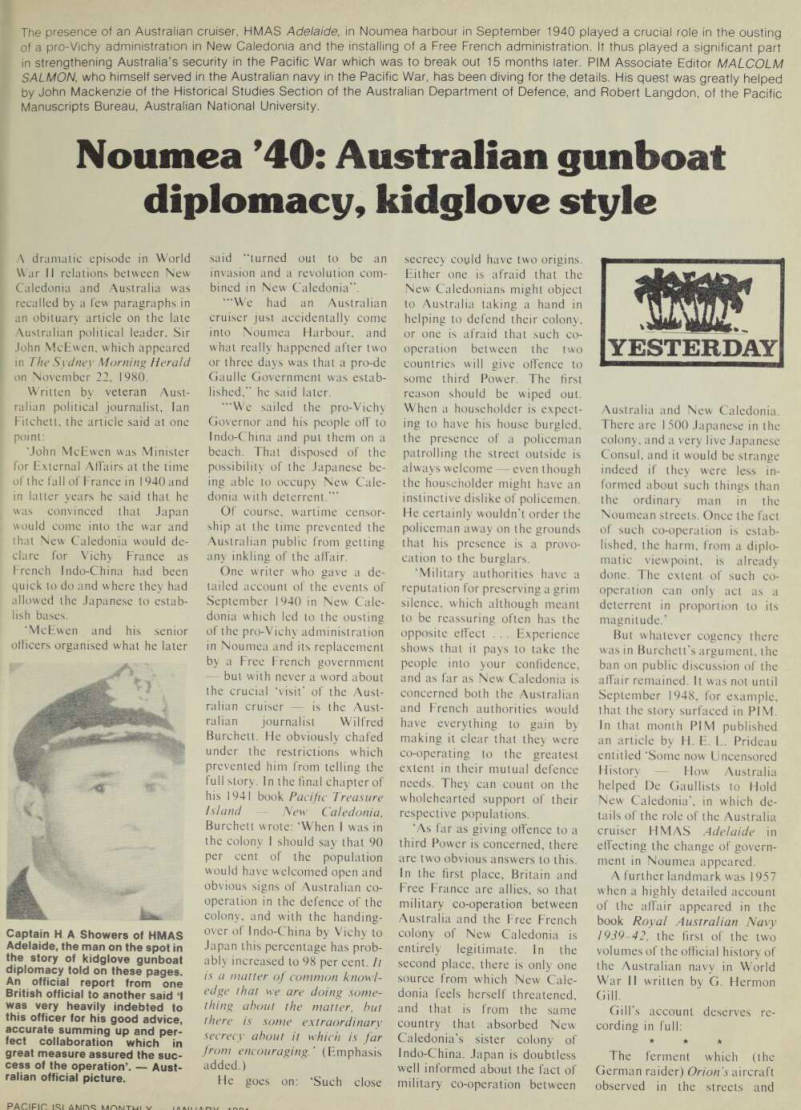
Captain H. A. Showers of HMAS Adelaide, the man on the spot in the story of kidglove gunboat diplomacy told on these pages.
An official report from one British official to another said ‘I was very heavily indebted to this officer for his good advice, accurate summing up and per fect collaboration which in great measure assured the suc cess of the operation’. - Aust ralian official picture.
[ squares of Noumea was at this time causing concern to the British and Australian Govern menls. Despite the resolution of the elective council of New f Caledonia of the 261 h June, affirming the decision to con tinue the fight against Germany, pro-Vichy elements in the island appeared to be gaining ground. The Governor M. Pclicicr who had apparently been trying to bal ance on a precarious foothold in each camp, telegraphed on the 29th July to M. Saulot in the New Hebrides staling that the Vichy Government desired the names of all French officials there rallying to the de Gaulle movement; and a few days later the Vichy Minister for the Colonies sent out an instruction to the effect that a French colony which continued to fight was guilty of treason.
Loyalties in the French Far Fast were divided. Indo-China was definitely pro-Vichy, and the New Hebrides as definitely pro-de Gaulle, to whose cause Tahiti after a movement in his favour had temporarily been suppressed also adhered.
The strength and organisation of de Gaulle supporters in New Caledonia were not known with any certainly outside that island. On the Islh August, alter some confusion and delay on the part of the British Government. M. Saulol who
had in the meantime been confirmed as French Resident Commissioner in the New Hebrides by de Gaulle received assurances of full British support for himself and all concerned in the de Gaulle movement there. When con firming his appointment de Gaulle asked M. Saulot to consider going to New Cale donia as Governor, and to try and rally that colony to the Free French movement a course which was then impracticable since Saulol was unaware of the identity of the de Gaullists in New Caledonia and had no secret means of contact with the island. A move to gel information at first hand was made at the end of August when the High Commissioner for the Western Pacific, Sir Harry Luke, who had reached the New Hebrides on the 25th to study the whole position, continued on to New Caledonia accompanied by the British Resident Commissioner, Mr Blandy. to confer with Pclicicr.
At this time the French Navy was represented in the South Pacific by the sloop Dumont d Urville. whose commanding officer, Touissanl de Quievre courl, was an ardent Vichy supporter. On the 6lh July Dumont d’Urville, which had been suppressing ‘autonomist movements’ in Tahiti, sailed from Papeete for outlying
islands after giving assurances that she would not leave the territorial waters of French Oceania without informing the British consul. Thereafter her whereabouts remained uncer tain to the British until Sir Harry Luke and Mr Blandy arrived in Noumea on the 30lh August and found her there.
They learnt also that, on the day they arrived, Pclicicr had been replaced as Governor by Colonel Denis, the military commandant whose appoint ment had been telegraphed by the Vichy Government the pre vious night so that ‘99 per cent of the cards were still in the hands of the Vichy authorities at Noumea’, though the French population of 1 7 000 was overwhelmingly pro-de Gaulle and pro-Ally.
The visitors discovered that no de Gaulle organisation existed; that no cooperation was to be expected from the Vichy authorities in Noumea who were, in fact, then ’seriously treating with Japan with a view to protection’; that a consider able proportion of the popu lation was ripe for a change of regime but lacked a leader; and that Dumont d'Urville was there to suppress any such movement.
Sir Harry Luke and Blandy arrived back in the New Hebrides on the 3rd Septem ber, and there learned for the
first lime that a plan was in train to send Saulol to Noumea as Governor in HMAS Adelaide . which had left Syd ney the previous day for Vila via Brisbane. The information was contained in telegrams from the Australian Prime Min ister and the Naval Board, both of which showed faulty appreci ation of the situation in New Caledonia, and of that of Saulot, who was still unaware of what was expected of him.
Adelaide reached Vila at 7am on the 7th September.
Her captain. Showers, had been told by the Naval Board that his principal objects were to convey Sautol to Noumea and, by the ship’s presence there, possibly induce Dumont d'Urville to leave. Great care was to taken to avoid any wrong impression that annexation was intended, and the pretext of the visit could be given as an operation in the search for the raider which attacked (the French ship) Notou and (the British) Turakina. ‘Your in
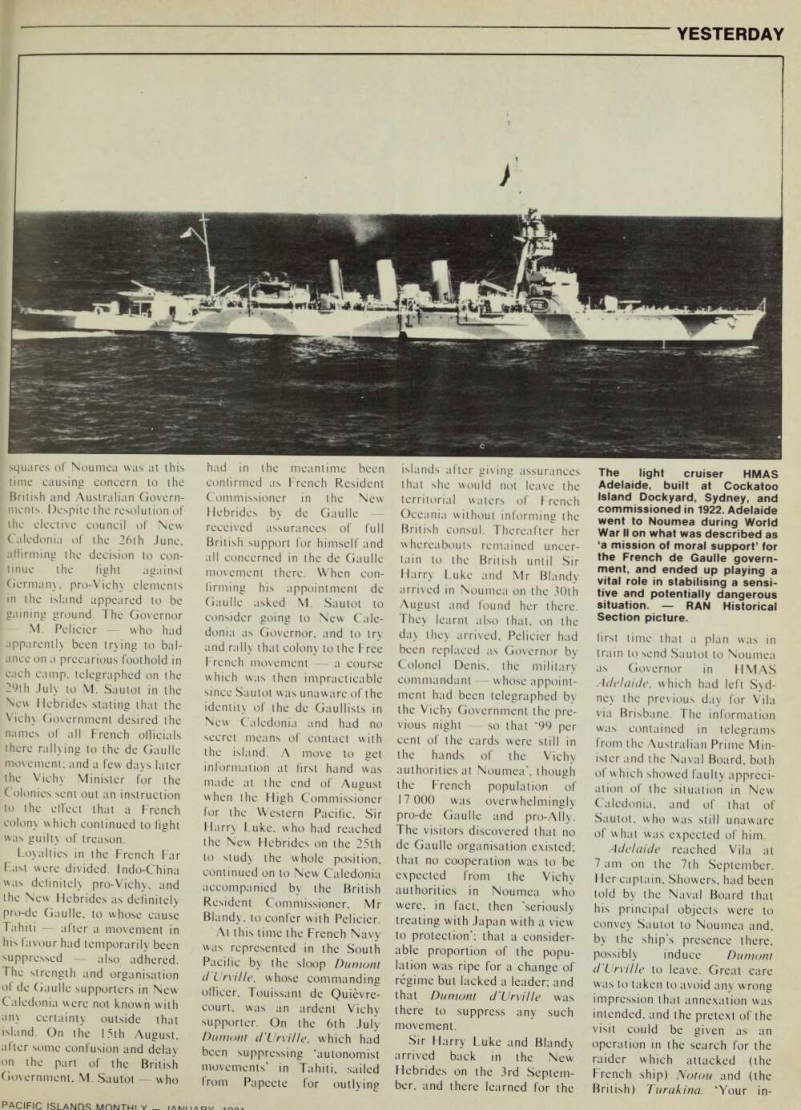
The light cruiser HMAS Adelaide, built at Cockatoo Island Dockyard, Sydney, and commissioned in 1922. Adelaide went to Noumea during World War II on what was described as ‘a mission of moral support' for the French de Gaulle govern ment, and ended up playing a vital role in stabilising a sensi tive and potentially dangerous situation. RAN Historical Section picture.
structions do not include the I use of force, at any rate at
I present.'
Before Adelaide reached I Vila, however, and as a result of I representations from Sir Harry r Luke to the Australian and [ British Governments, the I Naval Board told Showers that I he was to await further orders I at Vila. But on the day before B Adelaide’s arrival a ketch from B Noumea reached Vila with a B message that a de Gaulle com- I mitlce had been formed in New I Caledonia, and asking Sautol if I he would consider becoming I Governor, ‘to which end they I were willing to use force’. There I followed some days of confer enccs and telegraphic I exchanges with the interested I authorities overseas, as the re- I suit of which it was decided that the dc Gaulle committee in I New Caledonia should stage a I coup de force at I am on the I 19th September; that at 7am K Sautol - who had meanwhile I been appointed Governor by de Gaulle should arrive off I Noumea in the Norwegian I tanker IMorden escorted by I Adelaide ; and that, if the coup I de force were successful, he should then land and assume his position as Governor. The operation was to be completely French in form and manner, f and moral support only was to 1 be given by Adelaide. A de tailed plan, drawn up by Showers in consultation with Blandy. and approved by the Naval Board, allowed for the disembarkation of Sautot from A ’orden into an identified de Gaulle boat from the shore if the coup de force were success ful. and the withdrawal of the expedition ‘using least possible degree of force’, and the return ol Sautol to Vila in Adelaide, in the event of its failure.
Adelaide, with Norden in company, left Vila in the even ing ol the 16th September, and shortly after 6 am on the 19th approached Noumea with her company at action stations.
First indications were that the de Gaul list coup had gone awry. There was no boat at the arranged rendezvous, which the two ships reached at 7.10 am, and Showers decided to close Noumea harbour. Shortly af terwards a boat from Dumont d Vrville hailed Adelaide and
asked the reason of her pres ence. Adelaide’s reply was to close Norden to prevent any possibility of the boat boarding that vessel. By 8.33 the town of Noumea was in full view from Adelaide . and Dumont d’Urville was sighted alongside with her guns trained fore and aft, while the shore signal station, though flying the de Gaulle flag superior to the Tricolour, signalled to Adelaide ‘You must not enter harbour’.
It had been intended that, had all gone well and Sautot landed, Norden should have sailed at 9 am. but Showers decided to keep her pending the arrival of a boat seen approach ing from the shore. It brought a message from the de Gaulle committee to say that Governor Denis, alarmed by the concen tration in Noumea the previous day of de Gaullists, who were largely countrymen, had de clared a state of siege; that one member of the committee had been arrested and the remain der had fled to the country (actually they had gone there to organise the farmers) and that the Vichy element mainly through the agency of landing parlies from Dumont d'Urville were in control of the port and town and all roads to a distance of four miles beyond the town. Showers was told that Adelaide would probably be fired on by the forts if she approached Noumea.
This was glpomy news, but Showers, a 'steady type not easily tempted to impetuous action, considered that the re port was probably some hours old and that the situation might change for the better, and decided to wait upon events until 4 pm. In the meantime he look Sautot on board Adelaide and dispatched the tanker. A few minutes after 11 am a boat flying the de Gaulle flag ap proached from Noumea giving the pre-arranged identification signal the throwing over board of empty kerosene tins at stated intervals. This boat brought members of the de Gaulle committee, and news that the Governor had bowed to public opinion, that the state of siege had been lifted and the Dumont d’Urville parties with drawn to their ship, and that the de Gaullists were in control of
the town. At I 1.30 am Sautot disembarked into the boat and proceeded ashore. He landed at 12.10 pm and was met with great enthusiasm by a large crowd at whose head he marched to Government House where, alter ‘half an hour’s somewhat unpleasant dis cussion'. Denis agreed to hand over to him at 3 pm.
The coup de force was thus successful through careful planning culminating in the opportune arrival of Adelaide and Sautot. When they arrived the Vichy authorities were still in control of the town and forts; military picqucts blocked the roads and prevented members of the dc Gaulle committee and bodies of armed farmers from entering Noumea; and the Dumont d’Urville was support ing the Governor. The sight of Adelaide and A orden in the offing at 7 am doubtless influenced Pclainists, dc Gaullisls, and waverers at a crucial moment. It was sub sequently learned that at 8 am, as Adelaide closed Norden to forestall the Dumont d Urvilie’s boat, Denis ordered one of the shore batteries to open tire on the cruiser. The sergeant in charge protested, and at 8.10 the order was cancelled.
Throughout the I9lh Sep tember and the following night Adelaide patrolled off the har boui to give moral support to the dc Gaullists ashore. It had been intended that she should remain only twenty-four hours, but the instability of Sautot’s position in the early stages of his governorship; the presence
of Dumont d’Urville, whose captain remained obdurately dissident to the new adminis tration; and news of the depar ture from Saigon on the 20th September of the Vichy sloop Amiral Charner bound for Noumea, kept the Australian cruiser there for nearly three weeks. During that period the Sautot administration foiled two counter-strokes; and by delicate handling in a series of exchanges of notes and conver sations, backed by guarantees as to the treatment of Petainisls ashore and the provisioning and safe passage of his ship.
Showers prevailed upon Touissasnl dc Quievrecourt to sail Dumont d’Urville to Saigon, where Amiral Charner also returned. Dumont d’Urville left Noumea on the 25th September, some days before Amiral Charner could possibly have arrived there.
From then on the position ashore stabilised, and on the 28th Showers told the Naval Board he was confident Saulot’s government could handle any situation which might arise.
Adelaide finally sailed on the sth October and reached Syd ney on the Blh. Three days later the French steamer Pierre Loti left Noumea for Australia with
Noumea, July 14, 1943: Follow ing the dramatic events of September 1940, New Caledonia became a firm part of the Allied cause. US troops took part in the Bastille Day parade of 1943, which passed in review before Acting Governor Jan Bourgeau and the Commanding General of the island, Major- General Rush B. Lincoln of the US Army.
some 230 Pelainisls, including Colonel Denis and military and civil officers, for onward pass age to Indo-China.
The success of the Noumea operation concurrently with the failure of that at Dakar (an unsuccessful attempt to plant the Free French flag in West Africa) was largely due to adequate planning in cooper ation with the de Gaullisls on the spot. W ithout such planning it might well have proved another Dakar, but with more dangerous implications in view ol the possibility of Japanese intervention backed by superior sea power. The part played by Adelaide and her ship’s com pany and especially by Showers was considerable in bringing about the results achieved. I was very heavily indebted,' Blandy later wrote in his report to Sir Harry Luke, ‘to this officer [Showers] during the trying wailing period for his good advice, accurate summing up and perfect collaboration, which in great measure ensured the success of the operation and
the stabilisation of the final position.’ * ★ * So, what might be called an exercise in ‘kidglove gunboat diplomacy' was an unqualified success: the ‘gunboat’ was used for plainly ‘diplomatic’ pur poses and achieved its aim without a shot fired in anger.
This is not to belittle the courage and determination of the Free French supporters on shore in New Caledonia. Their action was vital to the outcome.
But it is beyond doubt that it would not have been so rapidly and easily achieved without the comforting presence offshore of HMAS Adelaide, which was armed at the time (according to her official ‘biography’) with eight six-inch guns, three four inch anti-aircraft guns, 12 smaller guns and two depth charge chutes. There is no doubt that had it come to a conflict, Adelaide had the ca pacity to blow Dumont d’Urville out of the water and everyone concerned was well aware of the fact.
Henri Sautot... a resounding success story.