Hodges, 208 years on
pp. 53-57 · Read in the full issue


Travel
Checking up on William Hodges, 208 years on
BARRY ROLETT* turns in a Pacific travel story with a difference. While he certainly expects to enjoy his journeyings, pleasure alone is not what he is seeking. He describes his unique purpose in the article below.
The myth of a paradise in the South Seas has lured many men abroad in the past. Gentlemen adventurers like Joseph Banks were excited by an opportunity to explore newly discovered lands and contribute to the learned world’s knowledge of distant peoples. Others, as ad venturous, but less fortunately provided for at home, shipped before the mast, eager like Herman Melville to see ‘the watery part of the world’.
Like Banks and Melville, I too am intent upon seeing the world not by making the Grand Tour of Europe but by travelling off the beaten path to places still relatively inaccess ible even in this age of jets and ocean liners.
During a year of independent study supported by the Thomas J. Watson Foundation, an or ganisation designed to provide selected university students
from the United States with an opportunity to travel while carrying out a project of their own devising, I will revisit the South Pacific islands explored by Captain Cook on his second voyage (1772-1775).
The goal of my project is to photograph the same views painted by William Hodges who, travelling with Cook, was the first professional landscape artist to accompany a circum navigator on a voyage of dis covery. Although Hodges re ceived his training in England under Richard Wilson and was taught to paint classical, ideal ised landscapes, his role on Cook’s voyage was strictly that of a scientific observer. With
his sketches and paintings Hodges was to illustrate scenes that words could only imper fectly describe.
Upon his return to England in 1775, Hodges was employed by the Admiralty to complete paintings which were to serve as the models for engravings used to illustrate Cook’s journal.
I hope to be able to show that while some of Hodges’ land scape paintings accurately portray the scene depicted, others are idealised views in
tended to conform to European conceptions of a South Sea paradise. Through the use of place descriptions given in Cook’s journal and the remark ably detailed charts drawn by him, I will find my way back to the sites that Hodges painted.
All of the 36 views that 1 will try to recreate photographically illustrate landscapes that should be readily identifiable by the characteristic features of the topography. On the site, reference to photographs of each painting should enable me to determine the correct angle and distance from which the views were taken.
Art historians have praised Hodges for his ability to faith fully render difficultly lit scenes and unusual atmospheric con ditions. At the same lime, it has
* Barry Rolett BA is a 21-year old American with a wealth of experience already behind him.
His interests range from pho tography, archaeology, travel ling (usually rough}, to the project he discusses here. We hope to have progress reports on his ‘William Hodges mission’ in future issues.
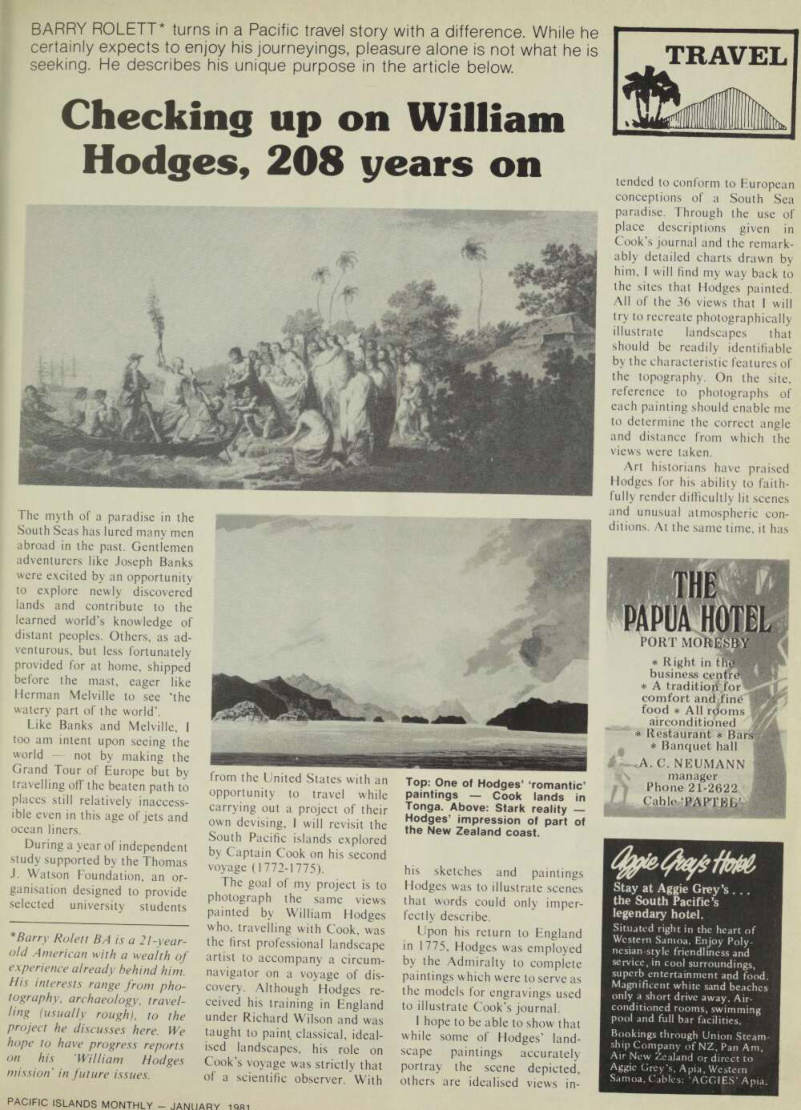
Top: One of Hodges' ‘romantic’ paintings - Cook lands in Tonga. Above: Stark reality - Hodges’ impression of part of the New Zealand coast.
been noted by Isabel Stuebe, in her book The Life and Works of William Hodges , that in painting Indian landscapes sev eral years after returning from Cook’s voyage, Hodges took considerable liberty in re arranging the topographical el ements of the composition.
This is particularly interest ing in light of the fact that Hodges once wrote that ‘truth is the base of every work of mine’.
But without the original sketches drawn on the spot it would seem impossible to learn the extent to which any of Hodges’ landscape paintings is romanticised, except by return ing to the place painted.
Almost none of the original sketches for Hodges’ landscape paintings of the South Pacific islands exist today, yet in the case of Hodges’ ink wash draw ings of Dusky Sound, New Zealand, I found another way to determine the accuracy with which the artist represented his subject matter. While looking through the collection of Cap tain Cook’s charts in the manu script department of the British Library, I located one of the Dusky Sound which included two coastal profiles, one each of the north and south entrances to the sound. I traced these and by comparing them with Hodges’ ink washes I could see that although Hodges’ views were taken from a slightly different angle, they correspond perfectly with the topography outlined in the coastal profiles.
Cook’s chart of Dusky Sound also shows his ship’s route and identifies the islands pictured both in the map and the coastal profile. This information allows me to orient Hodges’ views with Cook’s chart, revealing the exact locations from which Hodges’ ink washes of the entrances to the sound were painted. Yet although Dusky Sound provided Cook’s men with refreshment which they
welcomed heartily after having
spent 117 days out of sight of land, it is hardly a place one would consider idyllic. The harsh environment and rugged, sparsely wooded mountains of Dusky Sound contrast sharply with the fertile plains and favourable climate of Tahiti. It is not surprising then that Hodges’ views of Dusky Sound
are accurately portrayed, while his paintings of Tahiti and the Society Islands have a dis tinctly romantic air about them.
Unlike generations of adven turers who preceded me, my belief in a mythical South Sea
paradise was shattered long before I left home. Travellers after Cook were saddened to find the once happy Polynesians transformed into a dis heartened people in the throes of culture shock. I was fore warned, however, that having read the travel narratives writ ten by the first Europeans to live in Polynesia, I would know more about the original way of life on those islands than most of the indigenous people living there today.
A botanist at the National Museum of Natural History in Washington DC tried to dis courage me from going to the
Marquesas Islands by telling me that the young people there were only interested in earning enough money so that they could move to Tahiti. She laughed though when I asked if there were any banks in the Marquesas and described the boat trip between the islands as an unforgettable (and horren dous) experience.
But all that I have learned about the Pacific Islands has only heightened my curiosity and increased my desire to visit them. Once I even made the mistake of telling someone that 1 had already been there. In deed, in my dreams I have.
The illustrations showing two Hodges paintings reflect a strong contrast of styles. The depiction (top), of Dusky Sound, on the western side of New Zealand’s South Island, is sober and realistic, in keeping with the harsh, sparsely wooded peaks which dominate the scene. On the other hand, the painting of the lush scene at Oaitepeha Bay, Tahiti, seems heavily romanticised.