Fiji’s 10 years in words
p. 51 · Read in the full issue
words and pictures
The First Decade 1970-1980.
Published by the Ministry of Information, Suva, Fiji. SFI, plusSl for posting andpackaging for overseas. No ISBN provided.
October 10 is an important day in Fiji. It was on October 10, 1874 that the Fijian chiefs ceded their country to Queen Victoria, and it was on October 10, 1970, 96 years after cession, that Fiji again became an independent country.
October 10, 1980, was a happy day throughout the country during the celebration of the first 10 years of independence. It was a celebration of a decade of steady, peaceful progress.
The First Decade, 1970-80, produced by the Fiji Ministry of Information, reviews in words and pictures much of what has been achieved in those 10 years.
For those who knew Fiji in pre-independence days, what hiji has done, economically and socially is quite remarkable.
For so many years development had been marking time. Everybody seemed happy to live off what the sugar industry earned, plus a bit extra from copra, gold l ? ananas - Other primary industries and secondary industry were practically non-existent, except for
Some of the country’s sporting arenas are among the best in the South Pacific.
Sporting teams from Fiji have visted Australia, New Zealand, India, the UK and so on. Just after the 1 Oth anniversary of independence a Fiji Rugby team went on a tour of Argentina.
On the political scene there have been a few stirrings, but
the steady hand of Prime Min ister Ratu Sir Kamisese Mara has so far kept the country on a steady course, The First Decade, 1970-1980 is a quality publication, avail able at a surprisingly low price, The cover picture may be prophetic: it is of an oil explo ration ship Danwood Ice, stern towards the setting sun, off the north coast of Viti Levu.
Fiji, like so many other countries, needs a more econ omical source of fuel to develop u , . , .. F her econom y alon g stal >le lines, instead of constant inflation, of which continually rising OPEC prices are a major component, j, ■ ■ anwo ce < or a simi *ar ma y some day provide
some dairying in the Tailevu an d Navua areas and beef cattle at Yaqara in north-west Viti Levu, for CSR Ltd staff.
Sugar is still the No 1 primary industry, but to it can now be added sizeable fishing, forestry, cattle, poultry and pig industries which help to prevent too large a drain on overseas funds.
Supplementing these is tour ism, which is a big earner of foreign exchange, and a variety of small secondary industries.
Road, sea and air communi cations, with appropriate infra structure, have grown apace, Government services have by and large kept up with growth in the private sector, Fiji has an excellent system of telecommunications, which incorporate most of the latest
technological developments,
The media industry caters for the main three races with a number of daily, weekly and monthly newspapers, and the Fiji Broadcasting Commission, or Radio Fiji as it is known to many thousands, has a network of services which reflects the changing attitudes and life styles of a multi-racial popu lation.
Fiji is ‘sports mad’. Most sports common to the Common wealth qf Nations are played, Fiji sport has grown tremen dously since World War 11.
the answer.
Norman Baxter.
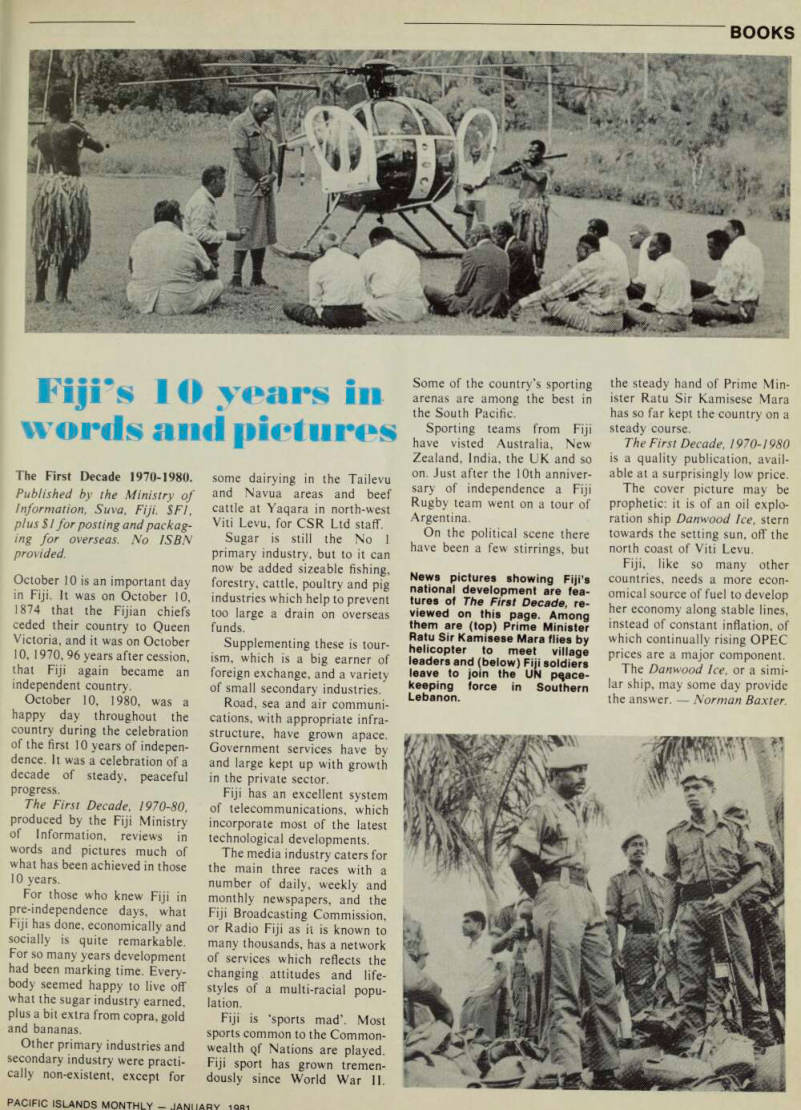
News pictures showing Fiji’s national development are fea tures of The First Decade, re viewed on this page. Among them are (top) Prime Minister Ratu Sir Kamisese Mara flies by helicopter to meet village leaders and (below) Fiji soldiers leave to join the UN peace keeping force in Southern Lebanon.