Pacific teaching satellite
pp. 21-25 · Read in the full issue

Tropicalities
Pacific teaching satellite links lecturers and students
High above the equator a geo-stationary satellite, with its control centre in Fiji, links faculty members of the University of the South Pacific with their extension students throughout the Pacific. ROBERT F. KAY, in Suva, writes about this fascinating project which may do much to forge greater Pacific unity.
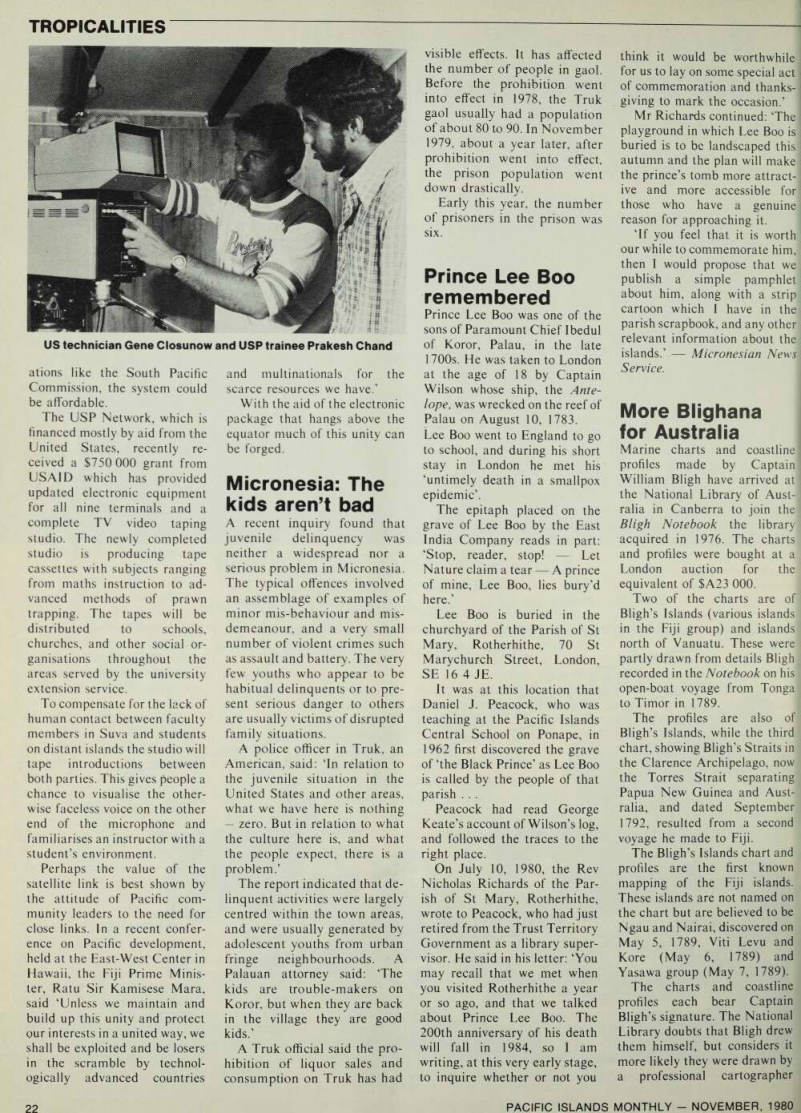
Helical antennas like cork screws point to the sky outside an unobtrusive aluminium shack at the University of the South Pacific in Suva. They are part of the Suva terminal in a two-way radio link beamed via satellite between Fiji and Tuvalu. Inside the shack five people sit at microphones at a table adjacent to an orange coloured console, listening to a voice from the tiny atoll just over 1000 km to the north.
Except for a liny background crackle the voice is clear and undistorled. ‘lf we don’t get those examination results pretty soon, and the books we ordered from Suva, we’re gonna start our own cargo cult’ it says.
The man sitting at the orange console flips a switch and as sures the voice in Tuvalu he will return the tests. The four others in the room giggle at the last comment. The man in Suva then announces it is time to switch to the Honiara station in the Solomons and a new contact begins.
Although separated by mil lions of square miles of ocean, the members of USP’s satellite network, part of the university’s extension service, are holding their weekly staff meeting. This conference is just one facet of the university’s pioneering ex
periment in education via satel lite.
USP has been involved with satellite communications proj ects in conjunction with America’s National Aeronaut ics and Space Administration (NASA) since 1972. In 1974, at NASA’s invitation, USP estab lished its own experimental satellite network. What has evolved from this is a 23 hours a week schedule divided be tween credit courses, tutorial sessions, adult education courses, conferences and ad ministrative sessions. The sys tem has links with Tarawa, Funafuti, Apia, Niue, Raro tonga, Nuku’alofa, Vila and Honiara, with the control centre in Suva. Inter-university links have also been established with the University of PNG and the University of Technology in Papua New Guinea.
The advantage of the pro gramme for USP’s extension students is enormous. A young ster in Rarotonga can discuss his algebra problems with his tutor in Suva, hold class sessions with other students and instruc tors on other islands, and par ticipate in group meetings with people from all the terminals simultaneously. Although there are still logistical problems involved with distributing
books and other educational aids, gone are the dreary days of wailing for correspondence from teachers who live thou sands of miles away.
The satellite that makes this possible. Applications Tech nology Satellite No. 1 (ATS-1) was launched by NASA in 1966. Known as a geo-stat ionary satellite, it is positioned above the equator over Christmas Island and enables its users to communicate with countries within a third of the earth's surface. The USP sys tem shares ATS-1 with the PEACESAT system which is co-ordinated by the University of Hawaii. When the two net works are linked together they integrate 16 terminals stretch ing from Papua New Guinea and Saipan to California and as far south as New Zealand. In addition to experiments in edu cation PEACESAT (Pan Paci fic Educational and Communi cation Experiments by Satel lite) conducts medical, social, and anthropological research throughout the Pacific.
The two networks represent the most important technologi cal development for South Pacific nations in years. Since the inception of South Pacific conferences and forums the leaders of the scattered nations
of Oceania have stressed the importance of better under standing and unity through greater exchanges between each other. For countries spread over 11 million square miles of ocean this has never been easy.
With the satellite system linking most of the major popu lation centres, the possibility of improved communication is no longer a pipe dream. A demon stration of this occurred during the Vanuatu independence day celebrations in July. USP students in Suva heard a live broadcast of the occasion from Vila. Later Vanuatu Prime Minister Walter Lini spoke personally to his fellow countrymen in Suva.
The director of the USP network, John Chick, says, ‘A satellite system could help over come the communications problems that face the Pacific Islands. The trouble that stands in the way of better communi cation between island nations are political and commercial rather than technological. The links exist and the governments can utilise them if the will is there.’
Chick emphasises that the Pacific, with its widely scat tered population centres, is made to order for communi cations by satellite. The satel lite link provides inexpensive, reliable, and relatively low maintenance service.
USP’s satellite will not last forever and already the univer sity is negotiating with INTELSAT, a commercial sat ellite consortium, to take over when the life of ATS-1 ends.
Chick pointed out that regional governments could lease a clus ter of channels with INTEL SAT for relatively little outlay.
Such a system could be pur chased for about $1 million a year. For most South Pacific nations this figure seems exorbi tant but if costs were divided between regional governments, the University, and organis-
Satellite communications centre in action in Suva
ations like the South Pacific Commission, the system could be affordable.
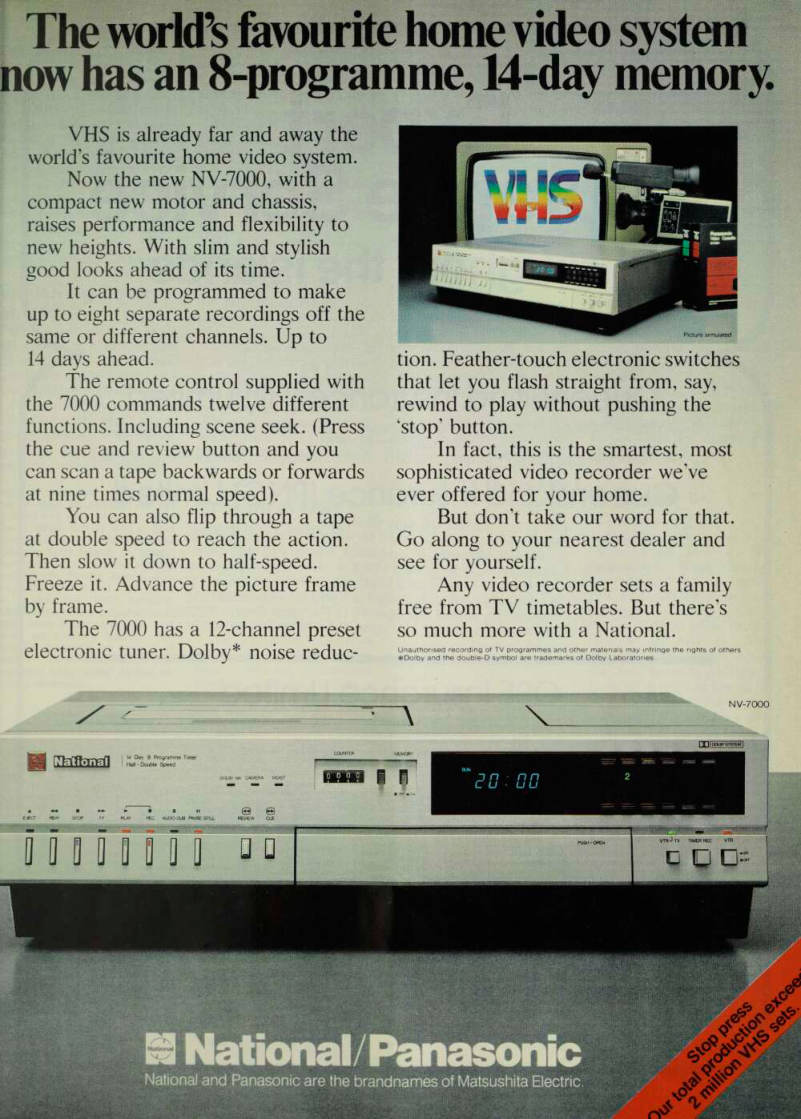
The USP Network, which is financed mostly by aid from the United States, recently re ceived a $750 000 grant from USAID which has provided updated electronic equipment for all nine terminals and a complete TV video taping studio. The newly completed studio is producing tape cassettes with subjects ranging from maths instruction to ad vanced methods of prawn trapping. The tapes will be distributed to schools, churches, and other social or ganisations throughout the areas served by the university extension service.
To compensate for the lack of human contact between faculty members in Suva and students on distant islands the studio will tape introductions between both parties. This gives people a chance to visualise the other wise faceless voice on the other end of the microphone and familiarises an instructor with a student’s environment.
Perhaps the value of the satellite link is best shown by the attitude of Pacific com munity leaders to the need for close links. In a recent confer ence on Pacific development, held at the East-West Center in Hawaii, the Fiji Prime Minis ter, Ratu Sir Kamisese Mara, said ‘Unless we maintain and build up this unity and protect our interests in a united way, we shall be exploited and be losers in the scramble by technol ogically advanced countries
and multinationals for the scarce resources we have.’
With the aid of the electronic package that hangs above the equator much of this unity can be forged.
Micronesia: The
kids aren’t bad
A recent inquiry found that
juvenile delinquency was
neither a widespread nor a serious problem in Micronesia.
The typical offences involved an assemblage of examples of minor mis-behaviour and mis demeanour, and a very small number of violent crimes such as assault and battery. The very few youths who appear to be habitual delinquents or to pre sent serious danger to others are usually victims of disrupted
family situations.
A police officer in Truk, an American, said; Tn relation to the juvenile situation in the United States and other areas, what we have here is nothing zero. But in relation to what the culture here is, and what the people expect, there is a
problem.’
The report indicated that de
linquent activities were largely
centred within the town areas,
and were usually generated by
adolescent youths from urban
fringe neighbourhoods. A
Palauan attorney said: The kids are trouble-makers on Koror, but when they are back in the village they are good kids.’
A Truk official said the pro hibition of liquor sales and consumption on Truk has had
visible effects. It has affected the number of people in gaol.
Before the prohibition went into effect in 1978, the Truk
gaol usually had a population
of about 80 to 90. In November 1979, about a year later, after prohibition went into effect, the prison population went
down drastically.
Early this year, the number of prisoners in the prison was six.
Prince Lee 800
remembered
Prince Lee 800 was one of the sons of Paramount Chief Ibedul of Koror, Palau, in the late 1700 s. He was taken to London at the age of 18 by Captain Wilson whose ship, the Ante lope, was wrecked on the reef of Palau on August 10, 1783.
Lee 800 went to England to go to school, and during his short stay in London he met his ‘untimely death in a smallpox epidemic’.
The epitaph placed on the grave of Lee 800 by the East India Company reads in part: ‘Stop, reader, stop! Let Nature claim a tear A prince of mine, Lee 800, lies bury’d here.’
Lee 800 is buried in the churchyard of the Parish of St Mary, Rotherhithe, 70 St Marychurch Street, London,
Se 16 4 Je.
It was at this location that Daniel J. Peacock, who was teaching at the Pacific Islands Central School on Ponape, in 1962 first discovered the grave of ‘the Black Prince’ as Lee 800 is called by the people of that parish . ..
Peacock had read George Keate’s account of Wilson’s log, and followed the traces to the right place.
On July 10, 1980, the Rev Nicholas Richards of the Par ish of St Mary, Rotherhithe, wrote to Peacock, who had just retired from the Trust Territory Government as a library super visor. He said in his letter: ‘You may recall that we met when you visited Rotherhithe a year or so ago, and that we talked about Prince Lee 800. The 200th anniversary of his death will fall in 1984, so I am writing, at this very early stage, to inquire whether or not you
think it would be worthwhile for us to lay on some special act of commemoration and thanks giving to mark the occasion.’
Mr Richards continued: ‘The playground in which Lee 800 is buried is to be landscaped this autumn and the plan will make the prince’s tomb more attract ive and more accessible for those who have a genuine reason for approaching it. ‘lf you feel that it is worth our while to commemorate him, then I would propose that we publish a simple pamphlet about him, along with a strip cartoon which I have in the parish scrapbook, and any other relevant information about the islands.’ Micronesian News Service.
More Blighana
for Australia
Marine charts and coastline profiles made by Captain William Bligh have arrived at the National Library of Aust ralia in Canberra to join the Bligh Notebook the library acquired in 1976. The charts and profiles were bought at a London auction for the equivalent of SA23 000.
Two of the charts are of Bligh’s Islands (various islands in the Fiji group) and islands north of Vanuatu. These were partly drawn from details Bligh recorded in the Notebook on his open-boat voyage from Tonga to Timor in 1789.
The profiles are also of Bligh’s Islands, while the third chart, showing Bligh’s Straits in the Clarence Archipelago, now the Torres Strait separating Papua New Guinea and Aust ralia, and dated September 1792, resulted from a second voyage he made to Fiji.
The Bligh’s Islands chart and profiles are the first known mapping of the Fiji islands.
These islands are not named on the chart but are believed to be Ngau and Nairai, discovered on May 5, 1789, Viti Levu and Kore (May 6, 1789) and Yasawa group (May 7, 1789).
The charts and coastline profiles each bear Captain Bligh’s signature. The National Library doubts that Bligh drew them himself, but considers it more likely they were drawn by a professional cartographer
US technician Gene Closunow and USP trainee Prakesh Chand
under the captain’s supervision.
The Australian Studies li brarian, Miss Catherine Santa maria, said it was noteworthy that Bligh’s open-boat voyage was so well documented in the Notebook that maps could be drawn from it and the boat’s route followed accurately. Re cords of the Bounty were so sparse that no one had known until comparatively recently the route taken by the mutin eers who set Bligh adrift. (Aust ralian Information Service.)
Vanishing books
at UPNG
Fhe estimated number of books ost from the library of the Jniversity of Papua New Suinea since 1978 is 6000, and ibrarian Alan Butler is angry.
He told the student paper Jni Tavur. T have a low )pinion of thieves. A library is a garden of knowledge. Stealing >ooks is starving the knowledge Pacific Islanders who have lever seen an aircraft on the jround are very much a rarity hese days, but it was a first ime recently for the people of Jiuatoputapu Island in Tonga.
Australian aid built the airstrip md South Pacific Island Air vays brought in this Twin Otter o make the first landing.
Almost the entire population of 1000 were there, and few had seen an aircraft before. The ;rowds wouldn’t go near it at irst ‘and then they just wouldn’t keep away’ airline of icials reported.
of other users, which is just like stealing food.’
Mr Butler added that thieves don’t know what a university is all about.
The loss of books is partly due to the fact that the library staff do not do their job prop erly, according to Mr Butler.
He said the staff are some times weak and sometimes tend to practise the ‘Wantok Sys tem’.
Mr Butler said the govern ment will not give UPNG library money to purchase new books to replace those lost. It will only allocate money to the running of the university as a whole.
Among measures taken to solve the problem were a ‘Miss ing Book Slogan’ competition to raise student awareness of what was going on, and the declar ation of an ‘Amnesty Month’ in which stolen books could be returned without questioning or fines.
20 years of Holy
Mama’s church
More than 3000 people gath ered at Paradise Village, North New Georgia, Solomon Islands, on August 13 to celebrate the 20th anniversary of the Christian Fellowship Church.
The celebrations lasted from August 10-17. People came from Marovo, Rendova, Choiseul and Vella La Vella.
Two traditional war canoes travelled from Roviana, one carrying 30 men and the other 20. It commemorated the old days when canoes offered the only means of travelling.
To accommodate the people, school buildings were used, and small houses and tents were put up. These were in a separate extension to the main well laid out village of the Holy Mama.
The Holy Mama, 75-year-old Silas Eto, founded the church in 1960 after a disagreement between himself and leaders of the United Church.
He believed the Holy Spirit had come upon him and talked in many tongues. He wanted to preserve this, so he and his followers broke away and in 1964 registered themselves as one of the recognised churches in the country.
Since then they have in creased in number and worked together as one community.
The church has made many successful projects, including having its own schools.
A special guest at the cel ebration was the Rev. David Bush, president of Polynesian Seminary which is called the ‘Beyond the Reef Theological Centre, USA. Mr Bush gave five trophies for a singing com petition held on August 16.
The president of the Western Provincial Assembly, Francis Hilly and his family also at tended.
At 12 noon on August 13, there was a big congregation at the Hall, and many people standing outside for the hour long service.
The Holy Mama, who occas ionally suffers illness, was able to attend and posed for photo graphs inside the hall.
During the service, presents were given to invited guests and there were speeches . . .
After the service there was more singing and feasting. The paddling of traditional war canoes was demonstrated to end the afternoon. From a report by Vickie Glass in Solomons News Drum.
You for an H. H. H.
fellowship?
Young men and women of outstanding ability but of modest means are being sought
in the South Pacific to study for a year in the USA under the Hubert H. Humphrey North- South Fellowship Program.
Humphrey fellowships are awarded annually to one person from each country with which the US has diplomatic re lations.
The programme brings mid career professionals from de veloping countries who have exemplified leadership in pub lic service for a year of study and practical, work-related ex perience.
Fellowships are granted com petitively to candidates pro fessionally engaged in agriculture, health and nu trition, planning and resource management, and public ad ministration.
The US Embassy in Fiji will be responsible for handling applications from Fiji, Kiribati, Tuvalu, Tonga and Vanuatu for the 1981-82 programme.
Sir Julius on
an emu egg A likeness of the Papua New Guinea Prime Minister, Sir Julius Chan, carved into the shell of n emu egg was among gifts presented by Australian performers to the organisers of this year’s Third South Pacific Festival of Arts in Port Moresby. The unusual objet d’art was created by Aboriginal artist. Bill Reid, from Bourke in New South Wales. He used a photograph of Sir Julius as his model for the work.
The carved egg was one of five gifts presented by the 100strong Australian contingent to the PNG organisers of the festival at the official closing ceremony. The other pieces were a pot by Thancoupie, of Cairns, a platter by Ned Lenthall of Norfolk Island, a print by John Bulun Bulun of Maningrida in the Northern Territory, and a copy of Jennifer Isaac’s book, Aust ralian Dreaming.
The organisers of the South Pacific Festival of Arts also received gifts from all countries which participated in the two week-lortg event. PNG’s Minis ter for Science, Culture and Tourism, Stephen Tago, ac cepted the presents on behalf of the PNG Government.