Baron
pp. 18-19 · Read in the full issue
A tale of a Terrible Baron
Can you imagine a windsurfer standing on his board for 10 days, travelling across the empty ocean in a straight line, and eventually landing among the breakers on a coral reef, fresh as an apple? Many people in Tahiti could not and refused to believe French Playboy Baron Arnaud de Rosnay when in mid- September he proudly announced that he had actually windsurfed unescorted from the Marquesas to Ahe atoll in the Tuamotu group. Even more sceptical were several well-known French windsurf champions back home who flatly accused him of having received lifts from an accompanying vessel. During the ensuing controversy that raged for several weeks in the Tahitian and French mass media, however, the Terrible Baron, as he was quickly nicknamed, managed to produce enough evidence to prove beyond reasonable doubt that he had indeed accomplished this extraordinary feat.
Much of the scepticism that 34-year-old Baron de Rosnay encountered was certainly due to his own flamboyant personality. Self-proclaimed playboy, clever publicity-seeker and eager name-dropper, his main ambition has constantly been to belong to the most fashionable of the jet sets.
Arnaud de Rosnay’s greatest claim to fame before his Pacific trip consisted of having invented a more up-to-date version of the game of Monopoly, based on Arab oil transactions and petrodollars. The windsurfing he had previously done had mostly taken place on sand beaches, on boards equipped with wheels. But he had also crossed Behring Strait in eight hours at the record speed of 15 knots. Or at least he claimed so, on grounds that seemed somewhat flimsy.
The baron also got off to a bad start in Tahiti by telling everybody who cared to listen that his aim this time was nothing less than to windsurf all the way from the Marquesas islands to Hawaii, a distance of about 3500 km. Admittedly, he was to be escorted by a small vessel, but the only reason for this arrangement was the need to transport a camera crew from the American TV company which was rumoured to have paid $5O 000 for the exclusive rights to film this greatest sea
adventure of all time. Experienced sea captains in Tahiti were quick to point out that this was to start at the wrong end, and that he would have to fight against the winds and currents that sweep down from Hawaii towards the Marquesas.
Undaunted, the Terrible Baron chartered a yacht and sailed for the Marquesas. By then his defiant stance had made him the darling of the French mass media, and a boatload of reporters sailed off to the Marquesas to cover the great event. The only thing they eventually were able to report, however, was that Arnaud de Rosnay had to give up his crazy enterprise 24 hours after his take-off in the face of the mountainous seas. k ln order to save his honour,’ he decided on the spot to sail off in exactly the opposite direction, towards Tahiti. The only trouble with this abrupt change was that first his TV sponsors refused to back him any longer, and then, when this became known, that the French authorities forbade him to leave Nukuhiva without another escort vessel, so as not to have to mount a costly rescue operation. De Rosnay’s next move was precisely the one which earned him henceforth the nickname of the Terrible Baron, for he simply paddled out to sea under cover of darkness and vanished into the night. Although he had left a letter behind, asking to be left alone, a French navy ship immediately gave chase. Soon a Neptune and a Twin Otter plane joined the search. But all efforts were in vain. The cost of the hopeless task of combing the vast expanse of water between the Marquesas and the Tuamotu groups had already reached the $5OO 000 mark, when a message was received in Papeete on September 12 from Ahe, one of the atolls in the northwest corner of the Tuamotus, that the lost windsurfer had crashlanded there the previous day.
When the first reporters reached Ahe from Tahiti (some were there in less than an hour by using a small plane and jumping out over the atoll in parachutes), they found Arnaud de Rosnay surprisingly fit and without any visible signs of the hardships he must have endured. These reports, together with his strange failure to announce his daily progress with the help of the radio
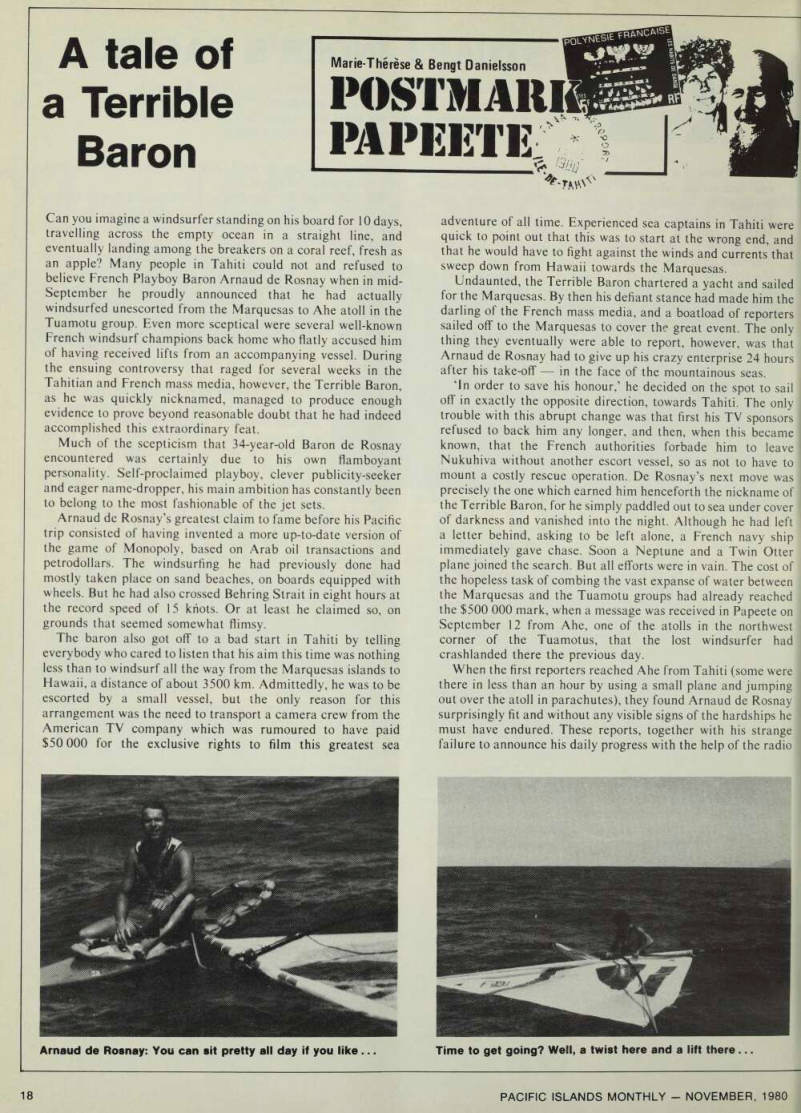
Arnaud de Rosnay: You can sit pretty all day if you like...
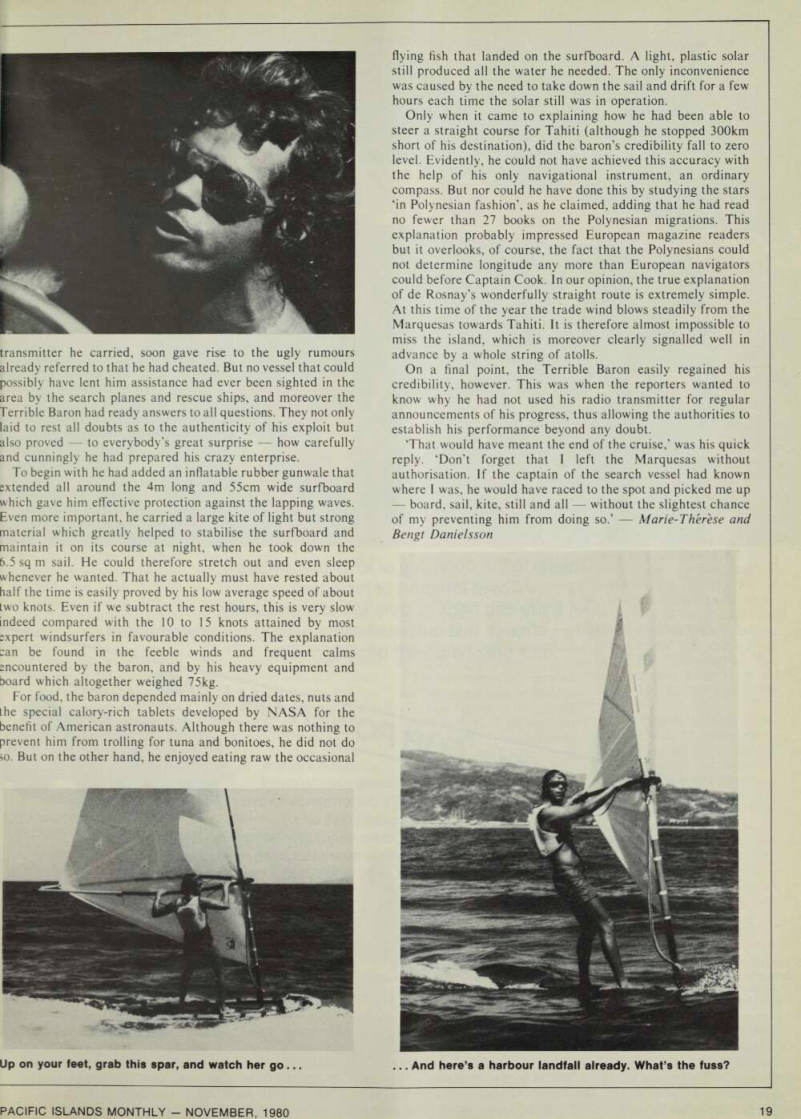
Time to get going? Well, a twist here and a lift there...
transmitter he carried, soon gave rise to the ugly rumours already referred to that he had cheated. But no vessel that could possibly have lent him assistance had ever been sighted in the area by the search planes and rescue ships, and moreover the Terrible Baron had ready answers to all questions. They not only laid to rest all doubts as to the authenticity of his exploit but also proved to everybody’s great surprise how carefully and cunningly he had prepared his crazy enterprise.
To begin with he had added an inflatable rubber gunwale that extended all around the 4m long and 55cm wide surfboard which gave him effective protection against the lapping waves.
Even more important, he carried a large kite of light but strong material which greatly helped to stabilise the surfboard and maintain it on its course at night, when he took down the 5.5 sq m sail. He could therefore stretch out and even sleep whenever he wanted. That he actually must have rested about half the time is easily proved by his low average speed of about two knots. Even if we subtract the rest hours, this is very slow indeed compared with the 10 to 15 knots attained by most expert windsurfers in favourable conditions. The explanation :an be found in the feeble winds and frequent calms encountered by the baron, and by his heavy equipment and hoard which altogether weighed 75kg.
For food, the baron depended mainly on dried dates, nuts and the special calory-rich tablets developed by NASA for the benefit of American astronauts. Although there was nothing to prevent him from trolling for tuna and bonitoes, he did not do jo. But on the other hand, he enjoyed eating raw the occasional
flying fish that landed on the surfboard. A light, plastic solar still produced all the water he needed. The only inconvenience was caused by the need to take down the sail and drift for a few hours each time the solar still was in operation.
Only when it came to explaining how he had been able to steer a straight course for Tahiti (although he stopped 300 km short of his destination), did the baron’s credibility fall to zero level. Evidently, he could not have achieved this accuracy with the help of his only navigational instrument, an ordinary compass. But nor could he have done this by studying the stars ‘in Polynesian fashion’, as he claimed, adding that he had read no fewer than 27 books on the Polynesian migrations. This explanation probably impressed European magazine readers but it overlooks, of course, the fact that the Polynesians could not determine longitude any more than European navigators could before Captain Cook. In our opinion, the true explanation of de Rosnay’s wonderfully straight route is extremely simple.
At this time of the year the trade wind blows steadily from the Marquesas towards Tahiti. It is therefore almost impossible to miss the island, which is moreover clearly signalled well in advance by a whole string of atolls.
On a final point, the Terrible Baron easily regained his credibility, however. This was when the reporters wanted to know why he had not used his radio transmitter for regular announcements of his progress, thus allowing the authorities to establish his performance beyond any doubt. ‘That would have meant the end of the cruise,’ was his quick reply. ‘Don’t forget that I left the Marquesas without authorisation. If the captain of the search vessel had known where I was, he would have raced to the spot and picked me up board, sail, kite, still and all without the slightest chance of my preventing him from doing so.’ Marie-Therese and Bengt Danielsson
Up on your feet, grab this spar, and watch her go...
... And here’s a harbour landfall already. What’s the fuss?