Stuart Inder’S Pacific
p. 17 · Read in the full issue
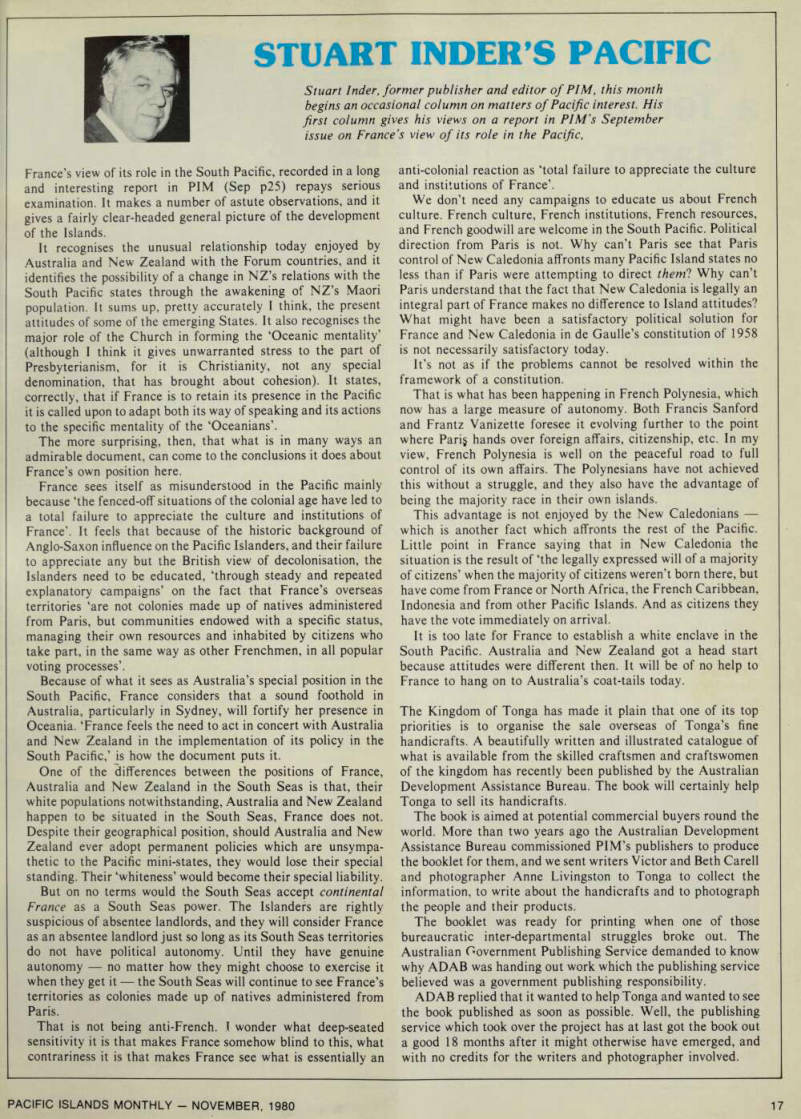
Stuart Inder, former publisher and editor of PIM, this month begins an occasional column on matters of Pacific interest. His first column gives his views on a report in PlM’s September issue on France's view of its role in the Pacific,
France’s view of its role in the South Pacific, recorded in a long and interesting report in PIM (Sep p 25) repays serious examination. It makes a number of astute observations, and it gives a fairly clear-headed general picture of the development of the Islands.
It recognises the unusual relationship today enjoyed by Australia and New Zealand with the Forum countries, and it identifies the possibility of a change in NZ’s relations with the South Pacific states through the awakening of NZ’s Maori population. It sums up, pretty accurately I think, the present attitudes of some of the emerging States. It also recognises the major role of the Church in forming the ‘Oceanic mentality’ (although I think it gives unwarranted stress to the part of Presbyterianism, for it is Christianity, not any special denomination, that has brought about cohesion). It states, correctly, that if France is to retain its presence in the Pacific it is called upon to adapt both its way of speaking and its actions to the specific mentality of the ‘Oceanians’.
The more surprising, then, that what is in many ways an admirable document, can come to the conclusions it does about France’s own position here.
France sees itself as misunderstood in the Pacific mainly because ‘the fenced-off situations of the colonial age have led to a total failure to appreciate the culture and institutions of France’. It feels that because of the historic background of Anglo-Saxon influence on the Pacific Islanders, and their failure to appreciate any but the British view of decolonisation, the Islanders need to be educated, ‘through steady and repeated explanatory campaigns’ on the fact that France’s overseas territories ‘are not colonies made up of natives administered from Paris, but communities endowed with a specific status, managing their own resources and inhabited by citizens who take part, in the same way as other Frenchmen, in all popular voting processes’.
Because of what it sees as Australia’s special position in the South Pacific, France considers that a sound foothold in Australia, particularly in Sydney, will fortify her presence in Oceania. ‘France feels the need to act in concert with Australia and New Zealand in the implementation of its policy in the South Pacific,’ is how the document puts it.
One of the differences between the positions of France, Australia and New Zealand in the South Seas is that, their white populations notwithstanding, Australia and New Zealand happen to be situated in the South Seas, France does not.
Despite their geographical position, should Australia and New Zealand ever adopt permanent policies which are unsympa thetic to the Pacific mini-states, they would lose their special standing. Their ‘whiteness’ would become their special liability.
But on no terms would the South Seas accept continental France as a South Seas power. The Islanders are rightly suspicious of absentee landlords, and they will consider France as an absentee landlord just so long as its South Seas territories do not have political autonomy. Until they have genuine autonomy no matter how they might choose to exercise it when they get it the South Seas will continue to see France’s territories as colonies made up of natives administered from Paris.
That is not being anti-French. I wonder what deep-seated sensitivity it is that makes France somehow blind to this, what contrariness it is that makes France see what is essentially an
anti-colonial reaction as ‘total failure to appreciate the culture and institutions of France’.
We don’t need any campaigns to educate us about French culture. French culture, French institutions, French resources, and French goodwill are welcome in the South Pacific. Political direction from Paris is not. Why can’t Paris see that Paris control of New Caledonia affronts many Pacific Island states no less than if Paris were attempting to direct theml Why can’t Paris understand that the fact that New Caledonia is legally an integral part of France makes no difference to Island attitudes?
What might have been a satisfactory political solution for France and New Caledonia in de Gaulle’s constitution of 1958 is not necessarily satisfactory today.
It’s not as if the problems cannot be resolved within the framework of a constitution.
That is what has been happening in French Polynesia, which now has a large measure of autonomy. Both Francis Sanford and Frantz Vanizette foresee it evolving further to the point where Pari§ hands over foreign affairs, citizenship, etc. In my view, French Polynesia is well on the peaceful road to full control of its own affairs. The Polynesians have not achieved this without a struggle, and they also have the advantage of being the majority race in their own islands.
This advantage is not enjoyed by the New Caledonians which is another fact which affronts the rest of the Pacific.
Little point in France saying that in New Caledonia the situation is the result of ‘the legally expressed will of a majority of citizens’ when the majority of citizens weren’t born there, but have come from France or North Africa, the French Caribbean, Indonesia and from other Pacific Islands. And as citizens they have the vote immediately on arrival.
It is too late for France to establish a white enclave in the South Pacific. Australia and New Zealand got a head start because attitudes were different then. It will be of no help to France to hang on to Australia’s coat-tails today.
The Kingdom of Tonga has made it plain that one of its top priorities is to organise the sale overseas of Tonga’s fine handicrafts. A beautifully written and illustrated catalogue of what is available from the skilled craftsmen and craftswomen of the kingdom has recently been published by the Australian Development Assistance Bureau. The book will certainly help Tonga to sell its handicrafts.
The book is aimed at potential commercial buyers round the world. More than two years ago the Australian Development Assistance Bureau commissioned PlM’s publishers to produce the booklet for them, and we sent writers Victor and Beth Carell and photographer Anne Livingston to Tonga to collect the information, to write about the handicrafts and to photograph the people and their products.
The booklet was ready for printing when one of those bureaucratic inter-departmental struggles broke out. The Australian Government Publishing Service demanded to know why ADAB was handing out work which the publishing service believed was a government publishing responsibility.
ADAB replied that it wanted to help Tonga and wanted to see the book published as soon as possible. Well, the publishing service which took over the project has at last got the book out a good 18 months after it might otherwise have emerged, and with no credits for the writers and photographer involved.