the prince and
p. 15 · Read in the full issue
Tongan tale of the prince and the commoner
Drama in Tonga: King Taufa’ahau Tupou IV has annulled the marriage, celebrated in Honolulu, of one of his sons who is second in line to the throne. Sheree Lipton in Honolulu tells the story.
Like the characters in a Barbara Cartland two -pa’anga novel, each captures your inter est and sympathy, not to men tion your curiosity as to how it will all end. First the King: the great Tongan Taufa’ahau Tupou IV; he might be the ‘bad guy’ yet you are sympathetic to him in an historical sense. An enormous but usually gentle bear of a man, he was educated at Australia’s Sydney Univer sity, and is, in many ways, a modern thinker.
But, not unlike royalty in other lands, he is bound to the same unchanging traditions as previous sovereigns includ ing his famous mother, the beloved Queen Salote. His Maj esty’s remote ancestors were ruling Tonga long before the Normans conquered England.
When his second son runs off and marries a beautiful young maiden of not so royal birth without permission, it is understandable that the royal ta’ovala might be a bit ruffled.
The Queen must also be heavy of heart, for though generally more loquacious than the King, Her Majesty has made no public statement.
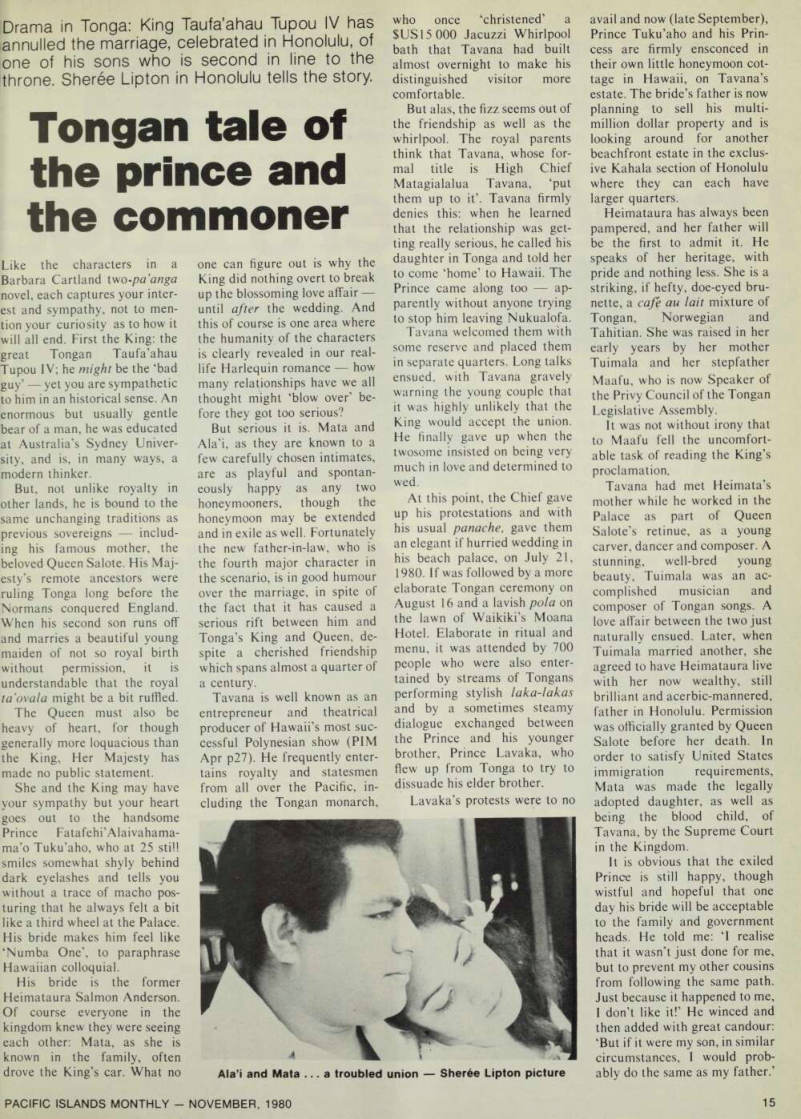
She and the King may have your sympathy but your heart goes out to the handsome Prince Fatafehi’Alaivahama ma’o Tuku’aho, who at 25 still smiles somewhat shyly behind dark eyelashes and tells you without a trace of macho pos turing that he always felt a bit like a third wheel at the Palace.
His bride makes him feel like ‘Numba One’, to paraphrase Hawaiian colloquial.
His bride is the former Heimataura Salmon Anderson.
Of course everyone in the kingdom knew they were seeing each other: Mata, as she is known in the family, often drove the King’s car. What no
one can figure out is why the King did nothing overt to break up the blossoming love affair until after the wedding. And this of course is one area where the humanity of the characters is clearly revealed in our real life Harlequin romance how many relationships have we all thought might ‘blow over’ be fore they got too serious?
But serious it is. Mata and Ala’i, as they are known to a few carefully chosen intimates, are as playful and spontan eously happy as any two honeymooners, though the honeymoon may be extended and in exile as well. Fortunately the new father-in-law, who is the fourth major character in the scenario, is in good humour over the marriage, in spite of the fact that it has caused a serious rift between him and Tonga’s King and Queen, de spite a cherished friendship which spans almost a quarter of a century.
Tavana is well known as an entrepreneur and theatrical producer of Hawaii’s most suc cessful Polynesian show (PIM Apr p 27). He frequently enter tains royalty and statesmen from all over the Pacific, in cluding the Tongan monarch,
who once ‘christened’ a SUSIS 000 Jacuzzi Whirlpool bath that Tavana had built almost overnight to make his distinguished visitor more comfortable.
But alas, the fizz seems out of the friendship as well as the whirlpool. The royal parents think that Tavana, whose for mal title is High Chief Matagialalua Tavana, ‘put them up to it’. Tavana firmly denies this: when he learned that the relationship was get ting really serious, he called his daughter in Tonga and told her to come ‘home’ to Hawaii. The Prince came along too ap parently without anyone trying to stop him leaving Nukualofa.
Tavana welcomed them with some reserve and placed them in separate quarters. Long talks ensued, with Tavana gravely warning the young couple that it was highly unlikely that the King would accept the union.
He finally gave up when the twosome insisted on being very much in love and determined to wed.
At this point, the Chief gave up his protestations and with his usual panache, gave them an elegant if hurried wedding in his beach palace, on July 21, 1980. If was followed by a more elaborate Tongan ceremony on August 16 and a lavish pola on the lawn of Waikiki’s Moana Hotel. Elaborate in ritual and menu, it was attended by 700 people who were also enter tained by streams of Tongans performing stylish laka-lakas and by a sometimes steamy dialogue exchanged between the Prince and his younger brother, Prince Lavaka, who flew up from Tonga to try to dissuade his elder brother.
Lavaka’s protests were to no
avail and now (late September), Prince Tuku’aho and his Prin cess are firmly ensconced in their own little honeymoon cot tage in Hawaii, on Tavana’s estate. The bride’s father is now planning to sell his multi million dollar property and is looking around for another beachfront estate in the exclus ive Kahala section of Honolulu where they can each have larger quarters.
Heimataura has always been pampered, and her father will be the first to admit it. He speaks of her heritage, with pride and nothing less. She is a striking, if hefty, doe-eyed bru nette, a cafe au lait mixture of Tongan, Norwegian and Tahitian. She was raised in her early years by her mother Tuimala and her stepfather Maafu, who is now Speaker of the Privy Council of the Tongan Legislative Assembly.
It was not without irony that to Maafu fell the uncomfort able task of reading the King’s proclamation.
Tavana had met Heimata’s mother while he worked in the Palace as part of Queen Salote’s retinue, as a young carver, dancer and composer. A stunning, well-bred young beauty, Tuimala was an ac complished musician and composer of Tongan songs. A love affair between the two just naturally ensued. Later, when Tuimala married another, she agreed to have Heimataura live with her now wealthy, still brilliant and acerbic-mannered, father in Honolulu. Permission was officially granted by Queen Salote before her death. In order to satisfy United States immigration requirements, Mata was made the legally adopted daughter, as well as being the blood child, of Tavana, by the Supreme Court in the Kingdom.
It is obvious that the exiled Prince is still happy, though wistful and hopeful that one day his bride will be acceptable to the family and government heads. He told me: ‘I realise that it wasn’t just done for me, but to prevent my other cousins from following the same path.
Just because it happened to me, I don’t like it!’ He winced and then added with great candour: ‘But if it were my son, in similar circumstances, I would prob ably do the same as my father.’
Ala’i and Mata ... a troubled union - Sherée Lipton picture