P. J. Twomey Memorial Hospital,
pp. 13-14 · Read in the full issue
HQ for a war on leprosy
Seona Martin* writes below on the outstanding work of Fiji’s P. J. Twomey Memorial Hospital in the treatment of leprosy.
The Twomey centre is backed by the World Health Organisation, the New Zealand Leprosy Trust Board and the Fiji Government. Part of its work is the running of training programmes for personnel from a large number of South Pacific countries. She concludes: ‘The . . . training programme aims to increase knowledge of the disease, make control more effective, and ultimately increase people’s understanding and tolerance of leprosy sufferers.’
Leprosy. The word which in these days of nuclear leaks, napalm and hostages still has power to strike fear and loath ing into the hearts of men.
Most men, that is. Fortu nately there are some who not only fight the dread disease but also fight to bring more under standing of its course and more acceptance of its victims.
Men like Albert Rose, long serving chairman of the New Zealand Leprosy Trust Board.
Why should Mr Rose or any body else in New Zealand, or in England or the United States, for that matter care about leprosy which is endemic only in less developed. Third World :ountries like the South Pacific region?
Amongst reasons of the heart :here is also the practical fact, as Fiji’s P.J. Twomey Memorial Hospital Medical Superintend ent, Dr Esaroma Daulako, can ;ell you, that the United States of America has to operate a 300-bed leprosy hospital in Earville, Lousiana, and there ire leprosy cases now being •eported in London, where the ast Englishman to have the Jisease died 100 years ago.
In Europe and other devel oped areas, it is true the disease vas eradicated as standards of iving rose.
But migrants from the Third World are bringing it back to hese places. Leprosy is again oecoming an international oroblem, although not the 'rightful ogre it once was.
In the South Pacific, the ;ame increased mobilisation of he population and easier com
* Ms Seona Martin lives in Fiji md was commissioned to write his article by the New Zealand leprosy Trust Board and the World Health Organisation.
munications are having the same sort of effect.
Dr Daulako said that in Fiji the disease used to be tradition ally prevalent in the island groups of Yasawa, Lau, Lomaiviti and on Rotuma and Kadavu, where the relative isolation of the communities kept the disease confined to those areas.
But now, for the first time, cases are being discovered in areas where they were never reported before. ‘Although more cases are being recorded, 1 believe the disease is stabilising in Fiji,' Dr Daulako said. ‘The figures give a rather wrong impression, because al though they are up, 1 believe it is because we are detecting and diagnosing cases earlier. Our field workers are more aware of the disease.’
This awareness is one of the key factors in controlling the disease.
The spread of leprosy ‘aware ness’ received a major boost in 1978 when the World Health Organisation, the New Zealand Leprosy Trust Board and the Fiji Government made an agreement to run training courses in the identification, care and treatment of leprosy patients for the region. Another source of funds for leprosy activities in the South Pacific that is proving most valuable is the Japan Shipbuilding Indus tries Foundation (JSIF). They are providing funding for con sultants, laboratory equipment, drugs and transport equipment in many countries of the South Pacific where there are ongoing leprosy programmes.
Twomby Hospital in Fiji was selected as the centre because it had the most suitable facilities for training including a pool of patients, two specialist lep rosy doctors, a new modern hospital and proximity to the Fiji School of Medicine. Also,
the hospital has the only specialised shoemaker for lep rosy cases in the South Pacific, and this happens to be Dr Daulako himself.
Special protective footwear, to stop the injuries which lead to severe ulceration of anaes thetised leprosy-affected limbs, is a vital part of patient care.
Dr Daulako studied shoe making in India and the United States as part of his specialist leprosy care training. In spite of his heavy medical load he has kept up his shoemaking as a hobby and he personally teaches the shoemakers on the training courses.
The first course kicked off within three months of the training agreement, in
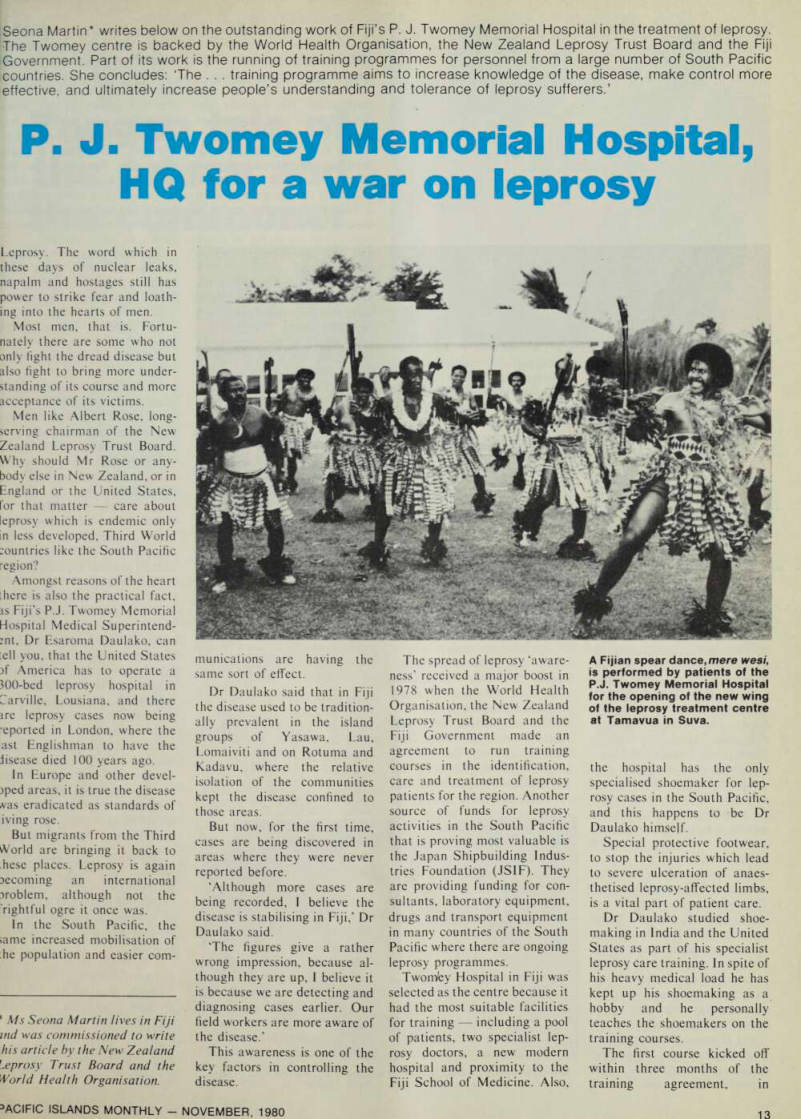
A Fijian spear dance, mere wesi, is performed by patients of the P.J. Twomey Memorial Hospital for the opening of the new wing of the leprosy treatment centre at Tamavua in Suva.
September 1978, and the fifth course began in September 1980.
Included in the five has been a course for Fiji medical workers, and another for French-speaking representa tives from the French territories.
Each participating country American Samoa, Western Samoa, Kiribati, Trust Terri tory of the Pacific Islands, Solomon Islands, Vanuatu, New Caledonia, French Polynesia, Papua New Guinea, Tonga, Cook Islands and Fiji are entitled to send two rep resentatives from the fields of medical officers, nurses, medi cal assistants, laboratory tech nicians, shoemakers, and health extension officers to each course.
To improve facilities even more at P.J. Twomey, the New Zealand Leprosy Trust Board has recently funded the build ing of a $65 000 hall and new outpatients section, set separ ately in the garden-filled grounds of the hospital over looking a wide sweep of Suva’s Laucala Bay from far up on Tamavua Ridge.
P.J. Twomey Memorial Hos pital opened in November 1969, when patients were moved from the small,
paradise-like island of Makogai, off the Viti Levu coast. The Missionary Sisters of the Society of Mary, who have dedicated their lives, love and care to leprosy patients since 1911, used to run the island for sufferers from throughout the Pacific.
It was an island of fear and hopelessness to outsiders, but a haven of peace and compassion to those who had to go there.
Those who could, fished, gardened and lived a village community life but in tragic isolation. Then came the new drugs and new hope, and at last the reality of cure and a return to family and home. Now a return was possible, the other island territories took back their sick to care for them amongst their own people.
That was in the 19505, and then in the ’6os the New Zealand Leprosy Trust Board prepared the way to bring Fiji patients back to the main island of Viti Levu, to a new, fully equipped hospital within easy reach of the communities and families they hoped to rejoin.
There are now five nursing sisters at the hospital, three Fiji Government nurses, four ward orderlies, office and ancillary staff, and two medical officers including Dr Daulako, who was confirmed as superintendent in April 1979.
A Fiji School of Medicine graduate, he chose to specialise in the treatment of leprosy because he said he felt he could give his best service in this field.
There was also a compelling personal reason his home islands of Lau represented one
of the areas whence many of the leprosy patients came.
He said there were three stages to combatting leprosy identification, control and eradication. He believes the South Pacific is at the second stage.
The third stage is the ulti mate goal, but so many factors affect it that it is not within the capability of a hospital, or even a health service, to make it happen. It comes, he explained, with raised standards of living and the development which goes with it.
Yet there is progress as the Fiji figures show. The preva lence rate for leprosy in Fiji is .6 per 1000 people. The incidence rate, which is the number of new cases being diagnosed, is .07 in 1000.
WHO Inter-country Project, Leprosy Control Advisory Ser vices figures show the incidence rate for the whole South Pacific region is 1.7 cases per 1000 population, and available re cords indicate there is a total of 3213 active leprosy cases.
This compares with areas of the world where leprosy is endemic which have a rate of more than 20 per 1000, with entire communities regarded as disease contacts. Dr Daulako strongly emphasises the need to rehabilitate people back into their families and communities, with an ability to cope with a deformity and some assurance of acceptance. Medical care and cure is not all that is needed.
He and the other men and women working to fight the disease still have to fight the suspicion, stigma and prejudice which still prevail in different segments of the community. In some societies, Dr Daulako said, a person could develop a small patch on the arm which could be cleared up in a year and totally cured within three years. But the stigma would remain with that family for another three generations, isolating them and preventing successful marriages.
Not only to cure and care, but to change society’s atti tudes, is the mammoth task which the people who attend the three-week training courses at P.J. Twomey face.
With more cases now reach ing developed countries, the work takes on international
importance no longer confined within the boundaries of the South Pacific region.
Some progress is being made, as even Fiji figures show. There are 483 active leprosy cases throughout the country, but only 50-70 cases in hospital at any one time. They go only when the disease is in the infective stage or when they suffer ulcers or other problems requiring treatment. The rest of the time they are at home in their own communities.
The only people who remain in hospital are those who suffered major deformities be fore today’s drugs were avail able.
As WHO is trying to tell people, leprosy can be cured, conrolled and deformities pre vented.
More than half of all patients cannot pass the disease on to others, and modern drugs can make the few infectious cases non-infectious. It is essenn tial, doctors insist, to be treated early and regularly for as long as necessary for the modem drugs to have their effect.
WHO is concerned that many people still fear the dis-j ease, believe it still cripples and that all patients are able to pass, on the disease.
In some places, employers will not hire leprosy patients although they are no danger to anyone; schools will not admit children of leprosy patients or take young leprosy sufferers; neighbours will drive leprosy patients away from village wells and even from the village —j and because of this unjust and unfair treatment, people try to hide the early signs of the disease and so it takes longer for them to seek and get the treatment they need. This is what makes them a public health risk to the community.
Sometimes outdated legis lation reinforces outdated social attitudes for instance, permitting leprosy as a grounds of divorce and enforcing iso lation of a family with a leprosy sufferer.
The World Health Organis-, ation and Leprosy Trust Board training programme aims to increase knowledge of the dis ease, make control more effective and ultimately in crease people’s understanding and tolerance of leprosy sufferers.
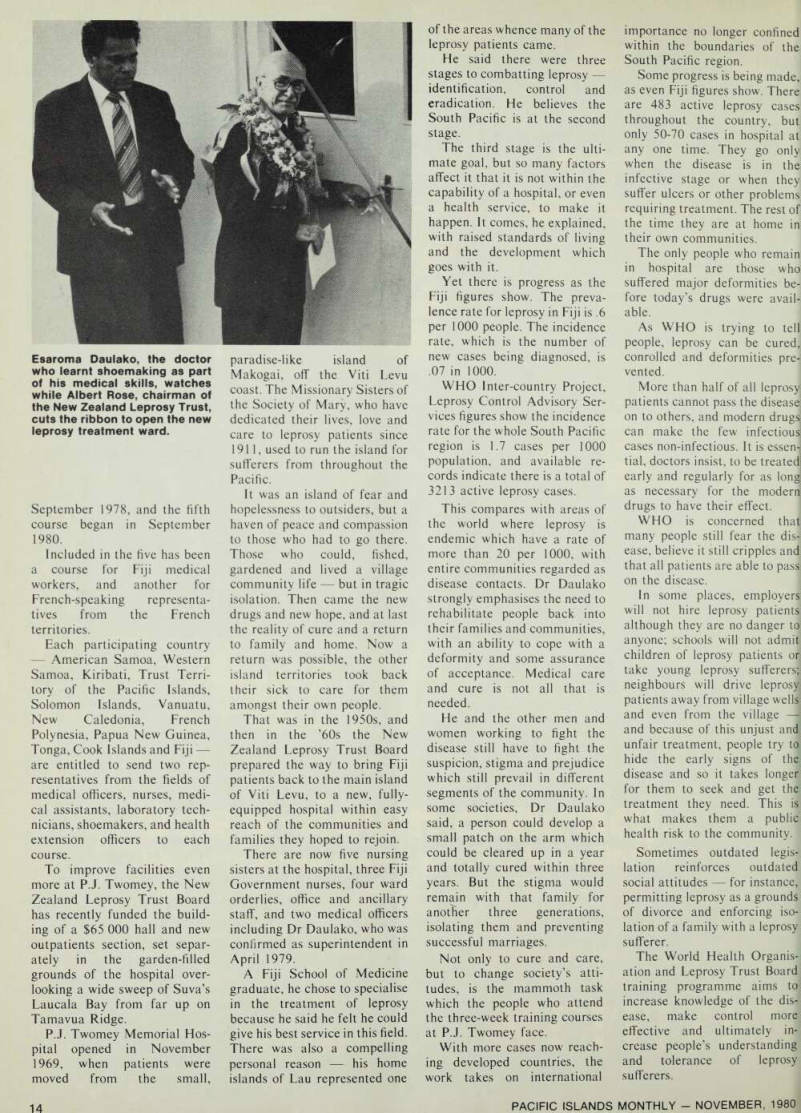
Esaroma Daulako, the doctor who learnt shoemaking as part of his medical skills, watches while Albert Rose, chairman of the New Zealand Leprosy Trust, cuts the ribbon to open the new leprosy treatment ward.