on killer
pp. 7-11 · Read in the full issue

Letters
Controls need on killer herbicide
In your August 1980 issue you reported (p 34) that five people in the Western Highlands Prov ince of Papua New Guinea had died after drinking ‘Gramo xone’ (paraquat). Since then mother patient has died at Soroka Hospital, another as yet unconfirmed death occurred lear Minj, and another two non 'atal poisonings were treated at Mt Hagen Hospital.
It is also reported that earlier his year a man died at Kimbe Tospital in West New Britain, ind another five died in the North Solomons Province. In ill 23 fatal and eight non-fatal ;ases of Gramoxone poisoning lave so far been recorded in s apua New Guinea since 1969.
Most of the deaths occurred iccidentally after the weedi :ide had been stored in drink joules, but there has been at east one murder and one at empted murder.
Paraquat poisoning is a vorld-wide health hazard.
Deaths have been reported rom Ireland, Australia, New Zealand, Samoa, Fiji and the JS. From 1974-79 inclusive, here were 670 reported poison ngs with 150 deaths, in the Jnited Kingdom alone.
Paraquat is a potent herbi :ide, and is widely used on flantations for controlling veeds and as a defoliant before he harvesting of certain crops uch as sugar cane. It is :xtremely toxic to humans istimates of a fatal dose vary rom 3 /4 teaspoon to 10 ml. It :auses acute kidney and liver lamage, and later causes pro ;ressive lung damage so that leath may occur several weeks Tter ingestion.
There is no specific antidote.
Several treatments are rec immended, the most useful >eing a special clay which
absorbs paraquat in the stomach and prevents it being ingested into the bloodstream.
However, treatment in general remains unsatisfactory, and in practice is non-existent in de veloping countries.
In most Pacific Island countries, legislation control ling the use of industrial and agricultural chemicals is non existent or totally inadequate.
Even when effective legislation exists, they have neither the staff nor the finance to police it.
The manufacturers have been very slow to act. A Lancet editorial of November 6, 1971 stated: ‘The onus rests with the manufacturers to develop for mulations which by altered smell, viscosity, or colour will make accidental ingestion of paraquat concentrate less likely.’ Nine years later, no action has yet been taken in PNG to make paraquat safer.
Today, there are other far less toxic herbicides on the market.
Pacific countries should seriously consider banning the use of paraquat altogether. Re gional co-operation is also needed to help countries to introduce effective comprehen sive legislation controlling the use of pesticides and to monitor the effects of their use.
(Dr) Damien
Wohlfahrt
Mt Hagen Papua New Guinea Thanks for 50th
anniversary PIM
Thank you so very much for the wonderful gift you offer to ‘lovers’ of Oceania with your 50th Anniversary Souvenir Edition. Congratulations to all for such a beautiful issue, which all Pacific friends will treasure as a ‘must’ in their collection of Pacificana.
Special thanks to PIM for bringing news from our brothers scattered all over the hugeness of the Pacific, and above all for promoting the unity of our unique world! I wait impatiently and eagerly for PIM every month.
My only wish is that PIM would give more articles in the times ahead concerning the French and US territories which, until now have been somewhat the parent pauvre (poor relation). Please also, tell
us more about West Papua (I don’t want to call it Irian Jaya), that inadmissible wound on Oceania’s left side, as it is now!
Once again thank you for your unique and irreplaceable maga zine.
In my view there are four Pacific ‘events’: the South Pacific Conferences, which are for the politicians; the South Pacific Games, for the sports men; the South Pacific Festi vals of Arts, for the performers and the lovers of their work. All these three ‘events’ are avail able only to people who can afford the air fare and expenses of the visits. Last but not least, there is the Pacific ‘event’ of PIM, which is for all Pacific Islanders and ‘lovers’, and available to all, all the time, and at such an absurdly low cost. It is the sole permanent ‘event’ of the Pacific.
David Scott
Papeete French Polynesia Tale of a monster with two heads In his article in the 50th Anniversary issue of PIM Stuart Inder (p 6) aptly de scribes the New Hebrides Con dominium as a ‘twin-headed administrative monstrosity’.
These English words our local people perhaps would not easily understand, but recently the same message was clearly acted out for all to appreciate.
At East Aoba, Vanuatu Inde pendence Week was enthusi astically celebrated by some 1500 ni-Vanuatu and six ex patriate New Zealanders with well organised custom ceremon ies, church services, flag raising, food, sports, picnics, music, dancing and more food.
The exciting and much appreciated visit of the Fiji Army Band to this out-of-the way centre made us feel part of the official ceremonies at Port- Vila.
Towards the end of the last day of festivities one group danced a mime. They were rythmically weaving their drummed dance patterns when yelling out of the scrub burst a personification of the mythical double-headed devil who was once thought to live on a hill at Waimemea (a nearby lake). He ran this way and that, his
tattered garments dragging, his two grotesque heads, one facing forward and the other back ward, flapped ears and jaws as his hands and feet searched for a way to join the scattered dancers. He was defeated in combat by one who cut off the rear-facing head. The revived body joined the dancers and all completed the pattern together.
A strong affirmation of a new Vanuatu.
Joyce K. Dey
Lolowai Aoba Vanuatu Protest at Japan’s
N-waste plans
Congratulations PIM on the occasion of your 50th Anniver sary. Your contribution to the Pacific region has been half a century of outstanding service and balanced reporting. More important is the manner in which PIM has always endeav oured to keep Pacific peoples aware of the implications of foreign impositions on our cul tures and environment.
In a world dominated by the dictates of imperialistic mo tives, PIM has usually provided platforms balanced in their coverage and development not only in the economic but also in the social and moral field. And while the world has very mark edly lost its humanity, your magazine has consistently con tinued to generate within Pacific peoples a genuine caring consciousness not only for our selves but also for our fellow men. Your concern at the mis use of our environment through continued nuclear testing by France is an example.
Unfortunately, and in spite of your many excellent articles on the subject, it is clear that Japan (and later the United States!) has every intention of dumping its nuclear waste in our home! In light of this renewed onslaught by the Japanese, I urge you to keep Pacific peoples informed with up-to-date reports on the issue.
Reports by humanitarians Bengt and Marie-Therese Dan ielsson in Tahiti should be stepped up. More recently I commend PIM for John T.
Robinson’s letter in the sou venir issue, under the heading ‘American Speaks Out’. It is
heartening to find that in spite of the moral poverty in the American Government, there are still many American citi zens who have not lost their humanity. We can only hope that the conscience of the Japanese people will not be subdued by the dictates of a leadership that has lost its morality.
More specifically then 1 write to register my absolute oppo sition to the proposal by Japan to dump its nuclear waste in the Pacific. As you well know (the Japanese and Americans too!), technology has not advanced to a stage whereby complete safety and conservation of our environment can be assured.
Professor Sadao Ichikawa, a world authority on the biologi :al effects of radiation, eonfirmed this fact in an inter view on June 30, 1980. Assur ances by Japan to the contrary, are nothing more than another official lie! The Japanese fur hermore claim that such waste will anyway be of low radiation evel and therefore quite safe.
Vfy question is: If such an assertion is true then why is it hat Japanese scientists will nonitor the dumped waste?
Does this not clearly show their ancertainty and that they are Till experimenting. And indeed f such waste is of low radiation evel, why doesn’t Japan dump t off its coast. Depositing such harmless’ waste, preferably vithin its 200-mile economic :one, would serve a number of
idvantages for Japan . . .
At the outset, it would mean in enormous saving. Many nore scientists would be able to aarticipate in the monitoring vork, as the distance to the lumping area would be cut iramatically. In turn it also neans that many scientists vould ‘advance’ from this ‘de irable’ undertaking. Conduci ng this experiment within its 100-mile zone also avoids the aossibility of any future inter tational complications. Above ill, the Japanese population vould be the first to directly aenefit from the ‘advancement’ hat will arise from this icientific venture.
In seems to me that history is epeating itself. The ‘players’ nay have changed but the notives for deception are the
same. Time and again Pacific peoples have been cheated by the Americans, the British, the French and the Chinese. And now Japan has undertaken to once again make ‘guinea pigs’ of us. How much longer are we to suffer the consequences of deception?
In my capacity as official delegate for the Cook Islands to the recent Nuclear-Free Pacific Conference 1980 in Hawaii, I declare my firm opposition to the proposal by Japan to dump nuclear waste in the Pacific. I cannot and I will not yield to ill motivated ventures. Further as surances by the visiting Japanese delegation of Messrs Honami and Ishihara will not convince me otherwise. For one thing the concern of these ‘sponsored’ scientists and that of the Japanese government stems from the head! I speak from the heart!
John J. Herrmann
USP Students’ Association Suva Fiji Yet another mystery ruin on Santo Having followed the saga of ‘Langdon’s Wall’ (PIM Aug p7l) with interest, and, not doubting its origin, I would like to bring to the attention of PIM readers another ‘mystery’ from the north of Santo.
In the current edition (1969) of The Pacific Islands Pilot , Vol IT published by the British Admiralty for the use of mari ners, is a very interesting state ment. On p 214 is a description which must surely stir the imagination of readers. I quote: ‘Cape Cumberland, the north ern extremity of Espiritu Santo island, extends from the high land in a low tongue for about 2 miles. Not far from this point are to be seen the ruins of buildings of considerable size, pillars of regular shape and fragments of masonry being scattered over a plain about 3 miles in extent, and at a village 5 miles from the cape are similar ruins, of the origin of which the local inhabitants appear profoundly ignorant.’
Could these ruins be anythng to do with Quiros? Perhaps he started building his cathedral after all, or are they the same
type of ruins as on Easter Island?
When I was in Santo during 1970-72 I asked a few of the older European inhabitants about the ruins, and everyone was likewise ‘profoundly ignor ant'.
The above-mentioned Pilot was first published in 1885.
Subsequent editions appeared in 1891, 1900, 1908, 1918, 1932, 1943 and 1956. I would hazard a guess and say that the ruins were first sighted by Europeans between 1884 and 1900, and could now be over grown.
Can any PIM reader shed any light on the mysterious ruins of Cape Cumberland?
Peter Cole
Brooklyn
Nsw
Australia
Independence for
French territories Congratulations on your ever improving magazine, and also congratulations for your fiftieth birthday.
I am very angry over the French handling of the prob lems in my country, Vanuatu, over recent months.
The French press has contrib uted a lot to the worsening of the situation on Espiritu Santo which ended in injuries and deaths. The French press, since the arrival of Papua New Guinea troops in Vanuatu, has been giving out biased news
usually unfavourable to both PNG and Vanuatu.
Most of the time newspapers such as Les Nouvelles Caledoniennes and the Corail carry news items that claimed Jimmy Stevens and his bunch of thugs represent the fran cophones of Vanuatu, and that the majority of ‘Man Santo’ (Santo Islanders) are support ing him. The above are all pure lies and French propaganda.
Four-fifths of all real ‘Man Santo’ are either central government supporters or inde pendents, and Jimmy Stevens is not a francophone and does not represent the francophone population of Vanuatu.
The French press has no right to criticise Vanuatu or PNG because whatever defence pact or alliance they sign is for the good of both countries and Mel anesia as a whole. What the French press should concen trate on is to tell President Giscard of France to give inde pendence to New Caledonian Melanesians and to remove the atomic bomb from French
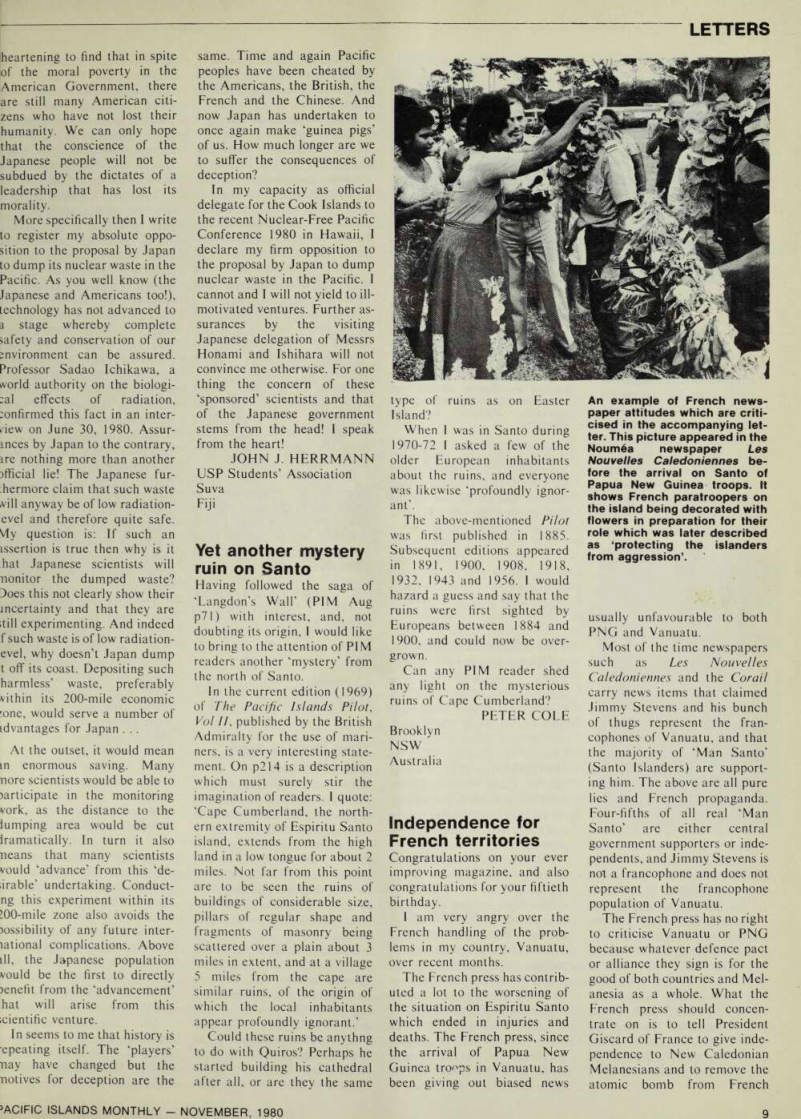
An example of French news paper attitudes which are criti cised in the accompanying let ter. This picture appeared in the Nouméa newspaper Les Nouvelles Caledoniennes be fore the arrival on Santo of Papua New Guinea troops. It shows French paratroopers on the island being decorated with flowers in preparation for their role which was later described as ‘protecting the islanders
from aggression'.
Polynesia and test it either in Paris, the Mediterranean or the English Channel.
The French never have any thing good to say of PNG.
During the South Pacific Festi val of Arts, for example, a leader of the New Caledonian contingent who is a ‘white’ gave very misleading information to many of our Melanesian brothers and sisters who came to participate. He was alleged to have said if they come to the festival they should watch out for cannibals, snakes and the like, and also that there is no meat in PNG, people live on crocodiles. The above infor mation was gathered from con versations I had with members of the New Caledonian contin gent to the South Pacific Festi val of Arts.
France has nothing to worry about in Vanuatu. All the francophones of Vanuatu who are both ni-Vanuatus, entitled citizens and naturalised citizens shall always have the same rights as everyone else.
Vanuatu is not USA, South Africa or Iran where we have second-class citizens. Fran cophony should not be an ex cuse to meddle in the affairs of independent Vanuatu. The French Government and people in the Pacific have been using the francophones of Vanuatu for far too long as scapegoats.
I am sorry, friends, but the ball has started rolling. It will never stop when it’s still on the slope. The end of the slope is Wallis and Futuna. Whether you like ir or not, Vanuatu has opened the door. French people, you better start packing up because New Caledonia, Tahiti and Wallis and Futuna will be due for independence before 1985.
It is a fact that we Pacific peoples were free before white men came and it is still a fact that we will all be free by the end of this decade. Vive la revolution du Pacifique!
C. M. Lawrence
(Ni-Vanuatu) University of PNG Waigani Papua New Guinea Two attitudes to
writing history
Today I received from the Australian National University Press a copy of your three-page review of my book, The Found ing of the Roman Catholic Church in Oceania 1825 to 1850 (PIM Aug p 133). I would like to thank Marist Father John Hosie publicly for writing such a thorough and fine review and I also wish to thank you for printing it.
Father Hosie is correct when he says in his analysis of my approach that I deliberately refrain from making comments of my own on the characters of Bishop Pompallier, Father Colin and the huge number of persons who come into the story. I neither condone nor condemn, but not for the reason suggested by Father Hosie.
I dislike histories in which the writer is forever passing judgment on his characters, while depriving them of the opportunity to speak out in
their own defence to the reader, who consciously or uncon sciously sits in judgment over them.
Being fortunate in having a wealth of archive material at hand, I elected to allow my characters first to attack or condemn one another in their own words, and then again in their own words to defend themselves. A reader thus has before him the very same evi dence that I as author have and is free to condemn, condone, or make any other judgment that he may wish.
In the case of Pompallier and Colin, whose virulent condem nations of one another are regularly followed by a pious defence of themselves, any comment on my part would have sounded hollow and superfluous and could have served no purpose but to slow down the tempo of the drama and mitigate its intensity.
In my preface 1 was of course referring to Pompallier, to Colin, and to the other charac ters in my history when I said: ‘By their words and by their actions they should win your admiration, your pity, your scorn.’
Rev Dr Ralph M.
Wiltgen Svd
Collegio del Verbo Divino Rome Italy PS Your layout and illustration of the review was very good.
The People from the Horizon’
We would like to thank you for the compliment of giving pride of place in the Brooks section of your splendid 50th anniversary edition to a review of The People from the Horizon. Our thanks, too, to Robert Langdon for inserting much praise in his review ‘excellence’, ‘superb’, ‘magnificent’ are sweet words indeed.
Just as we had no say in the price determined by the pub lisher, Phaidon Press, we were also limited in the commission ing to 90 000 words not many in which to cover the sub title ‘An illustrated history of the Europeans among the South Sea Islanders’. Since there have been over 450 years
of contact between the Islanders and Europeans, we decided that the only approach to this vast subject was from the personal angle, a point which we emphasised in the book.
Langdon must have overlooked this in rounding on this angle towards the end of his review.
There was a similar problem over the 1000 or more pictures that we wished to include and the daunting task of restricting these to the publishers’ limit of 250. Our preference for un known or scarcely known pic tures accounts for our choice ol illustration of one of our houses and of Ratu Sir Edward Cako bau and Ratu Sir Kamisese Mara with one of the authors as part of the friendship theme aspects of which Langdon dis approved, together with othei occasional personal items.
He will be interested to know that reviewers of the book such as Professor Albert Schiitz and Steven Phelps asked for more individual touches rather than fewer of them. The blurb foi Langdon’s latest book contains a portrait of himself: that ours did not have pictures of our selves must have earned a good mark from him.
You have been so generous in your space that it would be churlish of us to ask for more than to be able merely to reply to that part of Langdon’s review where the tone changes sud denly from congratulatory to tetchy. We shall steer away from controversial issues and confine ourselves to the less petty points. Every historian whom we have consulted de fends the ratio of the four chapters we devoted to explorers and discoverers from the early 16th century to the late 19th century, to the four pages on the American whalers spanning half a century, al though Langdon judges the latter to be disproportionately small.
Few also would agree with him that American Samoa has changed much since the War: for example, let him refer to PIM of July 1980 (Judy Tudor, p 63).
Of course, not all Micronesians are as described in general by us at plO. Nat urally, Melanesians such as Fijians and Polynesians such as
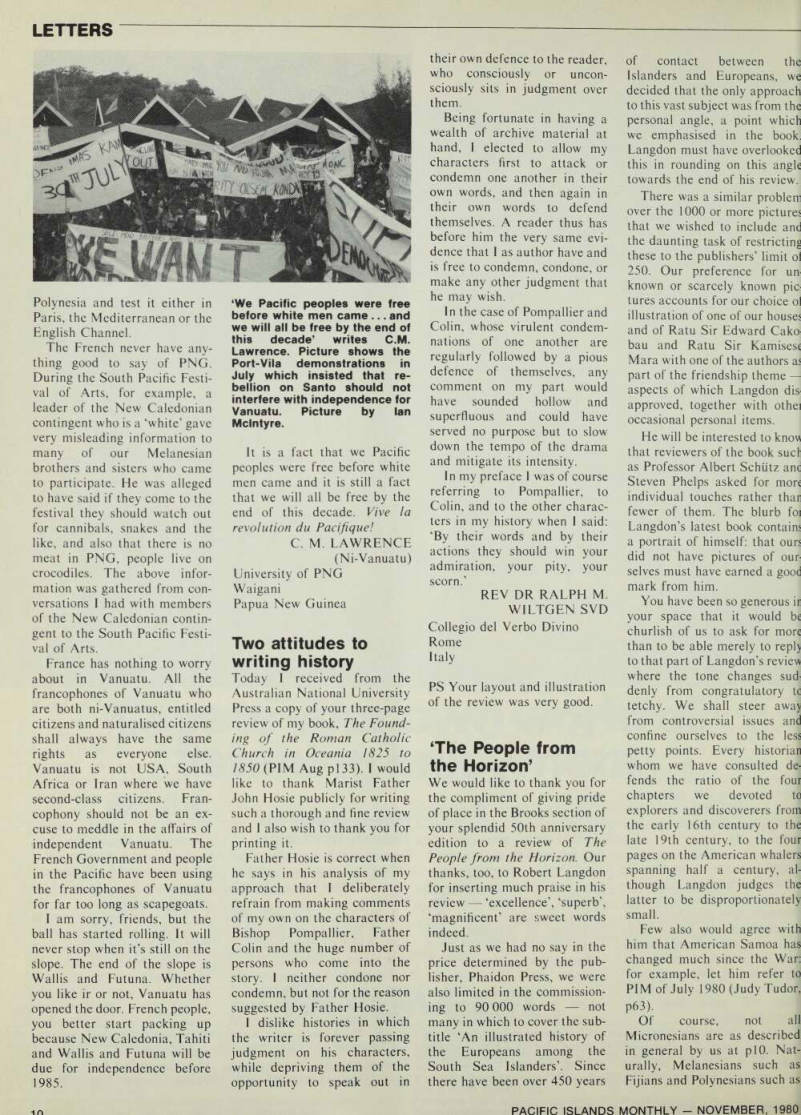
‘We Pacific peoples were free before white men came ... and we will all be free by the end of this decade’ writes C.M.
Lawrence. Picture shows the Port-Vila demonstrations in July which insisted that re bellion on Santo should not interfere with independence for Vanuatu. Picture by lan Mclntyre.
Tongans can be very different one from the other; no less so, Micronesians such as Caroline Islanders. The photograph of an elderly Yapese was selected to show his tattooing and nothing else there are other pictures of more typical Micronesians.
We do not agree with Lang don that there are no more pure Tuvaluans, pure Tahitians, pure Cook Islanders, etc.
European inter-mixture has been relatively muted: we still maintain however that pure Chamorros have been victims of ‘Europeanisation’ and do not exist. We never stated that there were no part-Chamorros.
Langdon comments that ‘the book’s text scarcely matches the magnificent illustrations’.
We never expected our own work to rank with the pictorial field. Can text ever do so?
We were only too gratified by the eminent historian Dame Veronica Wedgwood, OM, when The People from the Horizon was judged for the National Book Awards as the third best history or biography appearing in 1979, putting the following on record: ‘Philip Snow’s and Stefanie Waine’s book on Europeans in the South Seas is a richly illustrated book, but one of the very few in this category where the text is outstandingly good in its own right.’
We are grateful for Langdon’s overall conclusion that ours is a beautiful book for a coffee table.
Philip Snow
Stefanie Waine
Oxford England
Those mammaries
again
Re your query (PIM Aug p3B) as to what other readers think of ‘the cover that upset reader Hitchcock’: I myself have never seen any great beauty in the naked human form, and I can only suppose those who object to such covers or other presen tations believe their privacy is being invaded and perhaps ex ploited, even though it is not their personal photo.
Whilst it is true a native once remarked to me he could not understand all the fuss the white men made about the
female breast, for, he said, to him they were merely an organ for feeding babies, nevertheless the natives all wore loincloths! I myself think the photo on pBl of the gal in the swimsuit and flower in her hair much more eye-catching or eye-appealing than the naked gal.
T. N. Thompson
Mount Tully Stanthorpe Qld Australia A word on Pacific
aviation history
Congratulations on your 50th birthday. I enjoyed the anniver sary issue and read with great interest the article on the devel opment of Pacific air routes, (pisl). Mr Percival is truly a Pacific pioneer and well in formed on his subject.
Perhaps I could add a few details that readers might find interesting. All of the key islands were not British when Pan Am began its Pacific Clip per service. American Samoa, directly on the proposed Pan Am route, had been a US Territory since 1900. Captain Lorenzo Musick, Pan Am’s chief route pilot, had made several landings and take-offs from the harbour at Pago Pago and after the sixth take-off the clipper crashed. The wreckage was found later about 12 miles off the harbour entrance. Capt Musick had commented that he disliked the steep cliffs sur rounding Pago Pago Bay and the short take-off required to clear the breaker line at the entrance, though neither appar ently contributed to the disas ter. This and other information is available in a new book titled An American Saga: Juan Trippe and his Pan Am Em pire; (Robert Daley, Random House, New York, 1980.) In my opinion, the view of the US Government does not favour protectionism or lack of competition for its airlines.
Witness the recent Airlines’
Deregulation Acts which have led to such fierce price-cutting competition for passengers that all but two US airlines reported massive first-half losses for 1980. Among those reporting losses is Continental Airlines which is again talking about a merger with Western Airlines.
These airlines are forced to fly their planes at losses just to stay in the ‘checkers’ game. Unfor tunately, these cheaper tickets and savings do not often extend to trans-Pacific passengers.
One more minor point.
BOAC, besides dropping ‘Air ways’ from their name, also omitted the ‘Overseas’ and ‘Corporation’ to become simply British Airways.
My regards to Mr Percival and to PIM. Keep up the good work.
David Sievers
Pago Pago American Samoa British Airways is an amalga mation of BO AC and BE A (British European Airways). It now flies under the name British ’. Editor.
More on the case of Olivier Breaud Thank you for having published in your August 1980 issue my letter concerning the assassin ation of Olivier Breaud. (p 37).
I did not intend to undermine the journalistic talent and repu tation of Marie-Therese and Bengt Danielsson, whom I have never met but with whom I share many concerns about this Pauvre Cythere that Tahiti has become (particularly when you have, as I do, the opportunity to know the rest of the Pacific and to make comparisons! I recognise that their first article in May was written before the outcome of this kidnapping torture and murder was known. Their following article was very much to the point and, as usual, very courageous.
Andre Rossfelder
La Jolla California
Usa
Determined in error I read with interest an adver tisement which first appeared in PIM August (pi 12) and was reprinted in identical form in September (p 45).
The firm Wonderest have an agent in Port Moresby and are ‘exporters of fine bedding’ to New Guinea (but not Papua).
British Solom an Islands
(which ceased to be British more than two years ago and to my knowledge has never been Solom an Islands) and New Hebrid/es (surely New Hebrides, if not Vanuatu).
It must be rare to find these three prominent Pacific nations misnamed and misspelt with such determination.
Andrew Keeble
Honiara Solomon Islands Many thanks. These errors are being cleaned up and, by the way, you missed a couple more in other ads. Editor.
50th birthday
congratulations
Forwarding my subscription re newal affords me the oppor tunity of conveying my con gratulations on the 50th anni versary of Pacific Islands Monthly.
For many years now PI M has been eagerly awaited each month and read from pi to the end with something akin to the
zest of devouring a tempting meal, which in my case is an obsession with the Pacific Islands. Thank you for giving me so much pleasure.
The anniversary issue was exceptionally well produced, and one can look forward eagerly to your next half century.
Best of good wishes to all staff.
Alan Escrow
Byron Bay
Nsw
Australia