active opposition
p. 27 · Read in the full issue
Vanuatu needs an active opposition
Political
Currents
fwo experts on the new nation of Vanuatu look at different aspects of the country’s problems as it lives through its first months of independence. The ethnologist Professor Jean Guiart of the Musee de I’Homme, Paris, discusses appropriate government structures for the far-flung archipelago, and ‘G.W.T.’, a specialist in Pacific Islands religious movements at a leading Australian university, writes on the religious aspect of the Na-Griamel movement headed by Jimmy Stevens, and its possible future impact. Professor Guiart’s article appeared in the Vanuatu Government paper Tam Tam, and ‘G.W.T.’ wrote his especially for PIM.
Fhe need for Vanuatu is to look ihead. Those who have been iving in the dream world of the Santo secession will be forgot :en. What will be remembered s that the government of Vanuatu had the support of the jireat Powers of the Western vorld, and that the South Pacific Forum states demon itrated their cohesion, and their veighl in international affairs, t isn’t the last time this will lappen.
Now the task is to study the :onsequences. The unhappiest mtcome would be if those who lo not belong to the majority )arty lost heart. Vanuatu needs in organised, coherent oppo ition, capable of strengthening ts analysis of the country’s >roblems, and of undertaking iffective activities at all levels.
The government needs to be aced with a vigilant defender if the rights of the minority.
Phis is the rule of the game in ill democratic countries. No natter where you look, things ire worse if the opposition is veak and divided. Without irodding, governmental ac ivity can lose its consistency.
and its role as the agent of progress for the good of all can crumble to nothing. Small countries face the dangers of nepotism and systems of pat ronage no less than big ones.
But the consequences for small countries are more serious.
The democratic opposition in Vanuatu will be based on the realities of that country. As a result of independence, these realities have a new legal as pect. Citizens of other nations must not interfere in the country’s domestic political life. That has been obvious for several years. It was easy to foresee that leadership of an opposition by Europeans could never work. Certain people didn't want to understand this, and have finished up in their present blind alley.
Things must be started again from scratch, free of any European presence or advice, and forgetting the UCNH ad venture, and the MANH of the Independents, which both came to miserable ends. It should have been quite obvious that they were going to fail and that provoking sporadic inci dents of violence was no way to establish political influence.
They wished to divide the archipelago into two parts, against the judgment of the states of the region and of all the world’s Great Powers as well.
The need today is to build in unity. But also in diversity. At no time over the last century has any group on any island, or any individual, agreed to re nounce their freedom. The gen eral practice has been for people to maintain good re lations with the administration in places where it worked for the good of all but to maintain a general refusal to allow themselves to be governed. The leaders of the
Vanuaaku Party, who have known how to struggle and press the country forward to independence, are well aware of this reality which also pro vides every chance for a dy namic and active, but prag matic, opposition, itself com mitted to the good of all.
A difficult problem and one which some sought to solve with cutting tools is the extent of decentralisation that is desirable. Decentralisation is the desire of both camps. But it is not easy to impose from the centre a juridical structure which meets the problem. Al liances and enmities take dif ferent forms in different parts of the archipelago. Here, a village will pretend to auton omy in relation to all other villages; elsewhere, it’s a part of an island that claims to be autonomous; elsewhere again, a whole island claims autonomy in relationship to its neighbour.
Traditional relations can be stronger between the extrem ities of two facing islands than they are between the coastal people of one island and the people of the same island’s interior. Public services schools, roads, water supplies, hospitals must be based on a structured geographical frame work which provides some ease of communication. So one is led to think of separate levels of government, and to acknowl edge that a municipal set-up, taking no part either in the national political contest or in the arena of custom, must be defined as a first priority.
The idea of having regional governments may appear an interesting one. But the secessionism of some in Santo town has perhaps dealt it a mortal blow. The main draw back of the idea is that regional governments could become lists for the jousting of competing
groups. They could be con tested from all sides, and have even more difficulty than the central government in estab lishing their authority. The opposition and the government would be well served if they reached agreement on experi ments of a limited nature, which could be gradually and gently expanded, based on the convocation of the regional assemblies on Santo and Tanna.
These have never met and the form of their activities is still to be defined. It is probable that discussion turning on the defi nition of the powers of these two intermediate bodies will take up most of the coming months.
The refusal to accept what was demanded in relation to their powers is perhaps the only objectively interesting manifes tation to occur during the recent events. So long as a local assembly has not functioned at its full capacity, mistrust of the institution could well be stronger than any enthusiasm it might arouse. One can well say that people refuse to be governed by folk from another island; it can equally well be said that people refuse to recog nise the authority of someone from another village. If feelings of mistrust on both sides were to cancel each other out, the central government could well remain the most readily accept able authority since it has the advantage of being in existence and of having inherited a struc ture, even a lame one, but one of which no one is really afraid.
There is every ground for be lieving that when the passions of the moment subside, the two camps will agree to act along these lines with prudence, and without excessive haste.
Jean Guiart.
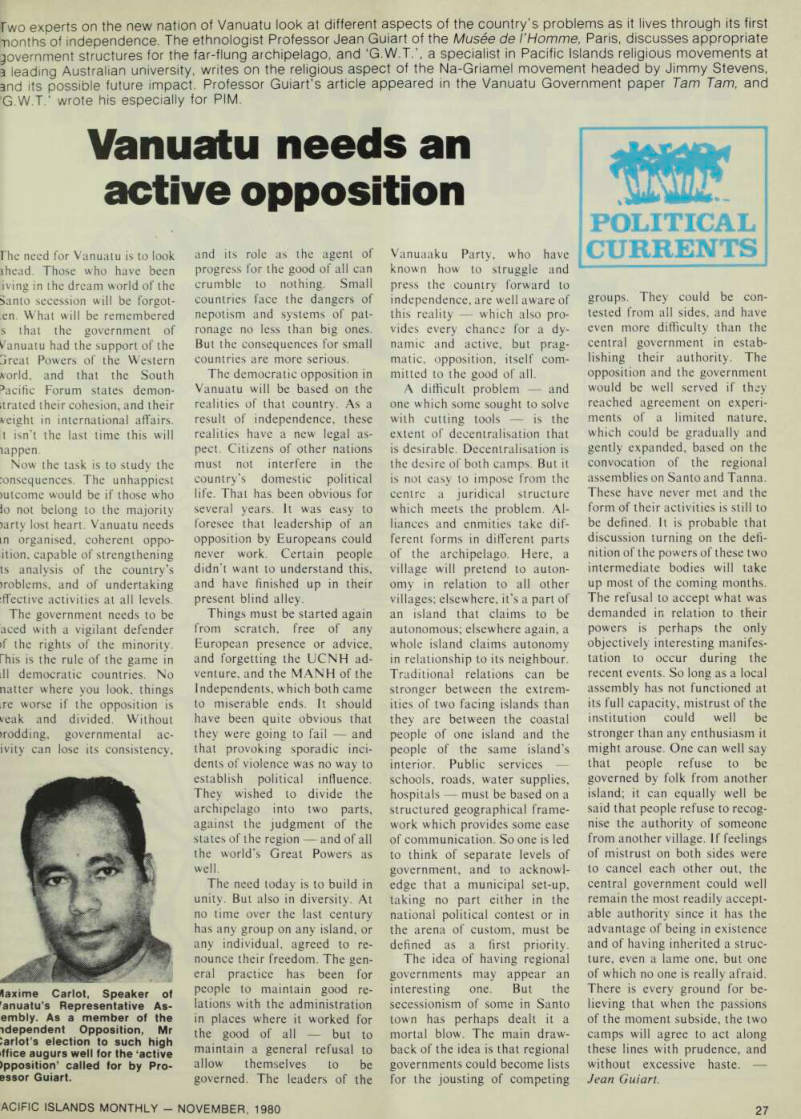
Maxime Carlot, Speaker of [?]anuatu’s Representative As sembly As a member of the
independent Opposition, Mr
Carlot’s election to such high office augurs well for the ‘active Opposition’ called for by Pro ccessor Guiart.